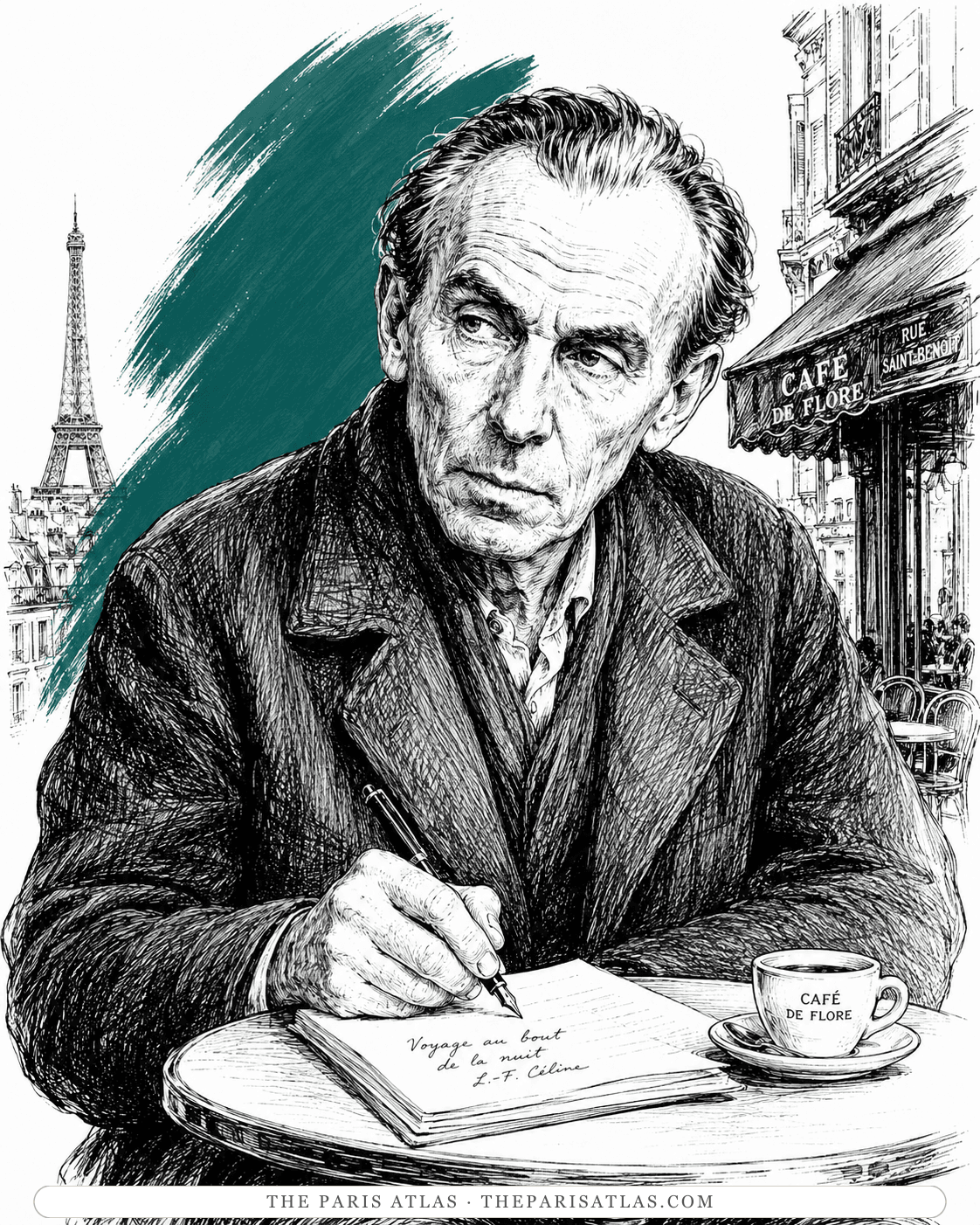

Journey to the End of the Night
The 1932 debut whose Rancy suburb is the fictional counterpart to the Bezons Céline addresses here directly.
Read our take
Louis-Ferdinand Céline's preface to Albert Serouille's 1944 history of Bezons — the neglected Paris suburb where Dr. Louis Destouches spent the war working the municipal dispensary.
Albert Serouille's Bezons à travers les âges is a local history of Bezons published by Denoël in January 1944. Céline did not write the history itself. He wrote its preface. At the time, Dr. Louis Destouches was physician-in-chief at the municipal dispensary in Bezons, a position he held from November 1940 until his departure from France in June 1944. Serouille was the town's municipal librarian and had been conducting research into Bezons's past; Céline encouraged the project and agreed to introduce it.
Céline begins from a simple observation: the Paris suburbs are ignored. Paris receives history, romance, monuments and literature. The industrial suburbs surrounding it are treated as ugly places people pass through without seeing.
Bezons, to Céline, represents that neglected territory. Factories, poverty, pollution, labour and wartime bombing have made the modern suburb difficult to romanticise.
That is precisely why he values Serouille's work. The local historian has recovered the older Bezons hidden beneath industrial modernity: its landscapes, bridge, fairs, historical figures and accumulated memories.
Céline opens with the neglected condition of the Parisian suburb. He describes a landscape subordinated to industry and to the needs of Paris. The inhabitants work and suffer largely outside the cultural imagination of the capital.
Then he introduces Serouille. The historian's achievement is to recover the town from this apparent historical emptiness.
Old Bezons emerges: fairs, roads, noble families, political events, wars and the bridge.
The bridge becomes a physical record of repetition. At times it carries festivities and commerce. At other times armies cross it or destroy it.
The preface therefore makes local history into a larger argument: places regarded as historically insignificant are often simply places whose histories nobody has bothered to tell.
The preface ends in admiration for Serouille's act of recovery rather than with a narrative event.
Céline presents the local historian as someone who has given a disregarded suburb back its past.
The achievement is not that Serouille transforms Bezons into Paris. It is that he demonstrates Bezons was already worth remembering on its own terms.
Calling the suburb a doormat does more than lament its ugliness. The image makes neglect an action performed by the people who pass through: Paris keeps its flattering public image while another place receives its dirt. A vocabulary of feeding, exhaustion and sickness turns the landscape into a damaged body. That is why the dispensary illustration fits the opening without depicting a scene the preface narrates. Serouille's history offers another kind of care, restoring memories and significance where the dismissive glance sees only waste.
At the bridge, a local feature becomes a measure of national fortune: festivities alternate with destructive arrivals. The recurring explosions matter more than a continuous chronology. Céline's exclamations collapse centuries into a noisy moment, then his personal recollection draws the writer himself into the scene. Yet the ending changes scale again, from passing armies to winter gulls and an intoxicating book. History can overwhelm as well as console; the closing advice to read cautiously makes the historian's revival of the past feel powerful, not merely reassuring.
The preface belongs directly beside Céline's fiction of the banlieue. The suburb of Journey to the End of the Night is defined by work, poverty, illness and proximity to Paris without participation in Parisian glamour.
Here Céline addresses a real suburb in nonfiction. But Bezons à travers les âges adds something the fictional suburbs often lack: historical depth. Modern industrial misery sits on top of older communities, celebrations, landscapes and political events.
The essay is therefore simultaneously about urban inequality and historical memory. It is also one of Céline's last publications before he left France in June 1944.
What the preface explores:
The banlieue Céline dramatises across the novels — the working poor, the dispensary, the physical damage of industry — appears here directly, in the register of a preface to a local history.
Céline uses the bridge as the organising image of historical repetition — festivities, commerce, armies, wars — a small piece of writing worth the trip to for its own sake.
Written the same year he fled France, the preface is a compact record of what a physician-writer was thinking about the neglected outskirts of the capital in the last months of the Occupation.
1940
Louis Destouches becomes physician-in-chief at the Bezons municipal dispensary in November.
1944
Denoël publishes Albert Serouille’s local history in January, with Céline’s preface.
June 1944
Céline leaves France, ending the Bezons medical appointment that had connected him with Serouille’s project.
The 1932 debut whose Rancy suburb is the fictional counterpart to the Bezons Céline addresses here directly.
Read our take
The 1936 novel and its shopkeepers' arcade — another piece of neglected working Paris, this time in fiction.
Read our take
The other Denoël publication of early 1944 — the two are Céline's last two public appearances before the flight from France.
Read our takeNo. Albert Serouille wrote the book. Céline wrote the preface.
January 1944 by Éditions Denoël.
He served as physician-in-chief of the municipal dispensary in Bezons from November 1940 until June 1944.
A municipal librarian and local historian in Bezons, formerly associated with the Opéra-Comique and the Ministry of Air.
The neglect of the Paris suburbs and Serouille's ability to recover Bezons's history beneath its modern industrial landscape.
It offers a nonfiction counterpart to his fictional treatment of working-class suburbs and shows how strongly place, poverty, work and historical memory were connected in his imagination.
Explore authors with a similar voice, perspective, and influence.
Miller read Journey in manuscript while writing Tropic of Cancer and never recovered — the two books are the era's twin gutter-testaments.
View author
The other French modernist Céline could not look away from: a war-wounded amputee whose spoken prose ran ahead of grammar and whose Moravagine anticipates Bardamu's tour of the century's slaughterhouses.
View author
The same war, the same refusal of the big words — delivered in whispers where Céline delivers it in screams. Both writers died in the same week of July 1961.
View authorThe sources below include the primary text, editions, scholarship, archival materials, and other records that informed this page. They document Preface to Bezons à travers les âges, its publication, and its place in literary history.

The primary text represented by this page, used for descriptions of the work’s contents and for any quoted passages shown here.

Published analysis and historical context used in preparing the Preface to Bezons à travers les âges page.
Published analysis and historical context used in preparing the Preface to Bezons à travers les âges page.
Godard's biography supplies independent context for Céline's relationship to the Paris suburbs and this late preface.
Gallimard's catalogue anchors the preface within Céline's established nonfiction bibliography.
Published analysis and historical context used in preparing the Preface to Bezons à travers les âges page.
The primary text is the baseline reference for every book page. Additional references document publication history, interpretation, and historical context where that evidence is available.
 Explore more resources