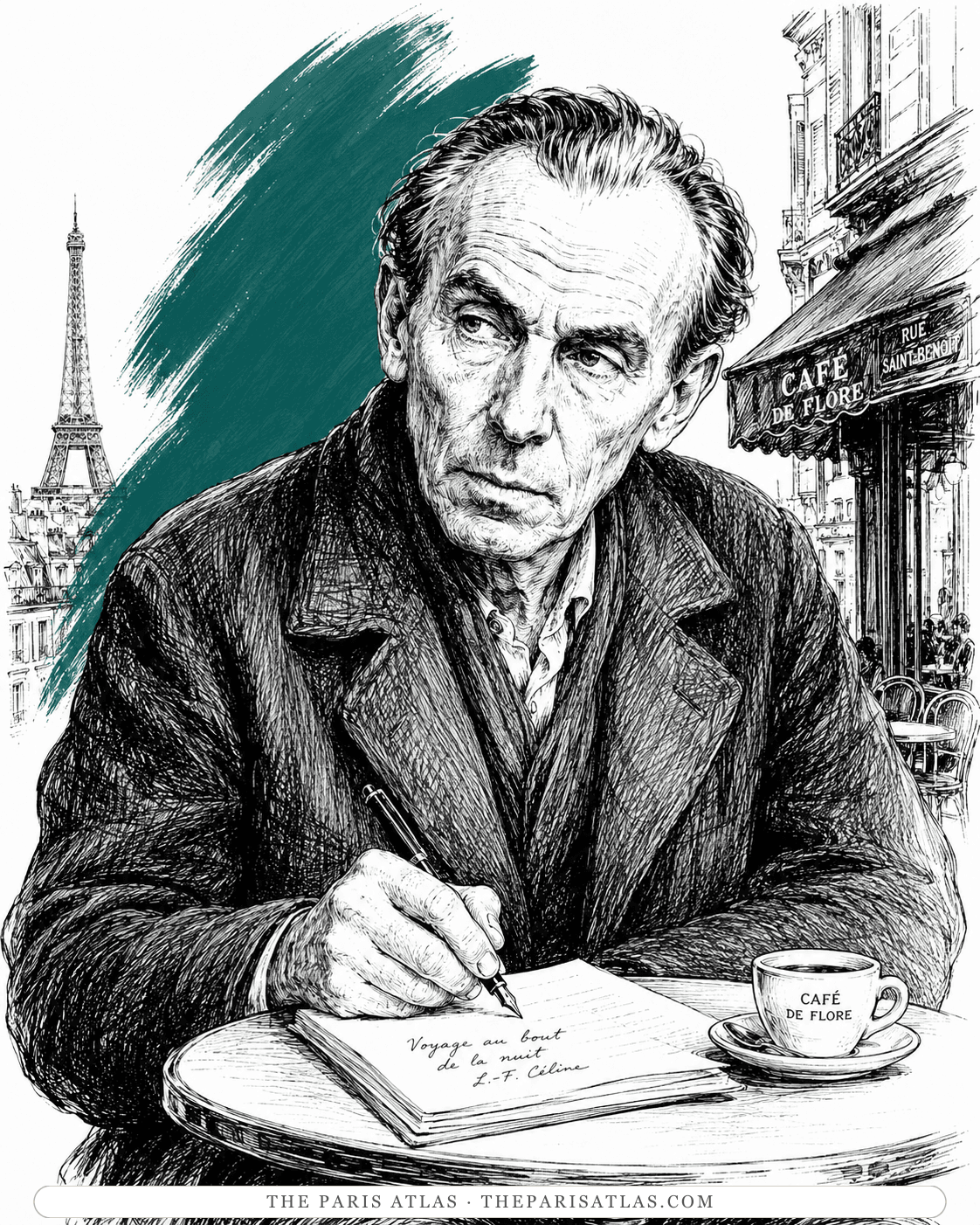

Cahiers de prison
The ten Copenhagen notebooks Céline kept in the same period; Réponses aux accusations is their legal-register companion.
Read our take
Louis-Ferdinand Céline's ten-page defence memorandum, written from the Copenhagen prison on 6 November 1946 — the primary source for how he answered the treason charges the French judiciary was building against him.
Written during Céline's detention in Denmark, Réponses aux accusations is his detailed written response to accusations transmitted to him by Danish police on behalf of French judicial authorities. The surviving signed typescript is dated 6 November 1946 and runs to ten large-format typed pages in one documented state. Céline later circulated copies to the president of the Cour de Justice de la Seine, journalists and friends. It should be read as a primary source for Céline's defence strategy, not as a neutral account establishing what did or did not happen.
Céline proceeds accusation by accusation. Among the matters raised were allegations that Guignol's Band and the Bezons book had served German propaganda, his relationship to the Cercle européen, his contacts with Germans during the Occupation, his public political writings, accusations concerning wartime persecution, and an allegation involving Dr. Pierre Rouquès.
Céline rejects these accusations. He argues that Guignol's Band and the history of Bezons are plainly literary or local-historical works rather than German propaganda. He denies holding an official collaborative role and distinguishes personal or literary contacts from political service.
He also disputes accusations that he had denounced individuals or actively participated in wartime persecution.
The document opens by naming the charge of treason under which the interrogations are taking place.
Céline then lists specific accusations. He responds to the allegation concerning the wartime publication of Guignol's Band and Bezons à travers les âges.
He addresses his connection to organisations and people associated with the Occupation. He responds to the accusation that he encouraged intensified wartime persecution. He discusses his literary relations with Germany and contacts with German figures. He answers the allegation involving Dr. Rouquès.
Throughout, Céline's method is to separate writing, acquaintance, publication and political action, arguing that the existence of the former does not prove the latter.
He also insists that his departure from France was aimed at reaching Denmark rather than serving Germany.
The document closes with a broader denunciation of political prosecution and historical punishment.
There is no legal resolution inside the text.
Céline ends still insisting that the charges against him are unjust and placing his own case within a larger history of people destroyed during periods of political passion.
The legal process continued independently of his memorandum. That distinction is important: Réponses aux accusations records what Céline said in his own defence, not the final judicial determination.
The accusation-and-answer pattern gives Céline control over how each allegation reaches the reader. Faced with the charge that two wartime publications served German propaganda, he answers by classifying one as fantastic literature and the other as local history. Genre becomes his proposed test of innocence. Elsewhere, he distinguishes attending dinners from belonging to an organization, and private letters from public political writing. These distinctions reveal his defensive method, not an independent finding: he repeatedly narrows the question to a category he believes he can deny.
The memorandum travels between audiences as well as countries. In the March 1947 covering letter to Descaves, Céline says he has adopted the official manner required for a defense, but also seeks sympathy as a persecuted writer. The memorandum's ending similarly leaves individual allegations behind and invokes Lavoisier, Chamfort and Chénier as victims of political punishment. This change of scale invites readers to imagine his case as another historical tragedy. The analogy seeks identification with the accused; it does not supply evidence that his circumstances or conduct were equivalent.
The text is exceptionally useful for understanding how Céline constructed his postwar defence. Several arguments that recur in later letters and novels are already organised here: the distinction between writing and action, denial of an official role, insistence on his independence, and portrayal of himself as a writer being politically prosecuted.
It is therefore both a legal document and an early source for the self-narrative that becomes prominent in Féerie and the later German trilogy.
What the text explores:
This is the compact, primary place where Céline organises the arguments he will later dramatise for the rest of his life — the distinction between writing and action, the denial of an official role, the presentation of himself as politically prosecuted.
Written in Vestre Fængsel in the same period as the Cahiers de prison, Réponses aux accusations is the legal-register companion to the memory work that will feed Féerie pour une autre fois.
The 1946 defence typescript and the 1948 pamphlet answering Sartre are the two most compressed pieces of Céline's postwar self-defence, one for the courts and one for the literary press.
1946
Céline dates his signed defense memorandum 6 November during his detention in Denmark.
1947
He sends copies to French judicial authorities, journalists, and acquaintances.
1950
His conviction in absentia follows in February; the memorandum remains his account of the accusations, not a judicial finding.
The ten Copenhagen notebooks Céline kept in the same period; Réponses aux accusations is their legal-register companion.
Read our take
The 1948 pamphlet answering Sartre — Céline's postwar self-defence in the literary press.
Read our take
The 1952 novel that dramatises the same postwar predicament in fiction.
Read our takeThe principal signed text is dated 6 November 1946.
In Copenhagen's Vestre Fængsel prison, during his postwar detention in Denmark.
No. It is Céline's own memorandum in his defence. His conviction in absentia followed in February 1950.
Charges concerning treason, wartime publications (including Guignol's Band and the Bezons book), relations with German or collaborationist organisations and figures, wartime persecution, and specific accusations such as the Rouquès matter.
Copies were sent in 1947 to French judicial authorities and to journalists and acquaintances.
Because many of the arguments Céline later dramatises about persecution, exile and his wartime conduct already appear here in direct legal form.
Explore authors with a similar voice, perspective, and influence.
Miller read Journey in manuscript while writing Tropic of Cancer and never recovered — the two books are the era's twin gutter-testaments.
View author
The other French modernist Céline could not look away from: a war-wounded amputee whose spoken prose ran ahead of grammar and whose Moravagine anticipates Bardamu's tour of the century's slaughterhouses.
View author
The same war, the same refusal of the big words — delivered in whispers where Céline delivers it in screams. Both writers died in the same week of July 1961.
View authorThe sources below include the primary text, editions, scholarship, archival materials, and other records that informed this page. They document Réponses aux accusations, its publication, and its place in literary history.


The primary text represented by this page, used for descriptions of the work’s contents and for any quoted passages shown here.

Published analysis and historical context used in preparing the Réponses aux accusations page.
Published analysis and historical context used in preparing the Réponses aux accusations page.
Published analysis and historical context used in preparing the Réponses aux accusations page.
Used to verify Louis-Ferdinand Céline's bibliography and place Réponses aux accusations within the broader chronology of Louis-Ferdinand Céline's career.
The primary text is the baseline reference for every book page. Additional references document publication history, interpretation, and historical context where that evidence is available.
 Explore more resources