

Réponses aux accusations
The 1946 defence typescript from the Copenhagen prison — the earlier bookend of Céline's postwar self-defence.
Read our take
Louis-Ferdinand Céline's 1957 argument for a broad postwar amnesty — nineteen handwritten pages that widen his own case into a general demand for reconciliation.
Vive l'amnistie, Monsieur! is Céline's argument for a broad postwar amnesty. Although Céline himself had received an amnesty in 1951, he remained affected by the penalty of dégradation nationale. In 1957 he used his own case as the starting point for a much broader argument about postwar punishment, political exclusion, reconciliation and France's unresolved divisions.
The manuscript dates from 1957 and runs to nineteen handwritten pages.
Céline presents himself as one of the people left marked by the aftermath of the épuration. But the argument does not remain exclusively autobiographical.
He invokes French political divisions, General de Gaulle, Pierre Mendès France, the Algerian conflict and other international examples while arguing that societies eventually have to move from punishment toward reintegration.
As usual, the argument is not delivered as a sober legal essay. It moves through jokes, exaggeration, political references and personal grievance.
Céline begins from the discrepancy between formal amnesty and continuing social or civic penalties. He considers the continuing political divisions produced by the Occupation and Liberation.
From his personal situation, he moves outward toward the idea of general amnesty.
He compares France with other countries that have taken steps to release or reintegrate political prisoners. He addresses contemporary political figures.
The Algerian War enters the background, although Céline deliberately declines to develop it into the centre of the article.
The argument ultimately becomes very simple: at some point a society has to stop perpetuating punishment from an earlier political conflict.
The manuscript culminates in its demand: general amnesty.
The rhetorical movement is from Céline's own postwar status toward a national proposition. It ends not by asking that one writer's case be reopened but by presenting amnesty as a general principle.
The appeal repeatedly reverses the roles of accuser and accused. Céline calls himself a resister at Sigmaringen, then imagines granting amnesty to the people he says took his property before demanding the same treatment for his own side. He casts himself as both injured party and magnanimous judge. The apparent generosity therefore carries a bargain: forgiveness should return to its speaker. This is a strategy for claiming moral standing, not evidence that his wartime position was equivalent to that of the Resistance.
The ending changes the appeal's scale. After naming political leaders and newspapers across opposing camps, the speaker reduces his argument to one small hope, pictured as a light atop the Eiffel Tower in the surrounding darkness. A tiny signal can become visible to an entire city: the image turns personal insistence into a proposed public rallying point. But the preceding taunts remain part of the appeal. The closing hope does not erase its grievances, and the illustration's open gate represents the reconciliation requested, not one the text shows achieved.
The article belongs with Céline's postwar self-defence writing but differs from Réponses aux accusations. The 1946 document argues innocence against specific charges. Vive l'amnistie is written more than a decade later and asks a different question: even after guilt, punishment and political conflict have been assigned, how long should the consequences continue?
It is consequently as much about historical memory as law.
What the article explores:
The 1957 pamphlet is Céline arguing publicly — not narrating in fiction — about the postwar predicament he otherwise dramatises in Féerie and the German trilogy.
The 1946 defence typescript and the 1957 amnesty article frame Céline's postwar self-defence: the first argues innocence against specific charges, the second asks how long punishment should continue after guilt has already been assigned.
The article records what a French writer at the end of the épuration could plausibly ask for in public — a brief snapshot of the country's post-Occupation political mood, useful independently of Céline's own case.
July 1957
Rivarol prints a shortened version of Céline’s appeal on 11 July.
December 1962
Rivarol publishes the complete text after Céline’s death.
January 1963
Éditions Dynamo issues the text as a separate small book.
The 1946 defence typescript from the Copenhagen prison — the earlier bookend of Céline's postwar self-defence.
Read our take
The ten Copenhagen prison notebooks (2019) — the workshop from which the postwar predicament emerged as material.
Read our take
The 1957 first book of the German trilogy — Céline's fictional treatment of the same postwar predicament, written in the same year.
Read our takeNo. Céline wrote it in 1957. The confusion comes from the complete version being published after his death.
Yes. A shortened version appeared in Rivarol on 11 July 1957.
In Rivarol in December 1962, after Céline's death.
A small Éditions Dynamo edition appeared in January 1963.
Yes, in 1951, but he continued to be affected by dégradation nationale and regarded his postwar civic position as unresolved.
No. His personal circumstances motivate the text, but he turns them into a broader argument for general political amnesty.
Explore authors with a similar voice, perspective, and influence.

Miller read Journey in manuscript while writing Tropic of Cancer and never recovered — the two books are the era's twin gutter-testaments.
View author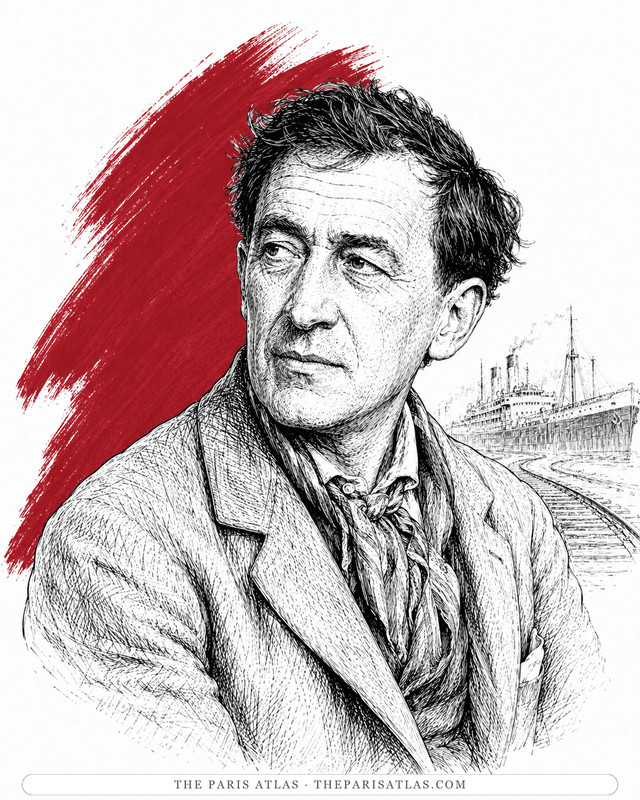
The other French modernist Céline could not look away from: a war-wounded amputee whose spoken prose ran ahead of grammar and whose Moravagine anticipates Bardamu's tour of the century's slaughterhouses.
View author
The same war, the same refusal of the big words — delivered in whispers where Céline delivers it in screams. Both writers died in the same week of July 1961.
View authorThe sources below include the primary text, editions, scholarship, archival materials, and other records that informed this page. They document Vive l'amnistie, Monsieur!, its publication, and its place in literary history.


The primary text represented by this page, used for descriptions of the work’s contents and for any quoted passages shown here.

Published analysis and historical context used in preparing the Vive l'amnistie, Monsieur! page.
Published analysis and historical context used in preparing the Vive l'amnistie, Monsieur! page.
Godard's biography supplies the postwar legal and biographical context behind Céline's appeal for amnesty.
Gallimard's authoritative catalogue anchors the article within Céline's collected political and nonfiction writings.
The primary text is the baseline reference for every book page. Additional references document publication history, interpretation, and historical context where that evidence is available.
 Explore more resources