
On the Road
The road book that made Kerouac famous. Satori in Paris is the same restless traveler, eight years after that book came out, on foreign streets.
Read our takeSatori in Paris
Jack Kerouac
by Jack Kerouac
Jack Kerouac flies to Paris in 1965 to prove he descends from Breton nobility. He finds closed archives, long nights in bars and, maybe, a moment of awakening in a taxi.
Satori in Paris is Jack Kerouac's short, funny book about ten days in Paris and Brittany in June 1965.[1][2] He went, aged forty-three, to look for proof that his family came from a noble Breton line. He did not find it.[2] The book begins in Paris and moves west to Brittany, through libraries, bars and all-night talk with strangers.[3] Grove Press published it in New York in 1966.[4]
The first sentence explains the title. Somewhere during his ten days in Paris and Brittany, Kerouac says, he had an illumination of some kind. He calls it a satori, the Japanese word for a sudden awakening.[1][5] The rest of the book tries to work out where it came from.
Kerouac tells the story under his own name, and his full one. He gives it as Jean-Louis Lebris de Kérouac, and he says he uses it because the book is about his search for that name in France.[2][5] His father had told him as a boy never to forget that he was Breton.[2]
The family legend went back two centuries. The legend said the family's first ancestor in Canada was a dispossessed Breton aristocrat called Le Bris de Kervoach, who had married in New France, now Quebec, in 1732.[2] Kerouac wanted to find that man's family in the French records.
Kerouac arrives in Paris on 1 June 1965, aged forty-three, to trace the Breton noble family he believes he descends from.[2] He looks in the Bibliothèque Nationale and the Mazarine Library and finds nothing. At the Mazarine the head librarian tells him the archives were bombed and burned in 1944.[6]
He spends his Paris nights in bars, talking with strangers until morning.[3] Then he travels west to Brest, at the tip of Brittany, where he drinks cognac with a bookseller named Le Bris, supposedly a distant cousin.[2]
The search fails. No record confirms the noble ancestor, and Le Bris turns out to be another false lead.
On his last day a taxi driver, Raymond Baillet, drives him to Orly airport. Kerouac wonders whether the satori of the title was handed to him by this driver.
Kerouac landed in Paris on 1 June 1965. In the book he goes looking in the libraries. At the Bibliothèque Nationale on the rue de Richelieu he asked for the list of officers in Montcalm's army in Quebec in 1756. He also went through the old reference works of Louis Moréri and Père Anselme, looking for anything on the royal house of Brittany. There was nothing there either.
He did not enjoy the Bibliothèque Nationale. He complains that you cannot smoke there, even in the toilets. He also complains that the librarians seem to admire fine handwriting more than anything a scholar writes. He knew big libraries well, he says, from the New York Public Library. Here he felt he was being watched with suspicion, an aging man who smelled of drink.
Then he tried the Bibliothèque Mazarine. There the head librarian, Madame Oury, patiently explained that all the archives had been bombed and burned by the Nazis in 1944. Kerouac admits he had forgotten this in his excitement. Penguin's account of the trip adds that he also read in the French archives, and found only dead ends.
Between the libraries Kerouac wanders around Paris, drinking in bars and talking all night with strangers. Then he heads west to Brest, the naval port at the far western tip of Brittany, in Finistère. Finistère means "where the land ends".
In Brest he shares cognac and stories with a bookseller named Le Bris, supposedly a distant cousin. The cousin turns out to be another false lead.
Pauline Bock, writing for Penguin, says there is hardly a page on which Kerouac fails to mention that his family came from France and was called de Kerouac. She says the book reads like dazed travel notes. Kerouac himself called it a novel.
The book ends in a Paris taxi. The driver is Raymond Baillet, and Kerouac gives his real name. Baillet drives him to Orly airport on the day he flies home. Kerouac wonders whether his satori was handed to him by this taxi driver.
Grove Press, which still publishes the book, calls it a pivotal cab ride. Not every reader agreed. Andrew Sarris, then the editor of Cahiers du Cinéma in English, reviewed the book for The New York Times in February 1967. He complained that the illumination came at the end of a long, rambling story, and that Kerouac grew sentimental over a Paris cab driver's straightforwardness.
Sarris thought Kerouac was too much at the center of his own travel book. In his view the author kept drinking, brawling and singing when he should have been watching. He called the Kerouac of this book more of a Babbitt than a beatnik. Babbitt is Sinclair Lewis's self-satisfied small-town businessman.
Kerouac wrote the book soon after he got home. On 2 October 1965 he wrote to his old friend Ed White from St. Petersburg, Florida: "Yes I went to Paris, came back all excited and wrote a novel about it." He added that a publisher had rejected it so far. Grove Press brought it out in New York the next year, a short book of 118 pages.
Kerouac never made the second trip to Brittany he planned. He died on 21 October 1969. The puzzle took another three decades. In 1999 the historian Patricia Dagier and the journalist Hervé Quéméner published a book that solved it.
The ancestor was not a nobleman. He was Urbain-François Le Bihan de Kervoac, the son of a notary in Huelgoat, in western Brittany. Around 1720, after a scandal over accusations of theft, he disappeared from the Breton records and sailed for Canada. In Quebec he traded furs and married under a false, grander name. Huelgoat now has a plaque to him.
Gallimard published the book in Paris in 1971 as Satori à Paris, in its series of foreign literature, Du monde entier. Jean Autret translated it. In 2007 Gallimard brought out a bilingual paperback in its Folio bilingue series. Yann Yvinec revised Autret's translation and added an introduction and notes.
Somewhere during my ten days in Paris (and Brittany) I received an illumination of some kind that seems to've changed me again, towards what I suppose'll be my pattern for another seven years or more: in effect, a satori: the Japanese word for "sudden illumination," "sudden awakening" or simply "kick in the eye."
Kerouac's Paris book, with scenes in the Bibliothèque Nationale, the Mazarine Library and the bars of the city.
Kerouac goes looking for a noble Breton ancestor and finds closed archives. Historians found the real ancestor in 1999, and he was a notary's son who fled a scandal.
At 118 pages in the first edition, it reads in an evening. Two of Kerouac's old friends, Ed White and Allan Temko, laughed until they cried over it, according to Christie's.

Kerouac himself, aged forty-three, in France to find the noble Breton family he believes he comes from.
The Paris taxi driver who takes Kerouac to Orly airport on his last day. Kerouac wonders if the satori came from him.
The head librarian of the Mazarine Library, who patiently explains that the archives were bombed and burned in 1944.
1 June 1965
Kerouac lands in Paris, aged forty-three, to trace his Breton ancestry.
June 1965
He searches the Bibliothèque Nationale and the Mazarine Library, then travels to Brest. A Paris taxi driver, Raymond Baillet, takes him to Orly when he leaves.
2 October 1965
Kerouac writes to Ed White that he went to Paris, came back excited and wrote a novel about it, which a publisher has so far rejected.
1966
Grove Press publishes Satori in Paris in New York, 118 pages.
26 February 1967
Andrew Sarris reviews the book in The New York Times as "More Babbitt Than Beatnik".
21 October 1969
Kerouac dies, without making his planned return to Brittany.
1971
Gallimard publishes the French translation in Paris, Satori à Paris, translated by Jean Autret.
1999
Patricia Dagier and Hervé Quéméner identify the real ancestor, Urbain-François Le Bihan de Kervoac of Huelgoat.
2023
Grove Press reissues the book after the Kerouac centenary.


The road book that made Kerouac famous. Satori in Paris is the same restless traveler, eight years after that book came out, on foreign streets.
Read our takeThe Dharma Bums
Jack Kerouac
Kerouac's novel about Zen Buddhism, the tradition the word satori comes from.
Read our takeBig Sur
Jack Kerouac
In Big Sur, Jack Duluoz shouts at the Pacific that he is a Breton. Three years later Kerouac went to Brittany to prove it.
Read our take
Ernest Hemingway's short book about his own Paris years. Hemingway looks back on a whole youth in the city; Kerouac spends ten days there looking for his family's past.
Read our takeJack Kerouac's ten-day trip to Paris and Brittany in June 1965 to find proof of a noble Breton ancestor. He searches Paris libraries, drinks and talks in bars, and travels to Brest. He finds no proof, but he thinks he may have had a moment of awakening.
Satori is a Zen Buddhist word from Japanese for a sudden awakening. In the first sentence Kerouac calls it a sudden illumination, a sudden awakening, or simply a kick in the eye.
Kerouac is not sure, and that uncertainty is part of the book. He wonders whether it was handed to him by Raymond Baillet, the Paris taxi driver who drove him to Orly airport on his last day.
The Bibliothèque Nationale on the rue de Richelieu and the Bibliothèque Mazarine. At the Mazarine the head librarian, Madame Oury, told him the archives had been bombed and burned by the Nazis in 1944.
No. The historian Patricia Dagier and the journalist Hervé Quéméner found him in 1999, thirty years after Kerouac died. He was Urbain-François Le Bihan de Kervoac, a notary's son from Huelgoat in Brittany. He vanished from the Breton records around 1720 after a scandal and turned up in Quebec. He was not a nobleman.
Both, in a way. Kerouac called it a novel in a 1965 letter. His publisher calls it semi-autobiographical, and he tells it under his own real name.
Yes. Gallimard published Jean Autret's translation, Satori à Paris, in Paris in 1971. A bilingual Folio edition from 2007 prints the English and French texts together.
Explore authors with a similar voice, perspective, and influence.
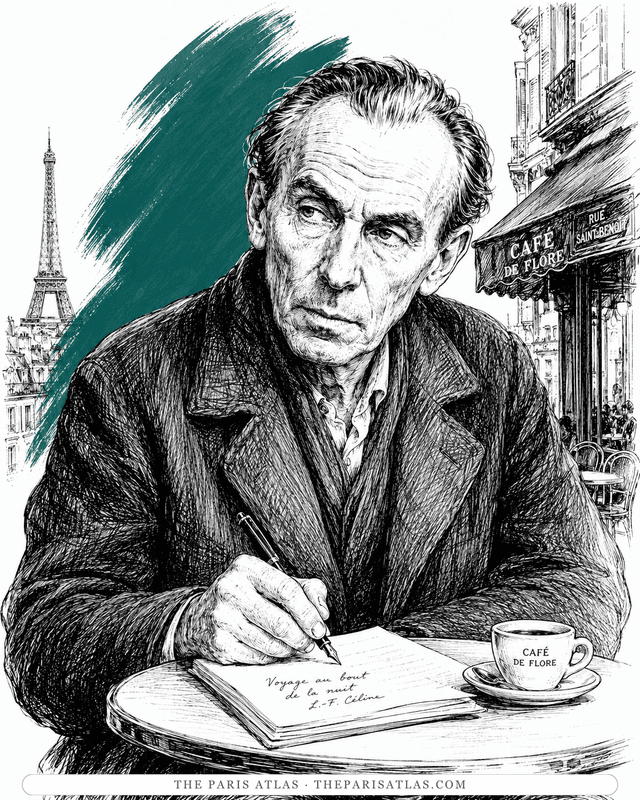
The doctor of the Paris slums who wrote the century's blackest, funniest novel — and changed the sound of French prose.
View author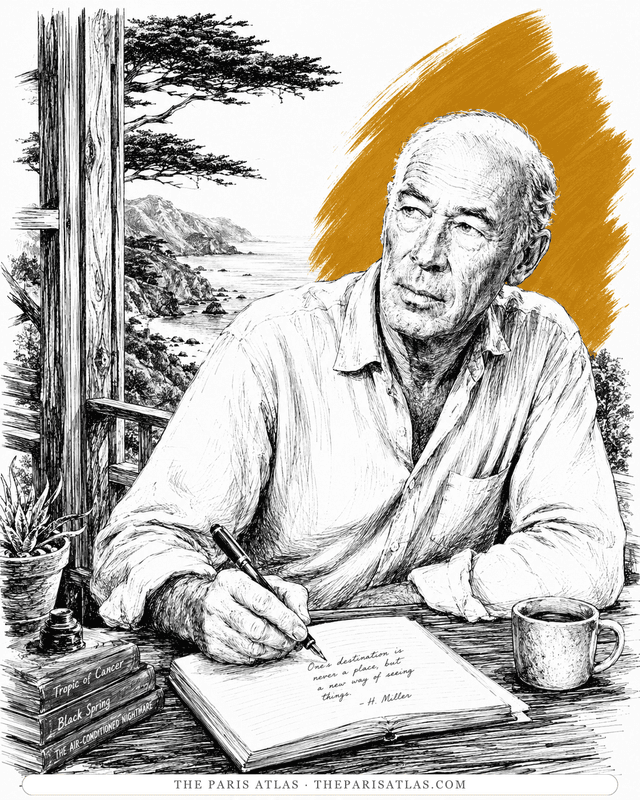
The Brooklyn dropout who arrived in Paris broke at thirty-eight and wrote the exuberant, banned books that ended American censorship.
View author
French writer and philosopher whose novels, memoirs, and social analysis examined freedom, gender, responsibility, aging, and the material conditions that shape a life.
View authorThe sources below include the primary text, editions, scholarship, archival materials, and other records that informed this page. They document Satori in Paris, its publication, and its place in literary history.


Library of Congress record for the Grove Press first edition: New York, 1966, 118 pages.

Italian Library Association's entry on the book's library scenes, quoting the Mondadori translation with page numbers.

Kerouac's letter to Ed White of 2 October 1965, describing the book just after he wrote it.
Scan of the André Deutsch 1967 edition, searched inside to confirm the names Raymond Baillet and Madame Oury.
Yves Buin's French biography of Kerouac, searched inside for the taxi ride to Orly.
Bibliothèque nationale de France record for the first French edition, Paris, 1971.
Bibliothèque nationale de France record for the 2007 bilingual Folio edition.
The primary text represented by this page, used for descriptions of the work’s contents and for any quoted passages shown here.
The primary text is the baseline reference for every book page. Additional references document publication history, interpretation, and historical context where that evidence is available.
 Explore more resources