
Semmelweis
Louis-Ferdinand Céline's 1924 medical thesis — a literary account of the Hungarian physician who discovered that doctors were killing their own patients.
Read our take
Gallimard's Cahiers Céline 3 — the collected medical corpus of Dr. Louis Destouches, before he became Céline: the 1924 Semmelweis thesis and the public-health and factory-medicine writings that surrounded it.
Before he was Louis-Ferdinand Céline, Louis Destouches was a physician who wrote extensively about medicine, public health, industrial organisation and social insurance. Gallimard's Cahiers Céline 3, edited by Jean-Pierre Dauphin and Henri Godard, gathers this pre-literary corpus: the 1924 Semmelweis thesis at the centre, the 1925 quinine monograph, the 1928 essay on the Ford factories in Detroit, the League of Nations reports, and the shorter public-health pieces that ran in medical journals through the 1920s and 1930s. Read together, they form a coherent body of work rather than the isolated curiosities they can look like when encountered separately. An appendix collects letters to the League of Nations; a bibliography and index close the volume.
The volume opens with Céline's 1924 doctoral thesis on Ignaz Semmelweis — the Hungarian physician who discovered that doctors were transmitting the infection killing women in the maternity wards, and who spent the rest of his life fighting a medical establishment unwilling to accept it.
It gathers the shorter medical papers Destouches wrote in the years that followed — including the 1925 monograph on quinine — for medical journals and hospital publications, and often in a plain professional register that reads nothing like the later fiction.
The 1928 Ford factory essay — À propos du service sanitaire des usines Ford à Detroit — sits with the League of Nations reports Destouches produced as a Health Section employee travelling in Europe and North America.
The 1941 book La Médecine chez Ford, a reworking of the earlier factory material, is printed here in its later form.
An appendix collects the surviving letters Destouches sent to the League of Nations, giving the volume a documentary tail that overlaps with the manuscripts published separately as On a les maîtres qu'on mérite.
Editorial matter — Jean-Pierre Dauphin and Henri Godard's introduction, a bibliography and an index — frames the whole.
The Semmelweis thesis reads as a literary tragedy dressed as a medical study. Céline traces Semmelweis from Vienna to Budapest, follows the fall of the mortality rate that proves his handwashing procedure works, and then follows the professional refusal that destroys him.
The shorter medical papers around it are the sober counterweight — factory hygiene, quinine dosages, tropical medicine, dispensary economics. They read as a doctor addressing other doctors.
The Ford section is the pivot. Destouches inspects the medical service inside a modern American car plant and reports back to French hospital audiences on what industrial-scale worker medicine looks like. The tone stays professional; the observations are the ones that later reappear in Journey to the End of the Night's Detroit chapters.
The League of Nations reports document the international-public-health period — the years Destouches was travelling as a Health Section employee before he turned to fiction.
The volume closes on the editorial apparatus rather than a narrative resolution. A collection of this kind stops when its documents stop.
What survives is a coherent pre-literary portrait: a physician trained on the tragedy of Semmelweis, thinking through factory medicine and public-health administration, one profession short of the one that made him famous.
In the Semmelweis passage quoted by Labreure, fever acts like an unpunished ruler: it chooses when and where to kill, while death leads a dance. The repeated claims of freedom make the ward feel governed by something that medicine has not mastered. Bell sounds turn that power into a grotesque rhythm, giving the suffering an urgency a clinical summary would not carry. Read this way, the bell is a feature of Céline's language, not evidence of a particular object or hospital routine.
The Ford essay's suggestion that work can come into the home extends the factory's claims beyond its walls. Set beside the assertion that age need not mean incapacity, it imagines continued production where retirement or withdrawal might otherwise appear. The troubling question is whose needs set the limits: the person's or the system's. The domestic illustration makes that tension visible without documenting an actual worker. This is an argument to examine critically, not a recommendation about what older or ill people should do.
Reading the medical writings scattered across journals and archives is a scholar's job. Cahiers Céline 3 is the book that put them between two covers, and it is the way most readers meet the pre-literary Céline.
The clinical attention of the novels — the ear for pain, complaint and evasion — is not a metaphor. It is what Destouches actually did for a living, and the writings gathered here are the record of the mind that later wrote Bardamu.
The 1928 Ford factory report is the direct source for what becomes the Detroit assembly-line section of Journey to the End of the Night. Reading the medical version next to the novel shows what Céline transformed and what he kept.
1924
Louis Destouches completes his medical thesis on Ignaz Semmelweis, the collection’s central work.
1977
Gallimard publishes the collected medical writings as Cahiers Céline 3, edited by Jean-Pierre Dauphin and Henri Godard.
1995
Gallimard reissues the scholarly collection.
Louis-Ferdinand Céline's 1924 medical thesis — a literary account of the Hungarian physician who discovered that doctors were killing their own patients.
Read our take
Dr. Louis Destouches's medical essay on the Ford factories in Detroit — a physician's report on what mass production does to the human body and what factory medicine is actually for.
Read our take
The 1924 philosophical opening Louis Destouches wrote for La Vie, Pasteur, Semmelweis et la Mort — cut by La Presse médicale, lost to the League of Nations archive in Geneva, and rediscovered in 2014.
Read our takeIt is the collected medical writings of Dr. Louis Destouches, gathered by Gallimard in 1977 as volume 3 of the Cahiers Céline series. Everything the physician wrote before Céline became a novelist is inside — the 1924 Semmelweis thesis, the quinine monograph, the Ford factory essay and the League of Nations reports.
No. The full Semmelweis thesis is inside this volume — as its centre piece and its title work. Reading it here means reading it alongside the shorter medical papers that surrounded it.
Jean-Pierre Dauphin and Henri Godard for Gallimard's Cahiers Céline series. The 1977 edition was reissued in 1995 and remains the standard scholarly reference for Céline's pre-literary medical work.
Céline's 1928 report on the medical service inside the Ford factories in Detroit is the direct documentary source for the Detroit assembly-line chapters in Journey (1932). The medical version stays professional; the novel version turns the observation into satire.
The Semmelweis thesis alone was published in English by Melville House, translated by John Harman. The rest of the volume — the League of Nations reports, the Ford factory essay in its earlier form, the shorter public-health papers — is French-only.
On a les maîtres qu'on mérite is a companion text: the philosophical opening Céline wrote alongside the Semmelweis thesis in 1924, cut by La Presse médicale before publication, and rediscovered in the League of Nations archive in 2014. The medical corpus and that opening belong to the same year of writing.
Explore authors with a similar voice, perspective, and influence.

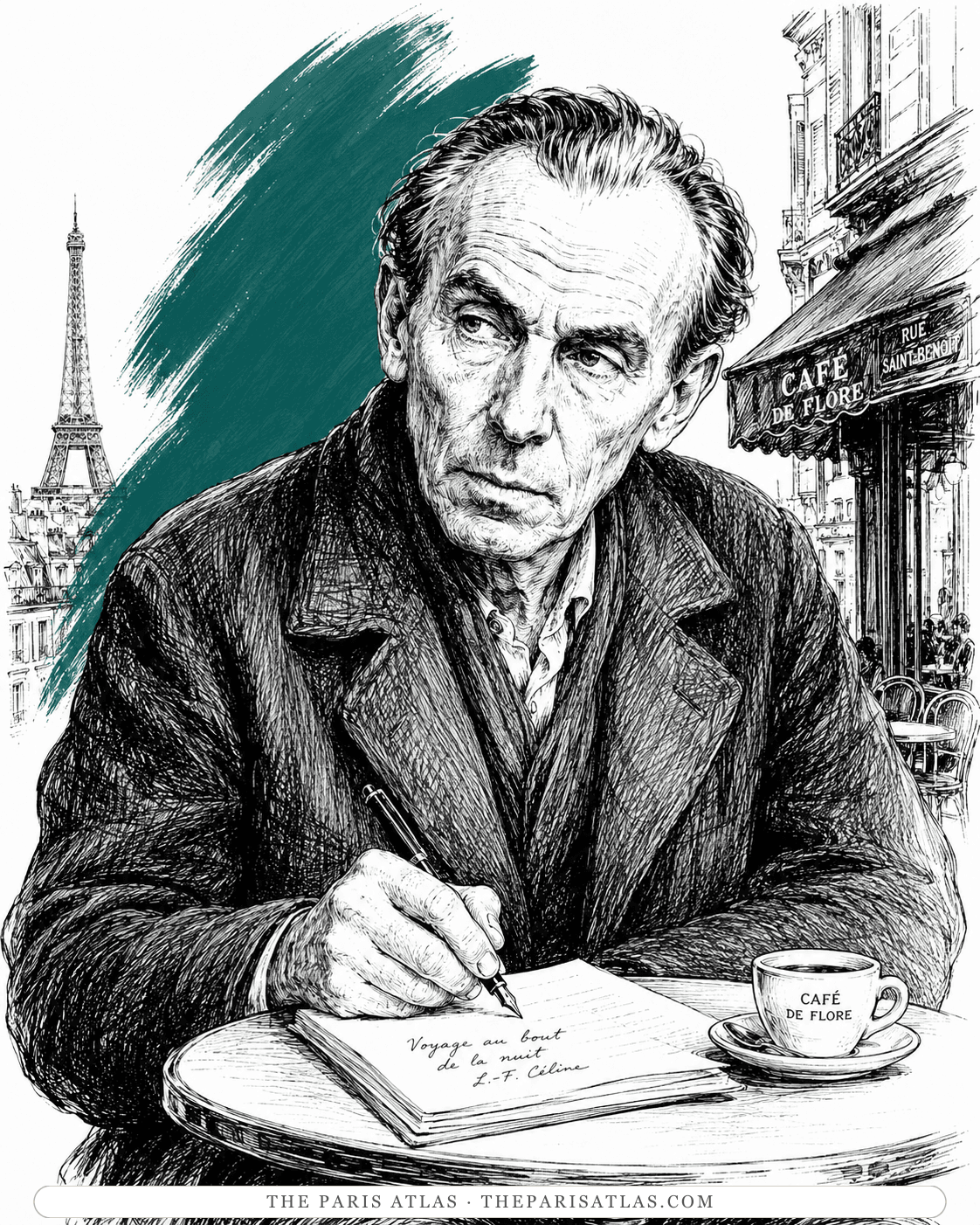
Miller read Journey in manuscript while writing Tropic of Cancer and never recovered — the two books are the era's twin gutter-testaments.
View author
The other French modernist Céline could not look away from: a war-wounded amputee whose spoken prose ran ahead of grammar and whose Moravagine anticipates Bardamu's tour of the century's slaughterhouses.
View author
The same war, the same refusal of the big words — delivered in whispers where Céline delivers it in screams. Both writers died in the same week of July 1961.
View authorThe sources below include the primary text, editions, scholarship, archival materials, and other records that informed this page. They document Semmelweis et autres écrits médicaux, its publication, and its place in literary history.


The primary text represented by this page, used for descriptions of the work’s contents and for any quoted passages shown here.
Web source consulted for documented facts and historical context presented on the Semmelweis et autres écrits médicaux page.

Published analysis and historical context used in preparing the Semmelweis et autres écrits médicaux page.
Biographical evidence used to verify chronology, relationships, and historical context connected to Semmelweis et autres écrits médicaux.
Used to verify Louis-Ferdinand Céline's bibliography and place Semmelweis et autres écrits médicaux within the broader chronology of Louis-Ferdinand Céline's career.
Quoted primary passages with checked notes: the Semmelweis citation uses the 1999 standalone edition; the Ford citation identifies Cahiers Céline III. Neither printed edition was collated.
The primary text is the baseline reference for every book page. Additional references document publication history, interpretation, and historical context where that evidence is available.
 Explore more resources