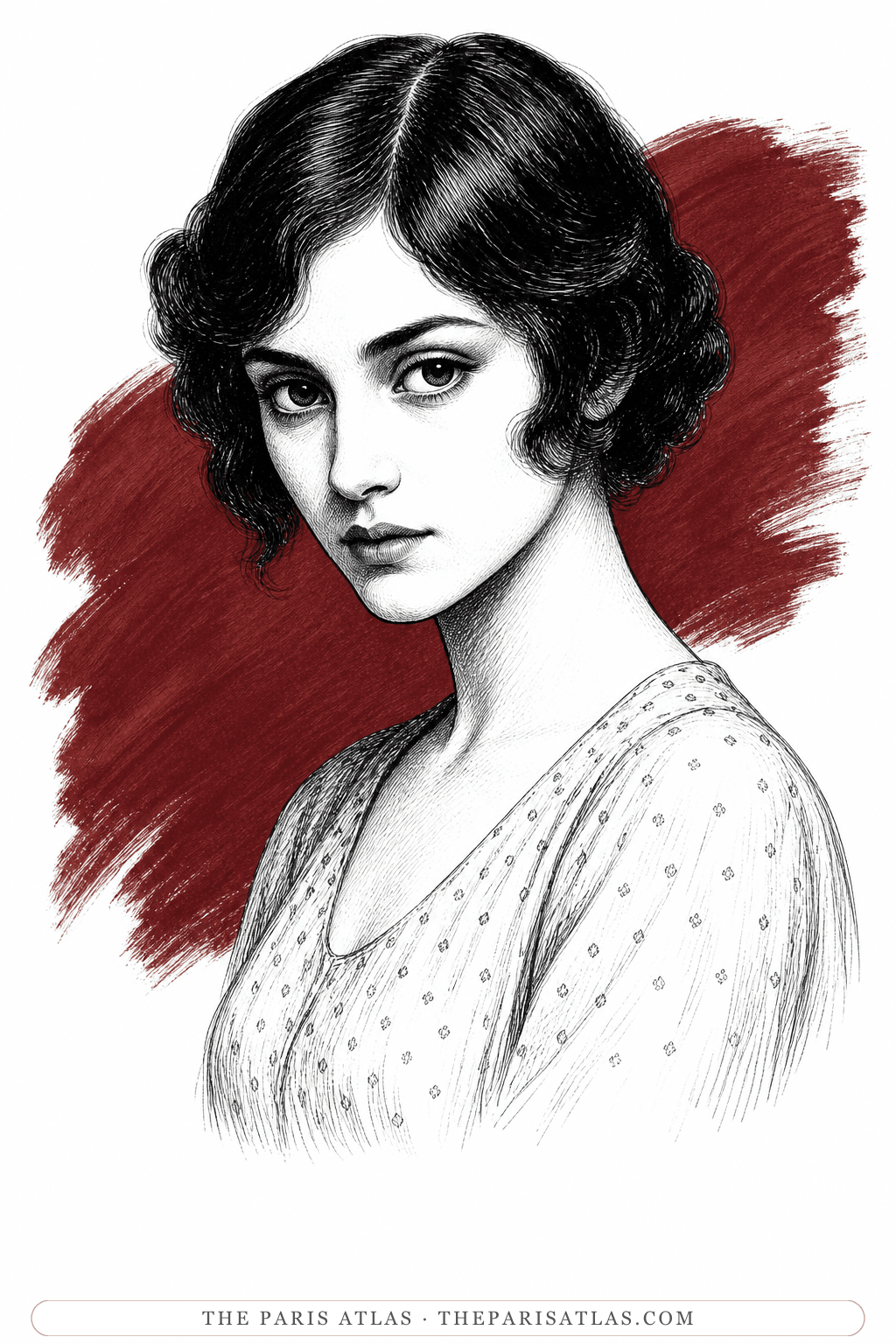
Mona
The taxi dancer the narrator leaves the marriage for — the dance-hall meeting and second marriage of 1923–24, retold at full length. June Miller, renamed.
To stop being the person a household runs on, and to make the narrator into the writer she keeps telling him he is.
The book

At a glance
- Mona, called Mara for the first half — the woman the narrator leaves his wife and daughter for
- A taxi dancer at a Broadway dance hall, paid by the ticket; later a rehearsal part and a place at the Theater Guild
- New Hampshire, and a college in New England; asked about her family, she says Vienna
- Val, short for Valentine — a name nobody else used for him
- A family kept going on her wages, by her own account at a restaurant dinner
- June Miller · 1902–1979 · Bukovina, Austria-Hungary; Brooklyn from the age of five
Who they are in the book
Spoiler-freeMona is the woman the narrator of Sexus leaves his wife and small daughter for. Sexus is Henry Miller's novel of New York in the early twenties, and its narrator is Miller himself, under his own name and holding the job Miller held, at a telegraph company. When the book opens the woman is not called Mona at all. She is Mara, and she works as a taxi dancer in a Broadway dance hall, where a man buys a ticket at the door and gets one dance for it. Partway through the book she changes her name to Mona, and Miller writes that the idea came from a friend of his, a doctor the book calls Kronski.
Almost nothing about her past holds still. For a long time she said she had been born in New Hampshire and educated at a college in New England. Miller writes that she had changed her name, her birthplace, her mother, her upbringing, her friends, her tastes and even her desires, in order to match the picture she suspected he had formed of her. She changed his name too. He became Val, short for Valentine, a name he had always disliked and that nobody except her used.
She is also the person a household is running on. At a restaurant dinner early in the book she says her wages are what keep her family's home together, that the woman at home calls her a whore, and that she is told she is just like her mother. Halfway through the novel she quits the dance hall and talks her way into a theater job, comes home with the script of a play by the Austrian dramatist Arthur Schnitzler, and attaches herself to the Theater Guild.
She is June Miller, Henry Miller's second wife, a taxi dancer he met at Wilson's Dancing Academy in Times Square in 1923 and married the following year. Everything the book reports about her comes through him, and a good deal of it is what she told him and he could not check. This profile is drawn from the text of Sexus, read in the Internet Archive's scan.
How Mona Is Portrayed
- The dance hall on BroadwayHer job is what the book calls a taxi girl: men buy tickets at a Broadway dance hall and she dances with them by the ticket. Asked by a friend where she works, the narrator answers plainly. 'In a dance hall. She's a taxi girl. Sounds bad, I know.'
- The night she does not turn upThe book's first pages have the narrator climbing the stairs to the dance hall to look for her, and failing to find her. A girl hired an hour ago has never heard the name. Another thinks she has a date somewhere. The Greek who runs the floor says she is coming. He waits until midnight and goes home. 'Miss Mara is never where she's expected to be, nor does anybody know where she might be expected to be.'
- The first time he sees her in daylightHe waits for her at the Long Island Railroad depot in Brooklyn at about six in the evening and watches her cross the tracks under the elevated line: a dotted Swiss dress, glossy black hair, a heavy chalk-white face. This was her daytime self, Miller writes, a fresh and healthy woman who dressed very simply and talked almost like a child.
- Where she says she is from'As for Mona, it was impossible to guess what her origins were.' She could have passed, Miller writes, for a Portuguese, a Basque, a Roumanian Gypsy, a Hungarian or a Georgian, and her English carried no accent anyone could place. At dinner the doctor Kronski announces that she is Jewish and the narrator laughs in his face. Asked directly where her family came from, she says Vienna.
- The family whose rent she paysAt that same dinner she says the household would not care what she did so long as she kept it going. The narrator and Kronski tell her to walk out and take her father with her. She does not. 'But I want to live,' she says. 'I refuse to be a drudge.'
- The first person who reads his writingOn the train out to the beach he hands her a manuscript and watches her face while she reads it. He had found nobody who believed he could write. When Kronski tells her over dinner that the narrator is not worth her trouble, she answers: 'I not only love him, I believe in him as a person.' She adds that she would sacrifice everything to make him happy.
- The sex, written out in fullThe scenes between them are explicit and physically detailed, and Miller offers no apology for any of them. They have sex in a moving taxi at dawn, on the grass of a vacant lot after a cat drops out of a tree onto them, and on a divan in a friend's studio alongside a second couple.
- The hundred dollarsA man called Monahan peels two fifty-dollar bills off a roll at dinner, puts them beside the narrator's plate and tells him to let her try the theater with the money. The narrator says nothing to her about where it came from, because he does not trust Monahan's reasons. When he shows her the notes she starts laughing and cannot stop. Later he comes back to find the room empty and the money gone.
- She quits the dance hall for the theaterWhether Monahan found her the job or she simply lied her way in, Miller writes, he was never able to discover. She comes home with a Schnitzler script and begins rehearsing her part in earnest, and when she attaches herself to the Theater Guild the other tenants in the house stop finding it funny. Miller's own line is that there was now a real danger she might become the actress she had been pretending to be.
- Two women taken for sistersHalfway through the book the couple move into a house belonging to a musician called Arthur Raymond, and everyone there takes Mona and Raymond's wife Rebecca for sisters. Miller says the two had nothing in common underneath it. Rebecca is the one person in the book who will not play along with her, and the bad feeling between them stays mostly unspoken.
Her father dies late in the book, and Miller writes that from then on she was more and more set on getting married. The narrator goes down to the East Side to buy her a mourning dress: size sixteen, not too expensive, delivered that night, cash on delivery. He asks the saleswoman to pick a model herself, nothing ugly and nothing too chic. His divorce comes through, and he and Mona marry in a civil ceremony.
The wedding is a miserable occasion. On the train afterwards they sit holding hands, both depressed, and he tells her he is sorry they did it that way. In a telephone booth he says, 'Now you're Mrs. Miller.' He asks how it feels and she begins to weep. At the celebration that follows she has a fit of laughing she cannot stop, and when the subject comes back round she cuts it off: 'Jesus, let's talk about something else.' She tells the room she will never get married again.
One thing she had already decided before any of this. Lying in bed after a dinner at a French-Italian grocery, she told him what came next: 'We've got to go to Europe.' The books that follow, Plexus and Nexus, take the story to the boat.
If you like Sexus


If you like Henry Miller
Explore authors with a similar voice, perspective, and influence.

Louis-Ferdinand Céline
Miller's acknowledged master at making literature out of the gutter. Journey gave him permission; Cancer is what he did with it.
View author
Ezra Pound
Pound read Cancer and sent Miller a famously backhanded postcard. Both believed literature's job was to wake the reader by any means necessary.
View author
Simone de Beauvoir
French writer and philosopher whose novels, memoirs, and social analysis examined freedom, gender, responsibility, aging, and the material conditions that shape a life.
View author