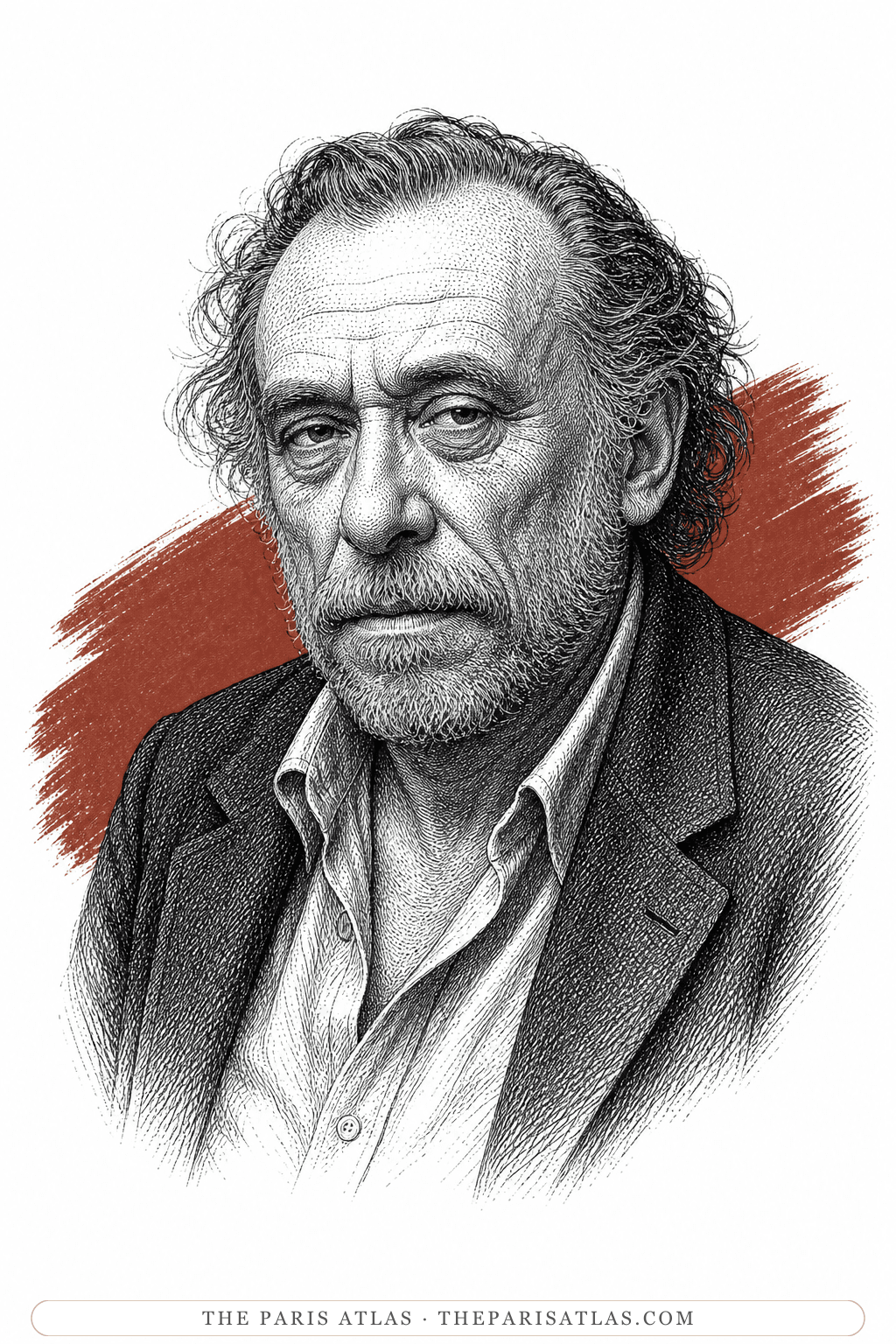


Shakespeare Never Did This
The 1978 European tour in prose and photographs — the Paris week, the Apostrophes disaster, and the return to Andernach, told by the man at the center.
- 1979
About Charles Bukowski
The story, briefly
Spoiler-freeShakespeare Never Did This, published by City Lights in 1979 with photographs by Michael Montfort, is Charles Bukowski's account of his 1978 European travels — the trip that included the September promotional week in Paris, the drunken live appearance on Bernard Pivot's television program Apostrophes, and the return to Andernach, the German town where he was born. Part travel book, part memoir, part photo album, it records what happened when Europe received a Los Angeles underground writer like a celebrity: readings, publishers, hotel rooms, interviews, and the night French television made him famous by disaster.
The story, in more detail
The book moves through the machinery of a European author tour as Bukowski experienced it: the flights and hotels, the readings with their drinking calibrated to the crowd, the publishers and journalists, and the return, as an adult American, to his German birthplace. Montfort's photographs run through the text and carry half the record.
One caution the book itself requires: it telescopes material from more than one 1978 journey, and the narrative can make separate trips — an earlier German visit, the September Paris week — feel like a single itinerary. The Paris events are firmly documented; the book's own chronology is looser than it looks.
Themes and analysis
Through the Hamburg crowd
In the Hamburg passage quoted by Leon Horton, celebrity first appears as a burden of expectation. Bukowski's narrator imagines ordinary escapes, even a visit to the dentist, while the audience anticipates something extraordinary. That comic mismatch exposes the apprehension beneath his public reputation. Moving through the crowd is also a movement into a role: hearing his name repeated, he begins to believe in the figure being acclaimed. The account makes the celebrated author seem partly produced by his listeners, rather than someone already secure in that identity.
Poems at the microphone
The quoted onstage passage changes pace as the narrator settles into familiar actions: opening wine, arranging books and finding the microphone. Repetition supplies a competence that the approach to the stage had obscured. His account of the audience then distinguishes laughter from applause for serious poems. What surprises him is the possibility of being heard in more than one register. The closing joke about needing another drink preserves the comic persona even as he describes recognition that reaches beyond it.
Why we recommend it
Bukowski's own Paris testimony
The television clip tells the famous hour; this book is the only place Bukowski tells the trip.
Europe receiving an American original
The reversal of the usual pilgrimage — Europe celebrating a Los Angeles writer — happens on these pages in real time.
A journey recorded in two media
Michael Montfort’s photographs give readers a visual account to compare with Bukowski’s narration of the trip.
What this book explores
Timeline
1978
Bukowski's European journeys, including the September Paris week and the Apostrophes broadcast, supply the material.
1979
City Lights publishes the book with Montfort's photographs.
1995
Black Sparrow Press publishes an expanded edition of the travel book.
Book editions

- Paperback
- City Lights Books
- 1979
- 9780872861176
Reader reviews
Readers may also like


Shakespeare Never Did This: frequently asked questions
What is Shakespeare Never Did This about?
Charles Bukowski's 1979 book, with photographs by Michael Montfort, recounts his 1978 European travels: readings, publishers, hotel rooms, the September promotional week in Paris with its notorious live appearance on the television program Apostrophes, and his return to Andernach, the German town of his birth.
Does the book describe the Apostrophes television appearance?
Yes — from Bukowski's side. The September 1978 Paris visit, including the broadcast night, is part of the material the book draws on.
Is the book's chronology reliable?
Only loosely. It telescopes more than one 1978 European journey into what can read as a single itinerary, so individual episodes are better dated from outside records than from the book's own sequence.
Who was Michael Montfort?
A German-born photographer and friend of Bukowski who accompanied him to Europe in 1978; his photographs run through the book and carry much of its record.
When was it published?
City Lights published it in 1979; an expanded edition followed later.
What is Shakespeare Never Did This about?
Bukowski's 1978 trip to Europe: his birthplace at Andernach in Germany, Hamburg, the French Riviera, a Düsseldorf racetrack, and his drunken appearance on French television.
Who took the photographs?
Michael Montfort, Bukowski's personal photographer, who travelled with him and whose pictures appear in five of his books.
If you like Charles Bukowski
Explore authors with a similar voice, perspective, and influence.
Louis-Ferdinand Céline
The doctor of the Paris slums who wrote the century's blackest, funniest novel — and changed the sound of French prose.
View author
Henry Miller
The Brooklyn dropout who arrived in Paris broke at thirty-eight and wrote the exuberant, banned books that ended American censorship.
View author
Simone de Beauvoir
French writer and philosopher whose novels, memoirs, and social analysis examined freedom, gender, responsibility, aging, and the material conditions that shape a life.
View author
References
References
The sources below include the primary text, editions, scholarship, archival materials, and other records that informed this page. They document Shakespeare Never Did This, its publication, and its place in literary history.


1Shakespeare Never Did This
NovelCharles Bukowski, 1979Used forThe primary text represented by this page, used for descriptions of the work’s contents and for any quoted passages shown here.
2Charles Bukowski: Only Tough Guys Shit Themselves in Public
WebsiteUnder the Counterculture, 2022Used forQuoted Hamburg passages only; not a complete-book or photographic reading.
3Charles Bukowski (Poetry Foundation)
WebsiteUsed forBiographical and bibliographic backbone: the career arc, the Black Sparrow relationship, and the book's place in it.
4Charles Bukowski timeline (bukowski.net)
WebsiteUsed forPublication dates, publishers, and chronology checked against the bukowski.net timeline.
5Charles Bukowski: books and chapbooks (Verdant Press checklist)
WebsiteUsed forBibliographic details cross-checked against the Verdant Press checklist.

6Quand Bukowski marchait sur Paris (Society)
PeriodicalSocietyUsed forThe reconstruction of the September 1978 Paris week used to keep the book's telescoped chronology honest.
7Bukowski Database — expanded Shakespeare edition
WebsiteUsed forWeb source consulted for documented facts and historical context presented on the Shakespeare Never Did This page.
i
Why these sources are here
The primary text is the baseline reference for every book page. Additional references document publication history, interpretation, and historical context where that evidence is available.
 Explore more resources