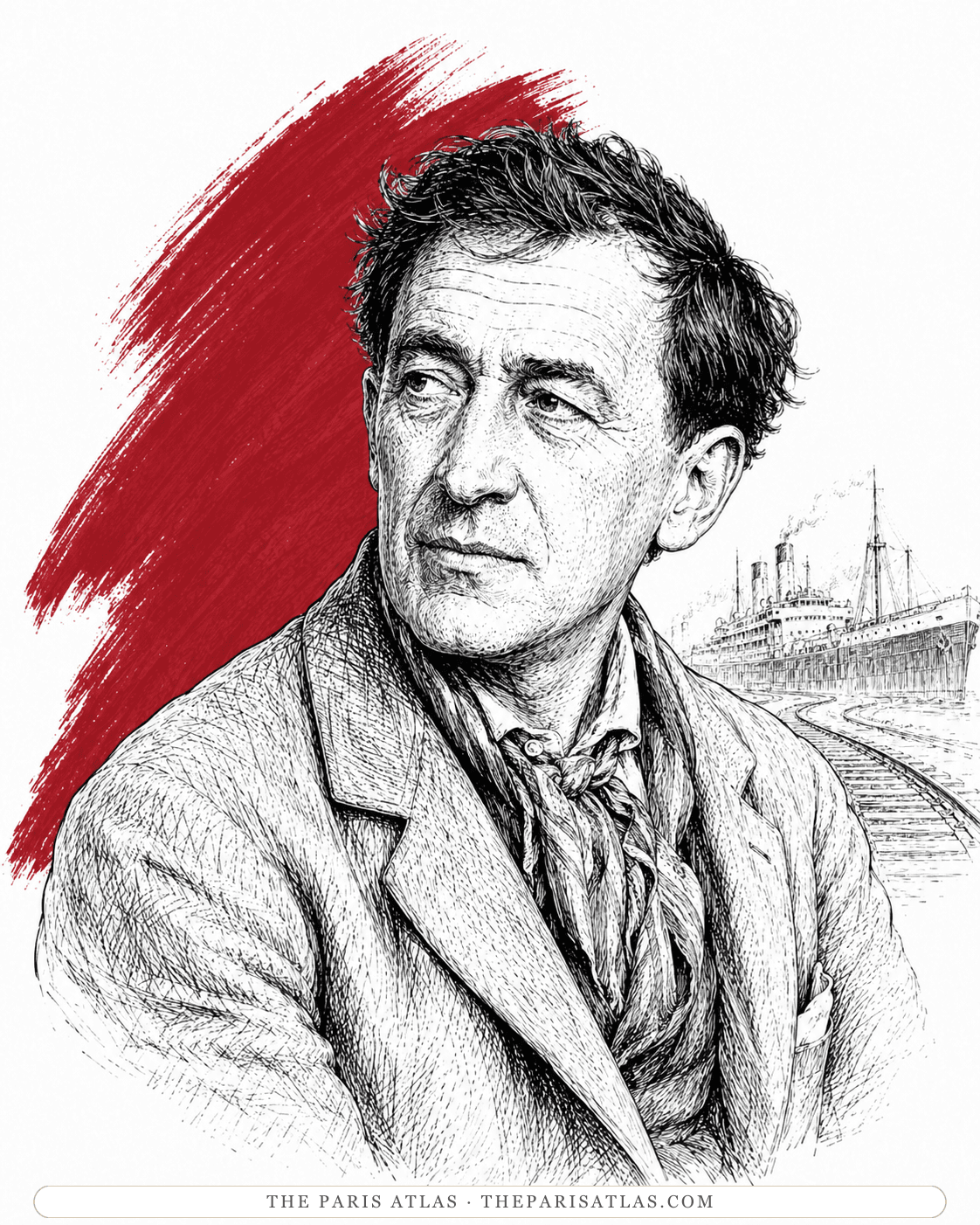


The Astonished Man
The memoir tetralogy opens like a lightning strike: war, gypsies, and the art of being astonished — written after a decade of silence.
- 1945
About Blaise Cendrars
The story, briefly
Spoiler-freeL'Homme foudroyé (1945) broke ten years of near-silence: the first panel of Cendrars' late memoir tetralogy, written in occupied France's aftermath, opening with the Great War's guns and spiraling out through the demimonde of his legionnaire and vagabond years — above all the gypsy encampments and their queen of hearts, Sauterelle. Memory here obeys no calendar: the book digresses the way roads do, and the astonishment of the title is a discipline, not a mood. In English it is The Astonished Man; in any language it is one of memory's great performances. (A memoir — nothing here to spoil.)
The story, in more detail
The silence it broke was real: the fall of France found Cendrars a war correspondent, and the Occupation shut him up in Aix-en-Provence, unpublishing and unpublished, for years he later called dead ones. What restarted the engine became the tetralogy's method — not chronology but detonation: L'Homme foudroyé ('the man struck by lightning') opens with the front, then lets memory arc wherever the current jumps — the Legion's underworld comrades, the caravans of the gypsies he lived among, kitchens, con men, roads, and the recurring figure of Sauterelle, the gypsy beauty whose court he joined. Each digression is a full tale; the whole is a life reassembled by voltage rather than date.[1]
Denoël published it in 1945, and three more panels followed in five years — La Main coupée, Bourlinguer, Le Lotissement du ciel — the sixty-year-old adventurer converting the legend into literature at last. Nina Rootes' English translation, The Astonished Man, carried it into the Anglophone canon of memoir. For this shelf it is the hinge of late Cendrars: where Miller's beloved talker finally sat down — one-handed, at Aix — and proved the talk had been books all along.[1]
The full story
Three grand movements, each a country of digressions: the war remembered from its shattering — the lightning of the title — and the comrades of the Legion's underside; the long vagabond passages among the gypsies, Sauterelle's world of caravans, horse fairs, and codes older than the states around them; and the Rhône-country of hermits, poachers, and kitchens where the narrator's France lives at ground level. Stories nest in stories; the astonished man's only rule is to follow the spark.[1]
Read it as evenings, not chapters — each digression is built to be told entire, the way it was lived and retold for thirty years first.[1]
Themes and analysis
The return to the table
The opening presents writing as a conversation that missed its moment. Peisson has already cycled away when the narrator wants to answer his account of an occupied household with a frightening memory from the earlier war. The typewriter becomes a way of continuing that exchange across an absence. Similar nights connect different conflicts, but their apparent beauty offers no shelter from humiliation or fear. The subsequent images of fire make renewed writing both consuming and regenerative: experience must be stirred up, not simply retrieved intact, before it can become a story addressed to someone else.
Three lines, then the coast
The three lines written at l'Escayrol turn the ideal writer's retreat into a small joke at its occupant's expense. He positions the table before the view, begins the last chapter, and then leaves to arrange domestic help. The promised working life never follows. His retrospective warning against panoramas reverses the usual idea that beautiful surroundings automatically inspire art. Looking outward and making a page are different activities. The narrator who now tells this failure can transform the distraction into prose, even though the earlier writer at the window could not finish his work.
Why we recommend it
The digression as art form
Nobody has ever wandered better on the page — each tangent lands like a told tale, because it was one.
The underworld preserved
Legionnaires, gypsies, poachers, cooks — a France no other shelf here reaches, rendered with total fraternity.
The comeback
A great writer restarting himself at sixty, in the ruins of a war — the tetralogy is late style as resurrection.
What this book explores
Timeline
1940–1945
The fall of France makes Cendrars a war correspondent, then the Occupation shuts him up in Aix-en-Provence through years he later called dead ones.
1945
Denoël publishes L'Homme foudroyé, breaking a decade of near-silence and opening the late memoir tetralogy.
1945–1949
Three more panels follow in five years — La Main coupée, Bourlinguer, and Le Lotissement du ciel.
Book editions
Hardcover
- Hardcover
- Denoël
- 1945
Paperback
- Paperback
- Peter Owen

- Hardcover
- Peter Owen
- 1970
- 9780720601602
- Nina Rootes
Reader reviews
Readers may also like


The Astonished Man: frequently asked questions
Who wrote The Astonished Man?
Blaise Cendrars. Published in 1945 as L'Homme foudroyé, it opens his late memoir tetralogy.
What is The Astonished Man about?
It spirals out from the guns of the Great War through the demimonde of Cendrars's legionnaire and vagabond years — above all the gypsy encampments and their queen of hearts, Sauterelle.
Is it a straightforward autobiography?
No. Memory here obeys no calendar — the book digresses the way roads do, and the "astonishment" of the title is a discipline, not a mood.
Why did Cendrars write it when he did?
It broke ten years of near-silence. The fall of France had shut him up in Aix-en-Provence, unpublished, through the Occupation.
Is it fiction or memoir?
Autobiographical memoir — though Cendrars reshapes his own life as freely as any novelist, curating a legend of restlessness.
If you like Blaise Cendrars
Explore authors with a similar voice, perspective, and influence.
Henry Miller
The devoted heir — Miller crowned Cendrars above every living writer, and the torrential first-person prose is the family resemblance.
View author
Louis-Ferdinand Céline
The other voyager at the end of the night — spoken rhythm, black exuberance, and a war wound at the center of everything.
View author
Ernest Hemingway
Author of The Sun Also Rises and A Moveable Feast; his pared-down style, developed in 1920s Paris, became the most imitated in American prose.
View author
References
References
The sources below include the primary text, editions, scholarship, archival materials, and other records that informed this page. They document The Astonished Man, its publication, and its place in literary history.

2L'Homme foudroyé — French text
WebsiteEbooks libres et gratuits, 2025Used forSelected French opening letter and La Redonne passages in the October 2025 Ebooks libres et gratuits transcription. Literary readings of conversation, memory and writing; not Nina Rootes's English version, independent biography or a full-volume collation.

3Blaise Cendrars — translations bibliography
Official recordSwiss National Library / Constellation Cendrars, 2019Used forThe Swiss National Library bibliography independently verifies Nina Rootes as the English translator of The Astonished Man.
4Rencontres de Chaminadour — Blaise Cendrars chronology (prepared with thanks to Claude Leroy)
WebsiteUsed forUsed to place The Astonished Man within Blaise Cendrars's published work and verify its bibliographic context.
5Bibliothèque de la Ville de La Chaux-de-Fonds — dossier Blaise Cendrars : « Tout ça, c'est digne d'être vécu »
WebsiteUsed forUsed for independent biographical, archival, or historical context surrounding Blaise Cendrars's career and the period in which The Astonished Man appeared.
6Meet Blaise Cendrars: the one-armed poet who worked with Sonia Delaunay, Fernand Léger and Robert Doisneau
PeriodicalThe Art Newspaper, 2022Used forUsed to cross-check authorship, chronology, and the work's place in Blaise Cendrars's wider catalogue.
7Fonds Blaise Cendrars, supplement S-89 finding aid — press clippings, including Paris-Presse of 24 January 1961 and Arts of 16 February 1951
ArchiveArchives littéraires suisses / Swiss National LibraryUsed forUsed to verify Blaise Cendrars's bibliography and place The Astonished Man within the broader chronology of Blaise Cendrars's career.
i
Why these sources are here
The primary text is the baseline reference for every book page. Additional references document publication history, interpretation, and historical context where that evidence is available.
 Explore more resources