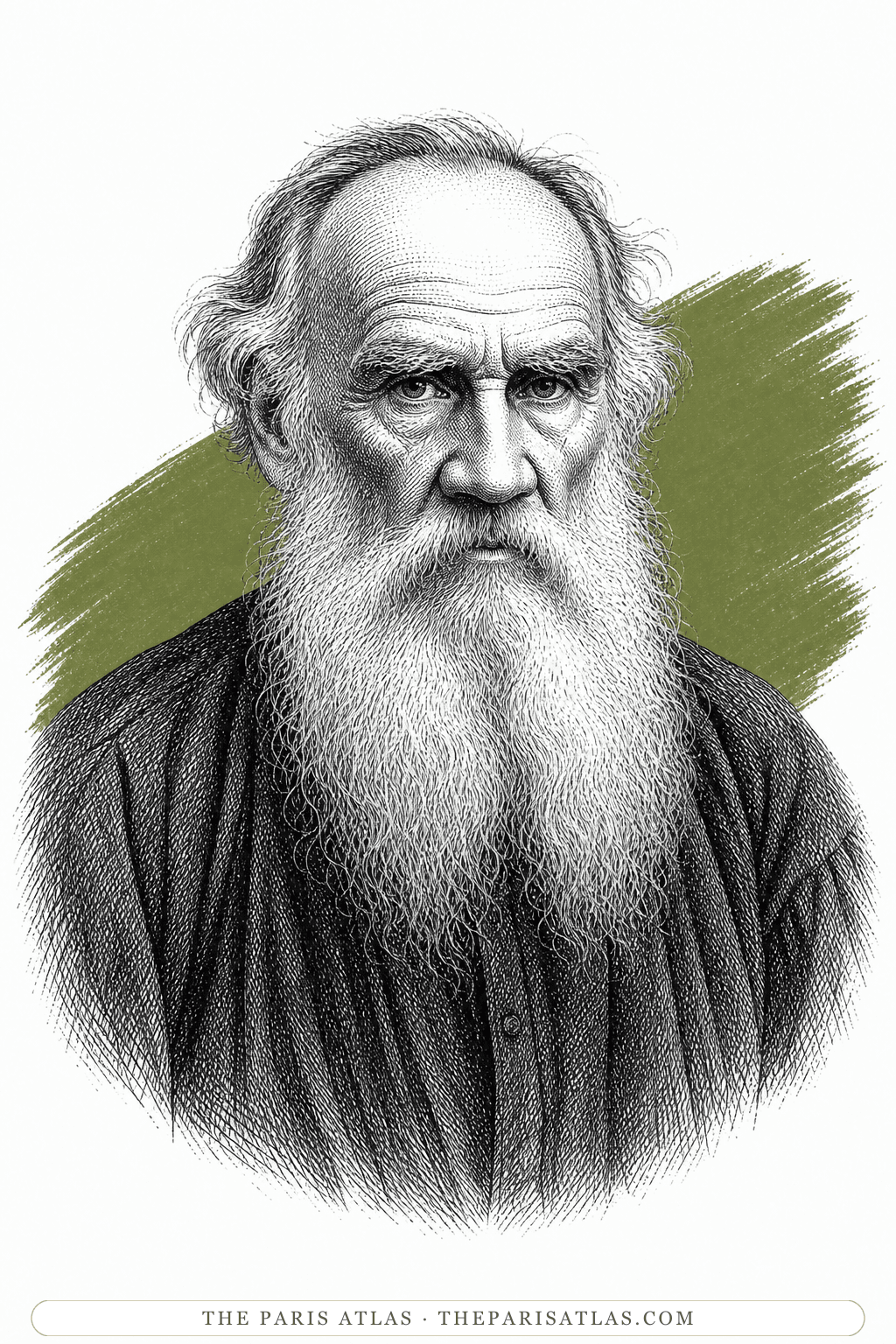
Anna Karenina
Leo Tolstoy
Anna Karenina
Tolstoy's earlier novel of adultery, told with sympathy for the wife. Here the husband tells it, and there is none.
Read our takeThe Kreutzer Sonata
Leo Tolstoy
by Leo Tolstoy
On a night train, a man tells a stranger how jealousy, a violinist and a Beethoven sonata led him to kill his wife.
Passengers on a long Russian train journey argue about love, marriage and divorce. A nervous man who has kept to himself breaks in and introduces himself as Pozdnyshev, the man who killed his wife. Through the night he tells the narrator the whole story. He describes his youth, his marriage at thirty, the quarrels and the jealousy that filled it, and the violinist who came to play music with his wife. The music they played together was Beethoven's Kreutzer Sonata. Leo Tolstoy finished the story at the end of 1889. The censors would not pass it, and it spread in copies passed from hand to hand before it was printed abroad.[1][2]
Tolstoy worked on the story through the second half of 1889, while also writing his comedy The Fruits of Culture. Just before the family performed the comedy at Yasnaya Polyana that December, the finished manuscript was read aloud to about fifteen people in the Countess's bedroom. The reader stopped when he reached the plot, embarrassed in front of the young ladies. They were sent out, and Tolstoy read on himself from his own corrections. Afterwards he said he wished they would talk about the story as if he were not there.[2]
The story was soon circulating in Moscow in lithographed copies. In Russia the Church was outraged, and so were progressive readers who believed in free choice in love. Archbishop Nikanor of Kherson called Tolstoy a wolf in sheep's clothing. Many readers said Tolstoy was simply getting old. In 1890 he wrote an Afterword explaining what he meant.[2]
Tolstoy's wife, Sofya, went to see Tsar Alexander III to ask permission to include the story in the thirteenth volume of her edition of his works. The Tsar asked why she wanted to publish a work directed against marriage. She answered that she asked as his publisher, not as his wife. He agreed, on condition that it was never issued as a separate book.[2]
A train crosses Russia. Among the passengers are a lady who smokes cigarettes, a talkative lawyer, an old merchant and a clerk. They argue about whether marriage should rest on love, and whether divorce is a good thing. A short, nervous gentleman with bright eyes has avoided everyone. He suddenly asks what they mean by love, and says love never lasts. Then he tells them who he is, the man in the Pozdnyshev affair, who killed his wife.[1]
When the others have left, Pozdnyshev tells the narrator his story through the night, drinking strong tea. At sixteen a student friend of his brother took him to a brothel. He lived loosely until he married, at thirty, one of the two daughters of a landowner from Penza. The honeymoon disappointed him. The marriage became a cycle of quarrels and reconciliations. His wife had many children, and after doctors told her to stop, she grew lovelier, idler and hungry for something. She went back to the piano.[1]
Then Trukhachevsky arrives. He is a violinist, the son of a ruined neighbour, trained at the Conservatoire in Paris, with a Parisian manner and a gaudy cravat. Pozdnyshev is jealous from the first meeting, and invites him back anyway. At an evening party the violinist and Pozdnyshev's wife play Beethoven's Kreutzer Sonata. The music transports Pozdnyshev, and for the moment he feels no jealousy at all.[1]
Two days later Pozdnyshev leaves for a district assembly. A letter from his wife mentions that the violinist has called with the music he promised. He cannot sleep. At dawn he sets off home, twenty-five versts, about sixteen miles, by carriage and eight hours by train, and arrives an hour after midnight. He sees the violinist's coat in the hall, takes off his boots, and takes a curved Damascus dagger from the wall. He finds the two of them together. The violinist escapes, and Pozdnyshev stabs his wife in the left side, between the lower ribs.
On her deathbed she tells him he has done what he wanted and killed her, and that her sister will take the children. Only when he sees her in her coffin does he understand what he has done. He spends eleven months in prison awaiting trial, and the court acquits him as a deceived husband defending his honour. He tells the narrator that if he had known then what he knows now, he would never have married her. He ends by quoting the Gospel of Matthew, chapter 5, verse 28, on looking at a woman with lust.
The title is the name of a real piece. Beethoven's Sonata for piano and violin in A major, opus 47, is dedicated to the violinist Rodolphe Kreutzer. Its original title calls it a sonata written in a very concertante style, almost like a concerto, which means the two instruments compete as equals. The wife and the violinist play it that way in Tolstoy's story.
Pozdnyshev calls the sonata a terrible thing, especially its first fast movement, the presto. Music, he says, makes him forget his real situation and carries him into a state that is not his own. He feels what the composer felt without knowing why, and the excitement has nowhere to go. A march ends in marching and a dance in dancing, he argues, but this music ends in nothing. He says that in China music is controlled by the State, and that is how it should be.
Paris is where the danger comes from. Trukhachevsky's ruined father sent him to his godmother in Paris, and there he was placed at the Conservatoire and came out a violinist. Pozdnyshev sneers at his special Parisianism, his buttoned boots and gaudy cravat and the something that foreigners pick up in Paris. At their first meeting the three of them talk about music and about Paris. Pozdnyshev also remembers a Paris sideshow, where he paid a franc to see a bearded woman who turned out to be a man in disguise.
Paris also published the story. In 1890 Alphonse Lemerre, whose shop was in the Passage Choiseul, brought out La Sonate de Kreutzer. The translators were J.-H. Rosny aîné, the novelist, and I. Pavlovsky. The French catalogue lists more than one edition that same year. One printing adds Tolstoy's reply to his critics. Its publisher's notice says the story had been banned not only in Russia but in countries as free as North America.
In the United States the book was at first treated as indecent literature, and the Post Office refused to carry it, according to Aylmer Maude. Benjamin R. Tucker, a Boston publisher, printed his own English translation in 1890, and the copy scanned by the University of Pittsburgh is already marked fourth edition.
Maude, who knew Tolstoy, tried to explain the uproar. One half of society, he wrote, wanted the whole question of sex left alone, believing ignorance was the nearest thing to innocence. The other half held Tolstoy's views in reverse, seeing as good what he saw as bad, and did not like being denounced. Tolstoy's answer to both, Maude wrote, was that rational beings dare not refuse to think about it. He added that the story sets out the honest, strongly felt opinions of a man of genius.
They played Beethoven's 'Kreutzer Sonata.' Do you know the first presto? Do you know it? Ah!
A terrible thing is that sonata, especially the presto! And a terrible thing is music in general.
Music makes me forget my real situation. It transports me into a state which is not my own.
The setting is one carriage and one long night, and the story comes out in the dark between stations.
Few stories try this hard to say what music does to a listener, and none blames it for so much.
Banned in Russia and by the US Post Office, published in Paris the same year by a leading novelist's hand.
Twenty-eight short chapters. Tucker's 1890 edition runs to 143 small pages.
A landowner who killed his wife in a fit of jealousy, was acquitted, and now tells his story to strangers on trains.
The violinist, son of a ruined neighbour, trained at the Paris Conservatoire, who plays the sonata with Pozdnyshev's wife.
A fellow passenger who stays awake all night to hear Pozdnyshev's story.
A landowner's daughter who marries Pozdnyshev young, bears his children, and takes up the piano again.
1889
Leo Tolstoy works on the story through the second half of the year.
December 1889
The finished manuscript is read aloud at Yasnaya Polyana, two days before a family performance of his comedy The Fruits of Culture.
1890
The story circulates in Moscow in lithographed copies. The censors do not allow it to be published.
1890
Benjamin R. Tucker publishes his English translation in Boston. The US Post Office refuses to carry the book.
1890
Alphonse Lemerre publishes the French translation by J.-H. Rosny aîné and I. Pavlovsky in Paris.
1890
Tolstoy writes the Afterword to The Kreutzer Sonata.
Early 1890s
Tsar Alexander III lets Sofya Tolstoy include the story in her edition of his works, but not as a separate book.
2009
Oxford World's Classics publishes the story with others in the Maude and Duff translations.

Anna Karenina
Leo Tolstoy
Tolstoy's earlier novel of adultery, told with sympathy for the wife. Here the husband tells it, and there is none.
Read our take
Written a few years earlier, another short book about a man who sees too late that his whole life was false.
Read our takeResurrection
Leo Tolstoy
Tolstoy's last novel, again about sex, guilt and a man trying to live by the Gospels.
Read our take
Fyodor Dostoevsky's bitter monologue by a man who cannot stop explaining himself.
Read our take
D. H. Lawrence's novel about sex and marriage, also banned and fought over, and on the opposite side of the argument.
Read our takeA man named Pozdnyshev tells a fellow passenger on a night train how he came to kill his wife. He blames jealousy, his own past, the way society arranges marriage, and a violinist who played Beethoven's Kreutzer Sonata with her.
After Beethoven's Sonata for piano and violin, opus 47, which Beethoven dedicated to the violinist Rodolphe Kreutzer. In the story Pozdnyshev's wife and the violinist play it together, and its effect on Pozdnyshev is at the centre of the book.
Its frank talk about sex and its attack on marriage. The Russian censors would not pass it, the Church denounced it, and in the United States the Post Office at first refused to carry it as indecent.
Pozdnyshev comes home at night, finds his wife with the violinist, and stabs her. She dies the next day. He is acquitted as a deceived husband, and he ends his story by quoting the Gospel of Matthew on lust.
The violinist trained at the Conservatoire in Paris, and Pozdnyshev resents his Parisian manners. In 1890 Alphonse Lemerre published the French translation in Paris, made by the novelist J.-H. Rosny aîné and I. Pavlovsky.
Benjamin R. Tucker's, published in Boston in 1890, the year the story first appeared in print. Tucker spells the narrator's name Posdnicheff.
Explore authors with a similar voice, perspective, and influence.
French writer and philosopher whose novels, memoirs, and social analysis examined freedom, gender, responsibility, aging, and the material conditions that shape a life.
View author
American novelist and composer whose expatriate fiction explores dislocation, unstable intimacy, fatalism, and North Africa.
View author
The Brooklyn dropout who arrived in Paris broke at thirty-eight and wrote the exuberant, banned books that ended American censorship.
View authorThe sources below include the primary text, editions, scholarship, archival materials, and other records that informed this page. They document The Kreutzer Sonata, its publication, and its place in literary history.


Tucker's 1890 Boston edition, used for every quotation.

Catalogue record for the Paris translation of 1890 and its translators.
A Lemerre printing, with the publisher's notice on the bans.
Beethoven's sonata: the dedication to Rodolphe Kreutzer and the original title.
Edition record confirming ISBN 9780199555796: Oxford, 2009, translated by Louise and Aylmer Maude and J. D. Duff, 477 pages.
The primary text represented by this page, used for descriptions of the work’s contents and for any quoted passages shown here.
The primary text is the baseline reference for every book page. Additional references document publication history, interpretation, and historical context where that evidence is available.
 Explore more resources