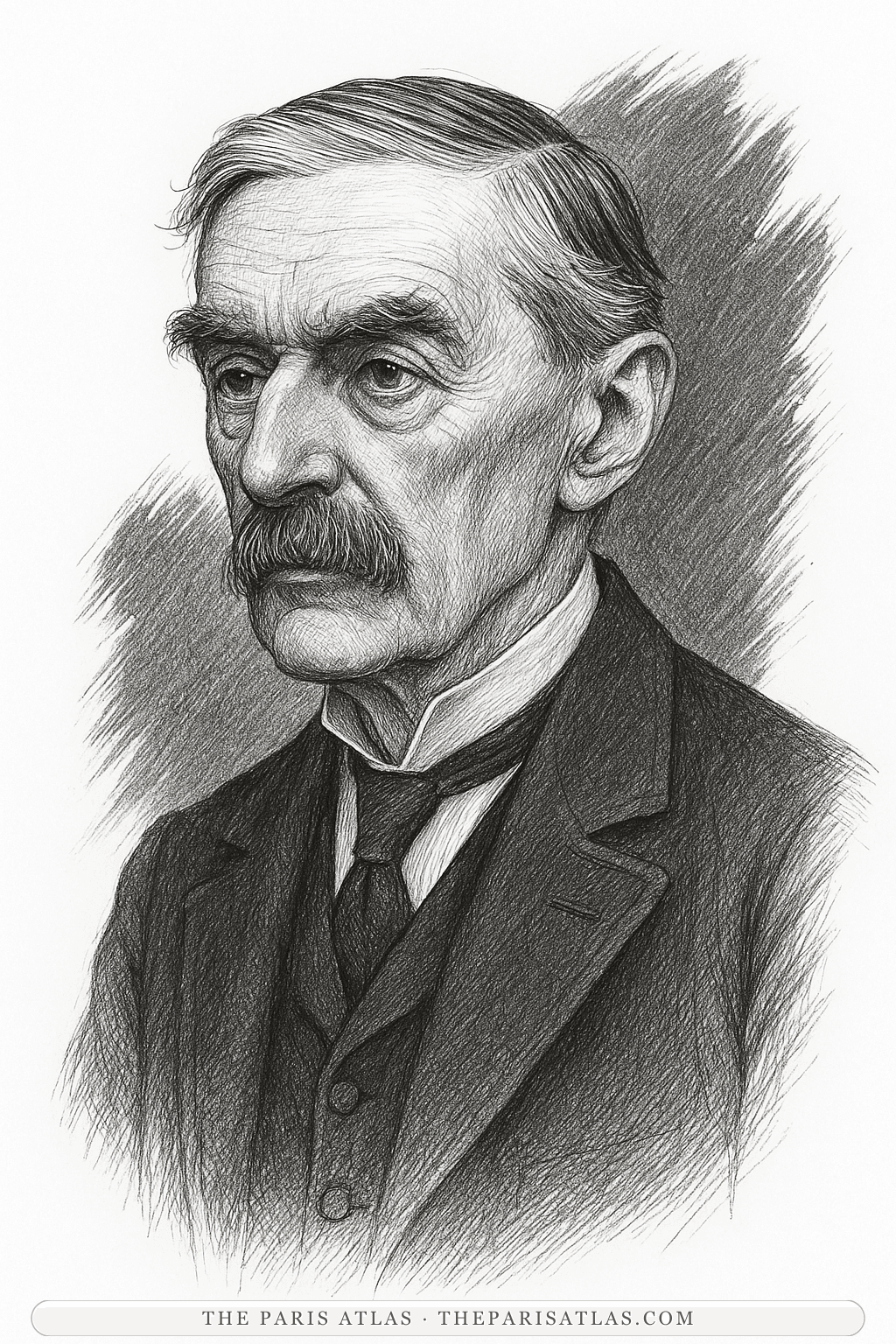
Neville Chamberlain
The British Prime Minister of the years the book is trying to explain. George Orwell rejects the idea that he was a schemer selling England to Hitler and calls him a stupid old man doing his best by very dim lights. The sharper half of the argument is that public opinion was behind him at every step.
In Orwell's account, to avoid paying the price of either peace or war. The book credits him with no design beyond that, and reads his policy as a series of incompatible moves made by a man who could not choose between them.
The book

At a glance
- The Prime Minister whose record Parts One and Two are explaining
- A stupid old man doing his best according to his very dim lights
- A dark and wily schemer plotting to sell England to Hitler
- Sir John Simon and Sir Samuel Hoare, as men who would have come to terms with Hitler
- Munich, an approach to Russia, the guarantee to Poland, and a half-hearted war
- It took the fall of Paris to remove him
- Part One, sections iii and iv; Part Two, sections i and ii; Part Three, section iii
Who they are in the book
Spoiler-freeNeville Chamberlain is the figure George Orwell uses to make his central point about how English public life goes wrong. The book is not much interested in him as a person and never describes his appearance, his manner or his voice. What it does at length is argue about how to read him, because the reading determines what has to change.
The left-wing account of the period, Orwell writes, saw in Chamberlain a dark and wily schemer plotting to sell England to Hitler. He thinks it is far likelier that the man was merely a stupid old man doing his best according to his very dim lights, and offers the contradictions of the policy as evidence: Munich, then an attempt at an understanding with Russia, then the guarantee to Poland, then honouring it, then prosecuting the war half-heartedly. Orwell reads that sequence as the record of someone who, like the mass of the people, did not want to pay the price of peace or of war.
That is the sting of the argument, and Orwell states it plainly. Public opinion was behind Chamberlain at every one of those incompatible steps, and turned against him only when the results became visible, which is to say it turned against its own lethargy of the previous seven years. The book's conclusion is that England had the Prime Minister its own drowsiness produced. Chamberlain reappears in Part Two as the man in whose England the shift from consumer goods to armaments could not be made, because the rich would not accept the necessary taxation.
How Neville Chamberlain Is Portrayed
- The reading Orwell rejectsThat he was a dark and wily schemer plotting to sell England to Hitler. Orwell says the schemer version cannot explain the failure to grasp any of the courses open to him, and the plainer version can.
- The reading Orwell offers instead"It is far likelier that he was merely a stupid old man doing his best according to his very dim lights." Orwell adds that the same struggle was going on in Chamberlain's mind as in the minds of ordinary people.
- Backed at every stepPublic opinion was behind him at Munich, in the attempt at an understanding with Russia, in the guarantee to Poland, in honouring it, and in prosecuting the war half-heartedly. Orwell notes that these policies were completely incompatible with one another.
- Chamberlain's EnglandPart Two uses his name for the whole arrangement. Armaments could not be paid for because the rich would not face the taxation, and while the rich are visibly rich the poor cannot be taxed heavily either.
- Named alongside Simon and HoareOrwell puts him with Sir John Simon and Sir Samuel Hoare as men whose natural instinct was to come to an agreement with Hitler, and says they could only have done it by breaking up the Empire and selling their own people into semi-slavery. Tossed between their incomes and their principles, they made the worst of both worlds.
- The red postersOrwell says the patriotic posters his government issued at the start of the war broke all depth-records, and then argues they could not have been better: anyone genuinely hostile to Fascism would also have had to be hostile to Chamberlain.
- How he went"It took the fall of Paris to get rid of Chamberlain." Orwell uses the timing as his example of a country that moves with glacier-like slowness and learns only from disasters.
If you like The Lion and the Unicorn


If you like George Orwell
Explore authors with a similar voice, perspective, and influence.

Henry Miller
The Brooklyn dropout who arrived in Paris broke at thirty-eight and wrote the exuberant, banned books that ended American censorship.
View author
Louis-Ferdinand Céline
The doctor of the Paris slums who wrote the century's blackest, funniest novel — and changed the sound of French prose.
View author
Simone de Beauvoir
French writer and philosopher whose novels, memoirs, and social analysis examined freedom, gender, responsibility, aging, and the material conditions that shape a life.
View author