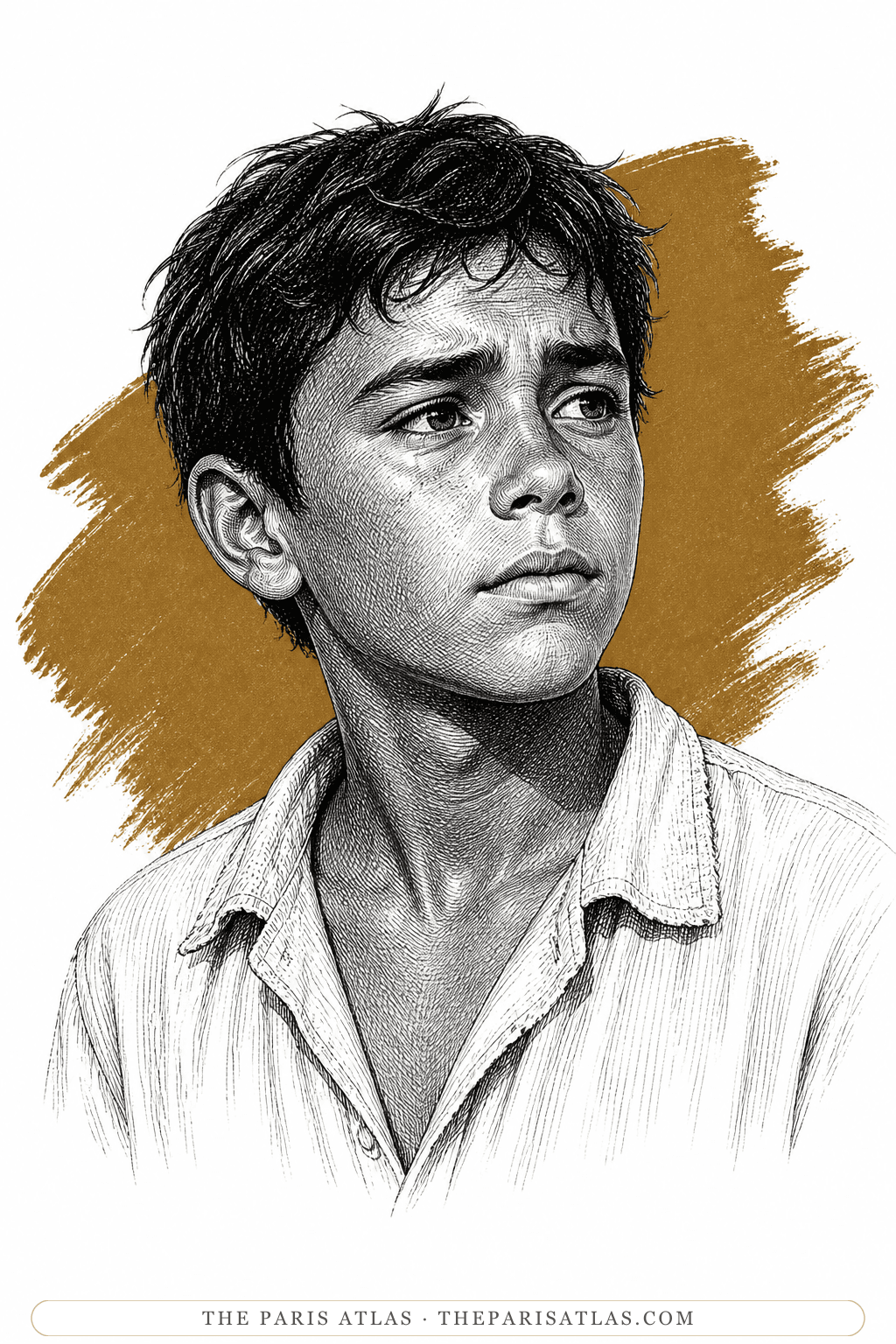
Manolin
The boy who learned to fish from Santiago and worked in his boat until the old man's bad luck ran too long. His parents moved him to another crew; he goes on looking after Santiago anyway.
To fish with Santiago again. He tells the old man that his family has made some money and he could come back, and when he is refused he asks to be allowed to serve in some way instead — fetching sardines, fetching baits, carrying gear.
The book

At a glance
- "The boy" — Santiago's former crewmate, now fishing on another boat out of the same village
- Twice in the whole novel, both times by Santiago
- Never stated. He was five years old when Santiago first took him out in a boat
- His parents ordered him onto a luckier boat after forty days without a fish
- Caught three good fish in its first week. Its captain is almost blind and does not like to work far out
- Sardines and fresh baits, supper from the Terrace, beer, and coffee with plenty of milk and sugar
Who they are in the book
Spoiler-freeManolin is a boy in the same Cuban fishing village as Santiago, the old man of the title. Santiago taught him to fish and first took him out in a boat when he was five. He worked in that boat until the old man had gone forty days without a catch, at which point the boy's parents decided Santiago was finally and permanently unlucky and put their son on a boat that was landing fish. It caught three good ones in its first week.
The novel calls him "the boy" almost everywhere; his name appears twice in the whole book, both times spoken by Santiago. His age is never given. What the book shows instead is what he does — carries the gear up from the beach, buys the beer, arranges the food, wakes before dawn, and keeps a private running list of everything the old man has stopped being able to afford.
How Manolin Is Portrayed
- He obeys his parents and does not pretend otherwiseForty days without a fish was enough for his mother and father. The boy does not argue the point with Santiago or dress it up: "It was papa made me leave. I am a boy and I must obey him." The old man tells him it is quite normal, and adds that he knows the boy did not leave because he doubted him. Neither of them says anything more about it.
- He buys the beerHe offers to buy the old man a beer at the Terrace, the café above the harbour, and Santiago says yes. "Why not?" the old man said. "Between fishermen." A few minutes later the boy asks to go for sardines, saying that if he cannot fish with Santiago he would like to serve in some way. The old man turns him down and tells him why. "You bought me a beer," the old man said. "You are already a man."
- He plays along with the empty shackEach evening he asks to borrow a cast net that was sold long ago, and accepts the offer of a pot of yellow rice with fish that does not exist. The book is blunt about it: "There was no cast net and the boy remembered when they had sold it. But they went through this fiction every day." He never lets on that he knows.
- He arranges the supper and does the thankingHe brings supper up from the Terrace in a two-decker metal container, with two sets of knives, forks and spoons wrapped in paper napkins. Martin, who owns the place, sent the food and two beers, and the boy has already thanked him so that Santiago is not left owing anybody. Then, looking at the shack, he thinks through what else is missing — water, soap, a good towel, another shirt, a jacket for the winter, shoes, another blanket — and asks himself: "Why am I so thoughtless?"
- Woken before dawn, and not sulking about itSantiago comes to the house in the dark and holds one of the boy's feet until he wakes. The boy pulls on his trousers and follows him out, and outside the old man says he is sorry for it. "Qué va," the boy said. "It is what a man must do." He has already explained the difference: being woken by the captain of his new boat makes him feel as though he were inferior.
- The person Santiago keeps asking for at seaOnce he is alone on the water, the old man says out loud at least seven times over three days that he wishes he had the boy — for the work, and to have someone there. "I wish I had the boy. To help me and to see this." By the third day it has worn down to a repetition: "Yes. If the boy were here. If the boy were here."
- He remembers his first trip, at five years oldSantiago asks whether he genuinely remembers being taken out at five or has only been told the story. The boy answers with the details, which is the answer: "I can remember the tail slapping and banging and the thwart breaking and the noise of the clubbing." He goes on to being thrown into the bow among the wet coiled lines, the whole boat shivering, and the smell of blood all over him.
He does not care that the other fishermen see him.
He also ends the arrangement his parents made. Told that Santiago is not lucky anymore, he answers "The hell with luck," the boy said, and tells him he will bring the luck himself. Asked what his family will say, he does not hedge: "I do not care. I caught two yesterday. But we will fish together now for I still have much to learn."
If you like The Old Man and the Sea


If you like Ernest Hemingway
Explore authors with a similar voice, perspective, and influence.

Louis-Ferdinand Céline
The other great stylist the Great War produced — where Hemingway cut the language down, Céline set it on fire. The same wound, opposite treatments.
View author
Henry Miller
Paris on no money a decade later, with the restraint removed. Miller called Hemingway's Paris a tourist's Paris; readers get to referee.
View author
Martha Gellhorn
War correspondent who covered the Spanish Civil War, D-Day, and conflicts across five more decades; Hemingway's third wife, 1940–1945.
View author