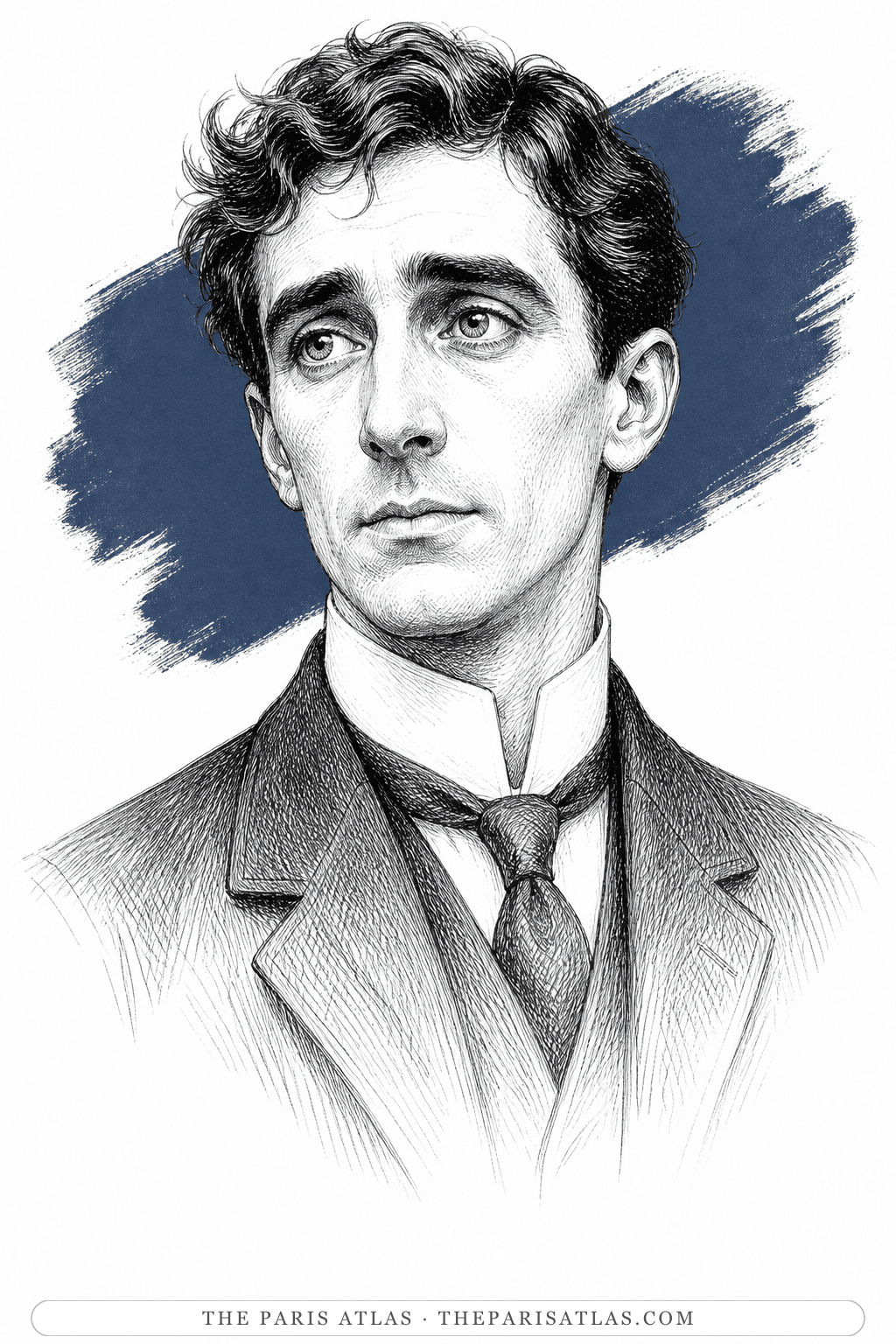
Maxime Dufferein-Chautel
The wealthy, decent admirer who offers Renée love and security — and, without meaning to, the loss of everything she has built alone.
To marry Renée Néré and have her stop travelling. He proposes in writing, plans the apartment before she has replied, and says openly that a child would mean she could no longer go off down the roads alone.
The book

At a glance
- Thirty-three and a half, almost exactly Renée's age
- Timber. His widowed mother runs the sawmills and the forest at Les Salles-Neuves in the Ardennes; his elder brother handles the family's business in Paris
- None at all. When Renée admits this to Brague, he whistles
- The second floor of his brother's Paris house, kept as a presentable bachelor flat
- He watched her act at the Empyrée-Clichy for a week, forced his way into her dressing room, and was introduced to her properly a few nights later at his brother's house, where she had been hired to dance
- Hamond, Renée's oldest friend, who knew his mother and still has the boy's first-communion photograph in a drawer
- Chérie, ma femme chérie, my little bluestocking of a wife
Who they are in the book
Spoiler-freeMaxime Dufferein-Chautel is the man who courts Renée Néré, the divorced music-hall performer who narrates this novel. He is thirty-three and a half, the same age as she is. He is tall, dark and bony, with thick untidy eyebrows and eyes set so deep that she takes them for black until daylight shows them to be a flecked grey-brown. Standing up he is stiff and awkward. Sitting down he loosens all at once and looks like a different, easier man.
His money comes from timber. His widowed mother runs the family sawmills and forest land in the Ardennes, and runs them expertly; he calls her la mère Coupe-Toujours, which is roughly Old Ma Keeps-On-Cutting. She cuts, she saws, she sells. He is the youngest son and the spoiled one, and he has no work of any kind: no office, no factory, not even a racing stable. Renée, who has never before met a man with nothing to do, finds it faintly scandalous and cannot stop noticing it.
She nicknames him le Grand-Serin. A serin is a canary, and the phrase means a great booby. She goes on calling him that after she has fallen in love with him, in a different tone. Colette makes him kind, unclever, easily wounded, easily delighted, and much better at love than at anything else. What he wants is never in doubt. He says it, he writes it, and long before she has answered he starts looking at flats.
How Maxime Dufferein-Chautel Is Portrayed
- The night he came into her dressing roomHe knocks, walks in on her half-dressed and still sweating from the stage, and delivers a compliment he has clearly rehearsed, about her talent as a mime and about her figure. She says nothing at all and looks at him until the sentence dies. He apologises properly, gets as far as the corridor, and then calls back through the shut door to ask whether she likes flowers, and which ones.
- Five nights in the front rowHe tells her later that he sat through the same act five evenings running, insulting himself on the way home each time and coming back the next night. After the first one he spent an hour drawing a small private diagram of her face, and repeated it in the margins of a book. The moment that finished him was a scene in the mime play where she sat on a table reading a threatening letter, slapped her bare thigh and threw herself back laughing.
- The presentsFlowers in the dressing room, and then a nickel dish for the dog's dinner; three tiny stone animals for her writing table, an amethyst cat, a chalcedony elephant, a turquoise toad; a jade ring round the stems of the lilies he sends on New Year's Day; a red morocco collar with gilt studs for Fossette, which Renée privately thinks hideous and does not mention; a diamond arrow pinned at her throat; and a pigskin travelling bag, ordered specially, for the tour that is taking her away from him.
- He runs in step so she cannot hear himIn the woods at Meudon she runs off down an alley after the dog and finds him at her shoulder when she stops. He explains, pleased with himself, that he was careful to run at exactly her pace so that she would not hear his feet, and that it is quite easy. The kiss that follows is angry, badly aimed and a failure.
- Angry that she fell asleepAfter a champagne dinner she dozes off in front of him and Hamond, wakes at midnight and finds him still there and furious. He tells her that when she sleeps she does not look like a sleeping woman, but like someone who has shut her eyes to hide a joy too strong for her, and that what he cannot bear is the thought of her sleeping like that in front of other people.
- He wants a child so that she cannot leaveWhen she mentions, as a joke, that Hamond would like them to have one, he is delighted and noisy about it. Then he stops laughing, pulls his eyebrows together and says that at least she could not leave him then, or go running about the roads on her own: she would be caught. Renée has already described him to his face as selfish, lazy, jealous, fond of the fireside, a despot underneath and monogamous by birth, and he was so pleased to be seen at all that he jumped up and said she was right.
- The doe in the BoisWalking early one morning they come round a corner on a young deer, which loses its nerve and stops instead of running. Renée asks him whether he would have shot her, out shooting. He answers without any fuss at all: shoot a doe? why not a woman?
- The letter that arranges her lifeFrom his mother's house in the Ardennes he sends eight pages offering marriage. His mother made a bit of a noise about it, he reports, but he is letting her make it, since she has always done what he wanted. Renée is promised the whole earth to travel over until she is tired of it and wants only one small corner, where she will no longer be Renée Néré but Madame My Wife. He has already started looking at somewhere near the rue Pergolèse. She reads it on a restaurant terrace in Marseille and asks aloud whether anybody proposes to consult her.
He never finds out what the decision cost her, because she refuses to have the conversation. From Caen, near the end of the tour, he sends her one line with no signature, asking whether she does not love him any more. She wires back that she will be home on Thursday at five, with all her tenderness, and then comes back a day early and secretly, writes him a farewell letter from her own flat at seven in the morning, and leaves before he can arrive.
In the letter she tells him to look elsewhere for youth, unspoiled looks and faith in the future, and not to come after her, because she has only just enough strength to run away from him. She keeps back her real reasons deliberately. She decides that being despised and cursed a little will get him over it faster, and that saying nothing is the kindest thing available.
If you like The Vagabond


If you like Colette
Explore authors with a similar voice, perspective, and influence.

Henry Miller
The Brooklyn dropout who arrived in Paris broke at thirty-eight and wrote the exuberant, banned books that ended American censorship.
View author
Louis-Ferdinand Céline
The doctor of the Paris slums who wrote the century's blackest, funniest novel — and changed the sound of French prose.
View author
Martha Gellhorn
War correspondent who covered the Spanish Civil War, D-Day, and conflicts across five more decades; Hemingway's third wife, 1940–1945.
View author