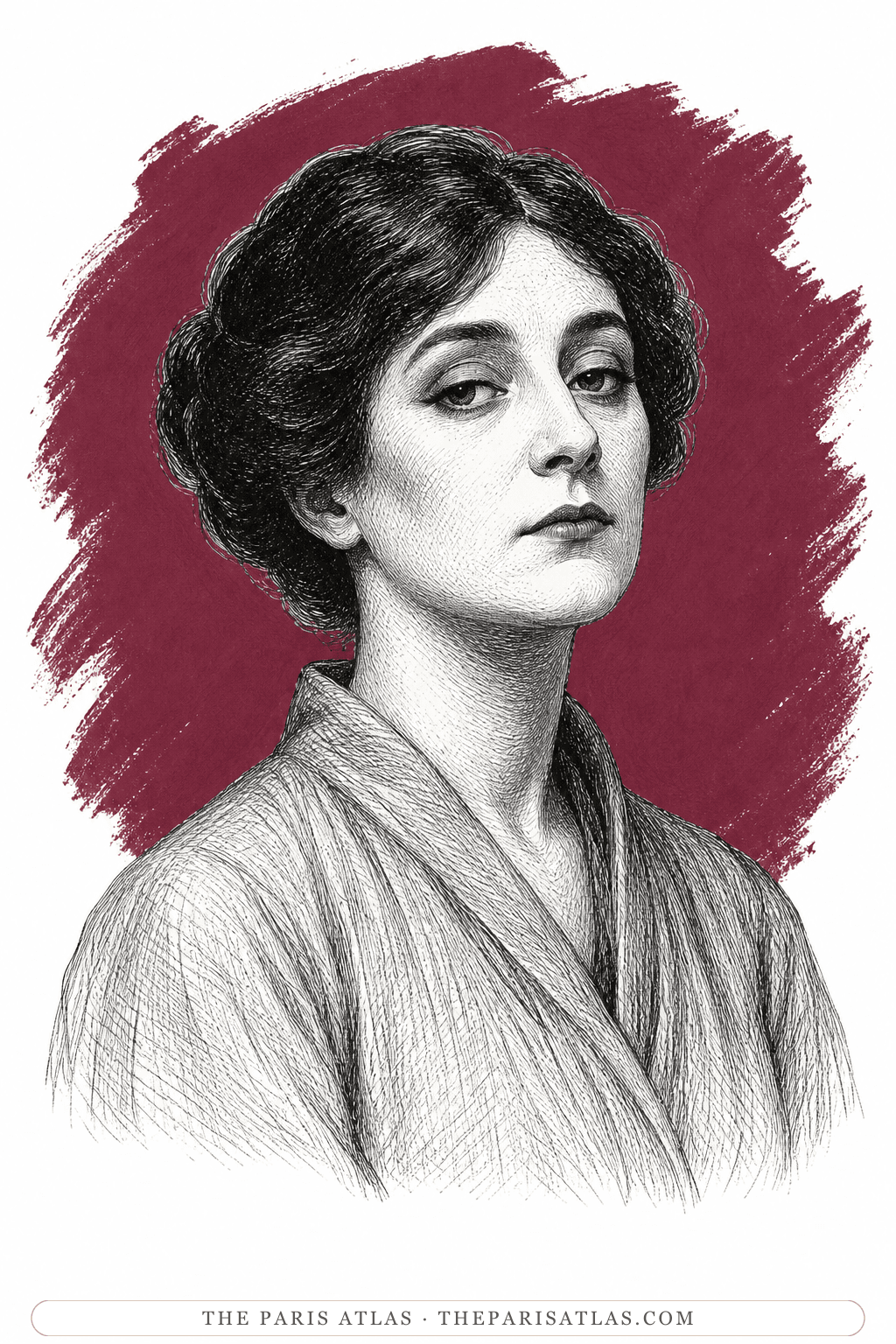
Renée Néré
Thirty-three, divorced, and earning her living as a music-hall mime — the narrator, weighing a second marriage against the independence she has paid for.
To go on paying for her own life and belong to nobody. She says the first part outright, repeating to herself with pleasure that she earns her living, and she has spent three years refusing every arrangement that would end it.
The book

At a glance
- Thirty-three; thirty-four in six months
- Renée Néré. She published her novels as Renée Taillandy, under her husband's name
- Mime and dancer, three years in the halls. Her act with Brague is a wordless play called L'Emprise, a word meaning a hold over somebody
- A new ground-floor flat behind the Ternes in Paris, rent seventeen hundred francs, with a maid, Blandine, and a brindled bulldog, Fossette
- Hamond, an out-of-fashion painter; Margot, her ex-husband's sister, who sends her money; Brague and the other performers on the bill
- Forty days, 5 April to 15 May, round the big provincial towns: Lyon, Marseille, Nice, Toulouse, Bordeaux and a dozen more
- Chance, which she calls her friend and her master, and the only thing besides herself she still has faith in
Who they are in the book
Spoiler-freeRenée Néré tells this novel herself. She is thirty-three, divorced for three years, and she earns her living on the stage of a Paris variety theatre, the kind of hall where a singer, a dog act, a comic and a troupe of Russian dancers follow one another on a bill timed to the minute. Her own turn goes on at ten past eleven at night. It is a pantomime, meaning a short play acted without any words, in movement, to music. She performs it with a partner called Brague, and on other evenings she dances alone.
Colette gives the work in detail, and none of it is glamorous. The dressing room is freezing, because on Saturdays the management leaves the heating to the packed house and nobody thought about the performers. The stage floor Renée kneels on with bare legs still carries the dried mud, dust and dog hair of the night before. The pay is decent when it comes and stops when it stops. She is proud of all of it. On her good days she repeats to herself that she is earning her own living, and the sentence still pleases her.
Before the music hall she was a novelist, and before that a wife. Eight years of marriage to the fashionable portrait painter Adolphe Taillandy ended when he put her out of his studio one afternoon so that he could receive a woman there, and she did not come home. Paris settled afterwards on a description of her that she repeats without arguing: a literary woman who has gone to the bad. She writes nothing now.
Then a rich admirer, Maxime Dufferein-Chautel, begins to court her seriously, and the book turns into an argument she conducts with herself. He is decent and the offer is real. What she spends the rest of the novel weighing is the price of accepting it.
How Renée Néré Is Portrayed
- Ready too early, every nightShe is dressed and painted by half past ten for a turn that starts at ten past eleven, and she knows the running order by the clock: the singer at ten, the dog act at ten past, the comic at twenty-five to eleven, the Russian dancers at thirteen minutes to. Brague calls her a hopeless amateur for it. Three years in the halls have not cured her.
- The mirror in the dressing roomWaiting alone, she holds conversations with her own painted face in the glass, which she calls her made-up adviser. The reflection, with greasy violet eyelids and black-red lips, asks her what she is doing alone in a white-walled box scratched all over with other performers' initials, and why there rather than anywhere else.
- The state of her kneesBrague throws her to the floor in the act and does not do it gently. Her knees are full of bruises, and before each performance she whitens and powders them along with her shoulders. The stage floor she lands on has been swept but not cleaned: dried mud off boots, dust, dog hair, crushed resin.
- What the work paysOne evening's dancing at a private party in a mansion on the avenue du Bois brings her five hundred francs, which she notes is a quarter of her rent. The forty-day provincial tour pays a hundred and fifty francs a day, six thousand francs in all, and in the agent's office she argues his commission down from ten per cent to seven and a half while he pretends to weep. Her former sister-in-law Margot sends her fifteen louis a month, three hundred francs, and that is what stands between her and real poverty.
- She published three novelsUnder her married name she wrote Le Lierre sur le Mur, a mild provincial love story that won a magazine's annual prize and made her briefly famous. The second, À côté de l'Amour, sold much less and earned her what she calls the esteem of literary people. The third, La Forêt sans oiseaux, was judged confused and unreadable and sank without trace. That one is her favourite. She has not written another.
- Eight years married to Adolphe TaillandyHer husband had painted the same soft, blonde-lit portrait of a woman for twenty years and took his mistresses from among his sitters. Lying was his real gift, she says, and adultery was only one of the shapes it took. He hit her occasionally, not in temper but to keep his authority. She spent whole days chaperoning one of his mistresses so that he could be with another in safety. At the divorce, opinion came close to blaming her for the whole thing.
- A house full of women living aloneHer ground-floor flat behind the Ternes is in a new building let to women with no husband, most of whom are kept by a man who does not live there. On the mezzanine is the acknowledged mistress of a motor-car manufacturer, above her a count's very correct girlfriend, above them two blonde sisters visited daily by one respectable gentleman in industry, and at the top a girl who throws empty bottles into the street. Renée is the quiet one. The concierge tells her that nobody would ever take her for a performer.
- What she thinks marriage isAsked by her old friend Hamond whether she would marry again, she answers with a list of what being a wife had meant: tie my tie, sack the maid, cut my toenails, get up and make me camomile tea, prepare my enema, pack my case so that I can go and join her. She calls it working as a nurse for a grown man, and says she is no longer young enough or generous enough to do it a second time.
- The words she avoidsShe writes Maxime Dufferein-Chautel love letters, lets him call her his wife, and still will not tell him that she loves him. It escapes her once in his arms, as part of a sigh, and she goes silent and cold immediately. When he works out that she has never once said it and asks her for the words directly, she gives them, and then calls them, privately, a lie.
She never gives Maxime Dufferein-Chautel his answer to his face. On the last night of the tour she sits alone in the dark at the end of an unlit platform at Boulogne, waiting for the two o'clock train, and lets herself into her own flat at first light, before anyone expects her, with the dust sheets still over the furniture.
She writes to him there, and dates it 15 May, seven in the morning. She tells him she is going to a village and then probably to South America with Brague; that she is not wicked, only worn out, and cannot take up the habit of love again or face suffering through it a second time; and that she has turned into a kind of old maid, one of those women so much in love with the idea of love that no actual love seems good enough. Then she signs it, rereads it, and calls it an unfinished letter.
The last pages are her private accounting rather than anything she sends him. She writes that he came offering to share her life and would in fact have taken his half of it, that she refuses to look at the finest countries on earth shrunk small in the mirror of his eyes, and that she rejects him and chooses everything that is not him. She also expects to want him back. He will be one of the thirsts of her road for a long time, she says, and she goes anyway.
If you like The Vagabond


If you like Colette
Explore authors with a similar voice, perspective, and influence.

Henry Miller
The Brooklyn dropout who arrived in Paris broke at thirty-eight and wrote the exuberant, banned books that ended American censorship.
View author
Louis-Ferdinand Céline
The doctor of the Paris slums who wrote the century's blackest, funniest novel — and changed the sound of French prose.
View author
Martha Gellhorn
War correspondent who covered the Spanish Civil War, D-Day, and conflicts across five more decades; Hemingway's third wife, 1940–1945.
View author