
Todos juntos podemos parar el sida
by Keith Haring
A band of red line drawing thirty-four metres long and a little over two metres high, running along a wall with no colour in it but red. A serpent with a sawtooth jaw crosses it, and its coiling body forms the word SIDA, Spanish and Catalan for AIDS. Keith Haring painted it in the Raval quarter of Barcelona in 1989, and the title means that all together we can stop AIDS. The Museu d'Art Contemporani de Barcelona holds the transferred original as R.1465.
- 1989
- Plastic paint on wall
- Museu d'Art Contemporani de BarcelonaBarcelona, Spain
About Keith Haring
What the mural shows
Everything is drawn in a single red line on bare grey wall. There is no fill and no second colour, which is unusual for Keith Haring and makes the band read as one continuous drawing rather than a set of panels.
The serpent runs through the whole length. Its head is at the left, with a jaw drawn as a row of sawtooth points and two round eyes stacked one above the other. Its body loops back on itself, and the loops are shaped into the four outlined capitals of SIDA.
A syringe is drawn inside one of those loops, barrel, plunger, finger flange and needle, with short strokes bursting from the needle tip. Below it three X marks stand in a row above a figure lying flat on its back, arms and legs straight, a rounded head at one end.
At the centre a pair of scissors cuts the serpent's body. Two round finger loops sit above two long crossed blades, and the severed end of the snake is drawn with a jagged edge and lines flying off it. Figures stand and struggle along the rest of the band, several of them carrying an X across the torso.
The three who cover their faces
The right-hand end of the band holds three figures in a row. One crosses its forearms over its eyes, the second clamps both hands over its ears, and the third covers its mouth. Each has a large X across the torso and short strokes radiating from the head.
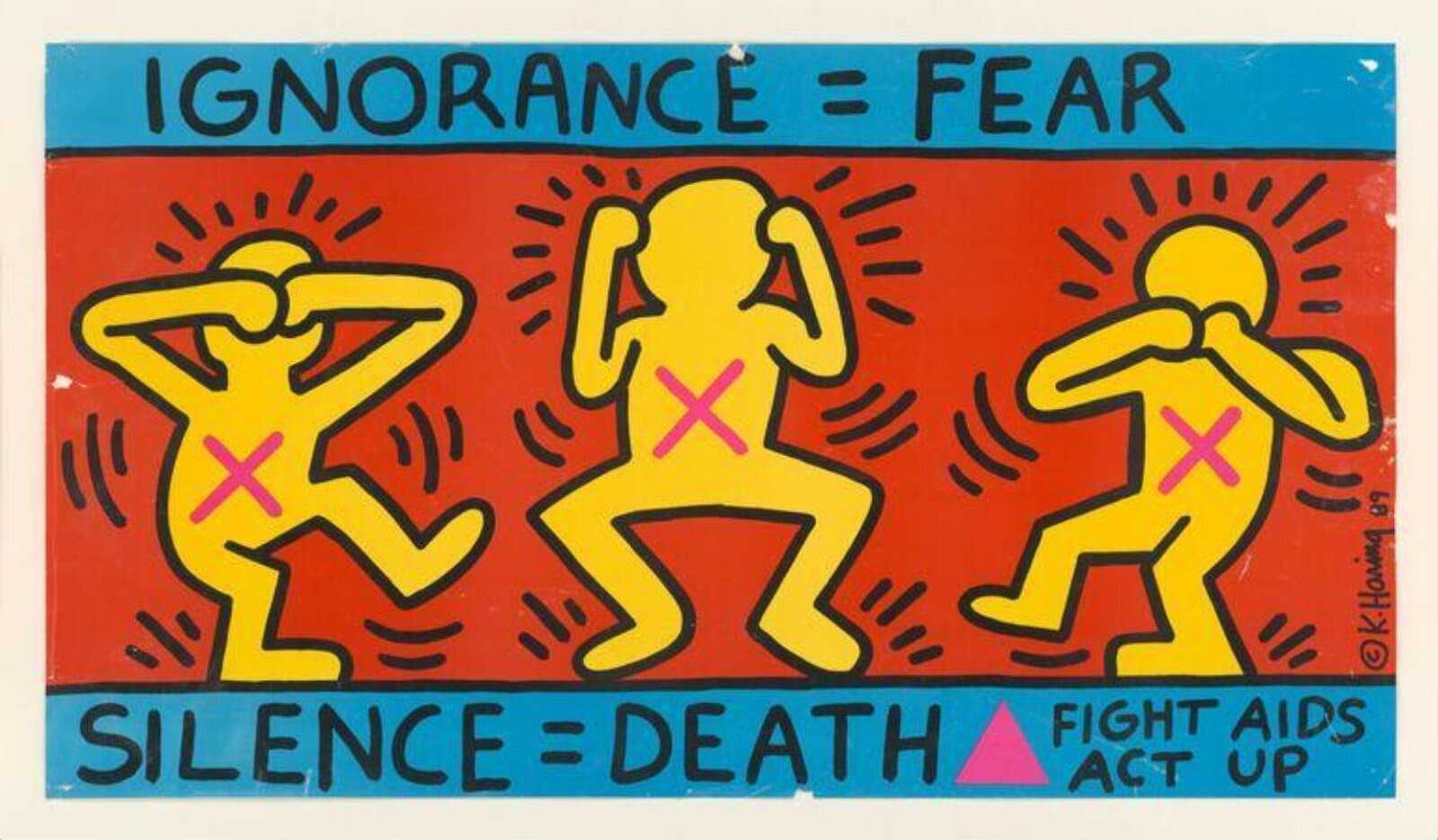
It is the same group Keith Haring used in Ignorance = Fear, the poster he made for ACT UP in the same year. Three yellow figures there cover their eyes, their ears and their mouth, with a cross on each body.
He had been diagnosed with AIDS the year before. He died of AIDS-related illness on 16 February 1990, at thirty-one.
The wall it was painted on came down
The Museu d'Art Contemporani de Barcelona records the original site: a wall in the Plaça Salvador Seguí in the Raval, between the Carrer Robadors and the Carrer Sant Pau. The mural deteriorated from weather and from graffiti painted over it.
The building was then scheduled for demolition under the Special Plan for Interior Reform in the Raval. Barcelona City Hall reached an agreement with Keith Haring's heirs and with the museum, and a restoration team hired by the Ajuntament de Barcelona began transferring the mural in September 1992, lifting the painted surface onto a new support.
That transferred original belongs to the museum's collection as R.1465, on long-term loan from the Barcelona City Council.
The photograph is of a repainting, not the original
The museum has reproduced the mural on one of its own exterior walls three times, in 1996, in 1998 and again in 2014 for the twenty-fifth anniversary. The photograph published here was taken in October 2024 and shows that outdoor reproduction beside the museum, not the wall Keith Haring painted in 1989.
The paint in it has faded to a dull pinkish red against grey concrete, and a vertical construction joint crosses the band about two-thirds of the way along.
The distinction matters for what a reader is looking at. The drawing is the one he made; the surface is not.
Close reading
Reading the work, detail by detail
The reproduction is cropped to the painted band, which is the honest shape of a mural thirty-four metres long and a little over two metres high. It is a photograph of the repainting on the museum's own outdoor wall, taken in October 2024, so the line is Keith Haring's and the surface is not. Everything is drawn in one red line on bare concrete.
1.The serpent's jaw is a row of points
The serpent's head is at the left, jaw open and edged with a row of sawtooth points. Two round eyes are stacked one above the other behind the jaw. The body runs out of it to the right and never leaves the band.
2.Its coils spell the word
The serpent's body loops back on itself and the loops are shaped into four large outlined capitals: SIDA. The letters are made of the same line as the animal, not drawn separately over it.
3.A syringe is drawn inside a loop
A syringe is drawn inside one of the coils, with a barrel, graduation marks, a plunger and a finger flange at the top. The needle points down to the left and short strokes burst from its tip. It is the only drug paraphernalia in the band.
4.Three crosses above a body lying flat
Three separate X marks stand in a row. Directly below them a figure lies flat on its back with its arms and legs straight out and a rounded head at the left end. It is the only figure in the band that is not upright or struggling.
5.A pair of scissors closes on the serpent
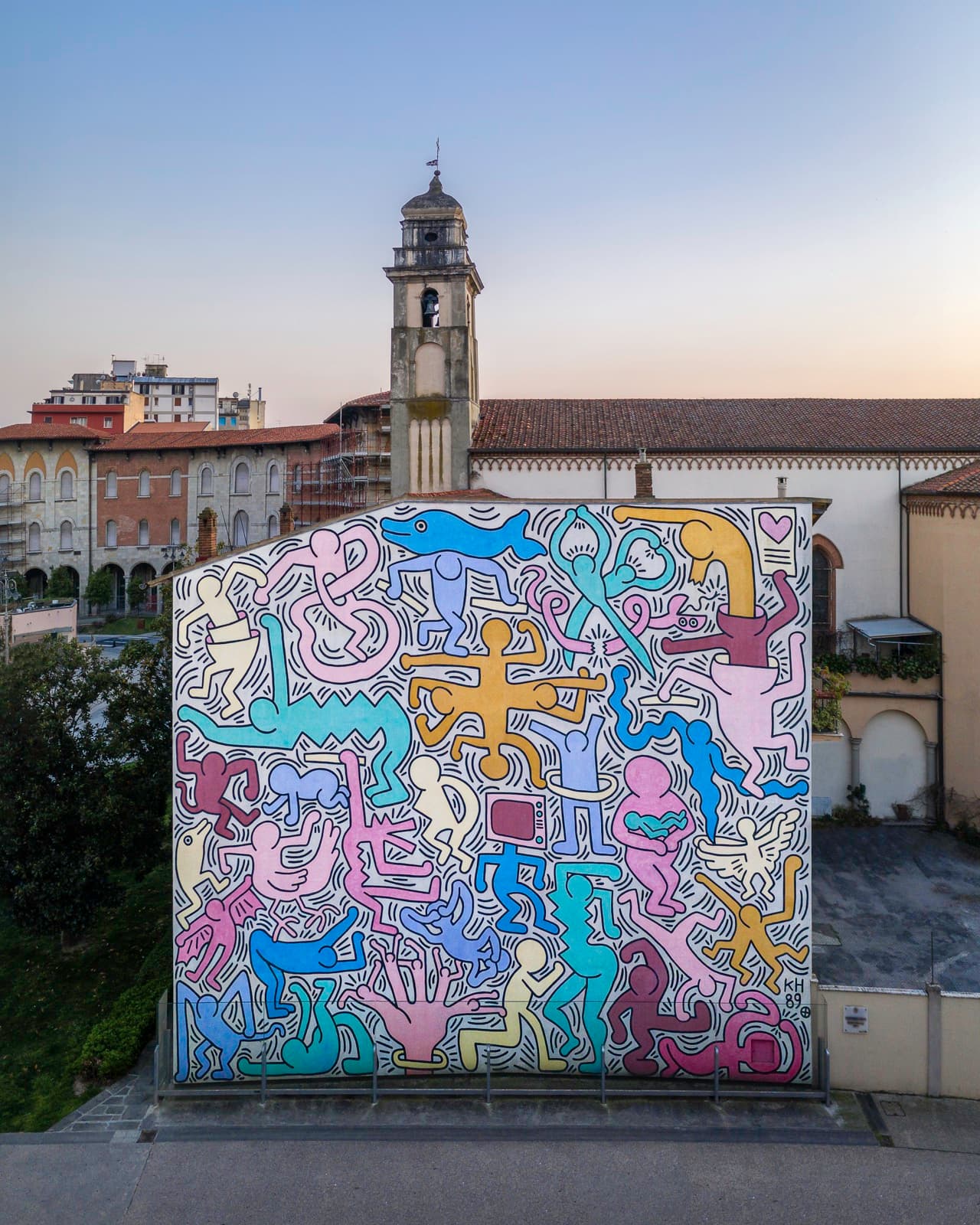
A large pair of scissors is drawn at the centre, two round finger loops above two long crossed blades. The blades close across the serpent's body. The same device appears in Tuttomondo, the mural Keith Haring painted in Pisa in the same year.
6.The cut end is drawn jagged
Below the blades the serpent's body ends in a jagged zig-zag, with short lines flying outwards from the break. The cut is drawn as an event rather than a clean edge.
7.Two figures stand together at a barrier
Two figures with round heads stand shoulder to shoulder behind a horizontal stack of bars. A smaller figure stands below them with its arms out to the sides. They are the only pair in the band drawn upright and still.
8.Three figures cover their eyes, ears and mouth
Three figures stand in a row at the right. The first crosses its forearms over its eyes, the second clamps both hands to its ears, the third covers its mouth. Each carries a large X across the torso. The same group is the whole subject of Ignorance = Fear.
9.A construction joint crosses the drawing
A vertical construction joint runs straight down through the band, and the red line carries on across it. The joint belongs to the museum's own wall. It is one of the plainest signs that the surface is a repainting and not the wall of 1989.
10.The red has weathered to a dull rose
Across most of the band the red has weathered to a dull pinkish rose against grey concrete. Staining and a dark tide line run along the bottom of the wall. The reproduction dates from 2014 and the photograph from October 2024.
Timeline
1988
Diagnosed with AIDS.
1989
Paints Todos juntos podemos parar el sida on a wall in the Plaça Salvador Seguí in the Raval, Barcelona.
1989
Makes Ignorance = Fear for ACT UP, using the same three covering figures.
1990
Dies of AIDS-related illness on 16 February, aged 31.
1992
A restoration team hired by the Ajuntament de Barcelona begins transferring the mural to a new support in September, ahead of the building's demolition.
1996
First reproduced on an exterior wall at the Museu d'Art Contemporani de Barcelona.
1998
Reproduced on the museum wall a second time.
2014
Reproduced again to mark the twenty-fifth anniversary of the mural.
Where to see it
Museu d'Art Contemporani de Barcelona
Barcelona, Spain
A public viewing address has not yet been confirmed for this holding.
The original was painted on a street wall, not made as a museum object, and was transferred to a new support in 1992. What stands in the open beside the museum is a reproduction, repainted in 1996, 1998 and 2014.
Frequently asked questions
Where is Keith Haring's Barcelona AIDS mural?
The transferred original belongs to the Museu d'Art Contemporani de Barcelona as R.1465, on long-term loan from the Barcelona City Council. A reproduction is painted on an exterior wall beside the museum, which is what visitors to the Plaça dels Àngels see. Keith Haring's own wall stood in the Plaça Salvador Seguí in the Raval and was demolished.
What does Todos juntos podemos parar el sida mean?
All together we can stop AIDS, in Spanish. Sida is the Spanish and Catalan word for AIDS, and the letters of it are formed by the coils of the serpent that runs through the mural.
How big is the mural?
The Museu d'Art Contemporani de Barcelona gives it as 235 by 3400 centimetres — about two and a third metres high and thirty-four metres long. The medium is recorded as plastic paint on wall.
What happened to the original wall?
It deteriorated from weather and graffiti, and the building was scheduled for demolition under the Special Plan for Interior Reform in the Raval. Barcelona City Hall agreed with Keith Haring's heirs and the museum that the mural should be saved, and a restoration team began transferring the painted surface to a new support in September 1992.
Why is there a snake in the mural?
The serpent is the mural's spine. Its jaw is drawn as a row of sawtooth points, its coils form the letters of SIDA, and at the centre a pair of scissors cuts its body, leaving a jagged severed end. Figures struggle with it along the length of the band, several of them marked with an X.
Did Keith Haring use the same figures anywhere else?
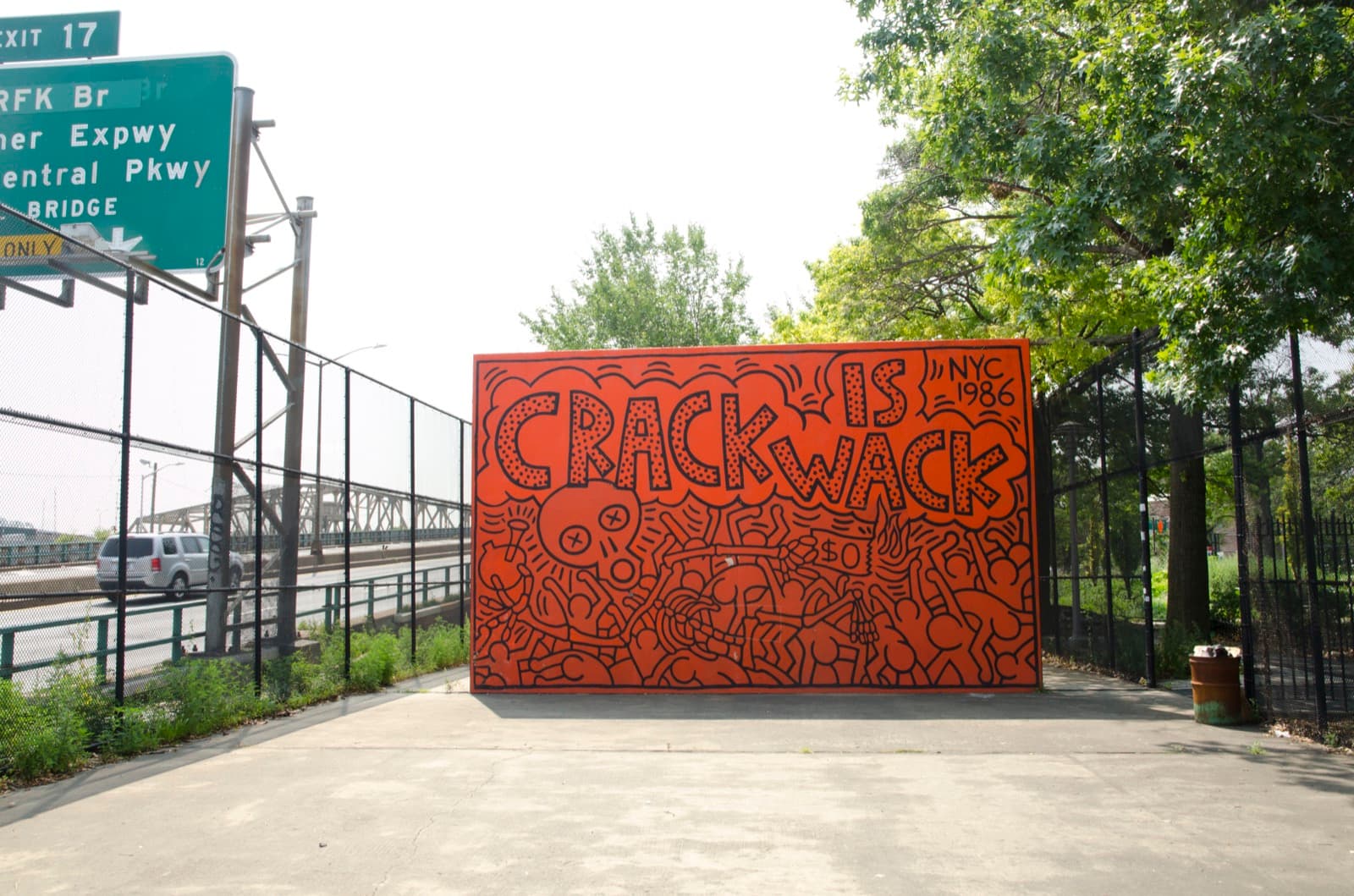
Yes. Three figures at the right of the mural cover their eyes, their ears and their mouth, with a cross on each torso. They are the group he used in Ignorance = Fear, the poster he made for ACT UP in the same year.
More by Keith Haring
If you like Keith Haring
Explore painters from the same movements and circles.
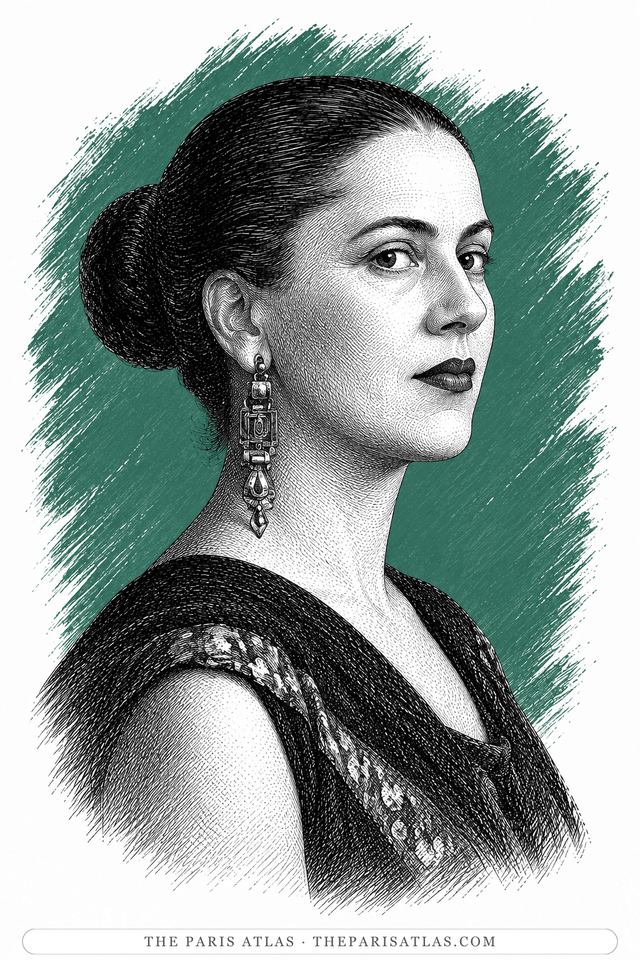
Tarsila do Amaral
Brazilian painter who spent the 1920s moving between São Paulo and Paris, studied Cubism under André Lhote, Albert Gleizes and Fernand Léger, and used what she learned to paint Brazilian towns, railways, plants and bodies. Her 1928 painting Abaporu prompted the manifesto that gave the Anthropophagic movement its name.
View artist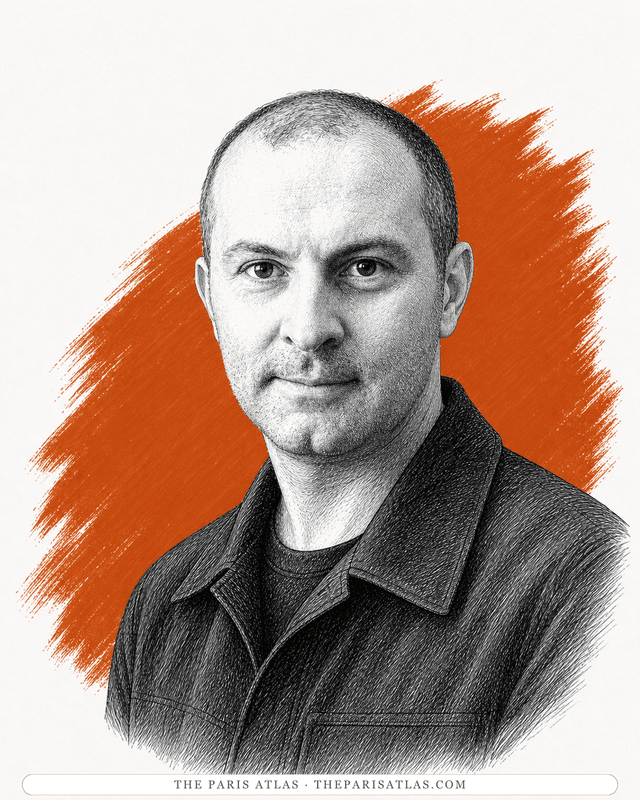
Arman
French-American artist, lifelong friend of Yves Klein, and a founder of New Realism.
View artist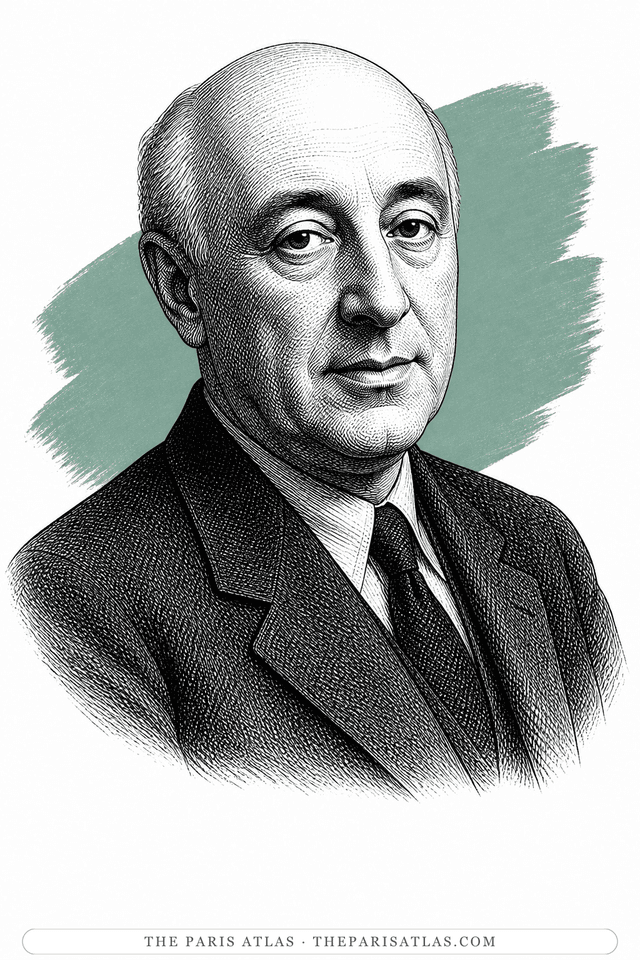
Jean Arp
Strasbourg-born sculptor and poet — Hans in German, Jean in French, both all his life — who co-founded Dada at the Cabaret Voltaire in 1916, composed collages by dropping torn paper 'according to the laws of chance', and settled at Meudon outside Paris in a house his wife Sophie Taeuber-Arp designed.
View artist
References
The sources below include collection records, catalogues, scholarly research, and primary materials that informed this page. They document Todos juntos podemos parar el sida, its making, and its place in cultural history.


1Todos juntos podemos parar el sida, registration number R.1465
Official recordMuseu d'Art Contemporani de BarcelonaUsed forThe museum's record: the medium, the 235 by 3400 centimetre dimensions, the credit line, the Plaça Salvador Seguí site, the 1992 transfer and the reproductions of 1996, 1998 and 2014.
2Poster, 'Ignorance = Fear, Silence = Death', museum number E.82-1996
Official recordVictoria and Albert Museum, LondonUsed forThe ACT UP poster of the same year, which uses the same three covering figures.

3Keith Haring — official biography
WebsiteThe Keith Haring FoundationUsed forThe AIDS diagnosis, the foundation and his death.
4Scissors with figures as handles cutting through a serpent, 'Stop AIDS', poster for the It's Time To Say We Care gala, Vienna, reference 675151i
Official recordWellcome Collection, London, 1989Used forThe same scissors-and-serpent device on a Keith Haring poster of 1989, for an AIDS-benefit gala in Vienna.
These references provide the documented foundation for this work's history and interpretation. Claim-level citations remain attached to the specific claims they support.
 Explore more resources