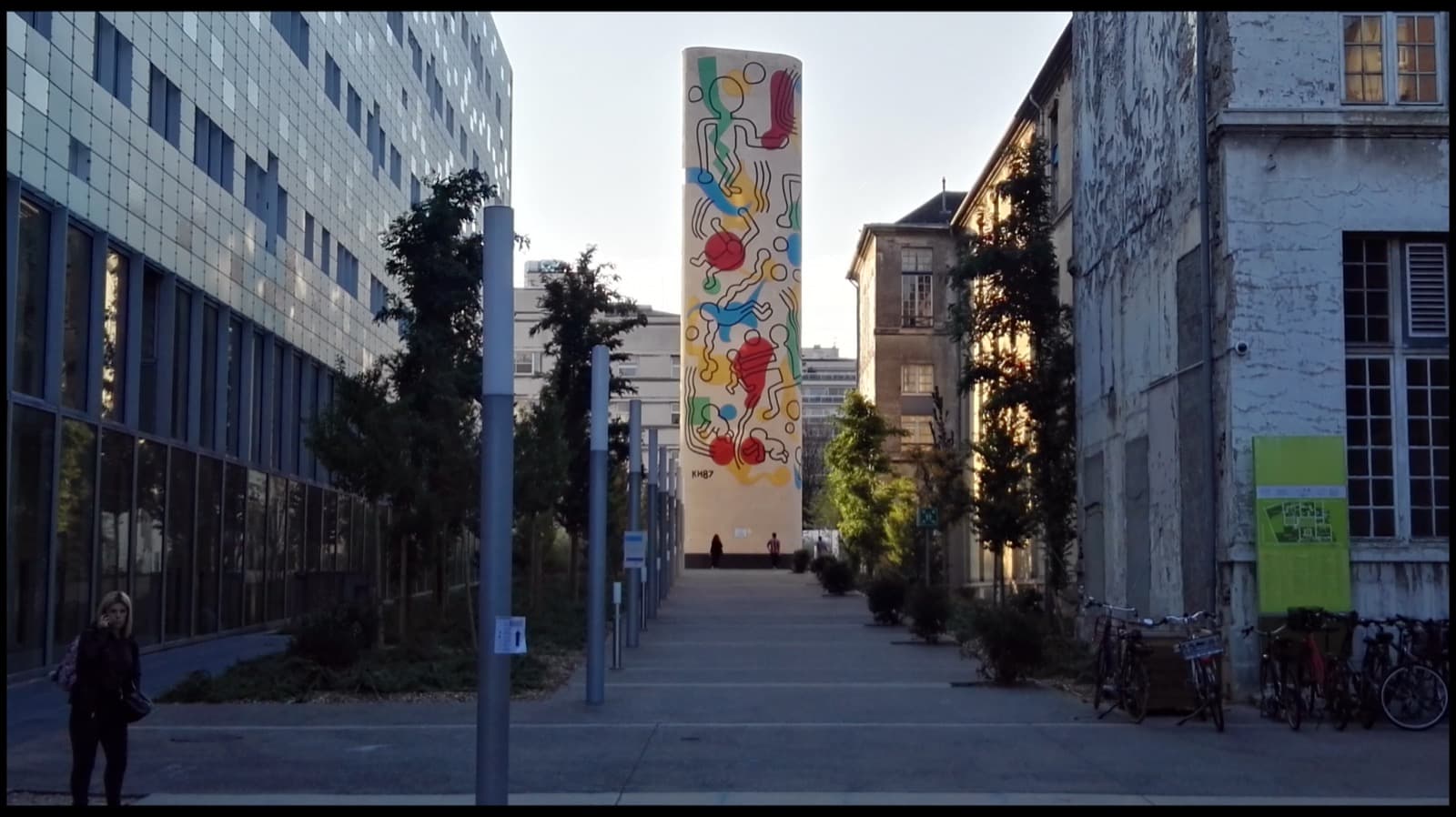
Untitled (Necker Hospital Mural)
by Keith Haring
A concrete stair tower at a children's hospital in the 15th arrondissement of Paris, painted from top to bottom with black-outlined figures over flat patches of red, yellow, blue and green. Keith Haring painted it in 1987 and signed it KH87 near the foot. It is not a museum object: it is the outside of a working building at the Hopital Necker-Enfants Malades, and it is the only permanent work he left in Paris.
- 1987
- Paint on the concrete face of an exterior stair tower
About Keith Haring
What the mural shows
The painted surface is a tall narrow shaft of concrete with rounded corners, standing free at the end of a paved way between hospital buildings. The ground colour is pale cream. Everything drawn on it is in heavy black outline, and the colour sits behind the outlines in flat patches that do not line up with them.
The figures run down the shaft rather than across it. A large striding figure with a plain round head holds the top, one arm bent down and the other reaching to the right. Below it the bodies tumble. One falls head-first past a red disc, a second lies horizontally across a blue ground, a third bends over a heavy red form, and near the foot a figure crouches on all fours beside two red circles.
Short curved strokes are set beside several of the bodies, three or four at a time, in the way Keith Haring marked movement everywhere else in his work. Nobody has a face. The heads are circles and ovals left empty.
The initials KH87 are painted in black block characters at the lower left of the painted area. Below them the concrete is left bare to the ground.
The words in brackets are a description
Keith Haring did not title the mural. The Keith Haring Foundation's biography records only that he created a mural on the exterior of Necker Children's Hospital in Paris in 1987, and gives it no name.
John Gruen's authorized biography of 1991 calls it the Tower mural, and in French the hospital and the neighbourhood call it la tour Keith Haring, the Keith Haring tower. Both are descriptions of the thing painted rather than titles given by the artist.
The words in brackets are the atlas's description of where the mural is. They are not Keith Haring's title, and no catalogue records one.
It is a staircase, not a wall
The surface is an external stair tower. John Gruen records the height as 88 feet, about 27 metres, which is why the drawing reads as a vertical column of falling and climbing bodies rather than a horizontal band.
Keith Haring painted it with Juan Rivera, his partner at the time, while he was in Paris for the Centre Pompidou's tenth-anniversary exhibition. The museum had opened in 1977, and his work hung that year in the group show L'Epoque, la Mode, la Morale, la Passion.
The photograph published here was taken on 15 October 2018, thirty-one years after the painting. The tower was still painted and still legible from the far end of the way.
Everything else he did in Paris came down
Keith Haring's Paris was short visits. The Keith Haring Foundation's exhibition lists record the Biennale de Paris at the Grand Palais and a group show at the Galerie Beau Lezard, both in 1985. A one-man exhibition at the Galerie Daniel Templon followed in 1986, the Centre Pompidou group show in 1987, and a show at the Galerie La Poche in 1990.
Every one of those had a closing date. The mural was painted onto the building, and the building is a hospital for children.
He was diagnosed with AIDS the year after he painted it. He died of AIDS-related illness on 16 February 1990, at thirty-one.
Close reading
Reading the work, detail by detail
The mural is painted on a narrow concrete stair tower that stands free at the end of a paved way between hospital buildings, so the only reproduction available takes in the whole site and the tower is a thin strip down the middle of it. The close views work down the shaft from the top, and the enlargements are heavy because the painted surface is a small part of the photograph.
1.One figure holds the whole top of the tower
A single figure occupies the top quarter of the shaft. Its head is an empty circle, its left arm drops and bends, and its right arm bends up and reaches across. A green band runs vertically behind it and a yellow circle sits beside the head.
2.A crimson form fills the upper right
A heavy curved crimson shape sits at the top figure's right hand. Four long black lines sweep across it and past its edge onto the cream ground. The colour runs well outside the black outline it belongs to.
3.A body falls head-first past a red disc
A figure is tipped head downwards with both arms raised. Its head overlaps a solid red disc that is larger than the head itself. Three short curved strokes sit to the left of the body, and a green patch is under the feet.
4.One figure lies across the shaft on blue
A figure lies horizontally, head to the right and legs to the left, across a flat blue patch. It is the only body on the tower drawn side-on to the ground. A yellow zig-zag figure descends diagonally just above it.
5.Two figures work around a heavy red form
A large solid red shape sits low on the shaft. One figure is bent over it with the outline crossing the red, and a second stands upright to its right. Neither outline follows the edge of the colour.
6.Two red circles sit side by side at the foot
Two solid red circles of about the same size sit side by side near the bottom of the painting. A green patch and a small blue circle are to their left. Black outlines cross both circles without stopping at them.
7.A figure on all fours beside them
A figure crouches on all fours at the lower right, back arched and rounded head lowered towards the red circles. It is the lowest complete figure on the tower.
8.He signed it KH87
The characters KH87 are painted in black at the lower left, below the last of the figures. Nothing else on the tower is lettering. Below them the concrete is left unpainted down to the ground.
9.Two people stand at the unpainted base
The painting stops well above the ground and the base is bare concrete with a small white sign fixed to it. Two people stand at the foot, one in dark clothes and one in a striped top. They give the height of the shaft above them.
10.It stands at the end of a hospital way
The tower closes the end of a long paved way. A glass-fronted block and a line of young trees run down the left, older stone hospital buildings and parked bicycles down the right. The mural is the only colour in the view.
Timeline
1985
Shows at the Biennale de Paris in the Grand Palais and in a group exhibition at the Galerie Beau Lezard.
1986
One-man exhibition at the Galerie Daniel Templon, Paris.
1987
In Paris for the Centre Pompidou's tenth-anniversary group exhibition, L'Epoque, la Mode, la Morale, la Passion.
1987
Paints the stair tower at the Hopital Necker-Enfants Malades with Juan Rivera, and signs it KH87.
1988
Diagnosed with AIDS.
1990
Dies of AIDS-related illness on 16 February, aged 31.
2018
Photographed on 15 October still painted and legible on the hospital site.
Where to see it
A viewing location has not yet been listed for this work.
Frequently asked questions
Where is the Keith Haring mural in Paris?
On an exterior stair tower at the Hopital Necker-Enfants Malades, the children's hospital at 149 rue de Sevres in the 15th arrondissement. Keith Haring painted it in 1987. It is on the outside of a working hospital rather than in a museum, so what a visitor can see depends on the hospital's own access arrangements.
What is the Keith Haring mural at Necker called?
It has no title. The Keith Haring Foundation records only that he painted a mural on the exterior of Necker Children's Hospital in 1987. John Gruen's authorized biography calls it the Tower mural, and in French it is known as la tour Keith Haring, but both are descriptions rather than names he gave it.
How big is the Necker hospital mural?
John Gruen's authorized biography gives the stair tower as 88 feet high, about 27 metres. The painted shaft is narrow in proportion to that height, which is why the figures are stacked in a vertical column rather than spread along a wall.
Who painted the Necker hospital mural with Keith Haring?
Juan Rivera, his partner at the time. John Gruen's authorized biography records the two of them painting it during Keith Haring's stay in Paris for the Centre Pompidou's tenth-anniversary exhibition in 1987.
Is the Necker mural still there?
It was photographed on the hospital site on 15 October 2018, painted and legible, and that photograph is the one published here. It is the only permanent work Keith Haring left in Paris; his gallery shows and his Centre Pompidou appearance all closed.
Why did Keith Haring paint a children's hospital?
He had been putting his figures in public places since the subway drawings of 1980, on the principle that the work should reach whoever was already there. The Keith Haring Foundation, which he established in 1989, funds children's charities alongside AIDS organizations.
More by Keith Haring

If you like Keith Haring
Explore painters from the same movements and circles.
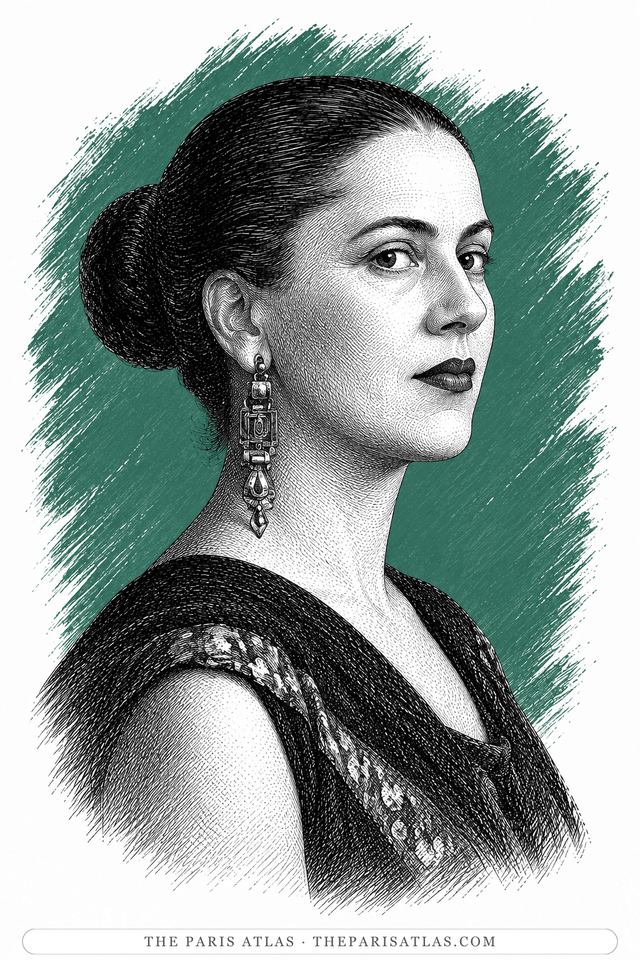
Tarsila do Amaral
Brazilian painter who spent the 1920s moving between São Paulo and Paris, studied Cubism under André Lhote, Albert Gleizes and Fernand Léger, and used what she learned to paint Brazilian towns, railways, plants and bodies. Her 1928 painting Abaporu prompted the manifesto that gave the Anthropophagic movement its name.
View artist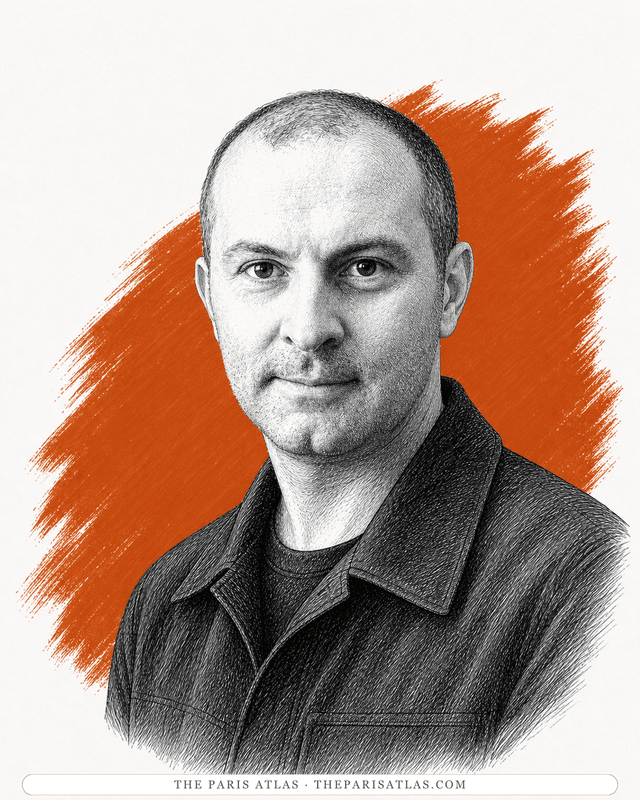
Arman
French-American artist, lifelong friend of Yves Klein, and a founder of New Realism.
View artist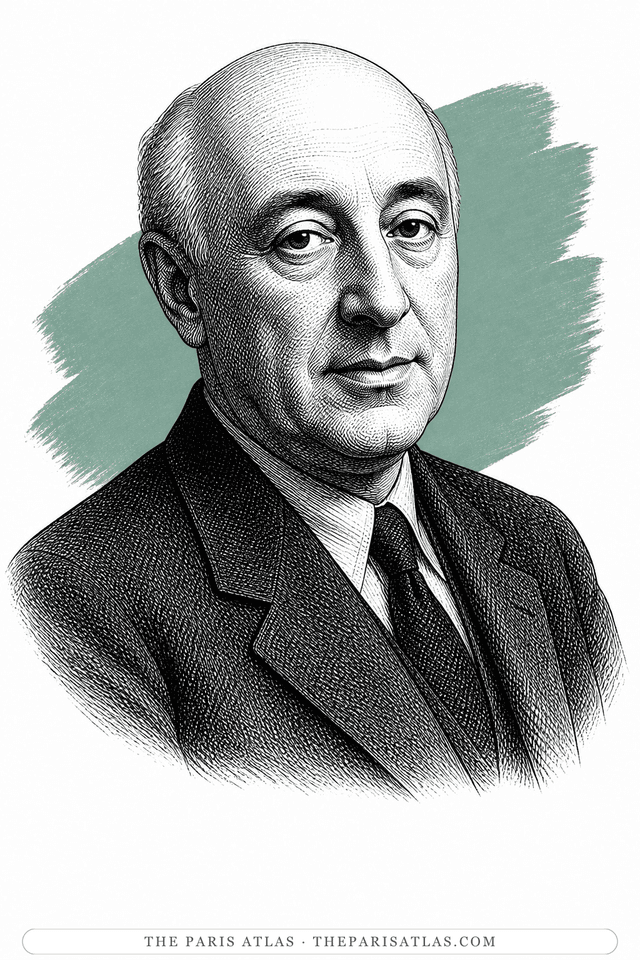
Jean Arp
Strasbourg-born sculptor and poet — Hans in German, Jean in French, both all his life — who co-founded Dada at the Cabaret Voltaire in 1916, composed collages by dropping torn paper 'according to the laws of chance', and settled at Meudon outside Paris in a house his wife Sophie Taeuber-Arp designed.
View artist
References
The sources below include collection records, catalogues, scholarly research, and primary materials that informed this page. They document Untitled (Necker Hospital Mural), its making, and its place in cultural history.


1Keith Haring — official biography
WebsiteThe Keith Haring FoundationUsed forRecords the 1987 mural on the exterior of Necker Children's Hospital, the AIDS diagnosis, the foundation and his death.
2Keith Haring: The Authorized Biography
BiographyPrentice Hall Press, New York, 1991Used forThe Tower mural, the 88-foot exterior stairwell, Juan Rivera, and the Centre Pompidou anniversary visit.
3Keith Haring — group exhibitions, year by year
WebsiteThe Keith Haring FoundationUsed forThe estate's year-by-year list of group shows, including the Centre Pompidou in 1987.
4Keith Haring — one-person exhibitions, year by year
WebsiteThe Keith Haring FoundationUsed forThe estate's list of solo shows, including Galerie Daniel Templon in 1986 and Galerie La Poche in 1990.
These references provide the documented foundation for this work's history and interpretation. Claim-level citations remain attached to the specific claims they support.
 Explore more resources