Crack Is Wack
by Keith Haring
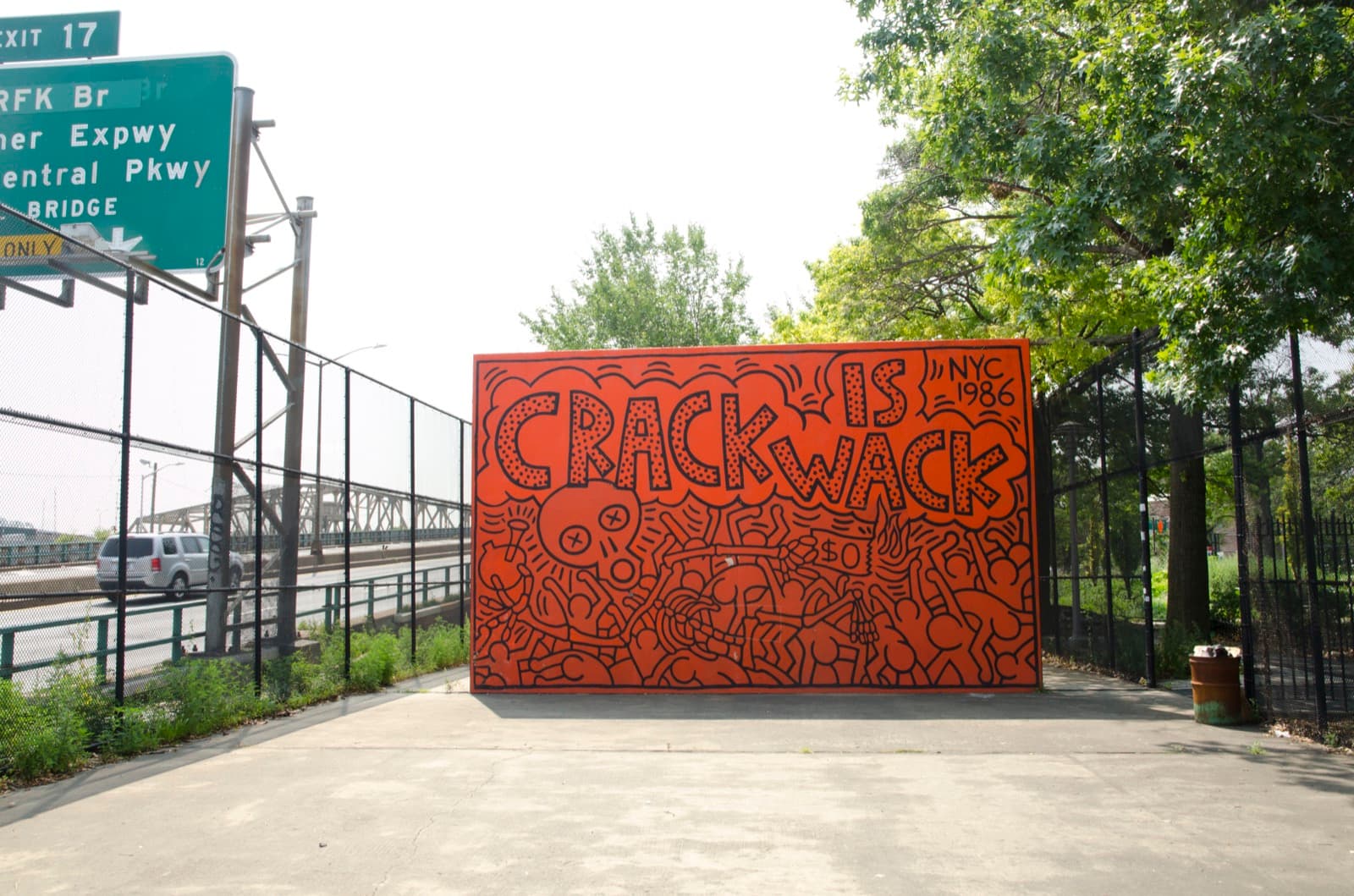
An orange wall carrying the words CRACK IS WACK in fat black capitals filled with dots, above a mass of black-outlined figures, a skull with crossed eyes, a burning dollar bill and flames. Keith Haring painted it in 1986 on a handball court beside the Harlem River Drive. The New York City Department of Parks and Recreation maintains it as a public artwork, and the playground around it is named after it.
- 1986
- Paint on both faces of a concrete handball court wall
- New York City Department of Parks and RecreationNew York, United States
About Keith Haring

What the mural shows
The whole wall is orange and every mark on it is black. CRACK IS WACK is lettered across the top in fat capitals, each letter drawn in outline and filled with a field of black dots, and each word sitting inside a cloud-shaped bubble with short strokes radiating off it. NYC and 1986 are written at the top right in plain block characters.
Below the lettering the wall is packed edge to edge with bodies. A large skull sits under the first word, its two eyes drawn as circles with an X through each, short strokes radiating from it. At the lower left a figure holds a rounded vessel on a stem. Figures kneel, reach and fall against one another with no ground under them.
At the centre right a dollar bill is drawn flat, torn along one edge, with $0 written on it. Three tongues of flame rise from the torn edge. Around them more figures throw their arms up, and one has a hand whose fingers hang down in loose strands.
The Department of Parks and Recreation records that the design is painted on both faces of the handball court wall. The photograph published here shows one face.
Why he painted it
Crack cocaine use in New York reached its height in the middle and late 1980s. The Department of Parks and Recreation states plainly what the mural is for. Keith Haring painted it to call attention to the damage drugs can inflict on community welfare. The department's own sign calls the message a serious anti-drug one, delivered in his signature style of thick black outlines and bright colours.
He had been drawing in public since 1980, when he began making chalk drawings on the blank advertising panels of the New York subway. The line was built to be read at once by somebody who was not stopping. Crack Is Wack uses it on public health.
The department dates his painting of the playground mural to 3 October 1986. The Keith Haring Foundation's biography gives the year only, and calls the wall a landmark along the Harlem River Drive.
The city took the wall into the parks system
The handball court stands on one of six parcels of land that together form Harlem River Park, along the strip of the Harlem River Drive running from East 125th Street to East 155th Street. The parcel was transferred to the Department of Parks and Recreation in 1956, and the handball court, the basketball courts and the trees were added afterwards.
The playground took its name from the mural rather than the other way round. The department's historical sign says so directly: Crack Is Wack Playground earned its distinctive name after Keith Haring painted the mural on the handball court walls.
The department and the Keith Haring Foundation have kept repainting it. The New York Times reported on 2 October 1986, in its New York Day by Day column, that the anti-crack mural would rise again. The design was renewed several times after that, most recently in 2012, before a full restoration was announced on 24 October 2019.
How the 2019 restoration was done
Louise Hunnicutt and William Tibbals carried out the work, sponsored by the Keith Haring Foundation. It followed a three-year reconstruction of the stretch of the Harlem River Drive beside the wall.
Much of the paint on the concrete was exfoliating. The two conservators made precise tracings of the designs in sections on both wall faces, then mechanically removed all the loose paint, patched and sealed the wall, and applied several base coats of fixative followed by colour-matched paint.
The design was then recreated from the tracings, checked against original photographic documentation. Jonathan Kuhn, the department's Director of Art and Antiquities, described the mural as a testament to the enduring power of art that arose first in public spaces.
Two addresses and one wrong age
The department gives the location two different ways. Its historical sign places Crack Is Wack Playground on Second Avenue, 127th Street and the Harlem River Drive. Its 2019 press release places the mural at East 128th Street and the Harlem River Drive.
The same historical sign states that Keith Haring died of AIDS on 16 February 1990 at the age of 32. He was 31. He was born on 4 May 1958, so he was fifteen weeks short of his thirty-second birthday when he died.
Close reading
Reading the work, detail by detail
The wall is photographed square on from the court in front of it, in flat daylight, with the Harlem River Drive and its signage at the left edge. Every mark on the mural is black on orange, so the close views are about drawing rather than colour.
1.Every letter is filled with dots
The letters are drawn in fat outline and then filled with an even field of black dots rather than solid black. A cloud-shaped bubble is drawn around the word, and short strokes radiate off its upper edge.
2.He dated it on the wall
NYC sits above 1986 at the top right, in plain block characters with no dots in them. Three short curved strokes are set to the left of each line. It is the only part of the lettering drawn solid.
3.A skull with an X through each eye
A large skull sits directly under the first word. Each eye is a circle with an X drawn through it, and three short strokes mark the cheek below. Short lines radiate outwards all around the head.
4.A figure holds a rounded vessel on a stem
At the lower left a figure holds a rounded vessel mounted on a straight stem. Its other hand is drawn with the fingers splayed apart. Short strokes burst from the top of the vessel.
5.A banknote marked $0
A banknote is drawn flat, as a plain rectangle with $0 lettered inside. Its right-hand edge is not straight but torn into a serrated line. Wavy strokes run above it.
6.Three tongues of flame take the torn edge
Three tall tongues of flame rise directly from the note's serrated edge. Curved strokes fan out to their right. The fire and the tear are drawn as one continuous event.
7.The bodies run out of room
The bottom of the wall is packed edge to edge with figures. Arms go up, bodies overlap, and one hand is drawn with the fingers hanging down in loose strands. No ground line is drawn under any of them.
8.The highway runs past the court
A green overhead sign for Exit 17 and the RFK Bridge stands beside the wall, with a chain-link fence, the lanes of the Harlem River Drive and a steel bridge behind it. The mural faces traffic as much as it faces the court.
Timeline
1956
The parcel carrying the handball court is transferred to the Department of Parks and Recreation from the Board of Estimate.
1980
Keith Haring begins the subway drawings, in chalk on blank advertising panels, and works on them until 1985.
1986
Paints Crack Is Wack on the handball court wall beside the Harlem River Drive. The Department of Parks and Recreation dates the playground's mural to 3 October.
1988
Diagnosed with AIDS.
1990
Dies of AIDS-related illness on 16 February, aged 31.
2012
The design is repainted, the most recent renewal before the full restoration.
2019
Restored by Louise Hunnicutt and William Tibbals, sponsored by the Keith Haring Foundation, announced on 24 October.
Where to see it
New York City Department of Parks and Recreation
New York, United States
A public viewing address has not yet been confirmed for this holding.
A mural on a handball court wall in a public park, not a museum object. It is outdoors and can be seen from the playground.
Frequently asked questions
Where is Crack Is Wack?
On a handball court wall in Crack Is Wack Playground, beside the Harlem River Drive in East Harlem, New York. The Department of Parks and Recreation's historical sign gives the location as Second Avenue, 127th Street and the Harlem River Drive; its 2019 press release gives East 128th Street. It is outdoors in a public park, not in a museum.
When did Keith Haring paint Crack Is Wack?
In 1986. The Department of Parks and Recreation dates his painting of the playground's mural to 3 October 1986, and the Keith Haring Foundation's biography gives the year without a day.
What does Crack Is Wack show?
The words CRACK IS WACK in fat dotted capitals inside cloud-shaped bubbles, with NYC and 1986 at the top right. Below them an orange field is packed with black-outlined figures, a skull with an X through each eye, a figure holding a rounded vessel on a stem, and a torn dollar bill marked $0 with flames rising from it.
Who owns Crack Is Wack?
The New York City Department of Parks and Recreation maintains it as a public artwork on city parkland. The Keith Haring Foundation sponsors the restorations and holds the copyright in the design.
Has Crack Is Wack been restored?
Yes, repeatedly. The design was repainted several times, most recently in 2012, and then fully restored in 2019 by Louise Hunnicutt and William Tibbals with sponsorship from the Keith Haring Foundation. They traced the designs on both wall faces in sections, stripped the loose paint, resealed the concrete and recreated the design from the tracings and original photographs.
Is Crack Is Wack painted on both sides of the wall?
Yes. The Department of Parks and Recreation's account of the 2019 restoration describes tracings being made of the designs on both wall faces. The photograph published here shows one of them.
More by Keith Haring

If you like Keith Haring
Explore painters from the same movements and circles.

Tarsila do Amaral
Brazilian painter who spent the 1920s moving between São Paulo and Paris, studied Cubism under André Lhote, Albert Gleizes and Fernand Léger, and used what she learned to paint Brazilian towns, railways, plants and bodies. Her 1928 painting Abaporu prompted the manifesto that gave the Anthropophagic movement its name.
View artist
Arman
French-American artist, lifelong friend of Yves Klein, and a founder of New Realism.
View artist
Jean Arp
Strasbourg-born sculptor and poet — Hans in German, Jean in French, both all his life — who co-founded Dada at the Cabaret Voltaire in 1916, composed collages by dropping torn paper 'according to the laws of chance', and settled at Meudon outside Paris in a house his wife Sophie Taeuber-Arp designed.
View artist
References
The sources below include collection records, catalogues, scholarly research, and primary materials that informed this page. They document Crack Is Wack, its making, and its place in cultural history.


1Crack Is Wack Playground — Historical Signs Project
Official recordNew York City Department of Parks and RecreationUsed forThe department's historical sign: the 3 October 1986 painting date, the park's naming, the parcel's 1956 transfer, and the anti-drug purpose.
2Iconic Crack Is Wack mural by Keith Haring is restored, press release no. 101
Official recordNew York City Department of Parks and Recreation, 2019Used forThe 2019 restoration, the conservators, the method, the 2012 repaint and the East 128th Street location.

3Keith Haring — official biography
WebsiteThe Keith Haring FoundationUsed forCalls the mural a landmark along the Harlem River Drive, and records the subway drawings, the diagnosis and his death.
4New York Day by Day: Anti-crack Mural Will Rise Again
PeriodicalThe New York Times, 1986Used forThe New York Day by Day column of 2 October 1986, reporting that the anti-crack mural would be painted again.
These references provide the documented foundation for this work's history and interpretation. Claim-level citations remain attached to the specific claims they support.
 Explore more resources