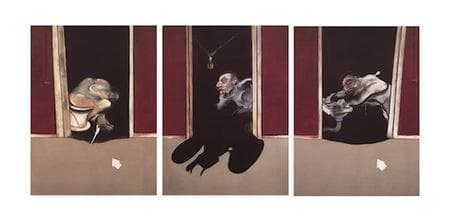
Triptych May–June 1973
Three panels, each nearly two metres high, each showing a dark doorway in a deep red wall with a figure in it. Francis Bacon painted them in 1973, eighteen months after George Dyer died in a Paris hotel two days before the opening of his retrospective at the Grand Palais. The Estate of Francis Bacon describes the work as one in which the circumstances of that death are re-enacted.
- 1973
- Oil on canvas
About Francis Bacon
What the painting shows
All three panels share one architecture. A wall of deep oxblood red fills the upper two thirds. A black rectangular opening stands in the middle of it, framed by pale grey-green jambs. Below the wall runs a flat floor of warm grey-brown, unmarked.
In the left panel a naked figure is hunched forward over a white lavatory bowl set inside the opening. The back is a pale pinkish-grey mass, the head down and turned away, one arm folded across the body. A thin white line runs from the figure down to the floor. A small white angular shape lies on the grey floor to the right.
The centre panel hangs a bare bulb on a cord from the top of the black opening, with a small pale disc beside it. Below it a head is thrown back and up to the left, the skull catching light, the face pale grey-white in profile with the mouth open. A grey-white cloud of smoky paint surrounds it. From the shoulders down the figure is a flat black silhouette that spills out of the doorway and spreads across the floor, an arm reaching down and to the left.
In the right panel a figure is bent double over a basin at the left of the opening. The back is a pale grey-cream arch, the head down, an arm reaching towards the basin, and a dark stem descends below it. A white angular shape lies on the floor at the right, matching the one in the left panel.
The paint is smoother and flatter here than in the 1940s and 1960s work. Large areas — the red wall, the black opening, the grey floor, the black body — are laid in without incident, and the modelling is concentrated in the small area of each figure.
What happened in Paris
In 1971 the Galeries nationales du Grand Palais gave Francis Bacon a retrospective of 108 works, running from 26 October 1971 to 10 January 1972 before moving to the Kunsthalle in Düsseldorf. The Estate of Francis Bacon calls the honour exceptional for a living painter.
Two days before the opening, George Dyer was found dead of an overdose of drink and drugs in the bathroom of their room at the Hôtel des Saints-Pères, at 65 rue des Saints-Pères in the 6th arrondissement. Francis Bacon and George Dyer had met in late 1963.
The Estate of Francis Bacon states the cause and does not describe the death as suicide. Tate does: Linda Nochlin, writing in Tate Etc. in 2008, calls it a suicide. Both the Estate and Tate misspell the hotel as Saint-Pères; its own name is the Hôtel des Saints-Pères.
Francis Bacon attended his opening. He was photographed at the Grand Palais with Jacques Duhamel, the French culture minister, on 29 October 1971.
The black triptychs
Three large triptychs came out of that week, and they are usually grouped together as the black triptychs. In Memory of George Dyer was painted in November 1971, in oil and dry transfer lettering on canvas. Triptych August 1972 followed, in oil and sand on canvas. Triptych May–June 1973 is the last.
All three are the same size: each panel 198 by 147.5 centimetres, or 78 by 58 inches. The Estate of Francis Bacon numbers them 71-09, 72-07 and 73-03.
The Estate calls this one the bleakest and perhaps the greatest of the three, and describes it as a work of monumental and grave simplicity in which the circumstances of George Dyer's death are re-enacted. The Estate's own biography, not the atlas, supplies that judgement.
Eighteen months separate the death from the painting. The Estate records that the canvases were photographed in September 1973.
What the title is, exactly
The Estate of Francis Bacon's catalogue raisonné enters the work as Triptych May-June, with a plain hyphen, and puts 1973 in a separate date field as number 73-03. The Estate's own biography runs the two together as Triptych May-June 1973.
Tate and general art-historical usage write it with an en dash: Triptych May–June 1973. That is the form used here, because Triptych May-June on its own names nothing — Francis Bacon titled a great many pictures Triptych.
The Estate's catalogue records the variants publishers have used, including Triptych, May-June 1973 and Triptych - May-June 1973. There is no single correct form.
Who owns it
The Estate of Francis Bacon gives the collection as a private collection and names no owner. Sarah Thornton, writing in The Art Newspaper in September 2008, identified the owner as Esther Grether, a businesswoman living in Basel. She reported that Esther Grether had bought the triptych at auction in 1989, for what was then a record 6.3 million dollars. The same article records that she owns four Francis Bacon triptychs.
Which auction house sold it is not established here. A contemporaneous trade report attributes the 1989 sale to Sotheby's; a primary record has not been checked, so no house is named.
The exhibition history is consistent with a Basel owner lending. The triptych went to the Fondation Beyeler in Riehen twice, in 2003 and 2004, and to Tate Britain in 2008.
Close reading
Reading the work, detail by detail
Three panels built from the same four elements: a deep red wall, a black doorway, pale door jambs and a flat grey-brown floor. What changes is the figure inside the opening. The close views take each panel's figure, then the details that repeat from panel to panel.
1.Left panel: hunched over a white bowl
In the left panel a naked figure is hunched forward over a white lavatory bowl set inside the black opening. The back is a pale pinkish-grey mass with the head down and turned away, one arm folded across the body. The white of the bowl is the brightest thing in the panel.
2.Centre panel: a bare bulb on a cord
A pale bulb hangs on a thin cord from the top of the centre panel's black opening, with a small pale disc beside it. The cord is a single fine line drawn across the black. It is the only light source described anywhere in the triptych.
3.Centre panel: the head thrown back
The centre head is thrown back and up to the viewer's left, the skull catching light and the face pale grey-white in profile with the mouth open. A grey-white cloud of smoky paint surrounds it, blurred where the rest of the panel is sharp. It is the most heavily worked passage in the triptych.
4.Centre panel: the body becomes a flat black shape
Below the shoulders the centre figure stops being modelled and becomes a flat black silhouette. It spills out of the doorway onto the grey floor, with one arm reaching down and to the left and a folded leg beneath. There is no shading in it at all — the black is a single uninterrupted area.
5.Right panel: bent double over a basin
In the right panel a figure is bent double over a basin at the left of the opening. The back is a pale grey-cream arch with the head down and an arm reaching towards the basin, and a dark stem descends below it. The flesh here is greyer and cooler than in the left panel.
6.A small white shape lies on the floor twice
A small white angular shape lies on the grey-brown floor in the outer panels, once at the lower right of the left panel and once at the lower right of the right panel. Each is painted as a folded flat form with two or three planes. They are the only marks on an otherwise empty floor.
7.Pale jambs frame every opening
Each black opening is framed by pale grey-green jambs, painted with a soft highlight down one side so that they read as mouldings rather than lines. They are the only architectural modelling in the triptych. Everything else is a flat area of a single colour.
8.The red wall is flat and even
The wall is a deep oxblood red laid in evenly, with almost no brushwork showing and no variation across its width. It meets the black opening at a hard edge and the grey floor at another. The flatness is what makes the small worked passages of flesh stand out.
9.A third of each panel is bare floor
The lower third of each panel is bare floor, a flat warm grey-brown carried across without shadow, join or texture. No figure stands on it. The emptiness is a decision rather than a background, and it pushes each figure up into the doorway above.
Timeline
1963
Francis Bacon meets George Dyer in London, late in the year.
1971
George Dyer is found dead of an overdose of drink and drugs at the Hôtel des Saints-Pères in Paris, two days before the Grand Palais retrospective opens.
1971
The retrospective opens at the Galeries nationales du Grand Palais on 26 October and runs to 10 January 1972. Francis Bacon attends, and is photographed there with Jacques Duhamel on 29 October.
1971
In Memory of George Dyer painted in November, the first of the black triptychs.
1972
Triptych August 1972 painted, the second. Tate acquires it as T03073.
1973
Triptych May–June 1973 painted, the last of the three. The canvases are photographed in September.
1975
Shown at the Metropolitan Museum of Art in New York, 20 March to 29 June.
1977
Shown at the Galerie Claude Bernard in Paris, 19 January to 26 March.
1989
Sold at auction for what The Art Newspaper reports as a then record 6.3 million dollars, and bought by Esther Grether of Basel.
2003–04
Shown at the Fondation Beyeler in Riehen, near Basel, twice — in Expressive! from 30 March to 10 August 2003, and in Francis Bacon and the Tradition of Art from 8 February to 20 June 2004.
2008–09
Lent to the Francis Bacon retrospective at Tate Britain, 11 September 2008 to 4 January 2009.
Where to see it
Private collection
No public viewing address is listed for this private collection.
Not publicly accessible. The Estate of Francis Bacon records the collection as private and names no owner; The Art Newspaper reported in 2008 that it belongs to Esther Grether in Basel.
Frequently asked questions
Where is Triptych May–June 1973?
In a private collection, and not publicly accessible. The Estate of Francis Bacon names no owner. The Art Newspaper reported in 2008 that it belongs to Esther Grether, a businesswoman in Basel, who bought it at auction in 1989.
What does Triptych May–June 1973 show?
The same dark doorway in a deep red wall in all three panels, each with a figure in it. The left panel shows a naked figure hunched over a lavatory bowl. The centre panel shows a head thrown back beneath a bare bulb, the body below it a flat black mass spreading across the floor. The right panel shows a figure bent double over a basin. The Estate of Francis Bacon describes the work as a re-enactment of the circumstances of George Dyer's death.
How did George Dyer die?
Of an overdose of drink and drugs, in the bathroom of the room he shared with Francis Bacon at the Hôtel des Saints-Pères in Paris, two days before the Grand Palais retrospective opened in October 1971. The Estate of Francis Bacon states the cause without calling it suicide; Linda Nochlin, writing for Tate in 2008, does call it a suicide.
What are the black triptychs?
Three large three-panel paintings Francis Bacon made after George Dyer's death: In Memory of George Dyer (November 1971), Triptych August 1972, and Triptych May–June 1973. Each panel of each is 198 by 147.5 centimetres, and the Estate of Francis Bacon numbers them 71-09, 72-07 and 73-03.
How big is Triptych May–June 1973?
Each of the three panels is 198 by 147.5 centimetres, or 78 by 58 inches — nearly two metres high. Hung together with the usual gaps, the work occupies well over four metres of wall.
Is the title written with a hyphen or a dash?
Sources differ. The Estate of Francis Bacon's catalogue raisonné enters the title as Triptych May-June with a hyphen, and holds 1973 in a separate date field. Tate and general art-historical usage write Triptych May–June 1973 with an en dash, which is the form used here.
Was Triptych May–June 1973 shown at the Grand Palais?
No. The Grand Palais retrospective ran from 26 October 1971 to 10 January 1972, and the triptych was painted in 1973. It is the exhibition's consequence rather than part of it. Francis Bacon did show it in Paris later, at the Galerie Claude Bernard in early 1977.
More by Francis Bacon
If you like Francis Bacon
Explore painters from the same movements and circles.
Tarsila do Amaral
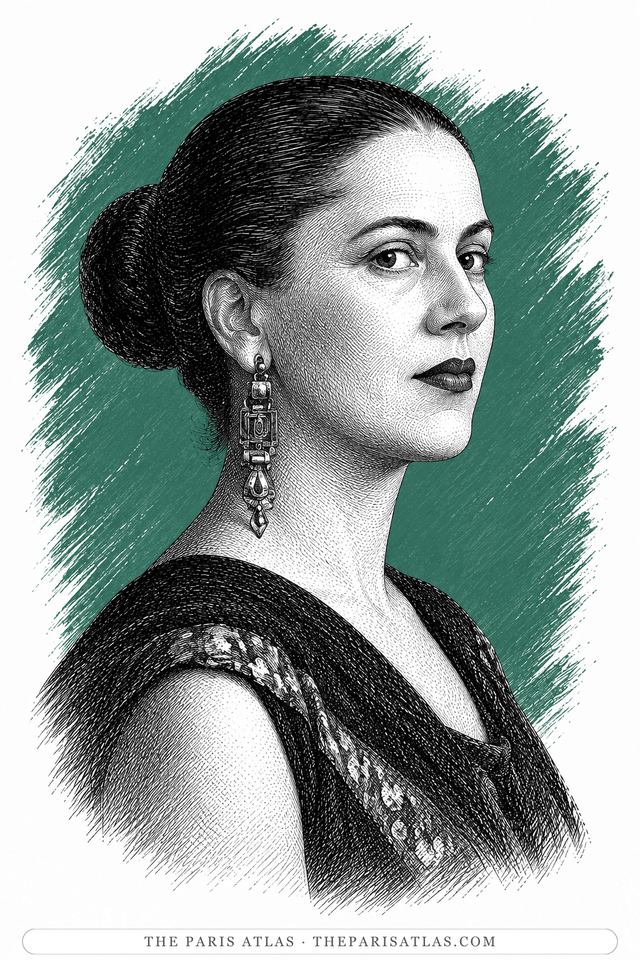
Brazilian painter who spent the 1920s moving between São Paulo and Paris, studied Cubism under André Lhote, Albert Gleizes and Fernand Léger, and used what she learned to paint Brazilian towns, railways, plants and bodies. Her 1928 painting Abaporu prompted the manifesto that gave the Anthropophagic movement its name.
View artist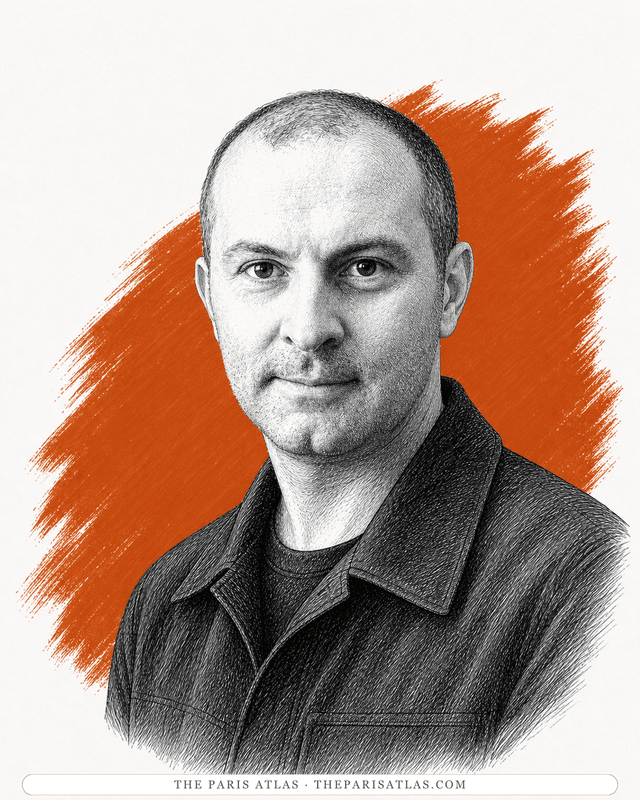
Arman
French-American artist, lifelong friend of Yves Klein, and a founder of New Realism.
View artist
Jean Arp
Strasbourg-born sculptor and poet — Hans in German, Jean in French, both all his life — who co-founded Dada at the Cabaret Voltaire in 1916, composed collages by dropping torn paper 'according to the laws of chance', and settled at Meudon outside Paris in a house his wife Sophie Taeuber-Arp designed.
View artist
References
The sources below include collection records, catalogues, scholarly research, and primary materials that informed this page. They document Triptych May–June 1973, its making, and its place in cultural history.


1Francis Bacon, Triptych May-June, 1973 — catalogue raisonné 73-03
WebsiteThe Estate of Francis BaconUsed forThe Estate of Francis Bacon's catalogue raisonné entry — title form, medium, panel dimensions, collection and exhibition history.
2Francis Bacon biography: the 1970s
WebsiteThe Estate of Francis BaconUsed forThe Estate's account of the Grand Palais retrospective, George Dyer's death, and the black triptychs.
3George Dyer — family, friends and sitters
WebsiteThe Estate of Francis BaconUsed forThe Estate's page on George Dyer, which states the cause of death and the two days before the opening.
4Francis Bacon, In Memory of George Dyer, 1971 — catalogue raisonné 71-09
WebsiteThe Estate of Francis BaconUsed forThe first of the black triptychs, painted in November 1971.
5Francis Bacon, Triptych August 1972, 1972 — catalogue raisonné 72-07
WebsiteThe Estate of Francis BaconUsed forThe second of the black triptychs.

6Francis Bacon claims his place at the top of the market
PeriodicalThe Art Newspaper, 2008Used forSarah Thornton's 2008 report, which names Esther Grether as the owner and records the 1989 purchase price.
7Homage to Bacon — Tate Etc., issue 14, Autumn 2008
PeriodicalTate, 2008Used forLinda Nochlin's essay for Tate, which describes George Dyer's death as a suicide where the Estate does not.
8Francis Bacon — Galeries nationales du Grand Palais, Paris, 26 October 1971 to 10 January 1972 (108 works)
Exhibition catalogueCentre national d'art contemporain, Paris, 1971Used forThe catalogue of the 1971–72 Paris retrospective, 108 works.
These references provide the documented foundation for this work's history and interpretation. Claim-level citations remain attached to the specific claims they support.
 Explore more resources