Three Studies for Figures at the Base of a Crucifixion
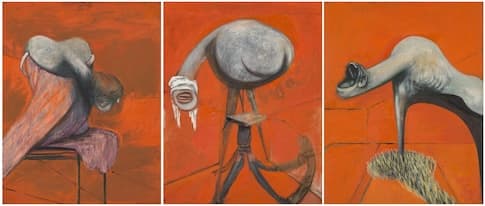
Three orange panels, each holding one pale grey creature with a long neck and a mouth. Francis Bacon painted them in 1944 and afterwards treated the triptych as the beginning of his work, destroying much of what he had made before it. Tate holds all three panels as a single accession, N06171, and shows them at Tate Britain.
- 1944
- Oil paint on 3 boards
- TateLondon, United Kingdom
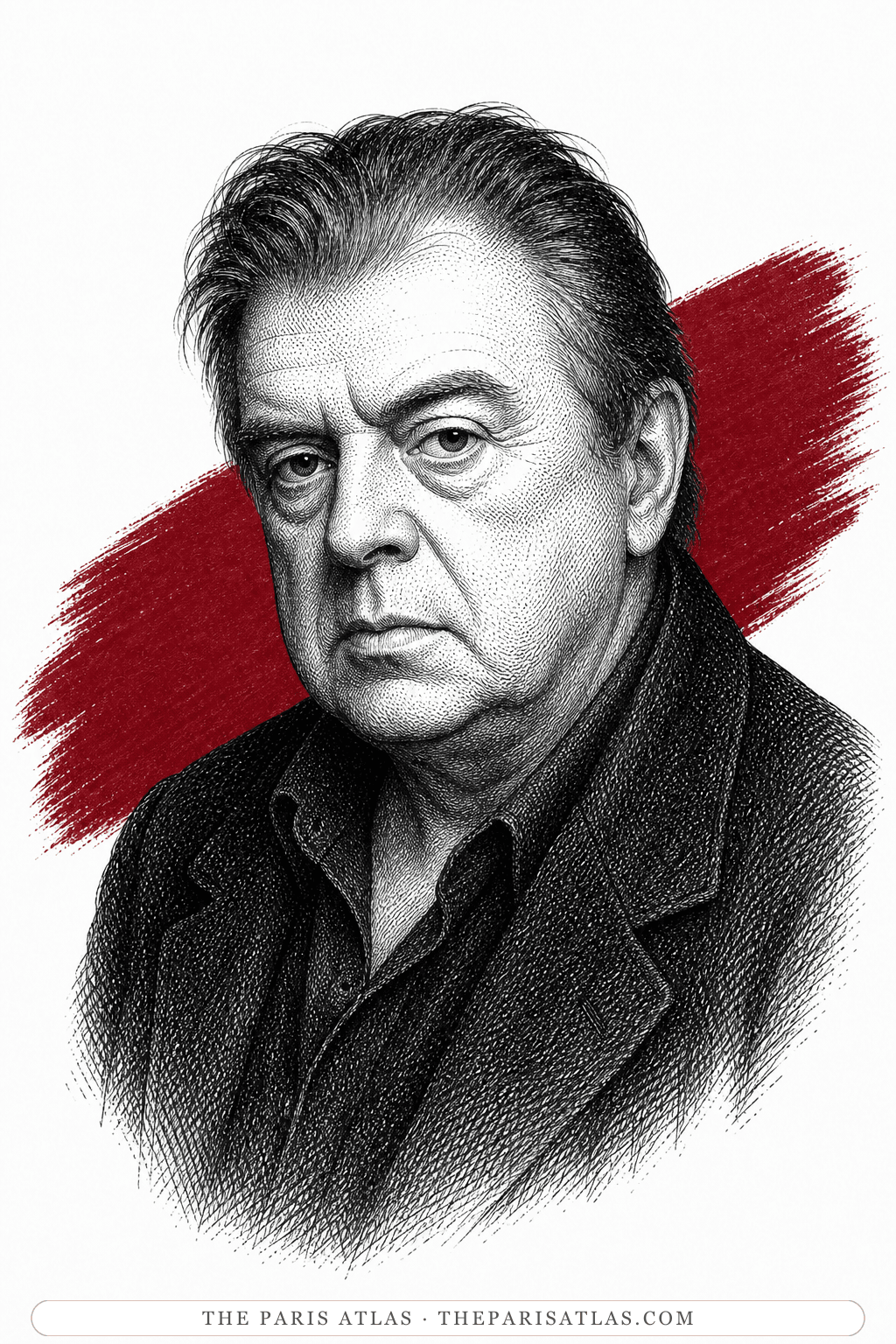
About Francis Bacon
What the painting shows
Each of the three boards carries a flat orange ground, scored with a few ruled darker lines that read as the corner of a room and a floor. Nothing else describes a place. The creatures sit in that orange with no shadow to fix them to it.
In the left panel a pale grey hump bows forward over a fold of mauve-pink cloth. A long limb sweeps down and to the left across the panel. A brown-grey knob hangs at the right of the hump with a single white point at its lower edge, and the cloth drops over the thin black legs of a stool.
The centre panel holds a smooth grey-white ovoid, egg-shaped, with one curved crease cut across its lower right. It stands on a thin neck rising from a dark banded stalk that splays into legs on the floor. To its left a white wrapping opens on a red-lipped mouth with pale teeth, and four white drips run down from it.
In the right panel a long neck arches down from a pale ribbed body at the upper right to a head at the upper left. That head is tipped back and the mouth is wide open, dark inside, with teeth showing along the top. A dark leg runs down to a patch of straw-yellow strokes on the orange floor.
The forms are not identified anywhere on the boards, and Francis Bacon gave them no names. What the paint states plainly is the repetition: three grounds of the same orange, three pale bodies, three mouths.
The title names what the picture leaves out
A crucifixion is a standard subject in European painting, and the figures at the base of one are the mourners and soldiers grouped below the cross. Francis Bacon painted the base and left the cross out. The title therefore describes a picture that is not there, and gives the three creatures a job — attendants at an execution — that nothing in the paint confirms.
The Estate of Francis Bacon connects the creatures to the Furies, the avenging spirits who pursue the matricide Orestes through the Greek tragedies of Aeschylus. That reading is the Estate's, not a label the painter attached at the time.
The word studies is doing work too. Three studies for figures is the language of preparation, of drawings made towards a painting that would come later. No such painting followed.
The beginning he chose for himself
Francis Bacon had been painting on and off since the late 1920s and had shown work in London in 1930 and 1937. He destroyed a great deal of it. From 1944 onwards he dated his career from this triptych and treated what came before as not counting.
That decision shapes every catalogue since. The Estate of Francis Bacon's catalogue raisonné gives the triptych the number 44-01 — the first entry of the first year it recognises as his own. Ronald Alley's 1964 catalogue had numbered it 15.
The triptych was first shown at The Lefevre Gallery in London in April 1945, in a group exhibition. Francis Bacon was thirty-five.
How Tate got it, and what Tate calls it
Eric Hall, a friend and patron of Francis Bacon, presented the triptych to the Tate Gallery in 1953. Tate records the acquisition as a gift, not a purchase, and the reference number is N06171.
Tate and the Estate of Francis Bacon describe the materials differently. Tate's record says oil paint on 3 boards. The Estate's catalogue raisonné says oil and pastel on fibreboard, and adds that the panels are irregular and measured only approximately.
The measurements diverge in the same small way. Tate gives each support as 940 by 737 millimetres. The Estate gives roughly 37 by 29 inches, which it converts to 94 by 74 centimetres.
There is a second version, and it is a different picture
In 1988, forty-four years later, Francis Bacon painted the subject again. Tate holds that work too, under the title Second Version of Triptych 1944 and the reference number T05858, and the painter presented it himself in 1991.
The two are easy to confuse and easy to separate. The 1988 panels are oil paint and acrylic paint on canvas rather than oil on board, each one 1980 by 1475 millimetres — more than twice the height of the 1944 boards. Their ground is a deep blood red instead of orange.
The year inside the later title is part of the title. Its own date is 1988.
Paris, 1971
The triptych travelled to Paris for the retrospective the Galeries nationales du Grand Palais gave Francis Bacon from 26 October 1971 to 10 January 1972. The Estate of Francis Bacon calls that exhibition an honour exceptional for a living painter.
Two nights before it opened, George Dyer — the painter's lover since late 1963 — was found dead of an overdose of drink and barbiturates. He was in a bathroom at the Hôtel des Saints-Pères, the Left Bank hotel where the two were staying. Francis Bacon attended the opening. The work he made over the following two years turns on that week.
Close reading
Reading the work, detail by detail
Three boards, three flat orange grounds, three pale bodies. The reproduction available is small and shows the panels side by side with dark gaps between them, so the close views take one panel at a time. Francis Bacon named none of the forms, and the descriptions below say what the paint does rather than what the shapes are.
1.Left panel: a pale hump bows over cloth
In the left panel a smooth grey-white mass bows forward from the top, modelled with soft shading and no outline. Below it a mauve-pink cloth falls in broad folds. The two are painted in different ways: the grey is blended and continuous, the pink is dragged and streaked.
2.Left panel: thin black legs under the drapery
Two thin black lines run down from under the cloth to the bottom of the left panel. They are the only straight, deliberate marks in that panel, and they read as the legs of a stool. Everything resting on them is painted as soft mass.
3.Centre panel: a grey ovoid with one crease
The centre panel is dominated by a smooth grey-white ovoid, egg-shaped and evenly shaded. A single curved dark crease cuts across its lower right. Nothing else marks it — no eyes, no nostrils — so the crease carries all the reading, and it can be taken as a closed mouth or a slitted eye.
4.Centre panel: a white wrapping and a red mouth
At the left of the centre panel a white bandage-like form wraps round and opens on a mouth with red lips and pale teeth. Four white drips run down from it in straight vertical lines. The drips are wet paint allowed to run, and they are the only place in the triptych where the paint behaves as liquid.
5.Centre panel: the stand the head sits on
Below the ovoid a thin grey neck drops into a dark banded stalk, which splays into legs on the floor. A large brown arc sweeps across the lower right of the panel. The stalk is painted with the hard edges of furniture while the form above it is painted as flesh.
6.Right panel: the mouth open and the teeth showing
The right panel carries the only fully open mouth in the triptych. The head is tipped back at the end of a long neck, the cavity is dark, and pale teeth run along the top edge. A raised flap of the same grey rises above it. The neck is painted in one continuous sweep with no join at the jaw.
7.Right panel: fine ribbing across the body
The pale mass at the upper right of the right panel is scored with close parallel lines, laid over the grey rather than modelled into it. The effect is of a ribcage seen through skin. A patch of yellow-grey sits at the top of the same form.
8.Right panel: a patch of straw on the floor
A dense tuft of straw-yellow strokes sits on the orange floor at the bottom of the right panel, where a dark limb comes down into it. It is painted as many short separate marks, unlike every other form in the triptych, which are painted as continuous masses.
9.The orange is ruled, not empty
The orange is not a plain field. Faint darker lines are ruled across it in each panel, meeting at angles that suggest a floor meeting two walls. They are the only perspective in the triptych, and the figures ignore them entirely.
Timeline
1944
Painted on three boards, at a house in Millbank, London. Francis Bacon afterwards dated his career from it and destroyed much of his earlier work.
1945
First shown in April at The Lefevre Gallery in London, in a group exhibition.
1953
Presented to the Tate Gallery by Eric Hall, and accessioned as N06171.
1962
Shown in the Tate Gallery retrospective, 24 May to 1 July, which then travelled to Mannheim, Turin and Zürich.
1971–72
Shown at the Galeries nationales du Grand Palais in Paris, 26 October 1971 to 10 January 1972.
1988
Francis Bacon paints the subject again, much larger and on canvas, as Second Version of Triptych 1944. He presents it to Tate in 1991 (T05858).
2026
On display at Tate Britain in the room Fear and Freedom 1940–1955.
Where to see it
Tate
London, United Kingdom
Tate has several galleries. A specific viewing address has not been confirmed here; check which venue, if any, is displaying this work before travelling.
On display at Tate Britain in the room Fear and Freedom 1940–1955. Tate's record is the place to check before travelling.
Plan your visit on the museum’s official website (opens in a new tab)Frequently asked questions
Where is Three Studies for Figures at the Base of a Crucifixion?
Tate Britain in London, reference number N06171, in the room Fear and Freedom 1940–1955. Eric Hall presented it to the Tate Gallery in 1953. All three panels are held as a single accession rather than three.
Why did Francis Bacon call it his first painting?
Because he chose to. He had painted since the late 1920s and had exhibited in London in 1930 and 1937, but he destroyed most of that work and afterwards dated his career from this triptych in 1944. The Estate of Francis Bacon's catalogue raisonné follows him, numbering it 44-01.
What do the three figures in the triptych represent?
The painting never says, and Francis Bacon gave them no names. The Estate of Francis Bacon connects them to the Furies, the avenging spirits who pursue Orestes through the Greek tragedies of Aeschylus. The title places them at the base of a crucifixion that the triptych itself does not show.
How big is Three Studies for Figures at the Base of a Crucifixion?
Each of the three panels is about 94 by 73.7 centimetres, roughly 37 by 29 inches. Tate gives the support as 940 by 737 millimetres each; the Estate of Francis Bacon records the boards as irregular and the measurement as approximate.
What is the difference between the 1944 triptych and Second Version of Triptych 1944?
They are two separate paintings forty-four years apart. The 1944 work is oil on board, each panel about 94 by 73.7 centimetres, on an orange ground (Tate N06171). Second Version of Triptych 1944 was painted in 1988 in oil and acrylic on canvas, each panel 1980 by 1475 millimetres, on a deep red ground (Tate T05858).
Is the triptych oil on board or oil and pastel?
The two authorities differ. Tate's collection record states oil paint on 3 boards. The Estate of Francis Bacon's catalogue raisonné states oil and pastel on fibreboard. Both agree the support is board rather than canvas.
Has Three Studies for Figures at the Base of a Crucifixion been shown in Paris?
Yes. It was in the Francis Bacon retrospective at the Galeries nationales du Grand Palais from 26 October 1971 to 10 January 1972. George Dyer died two nights before that exhibition opened.
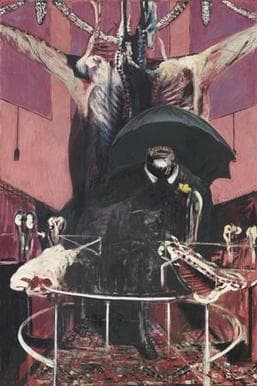
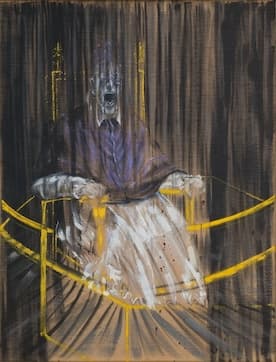
More by Francis Bacon
If you like Francis Bacon
Explore painters from the same movements and circles.
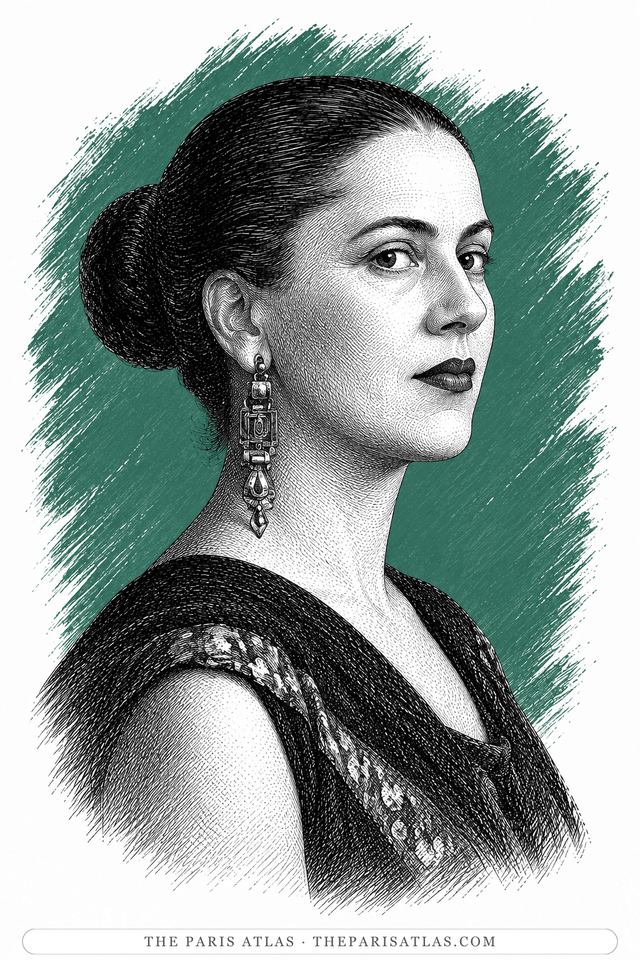
Tarsila do Amaral
Brazilian painter who spent the 1920s moving between São Paulo and Paris, studied Cubism under André Lhote, Albert Gleizes and Fernand Léger, and used what she learned to paint Brazilian towns, railways, plants and bodies. Her 1928 painting Abaporu prompted the manifesto that gave the Anthropophagic movement its name.
View artist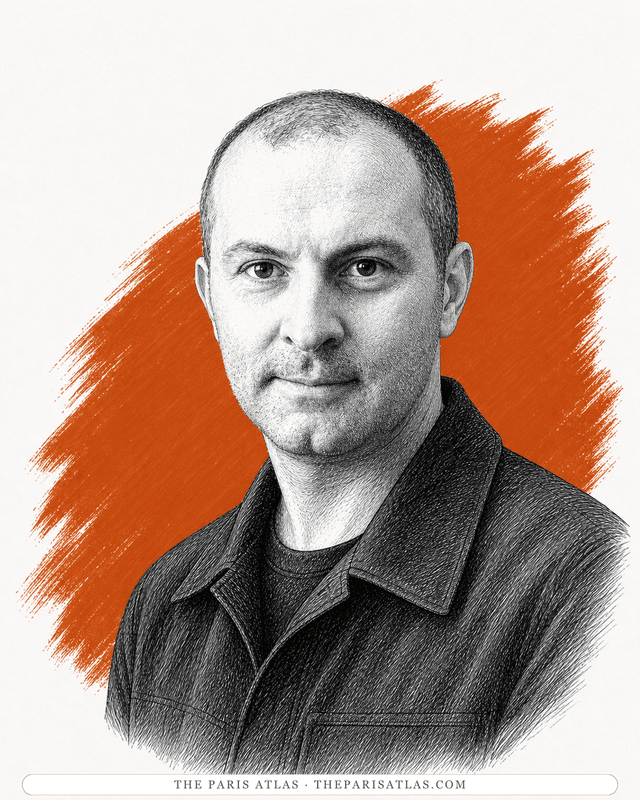
Arman
French-American artist, lifelong friend of Yves Klein, and a founder of New Realism.
View artist
Jean Arp
Strasbourg-born sculptor and poet — Hans in German, Jean in French, both all his life — who co-founded Dada at the Cabaret Voltaire in 1916, composed collages by dropping torn paper 'according to the laws of chance', and settled at Meudon outside Paris in a house his wife Sophie Taeuber-Arp designed.
View artist
References
The sources below include collection records, catalogues, scholarly research, and primary materials that informed this page. They document Three Studies for Figures at the Base of a Crucifixion, its making, and its place in cultural history.

1Francis Bacon, Three Studies for Figures at the Base of a Crucifixion, 1944 — collection record N06171
WebsiteTateUsed forTate's collection record — title, date, medium, dimensions, credit line and display status.
2Francis Bacon, Three Studies for Figures at the Base of a Crucifixion, 1944 — catalogue raisonné 44-01
WebsiteThe Estate of Francis BaconUsed forThe Estate of Francis Bacon's catalogue raisonné entry, with the 1945 Lefevre Gallery showing and the 1971 Grand Palais dates.
3Francis Bacon, Second Version of Triptych 1944, 1988 — collection record T05858
WebsiteTateUsed forThe 1988 painting of the same subject, kept distinct from the 1944 triptych.
4Francis Bacon biography: the 1940s
WebsiteThe Estate of Francis BaconUsed forThe Estate's account of the 1940s, including the destruction of the earlier work.
5Francis Bacon biography: the 1970s
WebsiteThe Estate of Francis BaconUsed forThe Grand Palais retrospective and the death of George Dyer.
6Francis Bacon 1909–1992 — artist record and collection
WebsiteTateUsed forTate's artist record and its holdings of Francis Bacon.
These references provide the documented foundation for this work's history and interpretation. Claim-level citations remain attached to the specific claims they support.
 Explore more resources