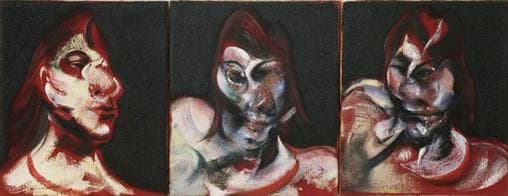
Three Studies for Portrait of Henrietta Moraes
Three canvases the size of a sheet of paper, each holding one head on flat black. Francis Bacon painted Henrietta Moraes in 1963 from photographs rather than from sittings, and the three panels move from a face clearly modelled to a face almost undone. William S. Paley bought the triptych the year it was painted, and it was sold at Sotheby's in London in October 2022.
- 1963
- Oil on canvas
About Francis Bacon
What the painting shows
Each panel is a head against a black so flat it gives no depth at all. The hair is a dark crimson mass in all three, and the shoulders come into the bottom of each canvas bare.
In the left panel the head turns three-quarters to the viewer's right. The face is built from thick white, cream and pink, with a band of granular pale green and gold speckle across the brow and cheek. The eye is a dark red slit under a pale brow, the mouth a red-brown smear, and a broad crimson band crosses the neck.
The centre panel brings the head almost frontal. A white crescent sweeps from the left brow across the bridge of the nose. One eye is a brown-grey socket with a pale iris; the other is a black hollow ringed in white. Below them the nose and cheek dissolve into slate blue and grey, and the mouth is a dark blue-grey smear.
In the right panel the features come apart. Where the face should be there is a knot of white, grey-blue and dark red twisting in on itself, with a pale wedge rising at the top left and a white hook curling under a plum-black mass. The shoulders below are broad and clear, cream at the left and crimson at the right.
The order left to right is not a sequence of events. What changes across the three is how much of the face survives the paint.
Who Henrietta Moraes was, and how he painted her
Henrietta Moraes lived from 1937 to 1999 and was, in the Estate of Francis Bacon's words, a key figure in post-war London's artistic and bohemian life. She set out to meet Francis Bacon and Lucian Freud, drank at the French House and other Soho bars, and belonged to the set that included Daniel Farson, Jeffrey Bernard, Brendan Behan and the photographer John Deakin.
The Estate records how the paintings began. In the French House, over a glass of champagne, Francis Bacon told her: 'I'm thinking of doing some paintings of my friends.' He then asked John Deakin to photograph her. He worked from the resulting prints — a nude Henrietta Moraes lying on a bed — rather than from sittings.
He returned to her repeatedly. The Estate's catalogue raisonné lists eleven paintings with her name in the title, all made between 1963 and 1969.
The method shows in the panels. The heads are lit and cropped the way a photograph crops, tight and close, with the shoulders cut by the canvas edge.
The title has no article in it
The title is Three Studies for Portrait of Henrietta Moraes, without an a before Portrait. Both the Estate of Francis Bacon's catalogue raisonné and the Sotheby's catalogue print it that way. Sotheby's records that Francis Bacon inscribed the reverse of the central canvas himself: 3 Studies For Portrait of Henrietta Moraes, and the date 1963.
The longer form, Three Studies for a Portrait of Henrietta Moraes, is in wide circulation and belongs to no catalogue.
Three further triptychs are titled Three Studies of Henrietta Moraes — one of 1966 and two of 1969 — and each is 14 by 12 inches a panel, exactly like this one. They are separate paintings, and only the catalogue numbers reliably tell them apart: 66-04, 69-01 and 69-06 against 63-12 here.
Who has owned it, and who has not
The triptych went from Marlborough-Gerson Gallery in New York to William S. Paley, the broadcasting executive, who bought it directly in 1963. It passed by bequest to the William S. Paley Foundation in 1990.
The Estate of Francis Bacon's catalogue raisonné gives the collection as the Museum of Modern Art, New York. That reflects where the picture hung: the Paley collection was shown at the museum and toured from it, beginning with an exhibition that opened there in 1992. The museum's own published collection data lists five Francis Bacon works and does not include this one.
On 14 October 2022 it was sold as lot 112 of the Contemporary Evening Auction at Sotheby's in London, under a banner announcing works from the collection of William S. Paley sold to benefit the Museum of Modern Art and other charitable organisations. The estimate was on request. Sotheby's records the result as 24,300,000 pounds, a figure that includes the buyer's premium.
The buyer was not named. The present owner is a private collection.
Paris, 1971
The triptych was among the works sent to Paris for the retrospective at the Galeries nationales du Grand Palais, 26 October 1971 to 10 January 1972, and then to the Kunsthalle in Düsseldorf. The Sotheby's catalogue records it as number 48 in the Paris catalogue.
Two days before the Paris opening, George Dyer — the painter's lover since late 1963, the same year the triptych was painted — was found dead of an overdose of drink and drugs at the Hôtel des Saints-Pères. The three-panel form Francis Bacon used for his friends' heads is the one he used again, at seven times the size, for the paintings that followed that death.
Close reading
Reading the work, detail by detail
Three small canvases, each a head against flat black. The reproduction available shows all three side by side, so the close views take them one at a time and then compare what survives of the face in each. The faces are made of thick paint rather than drawing, and the descriptions below follow the strokes.
1.Left panel: the face still holds together
In the left panel the head turns three-quarters to the viewer's right and the face still reads as a face. White, cream and pink are laid on thickly along the brow, the nose and the chin, with the crimson hair sweeping back over the crown. The paint is built up rather than drawn.
2.Left panel: a band of green-gold speckle
A granular band of pale green and gold flecks runs across the brow and upper cheek of the left head, and appears again on the bare shoulder below. The flecks are separate specks rather than a blended passage. They are the only cool colour in that panel.
3.Centre panel: two eyes made two different ways
The centre head carries two eyes painted by different means. One is a brown-grey socket with a pale iris inside it. The other is a black hollow with a white stroke ringed around it and nothing in the middle. Neither is placed where the other implies it should be.
4.Centre panel: the nose and cheek turn to slate blue
Below the eyes the centre face gives way to a mass of slate blue and grey where the nose and cheek should be. A pale wedge marks the right side of the nose and a white crescent sweeps across from the brow. The blue is cold against the crimson hair on either side.
5.Centre panel: one shoulder pale, one crimson
The two shoulders in the centre panel are painted unlike each other. The left is a pale pink-cream rounded mass with green-grey along its lower edge. The right is a broad crimson sweep carrying white highlights, with a pool of red at the bottom centre.
6.Right panel: the features come apart
In the right panel the face is a knot of white, grey-blue and dark red strokes twisting in on itself. A pale wedge rises at the top left of the head and a white hook curls under a plum-black mass below. No eye, nose or mouth can be located with any confidence.
7.Right panel: the shoulders stay legible
While the face in the right panel comes apart, the shoulders below it stay perfectly legible — cream and white curving over red at the left, a crimson sweep with white arcs at the right. A pale grey-white stroke loops beneath the head. The body is stated more plainly than the face.
8.The black gives no depth at all
The black behind each head is flat and unmodulated, with the canvas grain showing through. It meets the crimson hair at a hard edge. Because there is no gradation anywhere in it, the heads sit on the surface rather than in a space.
9.The same crimson runs through all three
Dark crimson does the same job in all three panels: it frames the head, falls to the shoulders, and is laid in broad sweeping strokes that thin at their ends. It is the one constant across the triptych, and it is what holds the three panels together as one picture.
Timeline
1963
Painted, and delivered to Marlborough Fine Art on 6 November. Francis Bacon inscribes the title and date on the reverse of the central canvas.
1963
Bought from Marlborough-Gerson Gallery, New York, by William S. Paley.
1964
Ronald Alley numbers it 221 in the first catalogue raisonné.
1971–72
Shown at the Galeries nationales du Grand Palais in Paris, 26 October 1971 to 10 January 1972, as number 48, then at the Kunsthalle in Düsseldorf.
1990
Passes by bequest to the William S. Paley Foundation.
1992–97
Tours in The William S. Paley Collection, which opens at the Museum of Modern Art in New York.
2005–06
Shown at the Scottish National Gallery of Modern Art in Edinburgh and the Hamburger Kunsthalle.
2022
Sold at Sotheby's in London on 14 October, lot 112, for 24,300,000 pounds including premium. The buyer is not named.
Where to see it
Private collection
No public viewing address is listed for this private collection.
Not publicly accessible. The Estate of Francis Bacon's catalogue raisonné still records the collection as the Museum of Modern Art, New York, where the William S. Paley collection was shown; the triptych was sold at Sotheby's in London on 14 October 2022 and the buyer was not named.
Frequently asked questions
Where is Three Studies for Portrait of Henrietta Moraes?
In a private collection. It was sold at Sotheby's in London on 14 October 2022 as lot 112 of the Contemporary Evening Auction, and the buyer was not named. The Estate of Francis Bacon's catalogue raisonné still gives the collection as the Museum of Modern Art, New York.
Did the Museum of Modern Art own the Henrietta Moraes triptych?
No. William S. Paley bought it from Marlborough-Gerson Gallery in 1963 and it passed to the William S. Paley Foundation by bequest in 1990. The museum showed it — the Paley collection opened there in 1992 and toured from it — and benefited from the 2022 sale, but its own published collection data lists five Francis Bacon works and not this one.
Is it Three Studies for Portrait or Three Studies for a Portrait?
For Portrait, with no article. The Estate of Francis Bacon's catalogue raisonné and the Sotheby's catalogue both print it that way, and Francis Bacon inscribed the reverse of the central canvas 3 Studies For Portrait of Henrietta Moraes with the date 1963.
Did Henrietta Moraes sit for Francis Bacon?
No. The Estate of Francis Bacon records that he told her in the French House, over a glass of champagne, that he was thinking of doing some paintings of his friends, and then asked the photographer John Deakin to photograph her. He painted from the prints — a nude Henrietta Moraes lying on a bed — rather than from the person.
How big is Three Studies for Portrait of Henrietta Moraes?
Each of the three panels is 35.5 by 30.5 centimetres, or 14 by 12 inches — about the size of a sheet of writing paper. The Estate of Francis Bacon gives one measurement covering all three panels rather than three separate ones.
How much did the Henrietta Moraes triptych sell for?
24,300,000 pounds at Sotheby's in London on 14 October 2022. Sotheby's states that its published results include the buyer's premium and exclude taxes and costs, so that is not the hammer price. The estimate was on request and no figure was published.
How many Henrietta Moraes paintings did Francis Bacon make?
Eleven carry her name in the title, all between 1963 and 1969, according to the Estate of Francis Bacon's catalogue raisonné. Only one is in a public collection: Portrait of Henrietta Moraes on a Blue Couch, 1965, at Manchester Art Gallery.
More by Francis Bacon
If you like Francis Bacon
Explore painters from the same movements and circles.
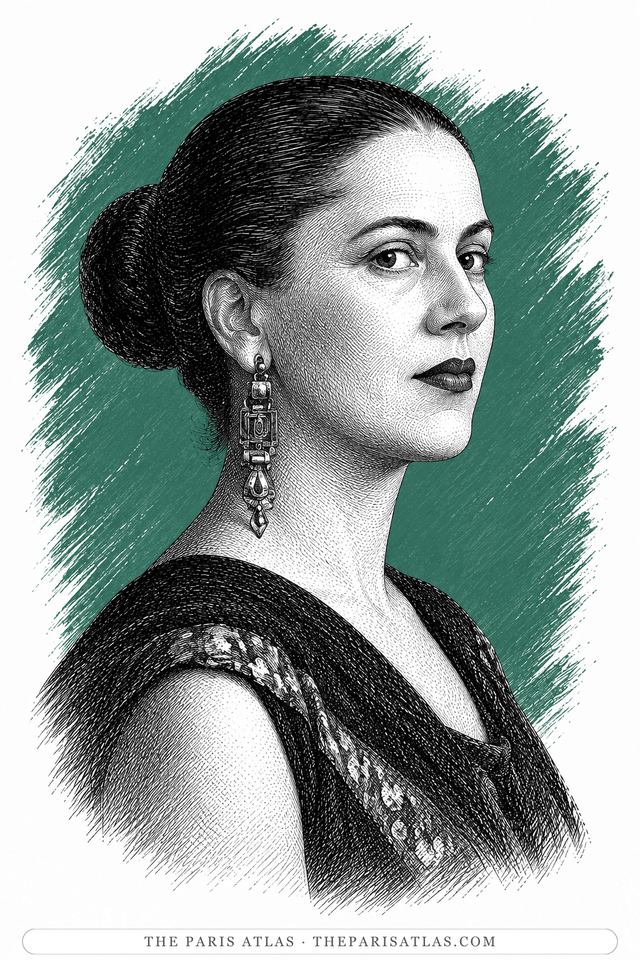
Tarsila do Amaral
Brazilian painter who spent the 1920s moving between São Paulo and Paris, studied Cubism under André Lhote, Albert Gleizes and Fernand Léger, and used what she learned to paint Brazilian towns, railways, plants and bodies. Her 1928 painting Abaporu prompted the manifesto that gave the Anthropophagic movement its name.
View artist
Arman
French-American artist, lifelong friend of Yves Klein, and a founder of New Realism.
View artist
Jean Arp
Strasbourg-born sculptor and poet — Hans in German, Jean in French, both all his life — who co-founded Dada at the Cabaret Voltaire in 1916, composed collages by dropping torn paper 'according to the laws of chance', and settled at Meudon outside Paris in a house his wife Sophie Taeuber-Arp designed.
View artist
References
The sources below include collection records, catalogues, scholarly research, and primary materials that informed this page. They document Three Studies for Portrait of Henrietta Moraes, its making, and its place in cultural history.


1Francis Bacon, Three Studies for Portrait of Henrietta Moraes, 1963 — catalogue raisonné 63-12
WebsiteThe Estate of Francis BaconUsed forThe Estate of Francis Bacon's catalogue raisonné entry — title, date, medium, dimensions, delivery date, Alley number and exhibition history.

2Francis Bacon, Three Studies for Portrait of Henrietta Moraes — Contemporary Evening Auction, London, 14 October 2022, lot 112
Official recordSotheby's, 2022Used forThe 2022 sale record, which supplies the provenance, the inscription on the reverse and the price realised.
3Henrietta Moraes 1937–1999 — family, friends and sitters
WebsiteThe Estate of Francis BaconUsed forThe Estate's page on the sitter — her dates, the Soho circle, and how the John Deakin photographs came to be made.
4Francis Bacon biography: the 1960s
WebsiteThe Estate of Francis BaconUsed forThe Estate's account of the 1960s, including the John Deakin photographs Francis Bacon painted from.
5Francis Bacon — Galeries nationales du Grand Palais, Paris, 26 October 1971 to 10 January 1972 (108 works)
Exhibition catalogueCentre national d'art contemporain, Paris, 1971Used forThe catalogue of the 1971–72 Paris retrospective, in which this triptych was number 48.
6George Dyer — family, friends and sitters
WebsiteThe Estate of Francis BaconUsed forThe Estate's page on George Dyer, for the death two days before the Grand Palais opening.
These references provide the documented foundation for this work's history and interpretation. Claim-level citations remain attached to the specific claims they support.
 Explore more resources