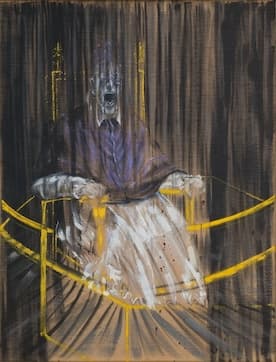
Study after Velázquez's Portrait of Pope Innocent X
A pope sits on a throne with his mouth open, behind a curtain of vertical brushmarks that falls across the whole canvas. Francis Bacon painted it in 1953 after a portrait of Pope Innocent X by Diego Velázquez that he never saw in the original. The Des Moines Art Center bought it in 1980 and calls it the definitive statement on a theme he returned to for more than twenty years.
- 1953
- Oil on canvas
- Des Moines Art CenterDes Moines, Iowa, United States
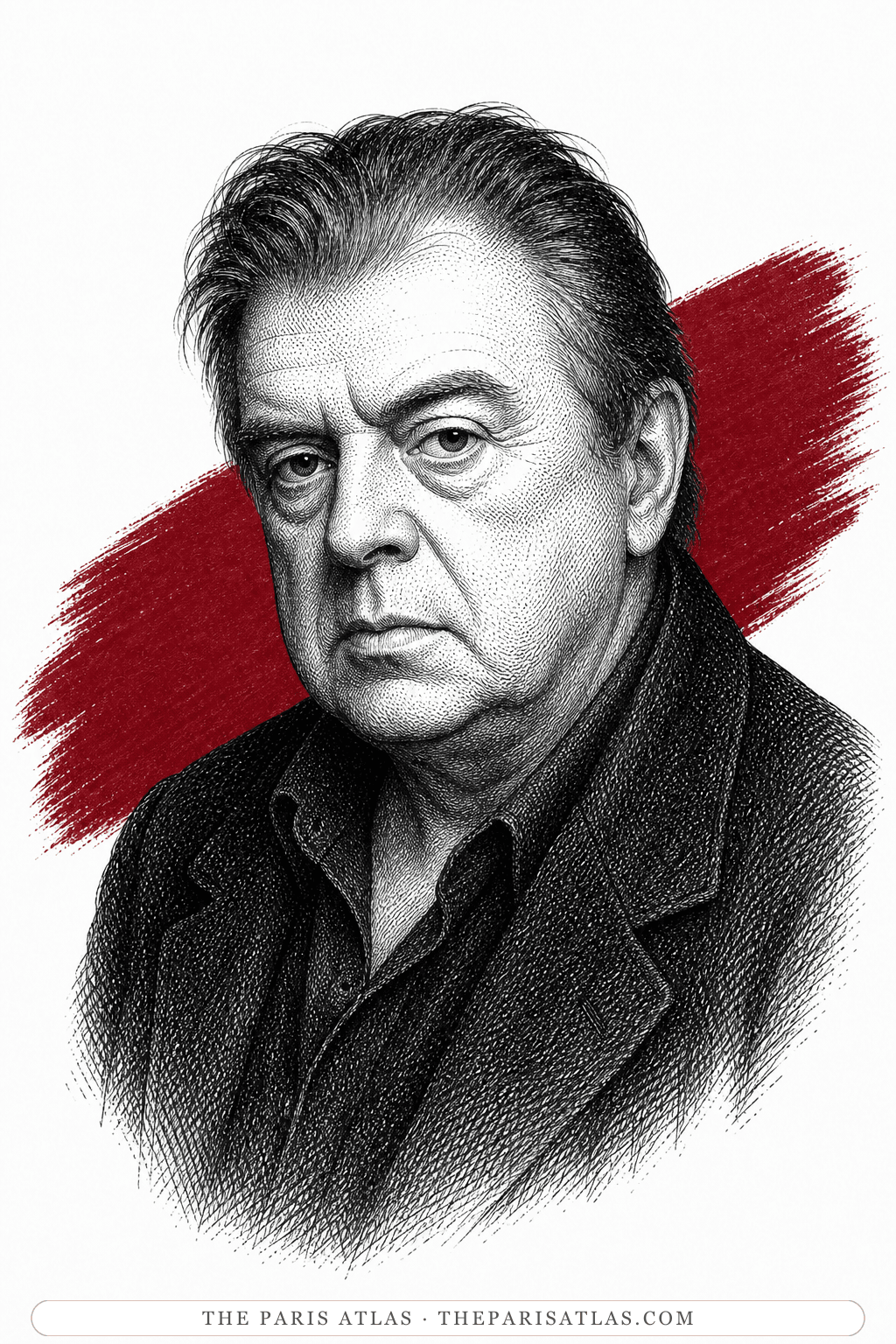
About Francis Bacon
What the painting shows
The ground is a dark brown-black worked in long vertical strokes that run from the top edge to the bottom. They read as a curtain, or as rain, and they pass over the figure as well as behind it, so the whole picture appears to be seen through them.
The head is pale grey-white and smeared downward. Two dark hollows sit under the brow. The mouth is a wide open dark oval with pale teeth above and below, and the flesh around it drags down into the shoulders.
Below the head is a band of deep violet-indigo running vertically, with purple-mauve spreading out to either side — the shoulders and the front of a cape. The lower half of the figure is a broad skirt of white and cream over ochre, dragged downward in long strokes that thin into the dark near the bottom.
Two pale hands grip the arms of the throne at left and right, fingers curled over. A yellow-ochre line structure runs through the picture: two thin uprights with small finials stand behind the head, and long yellow lines sweep in from both sides in perspective, meeting low at the centre.
Dark red spatters fall down the right side of the white robe and across the lower centre. They sit on top of the paint rather than in it.
The Velázquez he never saw
The source is a portrait of Giovanni Battista Pamphilj, pope from 1644 to 1655 as Innocent X. The Galleria Doria Pamphilj in Rome owns it, and records the canvas as 141 by 119 centimetres, oil on canvas, inventory FC 289. It dates the painting to the end of 1649 or January 1650 — probably, the gallery says, rather than certainly.
That gallery calls it the most important painting in its collection and notes that Diego Velázquez did not attempt to hide the sitter's ugliness. In the mid-nineteenth century Prince Filippo Andrea V Doria Pamphilj had a special chamber built for it at the end of the gallery's First Wing.
Francis Bacon worked from reproductions. The Des Moines Art Center states that he never saw the Velázquez in person and became entranced by photographs of it — and it is the museum, not the painter, that supplies that account on the object record.
The scale alone separates the two. The Velázquez is 141 by 119 centimetres; the Francis Bacon canvas is about 153 by 118, a head taller, and the head inside it is far smaller relative to the field.
A throne and a ring
The yellow lines do two jobs at once. Behind the head they stand up as the finials of a chair. Across the lower half they open out into a box drawn in perspective. The Des Moines Art Center reads that box as both a throne and a boxing or wrestling ring, a form that recurs in the artist's work.
The lines are thin and unshaded, closer to diagram than to furniture. They put a rectangular frame around the figure without enclosing it in anything solid.
The museum also connects the open mouth to the Odessa Steps sequence of Battleship Potemkin, the silent film directed by Sergei Eisenstein. A nurse in it cries out as she is shot through her glasses. The museum relates the red spatters on the robe to that imagery.
How many popes
Francis Bacon painted the subject many times. The Des Moines Art Center's label says he used the Velázquez portrait nearly fifty times between 1949 and 1971, and describes the 1953 canvas as the version most people consider his definitive statement on the theme.
He was uneasy about the word pope. The Estate of Francis Bacon's catalogue raisonné records the critic Robert Melville's doubt that the painter ever titled any picture Pope. Melville also recalled that at the Hanover Gallery the staff called them cardinals in front of visitors, so that nobody would be offended.
That is why the titles in the catalogue are what they are. The Estate keeps the titles Ronald Alley assigned in the 1964 catalogue for the earlier years, and this painting is Alley 56 and 53-02 in the current catalogue raisonné.
From a London gallery to Iowa
The canvas went from the artist to the Beaux Arts Gallery in London in February 1953, then to Anthony Diamond, then back to the Beaux Arts Gallery. Mr and Mrs William A. M. Burden of New York acquired it in 1954 and Carter Burden received it as a gift in 1964.
The Des Moines Art Center bought it from Carter Burden in 1980 with funds from the Coffin Fine Arts Trust, and it entered the Nathan Emory Coffin Collection as 1980.1. The museum lists it as currently on view.
The museum holds a second object that is easy to mistake for it: a colour lithograph of 1989, catalogued as after Francis Bacon, reproducing a different pope painting of 1965. Its record notes that Francis Bacon never made any prints of his own.
Paris, 1971
The painting travelled to Paris for the retrospective at the Galeries nationales du Grand Palais, 26 October 1971 to 10 January 1972, and on to the Kunsthalle in Düsseldorf in March 1972. The Paris catalogue counted 108 works.
Two days before the Paris opening, George Dyer — the painter's lover since late 1963 — was found dead of an overdose of drink and drugs. He was in the bathroom of their room at the Hôtel des Saints-Pères, at 65 rue des Saints-Pères. The Estate of Francis Bacon states the cause and does not describe it as suicide. Linda Nochlin, writing for Tate in 2008, calls it a suicide.
Close reading
Reading the work, detail by detail
Almost every square centimetre of the canvas is crossed by long vertical brushstrokes, including the figure. The close views separate what the strokes pass over: the head and its mouth, the violet cape, the white robe, the hands, the yellow framework and the red spatters that sit on top of everything.
1.The mouth is open and the teeth are pale
The mouth is a wide dark oval with pale teeth picked out along its upper and lower edges. The flesh around it is dragged downward in short strokes, so the lower face appears to be sliding off the skull. It is the darkest small area in the upper canvas.
2.The head dissolves above the eyes
Above the mouth the head is pale grey-white with two dark hollows under the brow. The top of the skull is smeared upward into the dark ground with no edge between them. Where the face ends and the background begins is not decided anywhere on the canvas.
3.A violet band runs down the front of the cape
Directly below the head a deep violet-indigo band runs vertically, with purple-mauve spreading out to either side across the shoulders. The violet is the most saturated colour in the picture. It is laid in broad flat strokes that still show the brush.
4.Two pale hands grip the arms of the chair
A pale hand grips each arm of the throne, cuffed, the fingers curled over a yellow-ochre upright. The hands are painted in thick white and grey and are among the few passages given firm edges. They also fix the figure to the yellow framework, which otherwise floats free.
5.The robe is dragged downward into the dark
The lower robe is a broad skirt of white and cream over ochre, pulled downward in long vertical strokes. Near the bottom the strokes thin and the white gives out into the dark ground. The robe has no hem — it simply stops being paint.
6.Yellow lines open into a box in perspective
Thin yellow-ochre lines sweep in from both edges and meet low at the centre, drawing an open box in perspective around the figure. The lines are unshaded and of even width, closer to a diagram than to furniture. They cross in front of the robe rather than behind it.
7.Two yellow uprights stand behind the head
Two thin yellow uprights rise behind the head, each ending in a small square finial with a cross-bar below it. They are the same yellow as the box in the lower half, at the same weight of line. They are drawn straight through the vertical brushmarks of the ground.
8.Red spatters sit on top of the paint
Small dark red spatters fall down the right side of the white robe and across the lower centre. They sit on top of the dried paint rather than in it, with hard edges and no blending. They are the last marks made on the canvas.
9.Vertical strokes fall across the whole canvas
The ground is dark brown-black worked in long vertical strokes that run the full height of the canvas. They pass over the figure as well as behind it. Because nothing interrupts them, the whole picture reads as seen through a screen rather than in open air.
Timeline
1649–50
Diego Velázquez paints Giovanni Battista Pamphilj, Pope Innocent X, in Rome. The Galleria Doria Pamphilj dates the canvas to the end of 1649 or January 1650 and still owns it as FC 289.
1953
Painted, and delivered to the Beaux Arts Gallery in London in February.
1953
Shown at the Beaux Arts Gallery, 12 November to 9 December.
1954
Acquired by Mr and Mrs William A. M. Burden, New York.
1964
Given by them to Carter Burden, New York. Ronald Alley numbers the painting 56 in the first catalogue raisonné the same year.
1971–72
Shown at the Galeries nationales du Grand Palais in Paris, 26 October 1971 to 10 January 1972.
1980
Bought by the Des Moines Art Center from Carter Burden, with funds from the Coffin Fine Arts Trust. Accessioned as 1980.1.
1999
Shown in Francis Bacon: The Papal Portraits of 1953 at the Museum of Contemporary Art San Diego, 17 January to 28 March.
2009
Shown at the Museo Nacional del Prado in Madrid, 3 February to 19 April, and then at the Metropolitan Museum of Art.
Where to see it
Des Moines Art Center
Des Moines, Iowa, United States
A public viewing address has not yet been confirmed for this holding.
The Des Moines Art Center lists the painting as currently on view. It catalogues the title with a capital A — Study After Velázquez's Portrait of Pope Innocent X.
Frequently asked questions
Where is Francis Bacon's screaming pope?
The Des Moines Art Center in Iowa, accession number 1980.1, and the museum lists it as currently on view. Its full title is Study after Velázquez's Portrait of Pope Innocent X, and the museum bought it in 1980 with funds from the Coffin Fine Arts Trust.
Did Francis Bacon ever see the Velázquez portrait?
No. The Des Moines Art Center states that he never saw the painting in person and worked from reproductions of it, having become entranced by photographs. The original hangs in the Galleria Doria Pamphilj in Rome, which dates it to the end of 1649 or January 1650 and catalogues it as FC 289.
How many pope paintings did Francis Bacon make?
The Des Moines Art Center's label says he used the Velázquez portrait nearly fifty times between 1949 and 1971. The Estate of Francis Bacon's catalogue raisonné records that Francis Bacon disliked the word pope as a title and that gallery staff called the pictures cardinals in front of visitors.
What are the yellow lines in the pope painting?
A thin ochre framework that behaves as two things at once. Behind the head it stands up as the finials of a throne; across the lower half it opens into a box drawn in perspective. The Des Moines Art Center reads that box as both a throne and a boxing or wrestling ring.
How big is Study after Velázquez's Portrait of Pope Innocent X?
The Des Moines Art Center gives the visible image as 152.1 by 117.8 centimetres and the frame as 173.7 by 139.4 by 8.6 centimetres. The Estate of Francis Bacon gives the canvas itself as 153 by 118 centimetres — a different measurement rather than a contradiction.
Why is the pope screaming?
The painting does not say, and Francis Bacon left no explanation on the canvas. The Des Moines Art Center connects the open mouth to the Odessa Steps sequence of Sergei Eisenstein's Battleship Potemkin, in which a nurse cries out after being shot through her glasses. It relates the red spatters on the robe to that image.
Is the title Study after or Study After Velázquez?
The two authorities capitalise it differently. The Des Moines Art Center, which owns the painting, prints Study After Velázquez's Portrait of Pope Innocent X. The Estate of Francis Bacon's catalogue raisonné prints Study after Velázquez's Portrait of Pope Innocent X, which is the form used here.
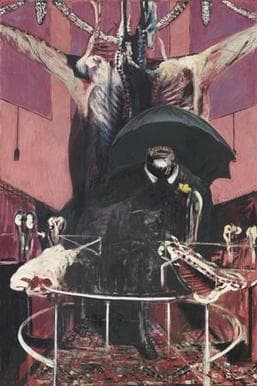
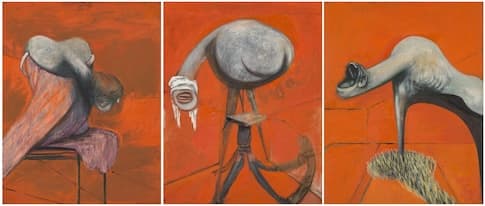
More by Francis Bacon
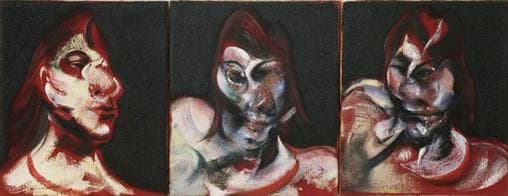
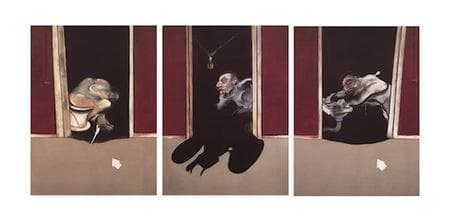
If you like Francis Bacon
Explore painters from the same movements and circles.
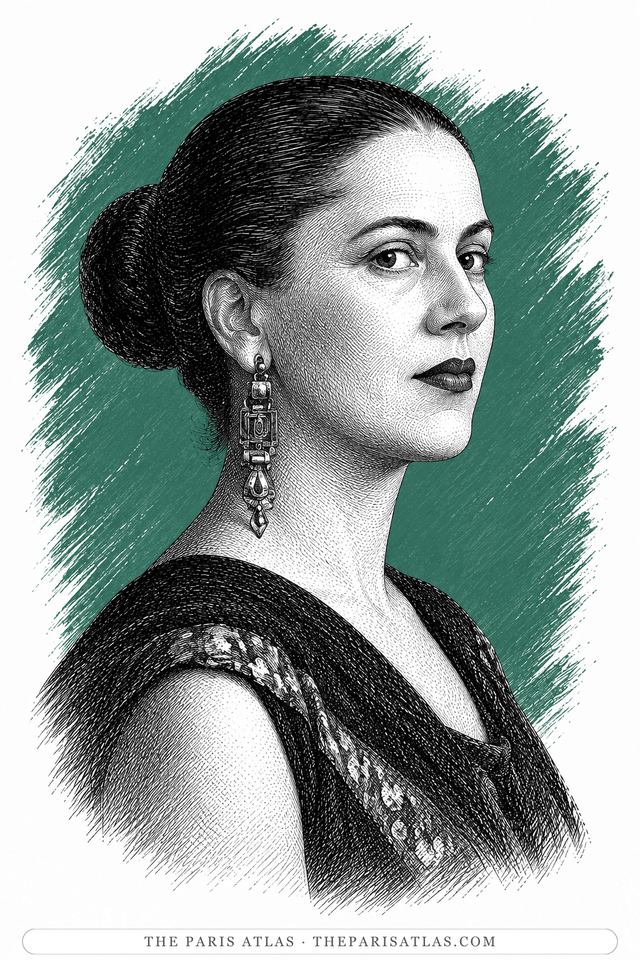
Tarsila do Amaral
Brazilian painter who spent the 1920s moving between São Paulo and Paris, studied Cubism under André Lhote, Albert Gleizes and Fernand Léger, and used what she learned to paint Brazilian towns, railways, plants and bodies. Her 1928 painting Abaporu prompted the manifesto that gave the Anthropophagic movement its name.
View artist
Arman
French-American artist, lifelong friend of Yves Klein, and a founder of New Realism.
View artist
Jean Arp
Strasbourg-born sculptor and poet — Hans in German, Jean in French, both all his life — who co-founded Dada at the Cabaret Voltaire in 1916, composed collages by dropping torn paper 'according to the laws of chance', and settled at Meudon outside Paris in a house his wife Sophie Taeuber-Arp designed.
View artist
References
The sources below include collection records, catalogues, scholarly research, and primary materials that informed this page. They document Study after Velázquez's Portrait of Pope Innocent X, its making, and its place in cultural history.

1Francis Bacon, Study After Velázquez's Portrait of Pope Innocent X, 1953 — collection record 1980.1
WebsiteDes Moines Art CenterUsed forThe owning museum's collection record — title, medium, dimensions, credit line, provenance, copyright notice and label text.
2Francis Bacon, Study after Velázquez's Portrait of Pope Innocent X, 1953 — catalogue record
WebsiteThe Estate of Francis BaconUsed forThe Estate of Francis Bacon's catalogue raisonné entry, with the canvas dimensions, the Alley number and the exhibition history.
3Velázquez, Portrait of Pope Innocent X Pamphilj
WebsiteGalleria Doria Pamphilj, RomeUsed forThe Galleria Doria Pamphilj's record of the Diego Velázquez portrait Francis Bacon worked from.
4After Francis Bacon, Study from Portrait of Pope Innocent X, 1965 — colour lithograph, 1989, collection record 2004.6
WebsiteDes Moines Art CenterUsed forThe 1989 reproductive lithograph after a different pope painting, which the same museum also holds.

5Francis Bacon — Galeries nationales du Grand Palais, Paris, 26 October 1971 to 10 January 1972 (108 works)
Exhibition catalogueCentre national d'art contemporain, Paris, 1971Used forThe catalogue of the 1971–72 Paris retrospective, 108 works.
6George Dyer — family, friends and sitters
WebsiteThe Estate of Francis BaconUsed forThe Estate's page on George Dyer, for the death two days before the Grand Palais opening.
7Homage to Bacon — Tate Etc., issue 14, Autumn 2008
PeriodicalTate, 2008Used forLinda Nochlin's essay for Tate, which describes George Dyer's death as a suicide where the Estate does not.
These references provide the documented foundation for this work's history and interpretation. Claim-level citations remain attached to the specific claims they support.
 Explore more resources