
Notes from Underground
Printed after White Nights in Garnett's 1918 collection. The underground man is what a dreamer becomes after twenty more years alone.
Read our takeWhite Nights
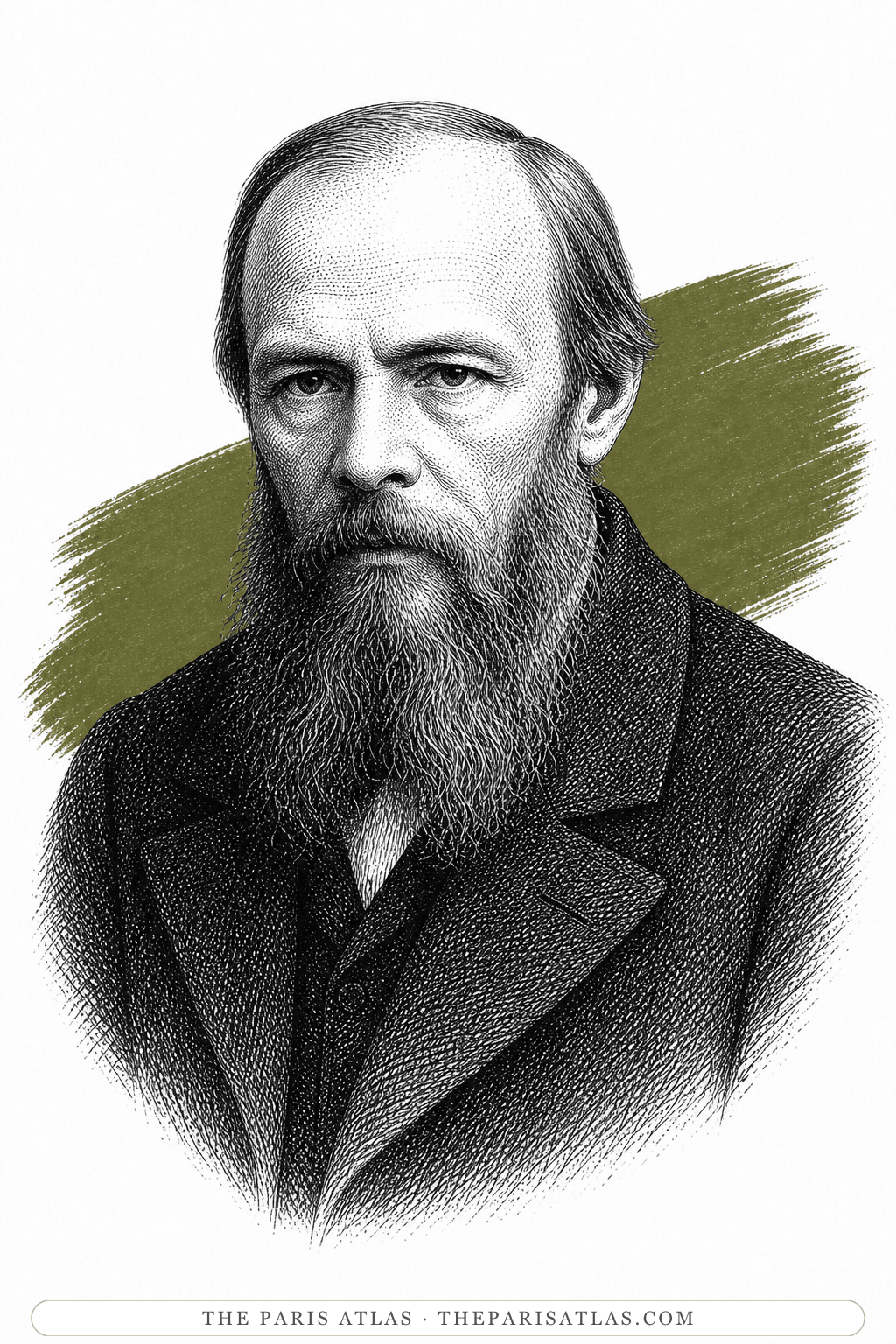
Fyodor Dostoevsky
A lonely young man meets a crying girl on a St Petersburg canal bank, falls in love with her over four summer nights, and helps her wait for someone else.
The narrator is a young clerk of twenty-six who has lived in St Petersburg for eight years and knows almost nobody. He calls himself a dreamer. On a white night in early summer, when the northern sky never quite gets dark, he finds a girl crying at the canal railing and walks her home. Her name is Nastenka and she is seventeen. They agree to meet again, and over four nights they tell each other their lives. She is waiting for a young man who promised a year ago to come back and marry her. The dreamer falls in love with her and hopes he will not come.
Fyodor Dostoevsky was twenty-seven when White Nights appeared in the December 1848 issue of the St Petersburg magazine Notes of the Fatherland. He dedicated it to his friend the poet Alexei Pleshcheyev. The Russian editors think Pleshcheyev may be one of the models for the dreamer, and note that the two friends were both in the Petrashevsky circle, the discussion group that got Dostoevsky arrested a few months later.[1]
The dreamer was a type Dostoevsky had been writing about all year in his newspaper sketches of the city. In one of them he described people who long for real life but are too weak and gentle to grab it, and slowly turn into strange creatures he called dreamers. He added that all of us are more or less dreamers. The Russian editors see a good deal of the young Dostoevsky in the hero.[1]
When he gathered his works for a collected edition in 1860, Dostoevsky revised the story and added a long passage to the second night, in which the dreamer describes what he dreams about. The quotations here come from Constance Garnett's English translation, printed in 1918 in White Nights and Other Stories. The text is out of copyright and free from Project Gutenberg.[1][2]
The story is told in five sections: four nights and a morning. On the first night the dreamer walks the city feeling that everyone has left for their summer houses and abandoned him. On the canal embankment he sees a young woman leaning on the railing, crying. When a drunk man starts to follow her, the dreamer chases him off. He walks her home, and she agrees to meet him at the same spot the next night, on condition that he does not fall in love with her.[2]
On the second night she asks for his story, and he tells it in the third person, as the history of a dreamer. He describes the hours of the evening when he drifts into imagined lives full of poets, battles and love affairs. Then she tells hers. She lives with her blind grandmother, who pins Nastenka's dress to her own so the girl cannot go out. A young lodger moved into the attic, lent them books, and took them to the opera to see The Barber of Seville. A year ago he left for Moscow, promising to come back and marry her. Now he is back in St Petersburg and has not come.[2]
Nastenka writes to the lodger, and the dreamer makes sure the letter reaches him. On the third night she arrives an hour early, glowing, sure that the lodger will come. She tells the dreamer she likes him because he has not fallen in love with her. The lodger does not come. The next day it rains, they do not meet, and the dreamer writes that he has never been so lonely.[2]
On the fourth night there is still no letter. Nastenka is heartbroken and furious with the lodger. The dreamer finally tells her that he loves her. She is moved, and slowly they start to plan a life together: they will take the grandmother with them and he will find them rooms. Walking along the embankment, they pass a young man. Nastenka stops, cries out that it is him, and runs into his arms. Then she runs back, throws her arms round the dreamer's neck, kisses him, and goes off with the lodger.
In the morning it is raining. A letter comes from Nastenka asking his forgiveness and telling him she is to be married next week. She hopes he will visit them as a friend. The dreamer looks round his dingy room and imagines himself fifteen years on, in the same place and just as alone. He decides he will never hold it against her, and blesses her for the moment of happiness she gave him. The last line asks whether a whole moment of happiness is too little for a man's life.
The second night holds the dreamer's long confession, and at its centre is a list of everything he imagines in his room. He dreams of being a poet first ignored and then crowned, and of friendship with the German writer Hoffmann. He dreams of the novels of Walter Scott, of Ivan the Terrible taking Kazan, and of Meyerbeer's opera Robert the Devil. Two of the dreams are set in Paris. He dreams of St Bartholomew's Night, the massacre of Protestants in Paris in 1572, and of Danton, a leader of the French Revolution.
The list ends somewhere much smaller. After all the massacres and operas, the last thing he dreams of is a little home of his own and someone beside him on a winter evening who listens to him. Then he turns to Nastenka and says she is listening to him now, just like that. The whole list is a way of telling her that she is the first real thing in years.
The story belongs to one city in one season. The white nights are the weeks around midsummer when St Petersburg never gets fully dark. The canal where the dreamer and Nastenka meet is the Catherine Canal, now the Griboyedov Canal, in the centre of the city. The Russian editors trace the story's feeling for the city to Pushkin's poems about St Petersburg.
In 1971 the French director Robert Bresson moved the story to Paris. His film Four Nights of a Dreamer takes place in the present day, and the Pont-Neuf, the old bridge across the Seine, replaces the canal railing. The dreamer, Jacques, meets Marthe on the bridge at the moment she means to throw herself into the river. Bresson cast only non-professional actors, Guillaume des Forêts and Isabelle Weingarten, and Pierre Lhomme filmed the city at night in colour.
The film was shown in the Directors' Fortnight at Cannes in 1971. The festival brought it back in its Cannes Classics section in 2024. Bresson had already adapted Dostoevsky two years earlier, in Une femme douce, also based on one of his stories.
Luchino Visconti filmed the story in Italy in 1957 as Le notti bianche, with Marcello Mastroianni as the dreamer and Maria Schell as Nastenka. Ivan Pyryev made a Soviet film of it in 1960. The artist Mstislav Dobuzhinsky drew illustrations for the story in 1922 that the Russian editors call classic.
Plon, the Paris publisher that brought out most of the early French Dostoevsky translations, printed Les Nuits blanches in a volume with Le Joueur (The Gambler), in the translation of E. Halpérine-Kaminsky. The Bibliothèque nationale de France holds a 1925 printing.
It was a wonderful night, such a night as is only possible when we are young, dear reader.
I am twenty-six and I have never seen any one.
She is blind and will never let me go anywhere, so that I have almost forgotten how to talk
My God, a whole moment of happiness! Is that too little for the whole of a man's life?
Written at twenty-seven, before prison and Siberia, White Nights has none of the murder and fever of the great novels. White Nights is a love story told over four nights.
About 50 pages. The most common way into Dostoevsky for new readers.
Robert Bresson moved the story to present-day Paris in 1971 as Four Nights of a Dreamer, with the lovers meeting on the Pont-Neuf.
Constance Garnett's translation is out of copyright and on Project Gutenberg as ebook 36034.
The unnamed narrator, a clerk of twenty-six who has lived in St Petersburg for eight years without making a friend. He lives in his imagination until he meets Nastenka.
A seventeen-year-old girl who lives with her blind grandmother, waiting for the young lodger who promised to come back for her.
The young man who rented the grandmother's attic, took Nastenka to The Barber of Seville, and left for Moscow for a year.
The dreamer's old servant, who brings him Nastenka's letter on the last morning.
1848
White Nights appears in the December issue of Notes of the Fatherland, dedicated to the poet Alexei Pleshcheyev.
1849
The first reviews appear in January. The critic Alexander Druzhinin rates it above Dostoevsky's recent stories.
1860
Dostoevsky revises the story for his collected works and adds a long passage to the second night.
1918
Constance Garnett's English translation is published in White Nights and Other Stories.
1957
Luchino Visconti's film Le notti bianche, with Marcello Mastroianni and Maria Schell, moves the story to Italy.
1971
Robert Bresson's Four Nights of a Dreamer sets the story in present-day Paris, on the Pont-Neuf. The film is shown in the Directors' Fortnight at Cannes.


Printed after White Nights in Garnett's 1918 collection. The underground man is what a dreamer becomes after twenty more years alone.
Read our takeCrime and Punishment
Fyodor Dostoevsky
The same St Petersburg canals, eighteen years later, in a much darker mood.
Read our takeThe Idiot
Fyodor Dostoevsky
The Russian editors see the dreamer's purity and self-sacrifice passing on to Prince Myshkin.
Read our takeThe Brothers Karamazov
Fyodor Dostoevsky
Dostoevsky's last novel, written more than thirty years after this first-person love story.
Read our takeA lonely young man in St Petersburg meets a girl called Nastenka crying by a canal on a summer night. Over four nights he falls in love with her while she waits for another man, who promised a year earlier to come back and marry her.
The weeks around midsummer when St Petersburg is so far north that the sky never gets fully dark. The story happens over four of those nights.
On the fourth night the lodger returns, and Nastenka runs to him after kissing the dreamer goodbye. The next morning she writes to say she is to be married. The dreamer blesses her for the moment of happiness she gave him.
Through film. Robert Bresson's Four Nights of a Dreamer (1971) moved the story to present-day Paris, where the lovers meet on the Pont-Neuf. In the story itself, two of the dreamer's daydreams are about Paris: St Bartholomew's Night and Danton.
About 50 pages in Constance Garnett's 1918 collection, and 128 small pages in the Penguin Little Black Classics edition.
In 1848, when he was twenty-seven. The story was published in December that year, a few months before his arrest.
Explore authors with a similar voice, perspective, and influence.
The doctor of the Paris slums who wrote the century's blackest, funniest novel — and changed the sound of French prose.
View author
French writer and philosopher whose novels, memoirs, and social analysis examined freedom, gender, responsibility, aging, and the material conditions that shape a life.
View author
American novelist and composer whose expatriate fiction explores dislocation, unstable intimacy, fatalism, and North Africa.
View authorThe sources below include the primary text, editions, scholarship, archival materials, and other records that informed this page. They document White Nights, its publication, and its place in literary history.


The scholarly commentary in the Russian academic edition: first publication, the dedication, the dreamer type, the 1860 revision, the first reviews and the film versions.

The Festival de Cannes article on Bresson's film: the Pont-Neuf, the Dostoevsky source, the cinematographer and the earlier Une femme douce.
The Directors' Fortnight record of Bresson's film: its 1971 selection, cast and Paris setting.
The Bibliothèque nationale de France's digitised copy of a 1925 Paris printing of the French translation.
Publisher record for Ronald Meyer's translation: ISBN, series, date and length.
Publisher record for the Signet Classics volume that prints Andrew MacAndrew's translation of White Nights with Notes from Underground.
Library catalogue records used to confirm the Penguin ISBNs and the Garnett reprints.
The primary text is the baseline reference for every book page. Additional references document publication history, interpretation, and historical context where that evidence is available.
 Explore more resources