Crime and Punishment
Fyodor Dostoevsky
Crime and Punishment
The earlier murder novel. Raskolnikov acts on his own theory; here the man with the theory leaves town and someone else acts on it.
Read our takeThe Brothers Karamazov
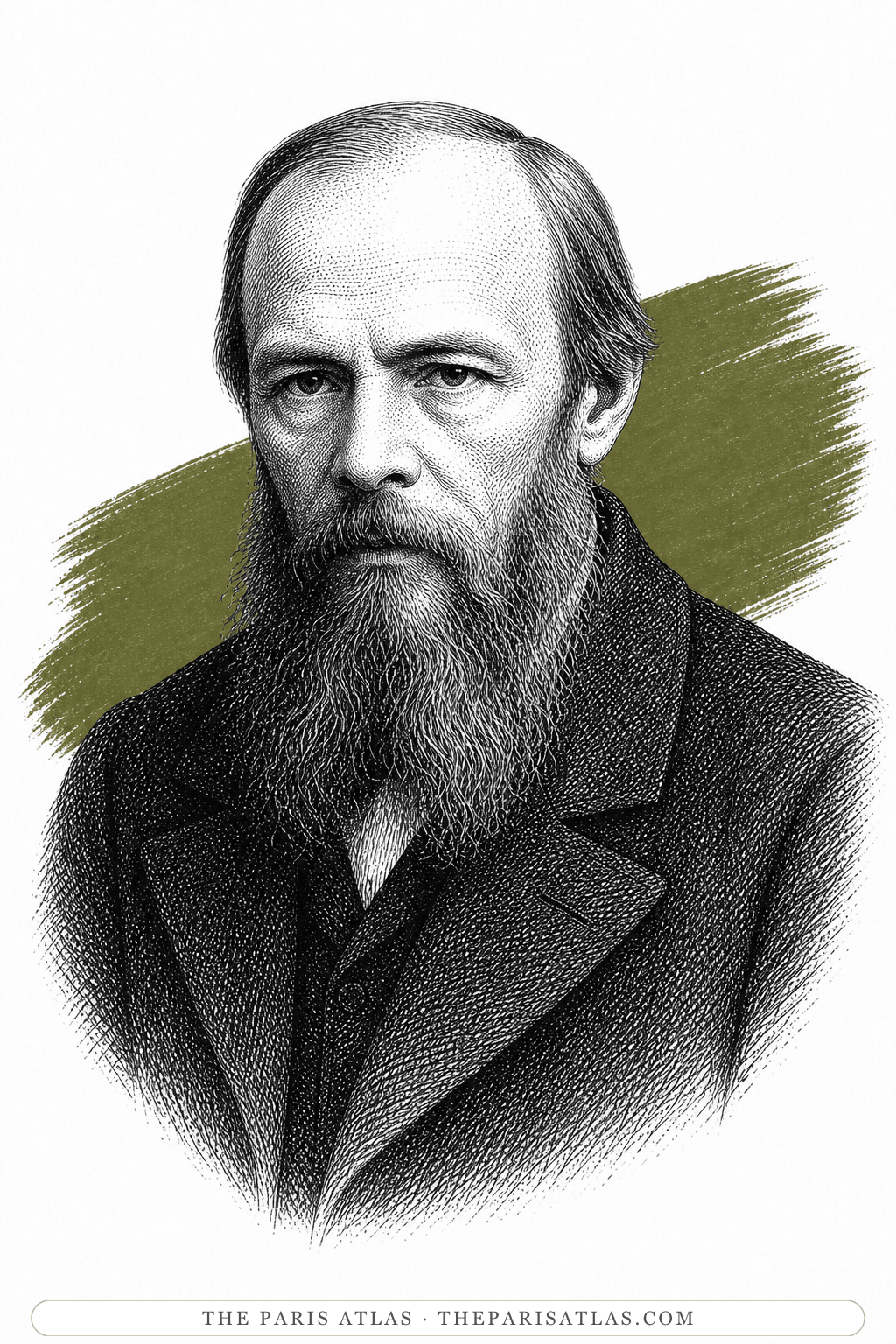
Fyodor Dostoevsky
A greedy old father is murdered, one of his sons is tried for it, and the three brothers argue about God, guilt and freedom on the way to the verdict.
Fyodor Pavlovich Karamazov is a rich, coarse landowner in a small Russian town. He has three legitimate sons: Dmitri, a hot-tempered army officer; Ivan, a cold, brilliant writer who doubts God; and Alyosha, the youngest, a novice at the local monastery. A fourth young man, the servant Smerdyakov, is widely thought to be his son too. Dmitri and his father want the same woman, Grushenka, and quarrel over money. When the old man is found with his skull broken and 3,000 roubles missing, everything points to Dmitri. The book follows the brothers through the murder, the investigation and the trial.
The Brothers Karamazov was Fyodor Dostoevsky's last novel. The Russian Messenger printed it in instalments through 1879 and 1880. The book edition came out in St Petersburg in December 1880, in two volumes whose title pages carry the date 1881. Dostoevsky died a few weeks later. His widow, Anna Grigorievna, said in 1916 that he had meant to start a sequel in 1882, set twenty years on, with Alyosha grown up.[1]
Two events of 1878 shaped the opening books. On 16 May 1878 Dostoevsky's small son Alyosha died. To take him out of his grief, his wife Anna Grigorievna asked the young philosopher Vladimir Solovyov to bring him along on a trip to the Optina monastery. They left in June, and the visit lasted about a week. Scholars agree that the monastery scenes of the first books were written under its fresh impression.[1]
The town is modelled on Staraya Russa, the small lakeside resort where the Dostoevskys spent their summers. The narrator admits the town's name only in Part IV: Skotoprigonyevsk, which comes from the Russian for driving cattle. The scholars trace it to the cattle market on the main square of Staraya Russa. The writer's daughter Lyubov later said she recognised the town's layout in the novel, down to the family's own summer house and their favourite coachmen.[1][2]
The quotations here come from Constance Garnett's English translation, first published in London by Heinemann in 1912. The text is out of copyright and free from Project Gutenberg. Garnett writes Alyosha's father as Fyodor Pavlovitch and the family's cousin as Miüsov.[3][2]
The novel is in four parts, twelve books and an epilogue. It opens with a family history. Fyodor Pavlovich neglected all his sons as small children. Dmitri, from his first marriage, was taken in by relatives; Ivan and Alyosha, from his second, were raised by others after their mother died. Now all three are back in the town. Alyosha has become a novice under Father Zosima, an elder of the monastery whom the townspeople revere.[2]
The family meets at the monastery to settle Dmitri's dispute with his father over his inheritance. The meeting turns into a scandal. Fyodor Pavlovich plays the clown, Dmitri bursts in late and furious, and at the end Zosima kneels and bows to Dmitri until his forehead touches the floor. He gives no explanation at the time.[2]
Dmitri is engaged to Katerina Ivanovna, a proud young woman who trusted him with 3,000 roubles to post to her sister in Moscow. He spent the money on a spree with Grushenka, the woman both he and his father are chasing. His father keeps an envelope with 3,000 roubles in it, tied with a ribbon and addressed to Grushenka, in case she comes to him. Dmitri needs money to pay Katerina back and to take Grushenka away, and he says openly that he could kill his father.[2]
In a tavern Ivan tells Alyosha why he cannot accept God's world. He lists real cases of cruelty to children and says no future harmony can be worth their suffering. Then he recites a prose poem he has made up, The Grand Inquisitor. In sixteenth-century Seville, Christ returns, and the old cardinal who runs the Inquisition arrests him. The Inquisitor explains that people cannot bear the freedom Christ gave them and want bread, miracles and authority instead. Christ answers by kissing him.[2]
Zosima dies, and his body begins to smell far sooner than the monks expect of a holy man. Alyosha is shaken and lets his friend Rakitin take him to Grushenka's house. Grushenka turns out to be kinder than her reputation, and Alyosha comes back to the monastery and throws himself down on the earth outside. That same night Dmitri goes to his father's garden, runs off, strikes the old servant Grigory with a brass pestle, and rides out to the village of Mokroe to find Grushenka. Before morning he is arrested there for his father's murder.[2]
While Dmitri waits for his trial, Alyosha befriends a group of schoolboys. One of them, Ilyusha, is dying. His father is a poor retired captain whom Dmitri once dragged out of a tavern by his beard, in front of the boy. Ivan, meanwhile, visits Smerdyakov three times.[2]
At the third visit Smerdyakov tells Ivan that he killed Fyodor Pavlovich himself, faking an epileptic fit as his alibi, and that he did it because of Ivan's own idea that everything is lawful. He hands over the 3,000 roubles. That night Smerdyakov hangs himself, and Ivan, on the edge of a breakdown, has a long conversation with a shabby, witty devil.
At the trial Ivan tells the court Smerdyakov did it and produces the money, but he is raving and nobody believes him. Katerina Ivanovna, frightened for Ivan, hands the court a drunken letter Dmitri wrote her the day before the murder, promising to kill his father. The jury of four petty officials, two merchants and six peasants and artisans finds Dmitri guilty on every count.
In the epilogue, Ivan lies ill with brain fever and Katerina Ivanovna is planning Dmitri's escape to America with Grushenka. Dmitri says he already hates America and means to come back to Russia in disguise, passing as an American. The book ends at Ilyusha's funeral. At the big stone where Ilyusha once asked to be buried, Alyosha asks the boys never to forget him or each other, and they cheer: Hurrah for Karamazov!
The idea that drives the plot belongs to Ivan and is stated by other people first. At the monastery, and again in Rakitin's mouth, it is summed up like this: if there is no immortality of the soul, there is no virtue, and everything is lawful. Ivan means it as an argument. Smerdyakov takes it as permission. In Book XI, at their last meeting, Smerdyakov tells Ivan that the murder was done with Ivan's help and on Ivan's principle.
So the book has three guilty men and one killer. Dmitri wished his father dead and said so in public. Ivan wanted it too and left town on the day it happened. Smerdyakov struck the blows. Dmitri is the one convicted. Even before the trial he says he will accept punishment, not for killing his father but for having wanted to.
Book V holds the two most famous chapters. In Rebellion, Ivan does not deny that God exists. He says that if the price of eternal harmony is the torture of one child, he will not pay it. He says it is not God he refuses, only the ticket, which he most respectfully returns. Alyosha answers quietly that this is rebellion.
Ivan introduces The Grand Inquisitor with a Paris example. In the Middle Ages, he says, French clerks and monks put the Madonna, the saints and God himself on stage. As proof he cites Victor Hugo's Notre-Dame de Paris, where a play of the Virgin's good judgment is staged for the people in the Hôtel de Ville of Paris under Louis XI. His own poem, he says, is that kind of thing.
Paris is where the Karamazov story begins. In the first book, Dmitri is rescued from his father's neglect by Pyotr Miusov, a cousin of his mother, who has just come back from Paris. Miusov is a liberal of the 1840s who knew Proudhon and Bakunin. In old age he loves describing the three days of the February 1848 revolution in Paris and hints that he nearly fought on the barricades.
At the monastery Miusov tells a Paris story. Soon after the coup d'état of December, he says, he met a man in charge of a whole regiment of political detectives, in the house of a powerful official. The policeman told him that atheist socialists did not frighten the government. What frightened it were the few socialists who were also Christians.
French readers first met the novel in 1888, when Plon in Paris published a version by E. Halpérine-Kaminsky and Charles Morice. The title page calls it translated and adapted, and it was shortened.
The stage version that lasted was made in Paris. Jacques Copeau and Jean Croué adapted the novel as a play in five acts. Copeau's staging opened at the Théâtre des Arts on 6 April 1911, with sets by Maxime Dethomas. The Russian academic edition calls it the best-known Western stage version of the book, and says it was later translated and staged in Belgrade, New York and Bucharest.
André Barsacq revived the Copeau and Croué play at the Théâtre de l'Atelier in Paris in 1946. He staged it with almost no scenery and in modern dress, and made Grushenka the centre of the evening. Maria Casarès played her.
Above all, don't lie to yourself. The man who lies to himself and listens to his own lie comes to such a pass that he cannot distinguish the truth within him, or around him, and so loses all respect for himself and for others.
It's not God that I don't accept, Alyosha, only I most respectfully return Him the ticket.
In Victor Hugo's Notre Dame de Paris an edifying and gratuitous spectacle was provided for the people in the Hôtel de Ville of Paris in the reign of Louis XI. in honor of the birth of the dauphin.
The question of who killed Fyodor Pavlovich is settled for the reader before the trial, which lets the novel ask the harder question of who is guilty.
Ivan's prose poem about Christ returning to Seville and being arrested is one of the most discussed chapters in any novel. The chapter sits in Book V.
Inside the novel, Dmitri's rescuer Miusov is a veteran of Paris in 1848. Outside it, Jacques Copeau's 1911 stage version opened in Paris and became the best-known Western adaptation.
Constance Garnett's 1912 translation is out of copyright and on Project Gutenberg as ebook 28054.
The father: a rich, drunken, clowning landowner who neglected all his sons. He is murdered in his own house.
The eldest son, an army officer ruled by his passions. He loves Grushenka, owes Katerina Ivanovna money, and is tried for his father's murder.
The middle son, a clever writer who cannot accept God's world. Author of The Grand Inquisitor, and of the idea that everything is lawful.
The youngest son, a novice at the monastery and a friend to everyone. The narrator calls him the hero of the book.
Fyodor Pavlovich's cook and servant, epileptic and resentful, widely believed to be his illegitimate son. He admires Ivan.
The elder of the monastery and Alyosha's teacher. His talks on love and responsibility fill Book VI.
A young woman of the town, kept by an old merchant, whom both Dmitri and his father want. Tougher and kinder than her reputation.
Dmitri's proud fiancée, who is in love with Ivan. Her evidence at the trial decides Dmitri's fate.
1878
Dostoevsky's son Alyosha dies on 16 May. In June Dostoevsky visits the Optina monastery with Vladimir Solovyov.
1879
The Russian Messenger begins printing the novel in its January issue.
1880
The last instalments appear in The Russian Messenger. The two-volume book edition comes out in St Petersburg in December, dated 1881 on its title pages.
1881
Dostoevsky dies in St Petersburg early in the year.
1888
Plon in Paris publishes the first French version, translated and adapted by E. Halpérine-Kaminsky and Charles Morice.
1911
Jacques Copeau and Jean Croué's stage version opens at the Théâtre des Arts in Paris on 6 April. Constance Garnett's English translation appears in London the following year.
1946
André Barsacq revives the Copeau and Croué play at the Théâtre de l'Atelier in Paris, with Maria Casarès as Grushenka.


Crime and Punishment
Fyodor Dostoevsky
The earlier murder novel. Raskolnikov acts on his own theory; here the man with the theory leaves town and someone else acts on it.
Read our takeThe Idiot
Fyodor Dostoevsky
Myshkin is the first draft of Alyosha. The Russian academic edition names him as Alyosha's forerunner.
Read our take
The first of Dostoevsky's arguing narrators. Ivan's case against the world grows out of the underground man's case against reason.
Read our takeWhite Nights
Fyodor Dostoevsky
The young Dostoevsky of 1848, before prison, writing about a dreamer rather than a murderer.
Read our take
The Victor Hugo novel Ivan cites to introduce The Grand Inquisitor, for its Paris mystery play at the Hôtel de Ville.
Read our take
Albert Camus's essay on revolt, which takes up Dostoevsky among the writers who asked what follows once God is refused.
Read our take
Albert Camus's essay on the absurd, which reads Dostoevsky's novels in its section on absurd creation.
Read our takeSmerdyakov, the servant who is probably his illegitimate son. He confesses to Ivan in Book XI and says he acted on Ivan's idea that everything is lawful. Dmitri is convicted of the murder anyway.
A prose poem that Ivan tells Alyosha in Book V, Chapter V. Christ returns to sixteenth-century Seville and is arrested by the aged head of the Inquisition. The cardinal explains why the Church has corrected Christ's work by taking away people's freedom. Christ kisses him in answer.
Yes, in two ways. Inside the novel, the family cousin Miusov has lived in Paris and loves to tell stories of the 1848 revolution, and Ivan introduces The Grand Inquisitor by citing Victor Hugo's Notre-Dame de Paris. Outside it, Jacques Copeau and Jean Croué's stage version opened at the Théâtre des Arts in Paris in 1911.
In instalments in The Russian Messenger in 1879 and 1880. The two-volume book came out in December 1880, dated 1881. Dostoevsky died a few weeks later.
Richard Pevear and Larissa Volokhonsky's (2002) and David McDuff's (Penguin, 2003) are the most widely used modern translations, and both are in copyright. Constance Garnett's 1912 translation is out of copyright and free on Project Gutenberg as ebook 28054.
The narrator names Alyosha, the youngest brother, as the hero. In practice the book is shared among the three brothers, and Dmitri's case drives the plot.
Explore authors with a similar voice, perspective, and influence.
The doctor of the Paris slums who wrote the century's blackest, funniest novel — and changed the sound of French prose.
View author
French writer and philosopher whose novels, memoirs, and social analysis examined freedom, gender, responsibility, aging, and the material conditions that shape a life.
View author
American novelist and composer whose expatriate fiction explores dislocation, unstable intimacy, fatalism, and North Africa.
View authorThe sources below include the primary text, editions, scholarship, archival materials, and other records that informed this page. They document The Brothers Karamazov, its publication, and its place in literary history.

The scholarly afterword in the Russian academic edition: publication dates, the 1878 Optina journey, Staraya Russa as the model town, and the foreign stage versions.

A scan of the 1912 Heinemann printing of Garnett's translation, for its date and publisher.
The Bibliothèque nationale de France's digitised copy of the first French version, Paris, 1888.
The Bibliothèque nationale de France's record of Maxime Dethomas's set design, which gives the theatre and the opening date of the 1911 production.
Library catalogue records used to confirm each modern edition's ISBN, publisher, year and translator.
The primary text is the baseline reference for every book page. Additional references document publication history, interpretation, and historical context where that evidence is available.
 Explore more resources