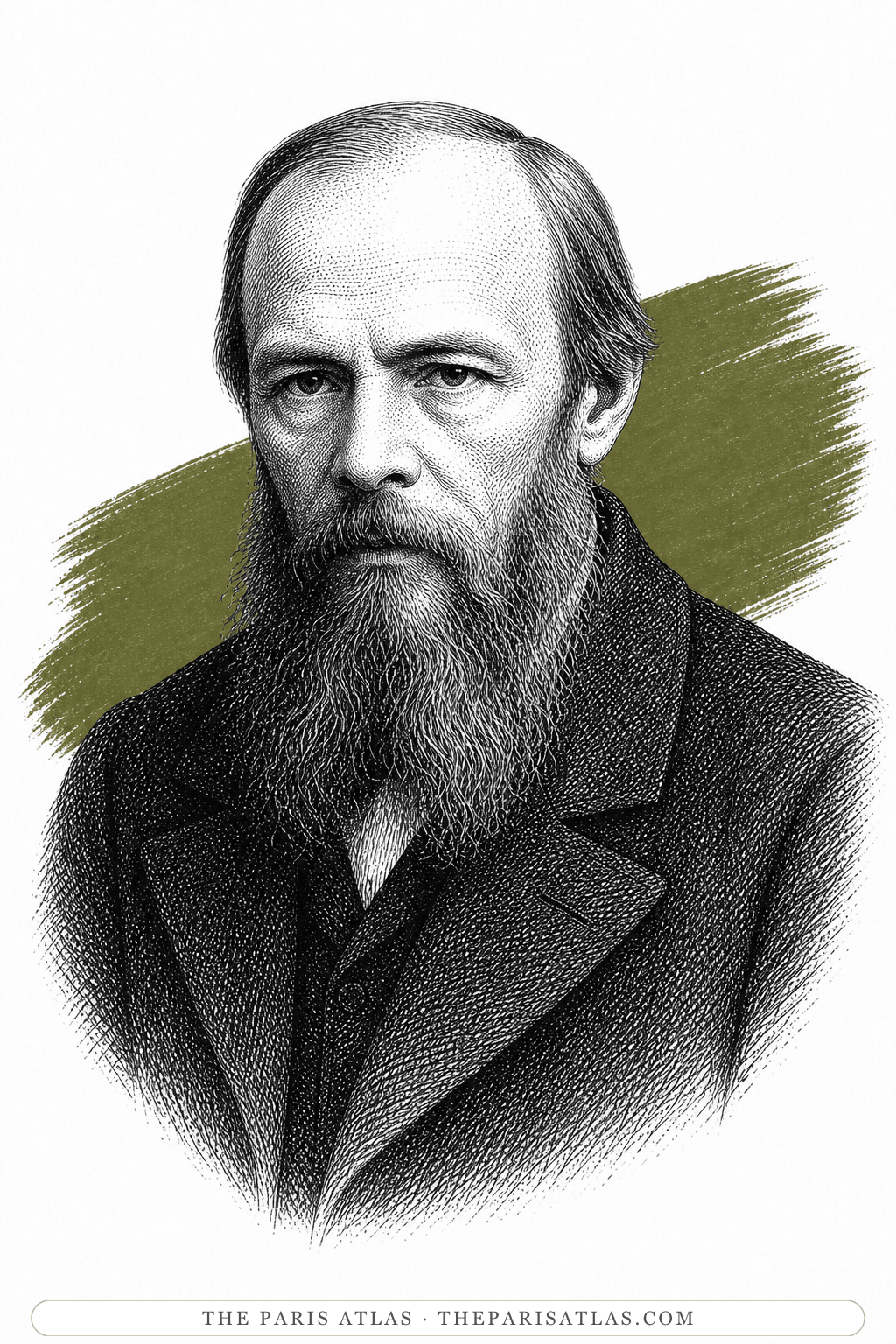

Notes from Underground
Written two years earlier. The Russian academic edition calls it the groundwork for Raskolnikov and Sonya: a proud thinker, a young woman from a brothel, and a theory that fails in contact with real life.
Read our takeCrime and Punishment
Fyodor Dostoevsky
A penniless former student kills an old pawnbroker to prove a theory, then spends the rest of the novel being hunted by his own conscience and a patient detective.
Rodion Raskolnikov is a former law student living in a tiny rented room in St Petersburg with no money left. He has half convinced himself that a great man may step over the law, and he kills an old pawnbroker with an axe to find out whether he is one. Her sister walks in and he kills her too. The rest of the book follows the weeks after the murders. Raskolnikov falls ill, gives money away, plays a long game of nerves with the investigator Porfiry Petrovich, and finds that the only person he can tell is Sonya Marmeladova, a young woman forced into prostitution to feed her family.
Fyodor Dostoevsky wrote the novel in 1865 and 1866, under heavy debt and against deadlines. The book came out of two separate plans. In June 1865 he offered editors a novel called The Drunkards, about drinking and the families it wrecks, and nobody took it. In mid-September 1865, writing from the spa town of Wiesbaden, he offered Mikhail Katkov of The Russian Messenger a shorter story he called a psychological account of a crime.[1]
The two plans grew into one novel. The drunken clerk Marmeladov and his starving family came from The Drunkards; the student and his murder came from the story for Katkov. Back in St Petersburg in late November 1865, Dostoevsky burned most of what he had written and started again on a new plan. The first chapters went to Katkov about a month later.[1]
The Russian Messenger printed the novel across eight monthly issues of 1866. In the magazine it was divided into three parts. For the book edition of 1867 Dostoevsky reorganised it into the six parts and epilogue that readers know now, cut some episodes and corrected the style.[1]
The quotations here come from Constance Garnett's English translation, which is out of copyright and free from Project Gutenberg. Garnett spells some names in an older way: Sonia for Sonya, Dounia for Dunya, Razumihin for Razumikhin.[2]
On a hot evening in early July, Raskolnikov leaves the attic room he rents and walks toward a bridge, rehearsing something he has not yet dared to do. He is visiting Alyona Ivanovna, an old pawnbroker, to measure her flat. In a tavern on the way home he meets Marmeladov, a drunken former clerk, who tells him that his daughter Sonya has taken the yellow ticket, the licence of a registered prostitute, so the family can eat.[2]
A letter from his mother tells Raskolnikov that his sister Dunya is to marry Pyotr Luzhin, a prosperous man of forty-five, largely to help her brother. Raskolnikov reads the engagement as a sale. He goes to the pawnbroker's flat with an axe under his coat and kills her. Her half-sister Lizaveta comes in while he is still there, and he kills her as well. He escapes down the stairs by luck and hides the purse and trinkets under a stone in a yard.[2]
For days Raskolnikov lies in a fever. His friend Razumikhin nurses him. When he recovers he behaves like a man who wants to be caught: he returns to the scene of the crime and teases a police clerk about the murders in a tavern. Marmeladov is run over by a carriage in the street, and Raskolnikov gives the widow the money his mother sent him for the funeral.[2]
Porfiry Petrovich, the investigating magistrate, has read an article Raskolnikov published months before. In it men are split into ordinary people, who must obey the law, and extraordinary ones, who have a right to cross it. Porfiry has no proof. He talks to Raskolnikov in long, friendly, circling conversations, and waits. A painter called Nikolay confesses to the murders, which buys Raskolnikov time but no peace.[2]
Arkady Svidrigailov, the rich man in whose house Dunya once worked as a governess, arrives in St Petersburg. Raskolnikov tells Sonya that he killed the pawnbroker and Lizaveta, and Svidrigailov overhears it through the wall. He tries to use the secret to force Dunya. She fires a revolver at him and grazes his head, then throws the gun away. He lets her go. The next morning he shoots himself in the street.[2]
Sonya tells Raskolnikov to go to a crossroads, bow down, kiss the earth and say aloud that he is a murderer. He goes to the Haymarket, falls to his knees and kisses the ground, then walks into the police station and confesses to the officer Ilya Petrovich. The court takes into account his illness and the good he did before, and sentences him to eight years of penal servitude in Siberia.
Sonya follows him to the prison town. Dunya marries Razumikhin, and their mother dies of a fever. For months Raskolnikov stays cold to Sonya and still does not believe his crime was wrong, only that he failed. Then, on a bright morning by the river near the prison, he throws his arms round her knees and weeps. Seven years of his sentence are left. The narrator ends by saying that the story of his gradual renewal would be a new story, and this one is over.
The murder is a test of an idea. In Part III, Porfiry sums up Raskolnikov's article for him: men are divided into ordinary and extraordinary, and the extraordinary have a right to commit any crime. Raskolnikov corrects him only slightly. Napoleon is his example throughout. Near the end of Part V he tells Sonya that he wanted to become a Napoleon, and that this is why he killed the pawnbroker.
Part of the idea came from Paris. In March 1865 Napoleon III, the emperor of the French, published a Life of Julius Caesar. In its preface he argued that exceptional men have a right to break the moral rules that bind everyone else. The book was quickly known in Russia and argued over in the Russian press. The editors of the Russian academic edition of Dostoevsky name that preface as one of the sources of Raskolnikov's theory.
The germ is older than the book. In September 1863 Dostoevsky was travelling in Italy with Apollinaria Suslova. Her diary records a dinner in Turin where he watched a little girl at her lessons and said something like this: imagine such a girl with an old man, and suddenly some Napoleon says, destroy the whole town. Things have always been like that in the world, he added.
Dostoevsky read French crime closely. Vremya, the magazine he ran with his brother Mikhail in the early 1860s, printed reports of famous French trials of the 1830s to the 1850s. One was the trial of Pierre-François Lacenaire, a Paris murderer who tried to justify his killings as a matter of principle. Dostoevsky added a note to the report. Cases like this, he wrote, are more gripping than any novel, because they light up dark sides of the human soul that art prefers not to touch.
The scholars also connect the novel to a Paris book, Balzac's Père Goriot. In that novel the student Rastignac asks his friend Bianchon a question. If you could get a million by willing the death of an old mandarin in China, without leaving Paris, would you do it? Bianchon says no. Dostoevsky remembered the scene well enough to retell it in a draft of his 1880 speech on Pushkin, where he called the refusal the French student's answer.
Sonya Marmeladova is the book's answer to Raskolnikov's theory, and she never argues with it. She is eighteen, sells herself so her stepmother and the small children can eat, and reads the Gospels. Raskolnikov goes to her room and makes her read aloud the story of Jesus raising Lazarus from the dead. Later he confesses to her there, and she tells him to go and kiss the earth at a crossroads.
The epilogue brings the Lazarus reading back. In the prison hospital Raskolnikov keeps Sonya's New Testament under his pillow, the same book she read from. He has not yet opened it. He only wonders whether her convictions could now be his. Dostoevsky stops the novel there, before any conversion is shown, and says the renewal of a man would be the subject of a new story.
French readers got the complete novel in 1884. Plon, the Paris publisher, issued Victor Derély's translation that year as Le Crime et le châtiment, in two small volumes. The Russian academic edition lists 1884 as the year of the full French translation. English readers waited until 1886.
The first stage version outside Russia opened in Paris, at the Théâtre de l'Odéon, on 15 September 1888. Paul Ginisty and Hugues Le Roux wrote it as a drama in seven scenes, and Paul Mounet played Raskolnikov under the name Rodion. The play text was printed in Paris the same year, and an engraving of the production appeared in Le Théâtre illustré. Both are in the Bibliothèque nationale de France.
On an exceptionally hot evening early in July a young man came out of the garret in which he lodged in S. Place and walked slowly, as though in hesitation, towards K. bridge.
Ordinary men have to live in submission, have no right to transgress the law, because, don't you see, they are ordinary. But extraordinary men have a right to commit any crime and to transgress the law in any way, just because they are extraordinary.
Pain and suffering are always inevitable for a large intelligence and a deep heart. The really great men must, I think, have great sadness on earth.
The crime happens early and fast. The rest is about what it does to the man who committed it, which is why the book still works as a thriller.
Porfiry Petrovich has no evidence and knows it. His three long conversations with Raskolnikov are some of the tensest scenes in the novel.
The idea of the extraordinary man has links to Napoleon III's Life of Julius Caesar and to a Balzac student in Père Goriot. The scholars of the Russian academic edition trace both.
Constance Garnett's translation is out of copyright and on Project Gutenberg as ebook 2554.
A former law student, proud and penniless, who kills an old pawnbroker to prove to himself that he is an extraordinary man. Garnett calls him Rodion Romanovitch.
Marmeladov's daughter, who sells herself to feed her stepmother and the little children. The first person Raskolnikov confesses to, and the one who follows him to Siberia. Garnett spells her Sonia.
The investigating magistrate. He has read Raskolnikov's article, suspects him early, and waits for him to break rather than arrest him.
Raskolnikov's sister. Agrees to marry Luzhin to help her brother, breaks it off, and fires a revolver at Svidrigailov. Garnett spells her Dounia.
Raskolnikov's loyal, noisy friend from the university, who nurses him through his fever and marries Dunya. Garnett spells him Razumihin.
Dunya's former employer, rich and depraved, who follows her to St Petersburg and overhears Raskolnikov's confession. He shoots himself before the end.
A drunken former government clerk who tells Raskolnikov his family's story in a tavern. He is run over by a carriage in Part II.
The old pawnbroker Raskolnikov kills. He has pawned his father's old silver watch with her.
1863
In Turin, Dostoevsky tells Apollinaria Suslova an idea about a Napoleon who orders a whole town destroyed. Scholars treat it as the novel's first seed.
1865
In June he offers a novel called The Drunkards to two editors, who turn it down. In mid-September, from Wiesbaden, he offers Mikhail Katkov a story about a student's crime.
1865
Back in St Petersburg in late November, he burns most of the draft and begins again on a new plan.
1866
The Russian Messenger serialises the novel through the year. On 18 March Dostoevsky reads the tavern chapter with Marmeladov at a public literary evening in St Petersburg.
1867
The first book edition appears, now divided into six parts and an epilogue.
1884
Plon in Paris publishes Victor Derély's complete French translation.
1888
Paul Ginisty and Hugues Le Roux's stage version opens at the Théâtre de l'Odéon in Paris on 15 September, with Paul Mounet as Raskolnikov.


Written two years earlier. The Russian academic edition calls it the groundwork for Raskolnikov and Sonya: a proud thinker, a young woman from a brothel, and a theory that fails in contact with real life.
Read our takeThe Brothers Karamazov
Fyodor Dostoevsky
Dostoevsky's last novel returns to murder, guilt and a trial, and asks who is responsible when an idea leads someone else to kill.
Read our takeThe Idiot
Fyodor Dostoevsky
The next novel, written abroad. Dostoevsky tried to draw a wholly good man after drawing a murderer.
Read our takeWhite Nights
Fyodor Dostoevsky
The same St Petersburg canals, eighteen years earlier and in a gentle mood.
Read our take
Victor Hugo's novel of a convict's redemption, which Dostoevsky admired. He named Jean Valjean in a letter about the good hero he wanted to write next.
Read our take
A real double killing told from inside the killers' heads, a century later and in Kansas.
Read our take
Another murder with no ordinary motive, told flatly where Dostoevsky is feverish.
Read our takeA poor former student in St Petersburg, Rodion Raskolnikov, kills an old pawnbroker and her sister with an axe. The novel follows the weeks after the murders: his illness, his duel of nerves with the investigator Porfiry Petrovich, and his confession to Sonya Marmeladova.
He gives more than one reason. He is desperate for money and wants to spare his sister a bad marriage. But he also wants to test a theory that extraordinary people, like Napoleon, have a right to break the law. He tells Sonya he wanted to become a Napoleon.
He confesses. Porfiry has no firm proof and waits for him to break. After Svidrigailov's suicide, Raskolnikov kisses the ground in the Haymarket and confesses at the police station. He is sentenced to eight years in Siberia.
Two things in the novel's background and two in its afterlife. Napoleon III's Life of Julius Caesar, published in 1865, fed Raskolnikov's theory, and Dostoevsky's magazine had printed the trial of the Paris murderer Lacenaire. Plon in Paris published the first full French translation in 1884, and the first stage version outside Russia opened at the Odéon in 1888.
Oliver Ready's (Penguin, 2015) and Richard Pevear and Larissa Volokhonsky's (Vintage, 1993) are the most widely used modern translations, and both are in copyright. Constance Garnett's older translation is out of copyright and free on Project Gutenberg as ebook 2554.
In 1866, in monthly instalments in the Moscow magazine The Russian Messenger. The first book edition followed in 1867.
The investigating magistrate in charge of the case. He has read an article Raskolnikov wrote about extraordinary men, suspects him early, and spends the novel talking to him rather than arresting him.
Explore authors with a similar voice, perspective, and influence.
The doctor of the Paris slums who wrote the century's blackest, funniest novel — and changed the sound of French prose.
View author
French writer and philosopher whose novels, memoirs, and social analysis examined freedom, gender, responsibility, aging, and the material conditions that shape a life.
View author
American novelist and composer whose expatriate fiction explores dislocation, unstable intimacy, fatalism, and North Africa.
View authorThe sources below include the primary text, editions, scholarship, archival materials, and other records that informed this page. They document Crime and Punishment, its publication, and its place in literary history.


The scholarly commentary in the Russian academic edition of Dostoevsky's works: the history of writing and publication, the French sources, and the first translations and stage versions.

The Bibliothèque nationale de France's digitised copy of the first complete French translation, Paris, 1884.
The printed text of the 1888 Paris stage version by Paul Ginisty and Hugues Le Roux.
The Bibliothèque nationale de France's record of an engraving of the Odéon production, which gives the opening date and the cast.
Library catalogue records used to confirm each modern edition's ISBN, publisher, year and translator.
The primary text is the baseline reference for every book page. Additional references document publication history, interpretation, and historical context where that evidence is available.
 Explore more resources