The Paris AtlasCharting the artists, works, and places worth returning to.
  • Sculptor
· French · 1864–1943

Camille Claudel

French sculptor who taught herself in the clay of Nogent-sur-Seine, was handed on from her first teacher to Auguste Rodin, worked ten years inside his studio as student, assistant and lover, made The Waltz and The Age of Maturity on her own, and spent the last thirty years of her life confined in asylums without sculpting.

Details

Lived
1864–1943
Born
1864
Birthplace
Fère-en-Tardenois, Aisne
Died
1943
Place of death
Montfavet, near Avignon
Nationality
French
Partner
Auguste Rodin · c. 1882–1892
Roles
Sculptor

About Camille Claudel

Camille Claudel was a sculptor at an age when most children have not chosen anything, and she was discovered by accident. Her family moved to Nogent-sur-Seine, a pottery town southeast of Paris, when she was twelve; she dug clay out of the ground and modelled it, and a professional sculptor who lived there, Alfred Boucher, noticed what the self-taught girl was doing and started correcting her. When Boucher left for Italy in 1882 he asked a colleague to take his pupil on. The colleague was Auguste Rodin.

What followed is usually told as a love story, and it was one. It was also a working arrangement of a specific and unequal kind: Rodin was twenty-four years older, already established, permanently attached to another woman, and her teacher. She spent roughly ten years inside his studio as student, assistant and model while making her own sculpture, left it in the early 1890s, worked alone for fifteen years, and in 1913 was committed to an asylum. She stayed in confinement for thirty years and died there in 1943. The museum that now carries her name, at Nogent-sur-Seine, was founded by Alfred Boucher.

The clay at Nogent

Claudel was born in 1864 at Fère-en-Tardenois, in the Aisne, north-east of Paris, into a provincial middle-class family. Her father's work moved them about, and in 1876, when she was twelve, he was appointed registrar of mortgages at Nogent-sur-Seine, a town on the Seine upstream from Paris. It was a pottery-making region, and the material was simply there: in the museum's phrase, she found the clay she needed on-site.

Nogent also held a working sculptor. Alfred Boucher, who had taken the second prize in sculpture for the Prix de Rome — the state scholarship that sent young artists to Italy — in the same year the Claudels arrived, detected the budding talent of the self-taught girl and set about teaching her the rudiments of sculpting, correcting and encouraging her. She had no other training and no art school. She had a man who came by to look at what she had made and tell her what was wrong with it.

Paris, 1881

In 1881 her father sent the rest of the family to Paris for a better education than the provinces could give: his wife, Louise Athanaïse Claudel, and their three children, Camille, her sister Louise, and her younger brother Paul, who would become one of the major French poets and playwrights of the next century. Camille was seventeen. She took courses at the Académie Colarossi, one of the private Paris art schools that trained the students the state academy would not, and shared a studio with a group of young English women who were studying there too.

Boucher kept teaching her, coming by twice a week from his own work to follow her progress. That lasted until 1882, when a gold medal at the Salon des Artistes Français — the annual state-sanctioned exhibition where French sculptors were judged — won him a study trip to Florence. Before he left, he convinced Auguste Rodin to take over for him. Claudel was eighteen, and Rodin, twenty-four years her senior, was an established sculptor with his own studio and assistants.

Ten years in the Rodin studio

The Musée Rodin, which holds both artists' work, sets the span plainly: from 1882, when they first met, until 1892, when they parted, Camille Claudel and Auguste Rodin would enjoy neither peace nor stability. It calls the decade a passionate love affair that lasted ten years, filled with harsh exchanges, hard work, misunderstandings and disappointments, and it lists her roles in a single line — student, assistant, mistress and muse of Auguste Rodin.

That line is also the most exact statement of the asymmetry. Every one of the four roles is defined by him. He was twenty-four years her senior and had been her teacher from the moment Boucher handed her over. He had lived with Rose Beuret since the 1860s and never left her; he married Beuret in 1917, two weeks before her death and nine months before his own. Claudel worked in his studio on his commissions, modelled for his figures, and made her own sculpture in the same years, on her own account, with far less money and no institution behind her. When the relationship ended — the Musée Rodin dates the parting to 1892, the Musée Camille Claudel to 1893 — she was in her late twenties, and what she had was the work.

Her own sculpture

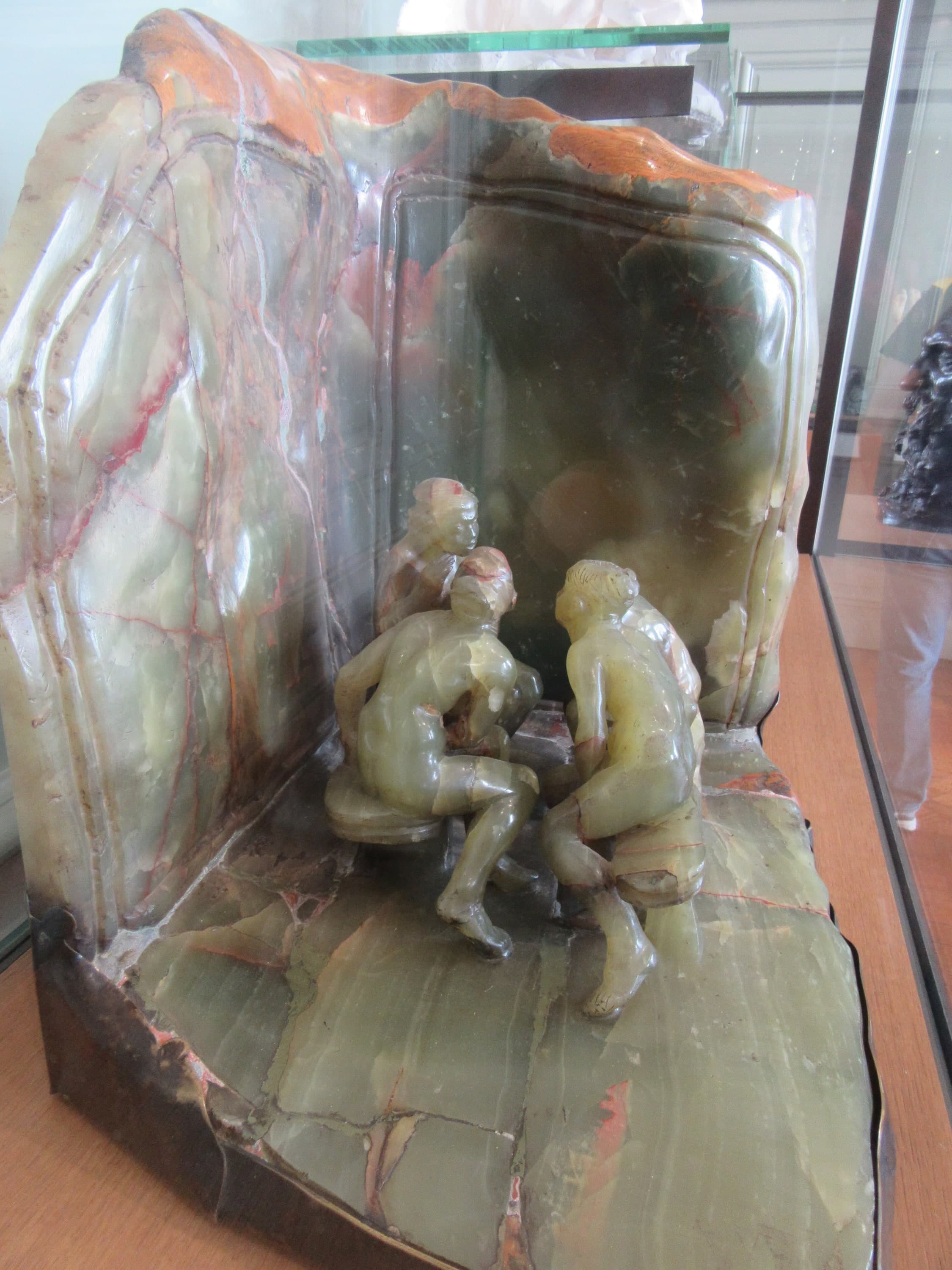
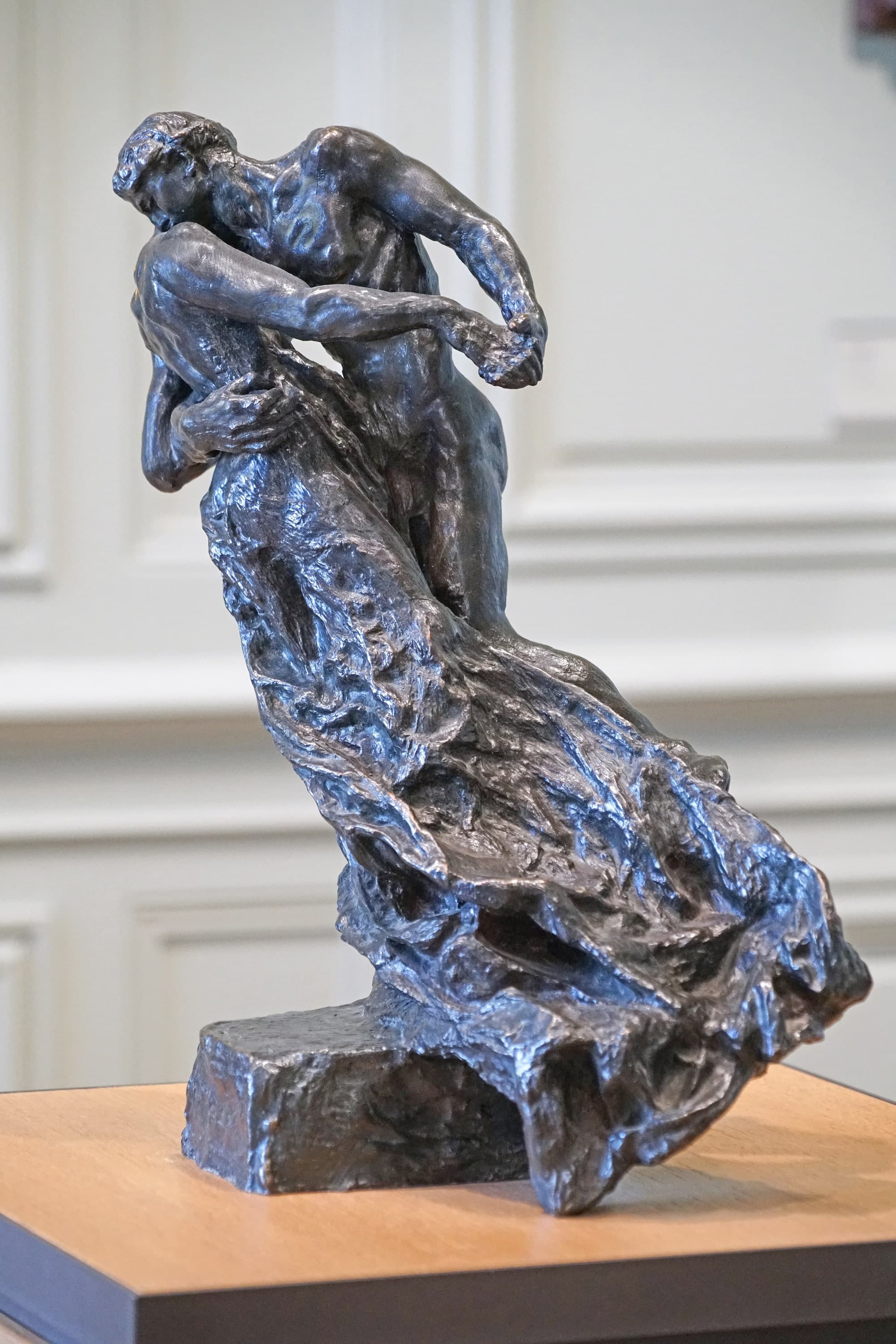
The Waltz gives a dancing couple locked together and leaning off the vertical, so that the whole weight of two bodies rides on a diagonal. The Gossips sets four small women in a huddle, three of them bent in towards the fourth, and began a series of intimate, delicate scenes taken from ordinary life. The Wave puts three bathers under a curling green wall of water, directly influenced by the Japanese printmaker Hokusai and by the taste for Japanese art the French called japonisme. Clotho is a gaunt, naked old woman tangled in her own hair, named for the Greek fate who spins the thread of a life.

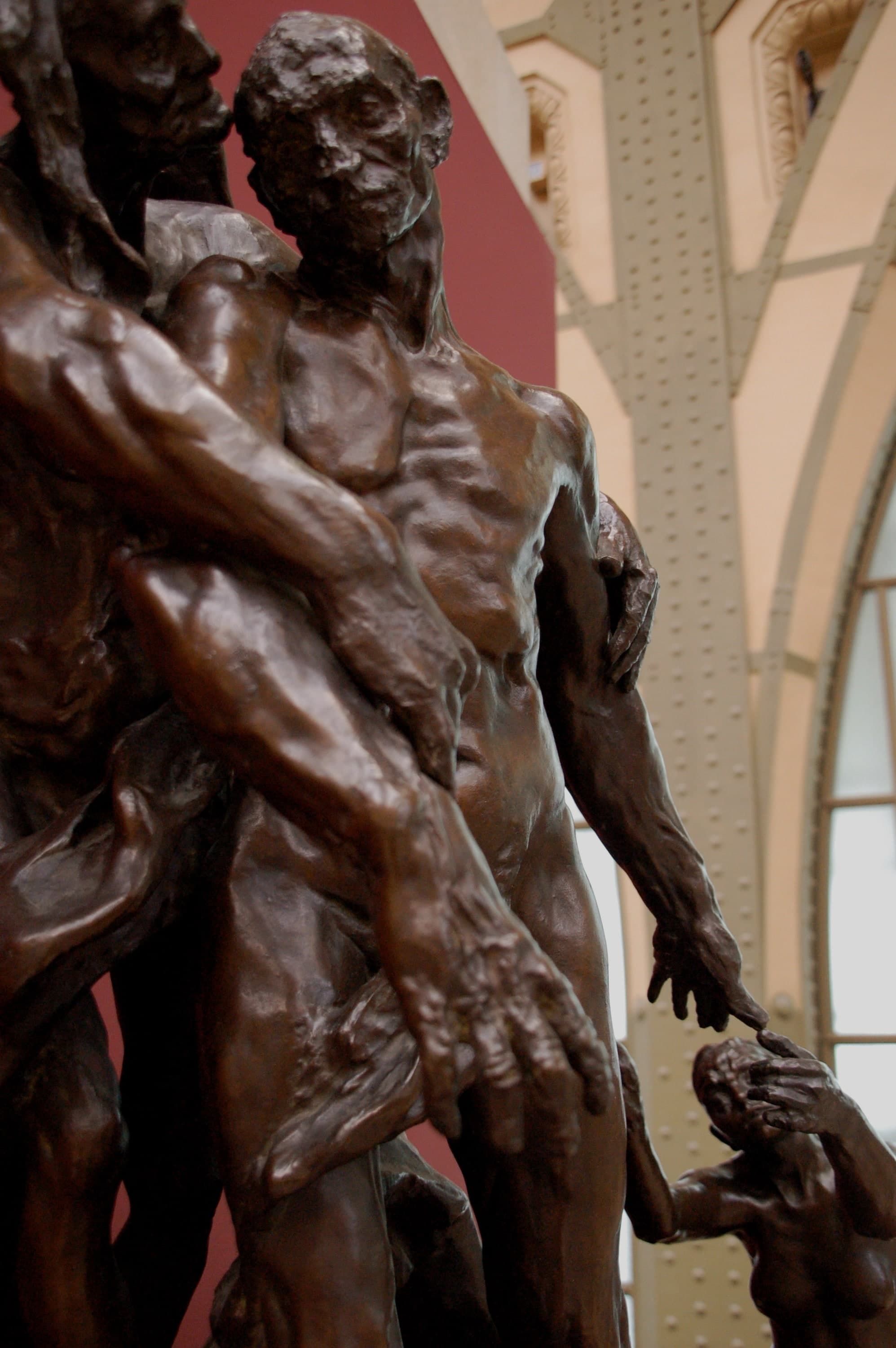
The Age of Maturity is the one that gets read as autobiography. Three figures: an older woman leads a man away, and a young woman on her knees reaches after him with both arms and does not reach him. The Musée Rodin calls it a bitter allegory of the passing of time and the weight of destiny, and dates it to the period of the break-up. Viewers from the start have read the three figures as Rose Beuret, Rodin and Claudel herself, and her brother Paul Claudel read it that way in print. The reading is not the museum's, and the sculpture is a complete work about ageing and abandonment whether or not the names are attached; but the group was modelled by a woman in her thirties in the years immediately after she was left, and the kneeling figure is the one nobody argues about.

The Musée Camille Claudel dates her period of solitary creation from 1893 to 1908. In it she produced the work she is now judged by, including Perseus and the Gorgon, the only monumental marble she ever made. She was exhibiting and selling, and she was doing it while paying for her own marble, her own casting and her own studio.

1913, and the thirty years

In 1913 Claudel was committed to an asylum. She was forty-eight. She was taken first to Ville-Évrard, east of Paris, and moved in 1914 to Montdevergues, at Montfavet near Avignon in the south, where the remaining twenty-nine years were spent. Her biographer Odile Ayral-Clause records that the commitment was made on her family's application days after her father's death, that the asylum staff more than once judged her well enough to leave, and that the family declined to take her out.

She did not sculpt again. That is the fact to hold on to: not thirty years of a mad artist working in confinement, but thirty years in which a sculptor at the height of her powers made nothing, and knew she was making nothing. She wrote letters asking to be let out. She died at Montdevergues in 1943, aged seventy-nine, having spent the last thirty years of her life in confinement.

Nogent-sur-Seine, 2017

Two museums hold the work. The Musée Rodin in Paris shows around twenty of her sculptures, exceptional for their quality and great rarity, given by her brother Paul Claudel or bought by the museum. And the town of Nogent-sur-Seine, where she first got her hands into clay, now has a museum of her own.

It came about slowly and by a neat piece of circularity. The institution began in 1902 as the Dubois-Boucher museum, founded in his home town by Alfred Boucher — the sculptor who had taught the twelve-year-old Claudel — to show his own work and that of the sculptor Paul Dubois. A Claudel exhibition there in 2003 drew forty thousand visitors in three months and redirected the whole institution. The town bought the house the Claudel family had lived in, and the Perseus and the Gorgon marble, in 2008. The rebuilt Musée Camille Claudel, designed by the architect Adelfo Scaranello, opened in 2017, setting her sculpture among some sixty works borrowed from fifteen institutions so that a visitor can see what French sculpture looked like around her.

Life events

  1. 1864

    Born at Fère-en-Tardenois, in the Aisne.

    Musée Camille Claudel, Nogent-sur-Seine, Camille Claudel: life and work (2026)

  2. 1876

    The family moves to Nogent-sur-Seine when she is twelve. She models the local clay untaught, and the sculptor Alfred Boucher begins correcting her.

    Musée Camille Claudel, Nogent-sur-Seine, Camille Claudel and Nogent-sur-Seine (2026)

  3. 1881

    Her mother and the three children move to Paris for a better education. Camille, seventeen, enrols at the Académie Colarossi and shares a studio with English women students.

    Musée Camille Claudel, Nogent-sur-Seine, Camille Claudel and Nogent-sur-Seine (2026)

  4. 1882

    Boucher wins a gold medal at the Salon des Artistes Français and leaves for Florence, persuading Auguste Rodin to take over her instruction. She is eighteen; he is forty-two.

    Musée Camille Claudel, Nogent-sur-Seine, Camille Claudel and Nogent-sur-Seine (2026); Musée Rodin, Camille Claudel comes out of the reserve collections (2026)

  5. 1886–93

    The years of closest work with Rodin — student, assistant, model and lover — and of an intense artistic exchange between them.

    Musée Camille Claudel, Nogent-sur-Seine, Camille Claudel: life and work (2026); Musée Rodin, Camille Claudel comes out of the reserve collections (2026)

  6. 1892

    The relationship ends. The Musée Rodin dates the parting to 1892, the Musée Camille Claudel to 1893.

    Musée Rodin, Camille Claudel (2026); Musée Camille Claudel, Nogent-sur-Seine, Camille Claudel: life and work (2026)

  7. 1893–1908

    Fifteen years of solitary creation: The Waltz, The Gossips, The Wave, Clotho, The Age of Maturity, and Perseus and the Gorgon, her only monumental marble.

    Musée Camille Claudel, Nogent-sur-Seine, Camille Claudel: life and work (2026); Musée Rodin, Camille Claudel (2026); Musée Camille Claudel, Nogent-sur-Seine, History of the museum (2026)

  8. 1902

    Alfred Boucher founds the Dubois-Boucher museum at Nogent-sur-Seine — the institution that will eventually become hers.

    Musée Camille Claudel, Nogent-sur-Seine, History of the museum (2026)

  9. 1913

    Committed to an asylum at forty-eight, on her family's application days after her father's death: first Ville-Évrard, east of Paris.

    Musée Rodin, Camille Claudel (2026); Odile Ayral-Clause, Camille Claudel: A Life (2002)

  10. 1914

    Transferred to Montdevergues, at Montfavet near Avignon, where she remains for twenty-nine years. She does not sculpt again.

    Odile Ayral-Clause, Camille Claudel: A Life (2002)

  11. 1943

    Dies at Montdevergues, aged seventy-nine, after thirty years of confinement.

    Musée Rodin, Camille Claudel (2026); Odile Ayral-Clause, Camille Claudel: A Life (2002)

  12. 2008

    Nogent-sur-Seine buys the house the Claudel family lived in, and acquires Perseus and the Gorgon along with the collections of two private collectors of her work, Reine-Marie Paris and Philippe Cressent.

    Musée Camille Claudel, Nogent-sur-Seine, History of the museum (2026)

  13. 2017

    The Musée Camille Claudel opens at Nogent-sur-Seine, designed by Adelfo Scaranello, her work set among some sixty sculptures borrowed from fifteen institutions.

    Musée Camille Claudel, Nogent-sur-Seine, History of the museum (2026)

People they knew

Documented connections — every one carries its source.

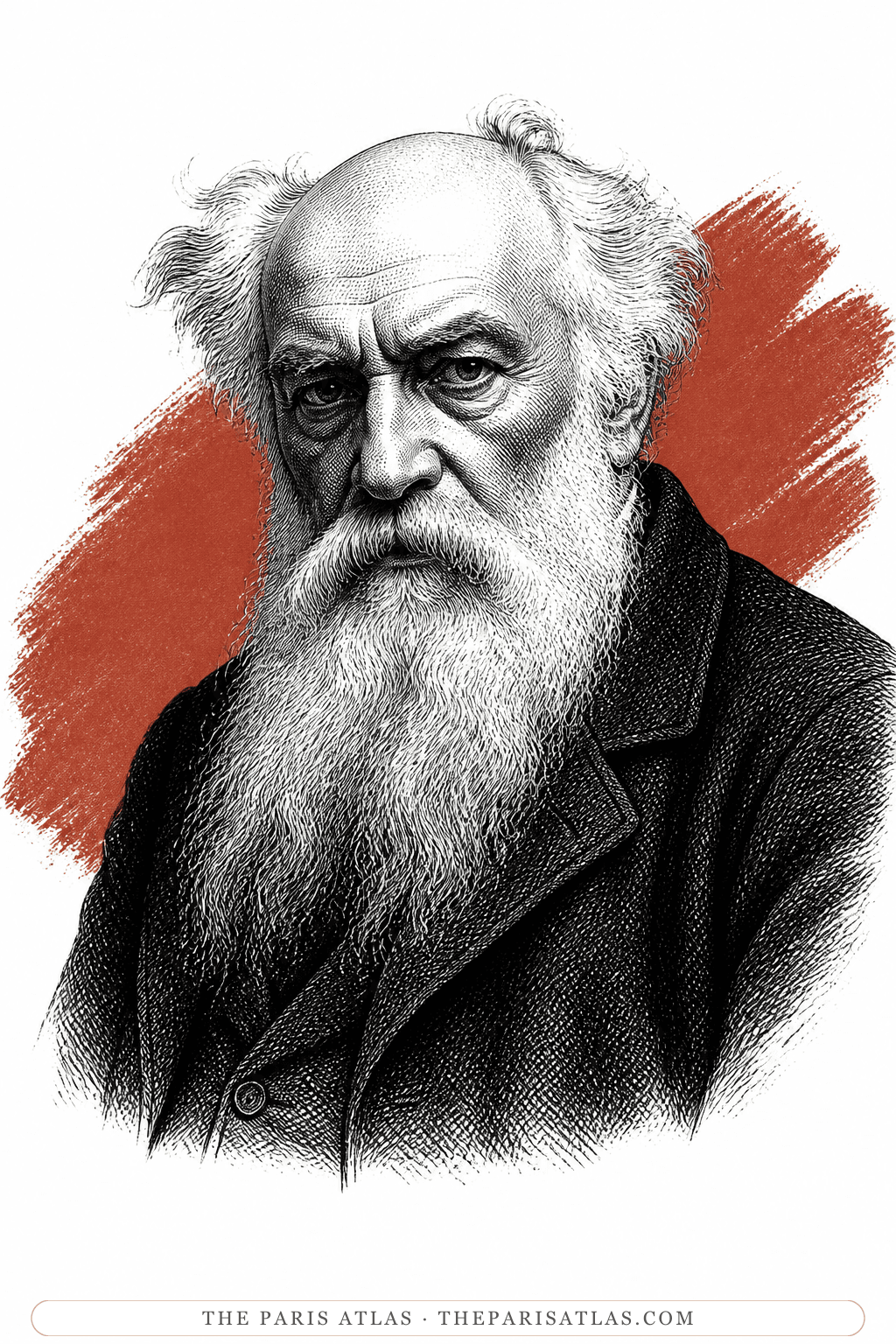
Illustrated portrait of Auguste Rodin

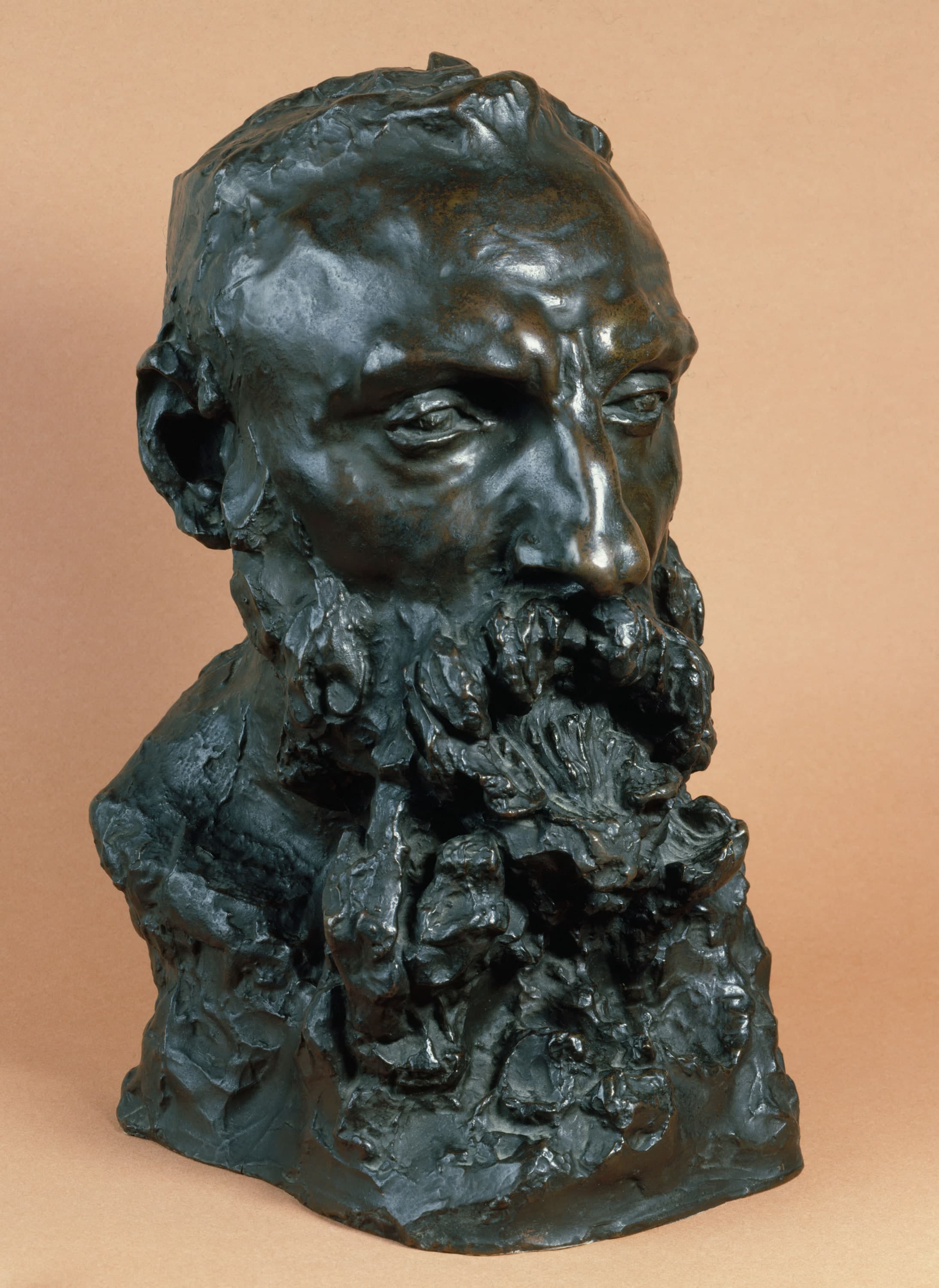
Auguste Rodin

  • Sculptor

Partner of · 1882–1892

The Musée Rodin dates the relationship from their meeting in 1882 to their parting in 1892 and describes Claudel as Rodin's student, assistant, mistress and muse; the Musée Camille Claudel dates the break to 1893. Rodin was twenty-four years her senior, had been her teacher since Alfred Boucher handed her over, and never left Rose Beuret, his companion since the 1860s.

Musée Rodin, Camille Claudel comes out of the reserve collections (2026); Musée Rodin, Camille Claudel (2026); Musée Camille Claudel, Nogent-sur-Seine, Camille Claudel: life and work (2026)

Studied under · 1882

Claudel's first teacher, the sculptor Alfred Boucher, left for Florence in 1882 after winning a gold medal at the Salon des Artistes Français and convinced Rodin to take over her instruction. She was eighteen; he was twenty-four years her senior and an established sculptor. She then worked in his studio for roughly ten years.

Musée Camille Claudel, Nogent-sur-Seine, Camille Claudel and Nogent-sur-Seine (2026); Musée Rodin, Camille Claudel comes out of the reserve collections (2026)

Questions about Camille Claudel

Who was Camille Claudel?

A French sculptor, born in 1864, who learned to model clay untaught as a child at Nogent-sur-Seine, trained in Paris at the Académie Colarossi, and from 1882 worked in Auguste Rodin's studio as his student, assistant and lover for about ten years. She made her own sculpture throughout — The Waltz, The Gossips, The Wave, The Age of Maturity — and worked alone from the early 1890s until 1908. In 1913 she was committed to an asylum, where she remained for thirty years until her death in 1943.

What was her relationship with Auguste Rodin?

Teacher, employer and lover, in that order and all at once. Her first teacher, Alfred Boucher, handed her over to Rodin in 1882 when she was eighteen and he was forty-two. The Musée Rodin describes her as his student, assistant, mistress and muse, and dates the relationship from 1882 to their parting in 1892, calling it a passionate love affair filled with harsh exchanges, hard work, misunderstandings and disappointments. Rodin never left Rose Beuret, his companion since the 1860s, whom he married in 1917 two weeks before she died.

Was Camille Claudel Rodin's student or his collaborator?

Both, which is why the question keeps being asked. She came to him as a pupil, worked in his studio on his commissions, and posed for his figures. She was also making and exhibiting her own sculpture in the same years, and the museums describe the decade as an intense artistic exchange running in both directions. What she did not have was his money, his assistants or his commissions.

What is The Age of Maturity about?

Three figures: an older woman drawing a man away, and a young woman kneeling with her arms out, not reaching him. The Musée Rodin calls it a bitter allegory of the passing of time and the weight of destiny and places it at the time of her break with Rodin. It has been read since its own day as a portrait of the situation — Rose Beuret, Rodin and Claudel — a reading her brother, the writer Paul Claudel, put in print. The museums describe the subject rather than the names.

Why was Camille Claudel committed, and for how long?

She was committed in 1913, at forty-eight, on her family's application, days after the death of her father, who had supported her. She went first to Ville-Évrard east of Paris and in 1914 to Montdevergues, at Montfavet near Avignon. She stayed thirty years, until her death in 1943 at seventy-nine. Her biographer Odile Ayral-Clause records that asylum staff more than once judged her well enough to be released and that her family declined to take her out.

Did she keep sculpting in the asylum?

No. The thirty years produced no sculpture. She wrote letters asking to be released, and the sculptor who had made Perseus and the Gorgon made nothing at all after 1913.

Where can you see Camille Claudel's sculpture?

Two places above all. The Musée Rodin in Paris shows about twenty of her works, given by her brother Paul Claudel or bought by the museum. And the Musée Camille Claudel at Nogent-sur-Seine, the town where she first dug her own clay, opened in 2017 with the largest collection of her sculpture anywhere, shown among works by her contemporaries.

How is she related to the writer Paul Claudel?

He was her younger brother. Paul Claudel became one of the major French poets and playwrights of the twentieth century, and a diplomat. He wrote about her sculpture, including the reading of The Age of Maturity as a portrait of her own situation, and after her death gave works of hers to the Musée Rodin, where they remain.

Sourced claims

Every connection the graph holds for Camille, with the evidence behind it.

Partner of · 1882–1892

Auguste Rodin

The Musée Rodin dates the relationship from their meeting in 1882 to their parting in 1892 and describes Claudel as Rodin's student, assistant, mistress and muse; the Musée Camille Claudel dates the break to 1893. Rodin was twenty-four years her senior, had been her teacher since Alfred Boucher handed her over, and never left Rose Beuret, his companion since the 1860s.

Musée Rodin, Camille Claudel comes out of the reserve collections (2026); Musée Rodin, Camille Claudel (2026); Musée Camille Claudel, Nogent-sur-Seine, Camille Claudel: life and work (2026)

Studied under · 1882

Auguste Rodin

Claudel's first teacher, the sculptor Alfred Boucher, left for Florence in 1882 after winning a gold medal at the Salon des Artistes Français and convinced Rodin to take over her instruction. She was eighteen; he was twenty-four years her senior and an established sculptor. She then worked in his studio for roughly ten years.

Musée Camille Claudel, Nogent-sur-Seine, Camille Claudel and Nogent-sur-Seine (2026); Musée Rodin, Camille Claudel comes out of the reserve collections (2026)

References

References

The sources below include biographies, scholarly essays, interviews, and primary materials that informed this page. They reflect both the historical record and ongoing critical conversations about Camille Claudel and their work.

  1. 1Camille Claudel: life and work

    Musée Camille Claudel, Nogent-sur-Seine, 2026

    The museum's periodisation of her life, from Nogent to the years of confinement.

    View source
  2. 2Camille Claudel and Nogent-sur-Seine

    Musée Camille Claudel, Nogent-sur-Seine, 2026

    Nogent-sur-Seine, Alfred Boucher's teaching, and the handover to Rodin in 1882.

    View source
  3. 3History of the museum

    Musée Camille Claudel, Nogent-sur-Seine, 2026

    How Boucher's 1902 museum became the Musée Camille Claudel in 2017.

    View source
  1. 4Camille Claudel

    Musée Rodin, 2026

    The Musée Rodin on her sculpture and on the end of the relationship.

    View source
  2. 5Camille Claudel comes out of the reserve collections

    Musée Rodin, 2026

    The 1882–1892 span, her four roles in the studio, and the twenty works the museum holds.

    View source
  3. 6Camille Claudel: A Life

    Harry N. Abrams, 2002

    The standard English-language biography; the source for the asylum years and the family's decisions.

i
Why these sources are here

These references anchor the page in the documented record and in the scholarly conversations around Camille Claudel. Every claim on this page traces back to one or more of the works listed here.

Explore more resources