The Waltz
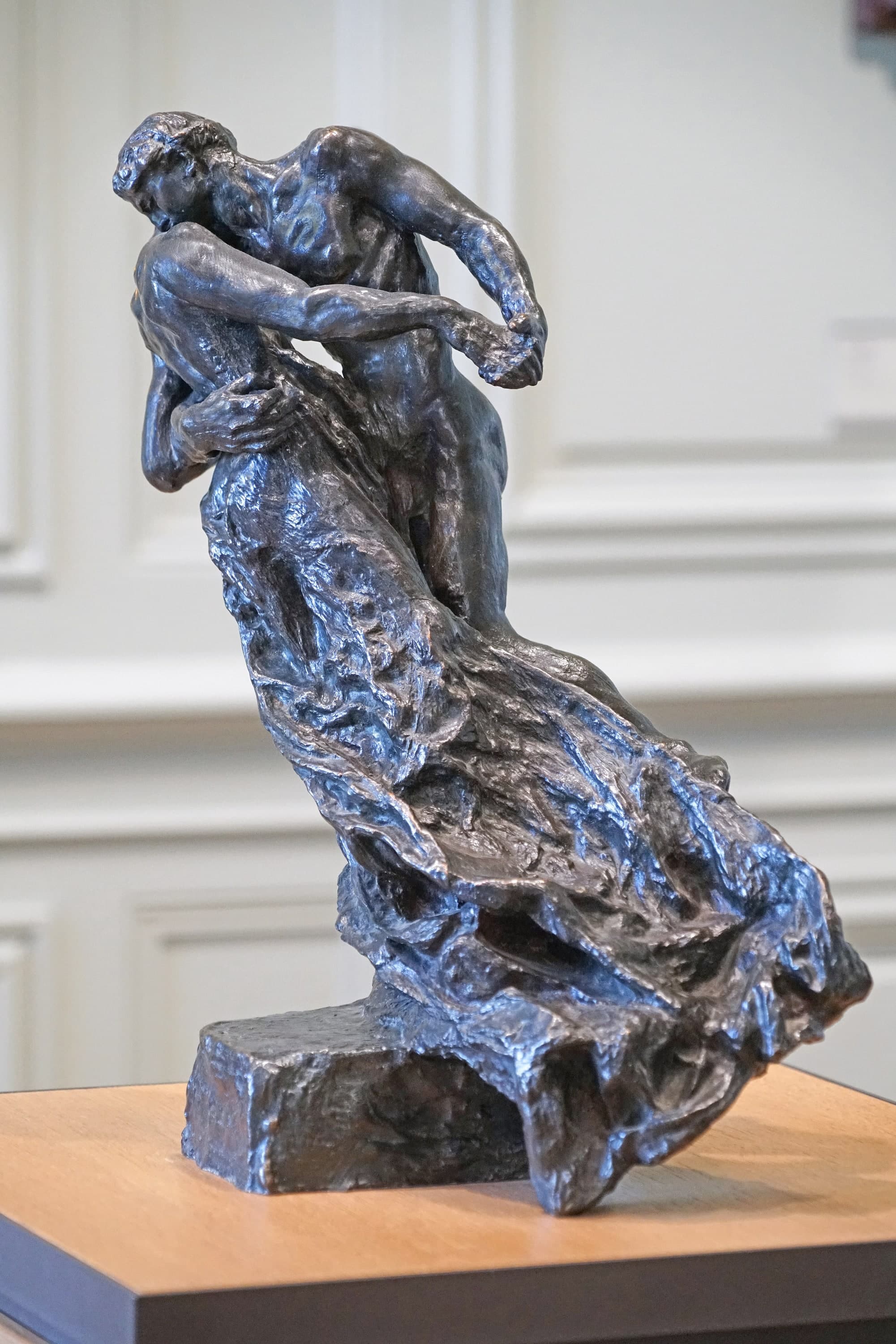
Two dancers hold each other and lean well off the vertical, so that the weight of both bodies rides on one diagonal. A drapery starts at the woman's hips and trails out behind them to the side. Camille Claudel worked on the composition between 1889 and 1893; the French state refused to pay for a marble, and the group survives in plaster, bronze and stoneware in several sizes. The Musée Rodin's bronze is numbered S.01013.
- conceived 1889–1893; this bronze of about 1893
- Bronze
- Musée Rodin, ParisParis, France
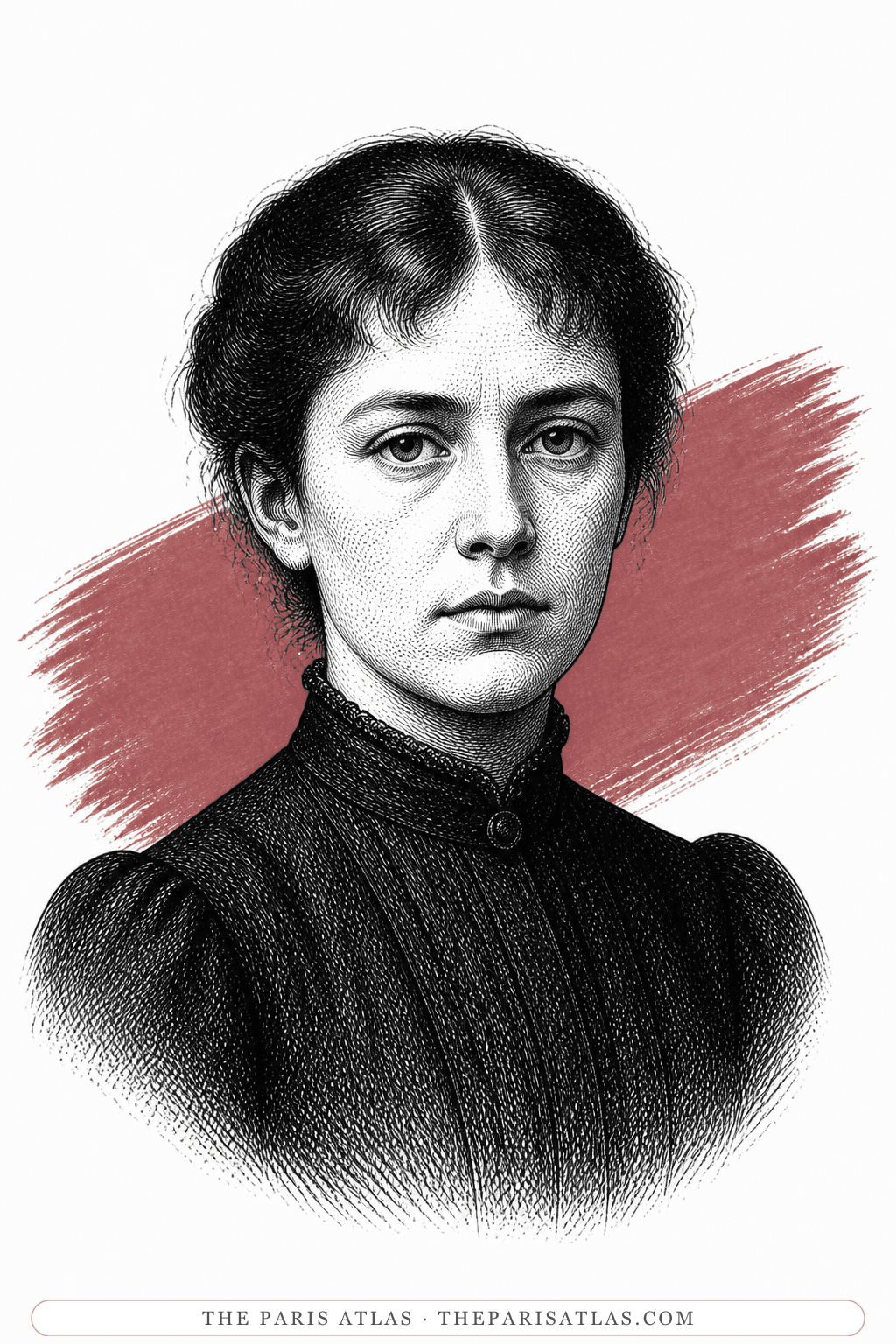
About Camille Claudel
What the sculpture shows
A man and a woman are locked together in a turn. Her head is tipped back against his shoulder and his head is bent over hers. One of his arms crosses her back, and their hands meet and clasp out to one side. His other arm is round her waist.
Both bodies tilt along a single diagonal, and nothing under them corrects it. The Musée Rodin notes the male dancer's raised foot and the low rectangular base, and describes the effect as a dynamic imbalance. Two people at this angle should be falling.
What holds them up is the drapery. It begins at the woman's hips and sweeps down and out to one side, spreading into a wide fan that reaches the edge of the base and takes the weight of the lean. The Musée Rodin describes it as accentuating the movement, and structurally it does more than that.
The bronze is small: 43.2 centimetres high, 23 wide, 34.3 deep. It is a tabletop object, not a monument, and it was conceived as one.
The nude version and the refused commission
The first version was entirely naked. The J. Paul Getty Museum records that it was rejected, and that Camille Claudel then reworked it with complex draperies, which she called veils.
The Musée Camille Claudel dates the composition from 1889 to 1893 and records that she applied for a state commission in marble in 1892 and that the application was refused. The Getty adds that the plaster was received with critical acclaim in 1893 and that the French government still declined to commission the marble.
The Musée Rodin describes the reception at the Salon of 1893 in the terms used against it: the work's passionate sensuality drew criticism for a violent sense of reality, and it was judged unsuitable for display in a public gallery.
Versions, materials and editions
A reader looking at a photograph of The Waltz should establish which object it shows. The Getty records versions in tinted plaster, bronze and stoneware, and the Musée Camille Claudel describes a third version with less drapery and smaller dimensions, produced in several materials.
The Musée Camille Claudel's own example is not a bronze at all. It is flambé stoneware from the Emile Muller works, numbered 14 in that edition, 41.5 by 37 by 20.5 centimetres, inventory 2010.1.11, bought from Reine-Marie Paris de la Chapelle in 2008.
The dealer Eugène Blot mattered to the circulation of the bronzes. The Musée Camille Claudel records that he cast about fifteen bronzes of her work from 1904 and that his gallery at 5 boulevard de la Madeleine showed eleven of her bronzes in December 1905, The Waltz among them.
The group travelled while she was still working. The Getty lists showings in Belgium in 1894, the United States in 1895 and Italy in 1911.
The Waltz and Clotho
The Musée Rodin sets The Waltz against Clotho, the gaunt old woman tangled in her own hair that Camille Claudel exhibited at the Salon of 1893. Writing about Clotho, the museum calls the hair an oppressive weight that seems to immobilise her, in stark contrast to The Waltz.
The two were made in the same years and both are in Room 16 of the Musée Rodin. One body cannot stop moving and the other cannot move at all.
“Only a great and broad mind could have conceived this materialization of the invisible.”
Close reading
Reading the work, detail by detail
The bronze is photographed from the dancers' left on a museum tabletop, which puts the lean and the trailing drapery across the frame. The couple tilts to the left and everything that keeps them upright is behind them to the right.
1.Her head goes back against his shoulder
Her head is tipped fully back so that her throat is exposed and her face turns up and away from the viewer. Her hair is gathered at the back in a loose mass. The neck makes the top of the diagonal the whole group leans along.
2.His head bends over hers
His head comes down over hers until the two faces nearly touch. From this side his features are shadowed and only the brow and the line of the nose read clearly. The two heads together make a single mass at the top of the sculpture.
3.Their hands clasp out to one side
His arm crosses her back and the two hands meet and grip, held well out from the bodies to the right. It is the one clean horizontal in a sculpture built from diagonals, and it fixes the couple's axis of rotation.
4.His other arm closes round her waist
His second arm wraps her waist just above the point where the drapery begins. The hand disappears into the folds. This is the join between the two bare bodies above and the mass of cloth below.
5.The drapery is hollow underneath
The cloth sweeps down and to the right and opens into a wide fan that reaches the end of the base. Its underside is modelled hollow, so the bronze is thin and the shadow inside it is deep. It also carries the weight of the lean.
6.A plain block, and nothing else holding them
At the left end the base is a plain rectangular block with flat sides. It supports the dancers' feet and stops there. The Musée Rodin notes the raised foot of the male dancer and the low base together, and from this angle the figures lean well outside the block's footprint.
Timeline
1889
Camille Claudel begins the composition, with both dancers naked. She is still working in Auguste Rodin's orbit.
1892
She applies for a state commission to carve the group in marble. The application is refused, and she adds drapery to the female figure.
1893
The plaster is shown at the Salon. Reviewers praise it and object to its violent sense of reality, and it is judged unsuitable for a public gallery. Clotho is exhibited the same year.
1894
Shown in Belgium.
1895
Shown in the United States.
1904
Eugène Blot begins casting her work in bronze, about fifteen models in all.
1905
Eugène Blot shows eleven of her bronzes at his gallery, 5 boulevard de la Madeleine, in December. The Waltz is one of them.
1911
Shown in Italy.
Where to see it
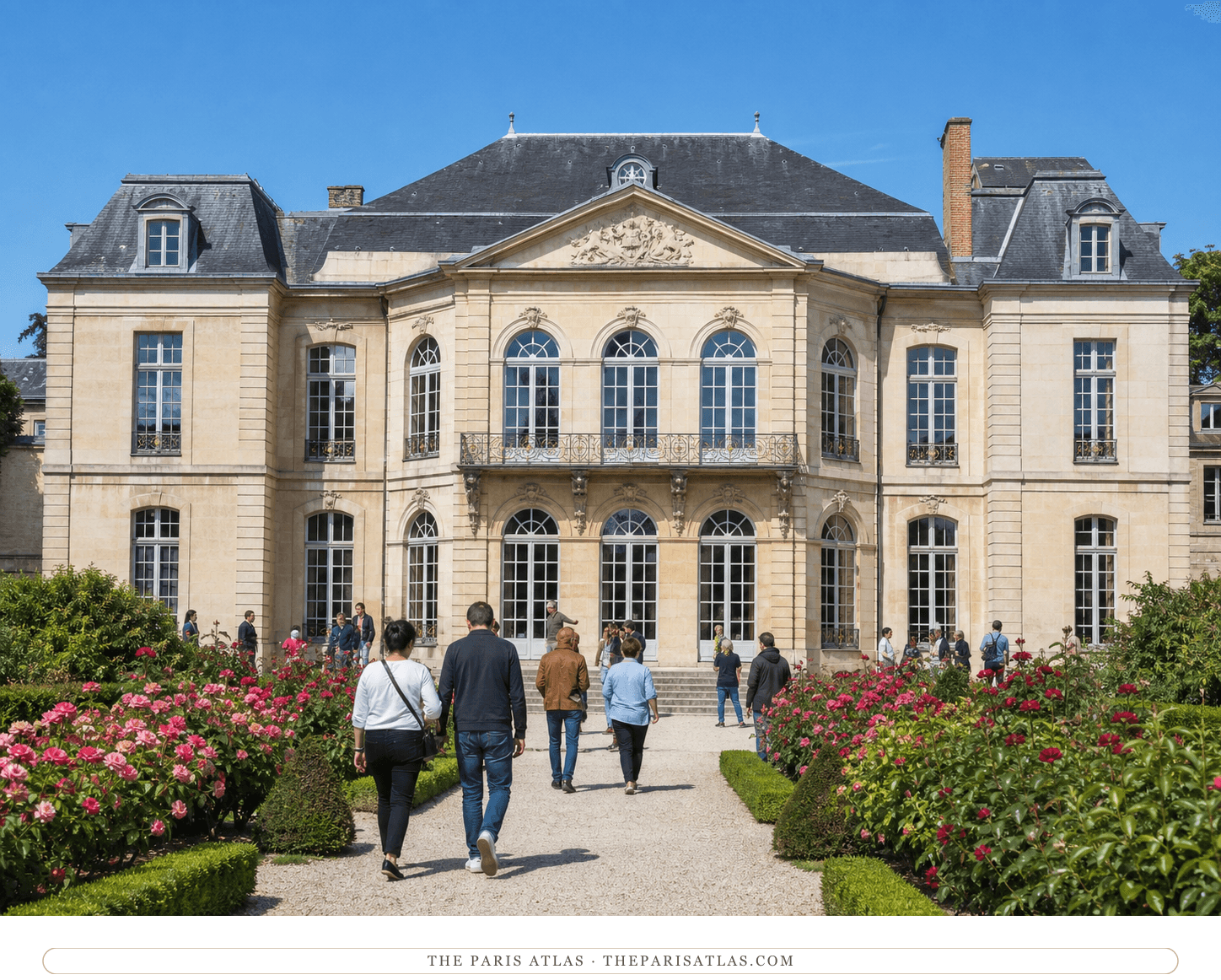
Musée Rodin, Paris
77 rue de Varenne, 75007 Paris, France
The Musée Rodin places it in Room 16 on the first floor, the room of Camille Claudel's work. Displays change, so check the museum's own object record before travelling to see it.
Plan your visitFrequently asked questions
Where can I see Camille Claudel's The Waltz?
The Musée Rodin in Paris holds a bronze, inventory number S.01013, in Room 16 on the first floor. The Musée Camille Claudel at Nogent-sur-Seine shows a flambé stoneware version from the Emile Muller works, inventory 2010.1.11. Other casts are in public and private collections, so check which object a photograph shows.
How big is The Waltz?
The Musée Rodin bronze is 43.2 centimetres high, 23 wide and 34.3 deep. The stoneware version at the Musée Camille Claudel is 41.5 by 37 by 20.5 centimetres. No monumental version was ever made, because the marble was never commissioned.
Why was The Waltz controversial?
The first version showed both dancers entirely naked, and it was rejected. Camille Claudel added drapery to the woman's lower body and applied again for a state commission in marble in 1892; that was refused too. The Musée Rodin records that the sculpture's sensuality was criticised for a violent sense of reality and that it was considered unsuitable for a public gallery.
Did Camille Claudel ever carve The Waltz in marble?
No. She asked the French state to commission a marble in 1892 and was turned down, and no marble was made. The versions that exist are plaster, bronze and stoneware, in more than one size.
What holds the dancers up?
The drapery. It starts at the woman's hips, sweeps down behind both dancers and spreads into a wide fan that reaches the edge of the base. Both figures lean along one diagonal, with the man's foot raised off a low rectangular base, so the cloth is what keeps the group standing.
How many versions of The Waltz are there?
More than one composition and several editions. The naked first version was rejected; a draped version followed in 1893; and the Musée Camille Claudel describes a third, smaller version with less drapery, made in several materials. The J. Paul Getty Museum records examples in tinted plaster, bronze and stoneware.
More by Camille Claudel
If you like Camille Claudel
Explore sculptors from the same movements and circles.

Arman
French-American artist, lifelong friend of Yves Klein, and a founder of New Realism.
View artist
Jean Arp
Strasbourg-born sculptor and poet — Hans in German, Jean in French, both all his life — who co-founded Dada at the Cabaret Voltaire in 1916, composed collages by dropping torn paper 'according to the laws of chance', and settled at Meudon outside Paris in a house his wife Sophie Taeuber-Arp designed.
View artist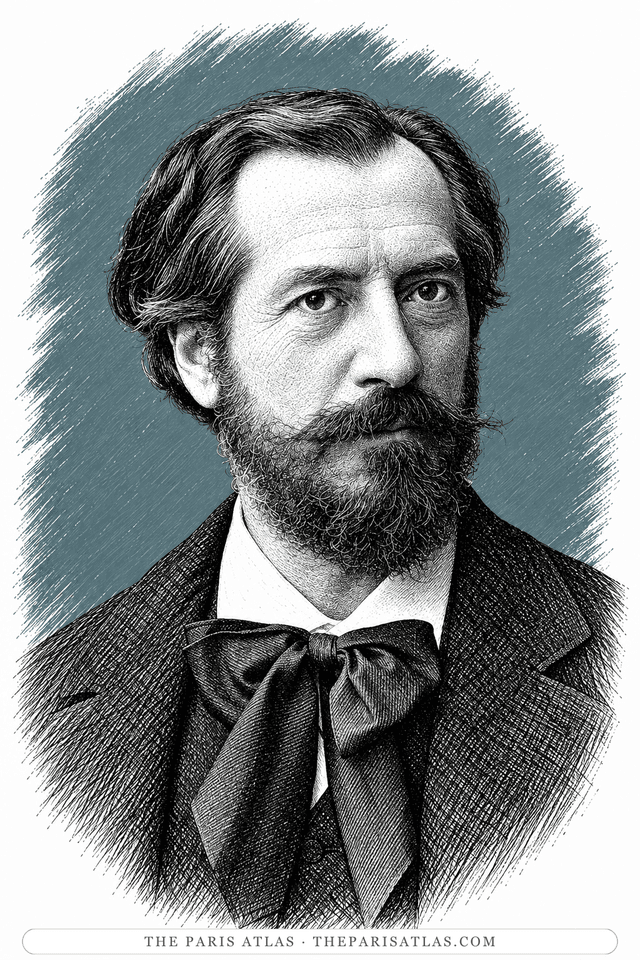
Frédéric Auguste Bartholdi
Frédéric Auguste Bartholdi was a French sculptor best known for designing the Statue of Liberty, dedicated in New York Harbor in 1886. Born in Colmar and based in Paris, he created public monuments that gave visible form to ideas of freedom, resistance and national memory. His other major works include the Lion of Belfort and the fountain in Lyon's Place des Terreaux.
View artist
References
The sources below include collection records, catalogues, scholarly research, and primary materials that informed this page. They document The Waltz, its making, and its place in cultural history.


1The Waltz or The Waltzers
WebsiteMusée Rodin, 2026Used forThe holding museum's record: the date of about 1893, the dimensions, the diagonal and the raised foot, and the criticism at the Salon of 1893.
2The Waltz
WebsiteMusée Camille Claudel, Nogent-sur-Seine, 2026Used forThe 1889–1893 span, the marble commission refused in 1892, the third smaller version, the museum's flambé stoneware example, and the Léon Daudet quotation.
3Camille Claudel — explore the exhibition
WebsiteJ. Paul Getty Museum, Los Angeles, 2024Used forThe J. Paul Getty Museum on the rejected nude version, the draperies Camille Claudel called veils, the materials, and the showings in Belgium, the United States and Italy.
41893–1908: period of solitary creation
WebsiteMusée Camille Claudel, Nogent-sur-Seine, 2026Used forEugène Blot's casting of about fifteen bronzes from 1904 and the December 1905 exhibition of eleven of them at 5 boulevard de la Madeleine.
5Clotho, by Camille Claudel
WebsiteMusée Rodin, 2026Used forThe museum's contrast between Clotho, immobilised by her hair, and The Waltz.
6Camille Claudel
WebsiteMusée Rodin, 2026Used forWeb source consulted for documented facts and historical context presented on the The Waltz page.
These references provide the documented foundation for this work's history and interpretation. Claim-level citations remain attached to the specific claims they support.
 Explore more resources