The Gossips
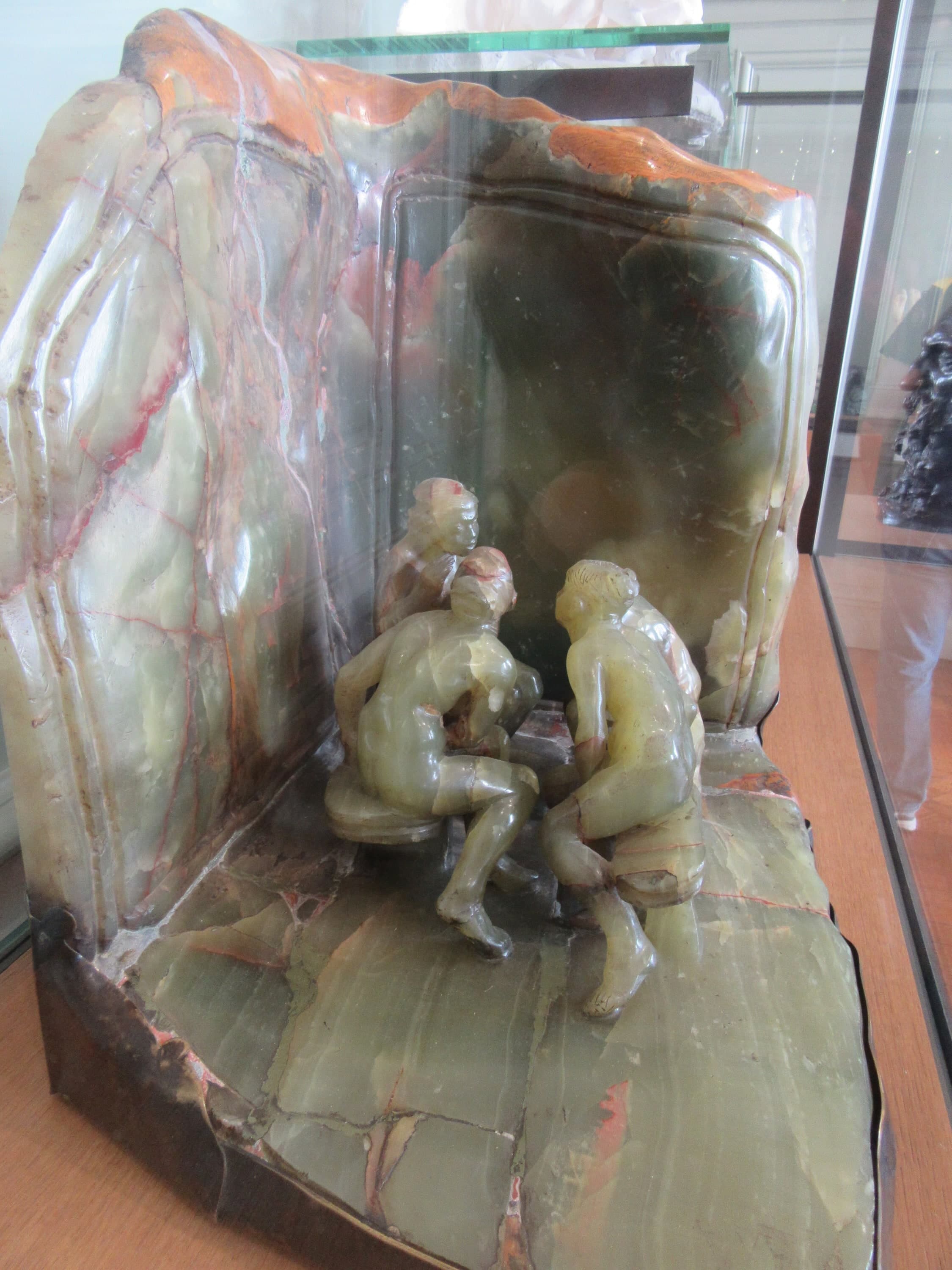
Four naked women sit in the corner formed by two onyx panels, three of them leaning in towards the fourth. The whole group is 45 centimetres high, carved from a stone whose green, orange and red veining is left visible. Camille Claudel described the idea in a letter to her brother Paul Claudel in 1893, showed a plaster at the Salon of 1895, and exhibited this onyx and bronze version two years later. It is at the Musée Rodin as S.1006.
- 1897
- Onyx marble and bronze
- Musée Rodin, ParisParis, France
About Camille Claudel

What the sculpture shows
Two flat slabs of onyx meet at a right angle, like a folding screen set into a corner. Four small women sit on the floor inside that corner. The nearest has her back to the viewer, on a low round stool, with her legs crossed in front of her. One leans in from the right with her head lowered, and two more sit behind, one of them facing out past the group.
They are listening rather than talking over each other. The Musée Rodin quotes Camille Claudel's own description from a letter of 1893 to her brother: a small group of three women listening to another, all seated behind a screen.
The screen does the work of a room. Its top edge is left rough and unfinished, and the slabs enclose the four figures on two sides, which is why a scene of four naked women reads as private rather than exposed. The floor of the group is another slab of the same stone, cracked in places, finished at the front with a dark bronze edge.
Nothing here is monumental. The group is 45 centimetres high, 42.2 wide and 39 deep, and the figures are a few centimetres tall.
Sketches from life
The Musée Rodin records that the work was labelled a study from life when it was first exhibited, and that it opened a series of intimate scenes taken from ordinary life.
That series began when she left Auguste Rodin's orbit. The Musée Camille Claudel dates her move away to 1893 and records her frustration that critics kept tying her work to his. It quotes a December letter to her brother in which she wrote that it was no longer anything like Rodin. The sketches from life were the new direction.
A group of women gossiping on the floor had no precedent in the sculpture being shown at the Salon. Heroic nudes and portrait busts did; four small figures leaning in to hear something did not.
Working in onyx
Onyx marble is hard, brittle and banded with colour, and it cannot be modelled. The Musée Rodin points to the preciousness of the materials she used and to the Japanese influence in the group. It adds that the hair of the figures tends to become a quasi-independent object, which heightens the strangeness of a familiar scene.
The stone's own veining stays in the finished work. Green and grey bands run through the screen and the floor, and rust-red seams cross both, so the colour of the piece is the colour of the block rather than a patina or a paint.
She was paying for the stone herself. The Musée Camille Claudel's account of the years from 1893 to 1908 has her working on her own account and asserting her independence from Auguste Rodin's studio, with the Comtesse de Maigret as her principal patron from 1896.
Which object a photograph shows
There is more than one. The plaster went to the Paris Salon in 1895 and the onyx and bronze version followed at the Salon of 1897. The Musée Rodin records two further versions, in marble and bronze, in marble, or in plaster, held in public and private collections.
Eugène Blot also cast the group in bronze. The Musée Camille Claudel lists The Gossips among the eleven bronzes he showed at his gallery in December 1905.
The object at the Musée Rodin is the onyx and bronze one, numbered S.1006, in Room 16 on the first floor.
Close reading
Reading the work, detail by detail
The photograph looks into the open side of the group through the glass of its case, so the screen is seen from behind its corner and the four figures are small in the middle of the frame. The stone's own colour is the subject as much as the women are.
1.The top edge is left uncut
The top of the screen is not finished. It is left as the block broke, a rough band stained orange and rust-red, and it runs the full width of both panels. Below it the surface is polished flat, so the contrast is deliberate.
2.Two panels meet at a right angle
The screen is two flat slabs meeting at a right angle, with a shallow incised border running inside the face of each. The corner closes the group off on two sides. It does the work of a room without any architecture in it.
3.Four heads lean into one conversation
Four small women are gathered in the corner. Three incline their heads towards the fourth, and one of the further figures looks out past the group. Camille Claudel described them to her brother Paul Claudel in 1893 as three women listening to another.
4.One sits with her back to the viewer
The nearest figure sits on a low round stool with her back to the camera and her legs crossed in front of her. Her shoulders and the nape of her neck are the most finished surfaces in the photograph. Nothing about her posture is on display for a viewer.
5.The floor is the same stone, and it is cracked
The floor is another slab of the same onyx, green and grey with rust-red seams running through it. Several cracks cross it. Onyx marble is brittle, and the flaws in the block stayed in the finished piece rather than being cut away.
6.A bronze edge finishes the base
A dark bronze strip runs along the front edge of the base under the stone. It is the second material the Musée Rodin lists for this object, and from this angle it is the only part of the bronze that is visible.
Timeline
1893
Camille Claudel describes the group to her brother Paul Claudel in a letter: three women listening to another, all seated behind a screen. The same year she begins to distance herself from Auguste Rodin.
1895
The plaster version is shown at the Paris Salon.
1897
The onyx and bronze version is shown at the Salon, labelled a study from life.
1905
Eugène Blot shows a bronze of the group among eleven of her bronzes at his gallery in December.
Where to see it
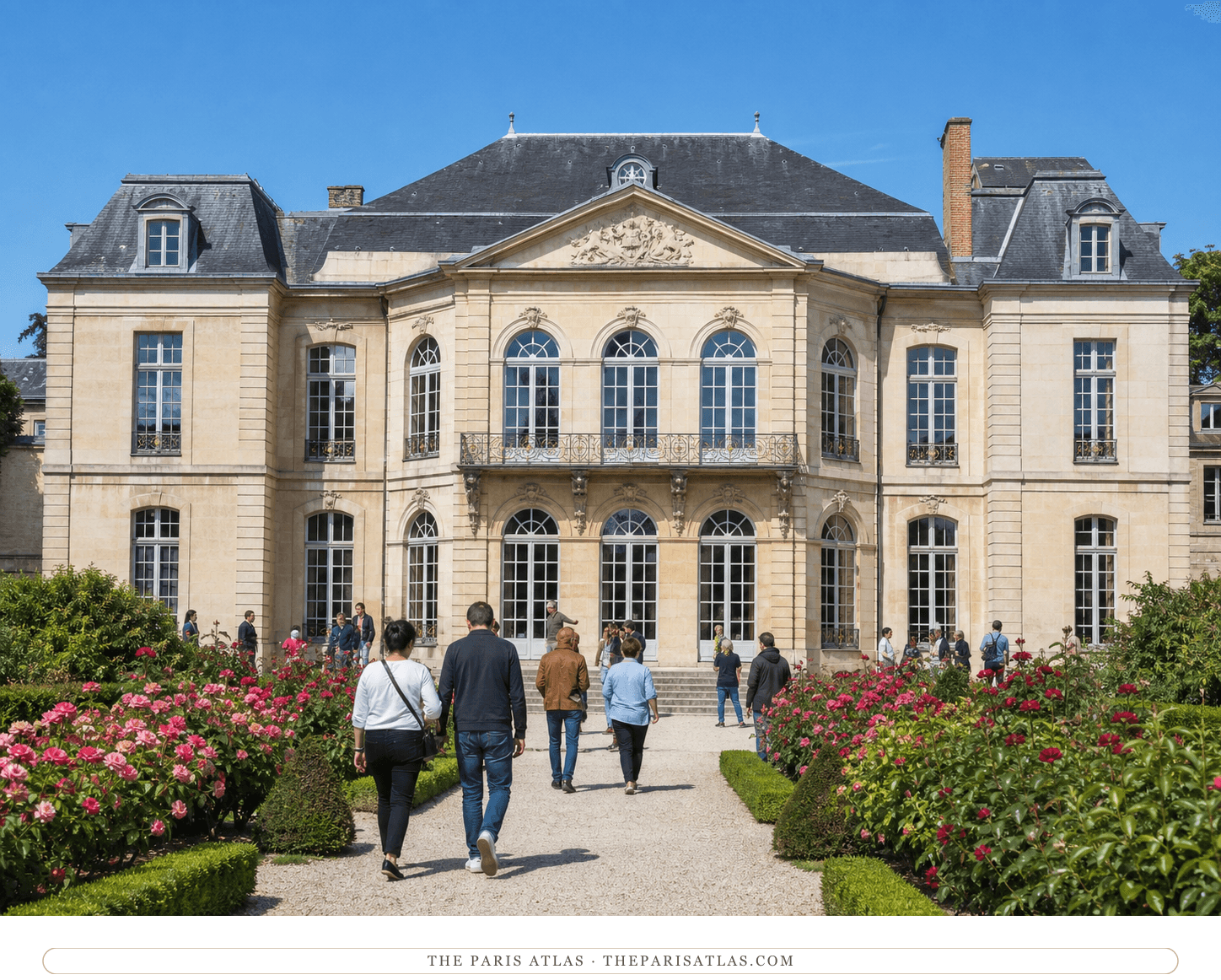
Musée Rodin, Paris
77 rue de Varenne, 75007 Paris, France
The Musée Rodin places it in Room 16 on the first floor, in a case with others of her small groups. Displays change, so check the museum's own object record before travelling to see it.
Plan your visitFrequently asked questions
Where can I see Camille Claudel's The Gossips?
The onyx and bronze version is at the Musée Rodin in Paris, inventory number S.1006, in Room 16 on the first floor. Other versions in marble, bronze and plaster are in public and private collections, so check which object a photograph shows before travelling.
How many figures are in The Gossips?
Four. Camille Claudel described them in 1893 as three women listening to another, all seated behind a screen. One sits on a low round stool with her back to the viewer, one leans in from the right, and two are behind them inside the corner of the screen.
What is The Gossips made of?
Onyx marble and bronze. The screen, the floor slab and the four figures are carved from onyx, whose green, grey and rust-red banding is left visible, and the front edge of the base is bronze. The Musée Rodin's example is 45 centimetres high.
Why is the group so small?
It was conceived as a study from life rather than as a monument, and that is how it was labelled when first exhibited. The whole piece is 45 by 42.2 by 39 centimetres. Onyx marble also comes in blocks, not in monumental quarry sizes, and it is brittle to carve.
Is there a Japanese influence in The Gossips?
The Musée Rodin says so, pointing to the preciousness of the materials and to the Japanese influence in the group. The museum also notes that the figures' hair tends to become a quasi-independent object, which it says heightens the strangeness of an otherwise familiar scene.
What does the screen behind the figures do?
It encloses them. Two flat onyx slabs meet at a right angle and shut the group in on two sides, which turns four naked figures on a floor into a private conversation. Its top edge is deliberately left rough.
More by Camille Claudel
If you like Camille Claudel
Explore sculptors from the same movements and circles.

Arman
French-American artist, lifelong friend of Yves Klein, and a founder of New Realism.
View artist
Jean Arp
Strasbourg-born sculptor and poet — Hans in German, Jean in French, both all his life — who co-founded Dada at the Cabaret Voltaire in 1916, composed collages by dropping torn paper 'according to the laws of chance', and settled at Meudon outside Paris in a house his wife Sophie Taeuber-Arp designed.
View artist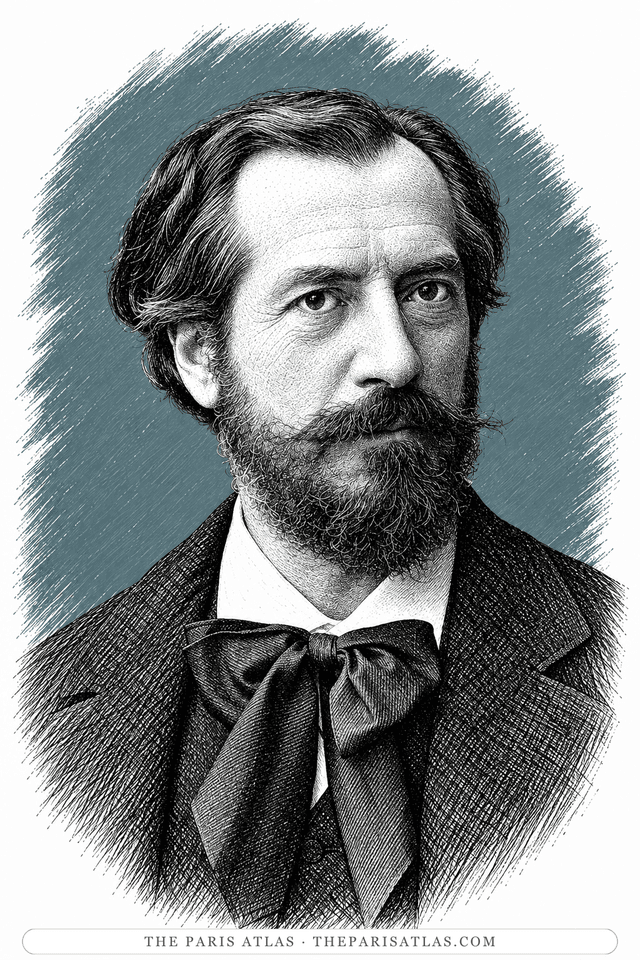
Frédéric Auguste Bartholdi
Frédéric Auguste Bartholdi was a French sculptor best known for designing the Statue of Liberty, dedicated in New York Harbor in 1886. Born in Colmar and based in Paris, he created public monuments that gave visible form to ideas of freedom, resistance and national memory. His other major works include the Lion of Belfort and the fountain in Lyon's Place des Terreaux.
View artist
References
The sources below include collection records, catalogues, scholarly research, and primary materials that informed this page. They document The Gossips, its making, and its place in cultural history.


1The Gossips or Women chatting
WebsiteMusée Rodin, 2026Used forThe holding museum's record: the 1893 letter to Paul Claudel, the Salons of 1895 and 1897, the study-from-life label, the materials, the hair, and the other versions.
2Camille Claudel
WebsiteMusée Rodin, 2026Used forThe Musée Rodin on The Gossips as the start of her series of intimate, delicate scenes taken from everyday life.
31893–1908: period of solitary creation
WebsiteMusée Camille Claudel, Nogent-sur-Seine, 2026Used forThe break of 1893, the sketches-from-life series, her letter saying the work was no longer anything like Rodin, the Comtesse de Maigret's patronage, and the Blot exhibition of December 1905.
4Camille Claudel comes out of the reserve collections
WebsiteMusée Rodin, 2026Used forThe Musée Rodin on the body of Camille Claudel's sculpture it holds, and on the decade she spent in Auguste Rodin's studio before the break.
These references provide the documented foundation for this work's history and interpretation. Claim-level citations remain attached to the specific claims they support.
 Explore more resources