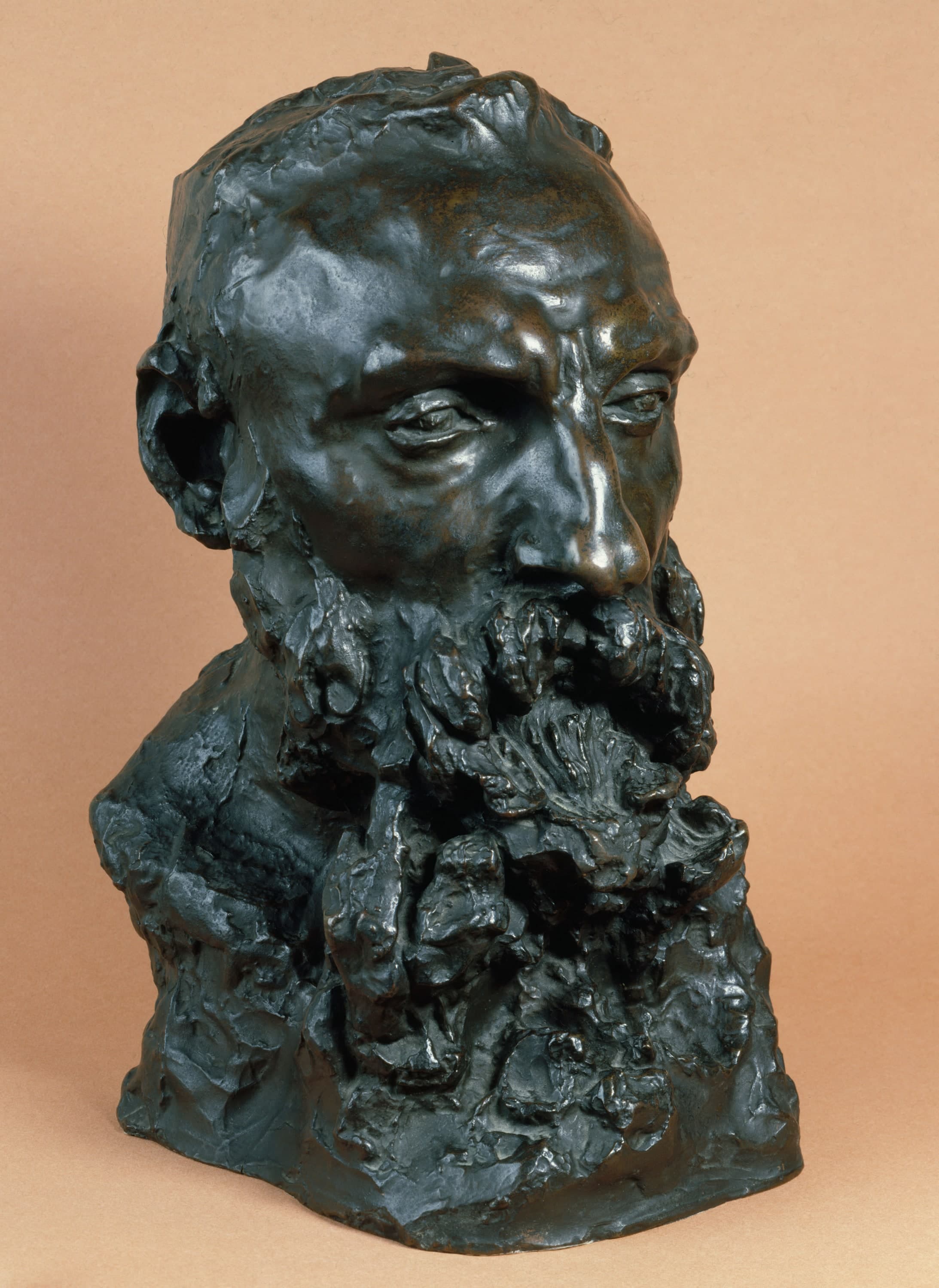
Camille Claudel made one portrait of Auguste Rodin. It is a head and shoulders with a high domed forehead and a beard modelled as a mass of separate lumps. The first bronze was shown at the Salon de la Société Nationale des Beaux-Arts in 1892, when she was twenty-seven and he was fifty-one. The Petit Palais holds a bronze of it, 41 centimetres high, given by the dealer Arnold Seligmann in 1922 and numbered PPS1268.
The head is turned slightly and tipped up, and the face is built around the brow and the nose. The forehead is high and smooth, the brows are heavy ridges, and the eyes sit deep beneath them in shadow. The Musée Rodin describes the deeply lined face with its strong nose and forehead, and says every little muscle is recorded.
The beard is treated as a separate problem. It is not combed or grooved but built from lumps of clay pressed on and left, so that it reads as a mass rather than as hair, and it covers the whole chest of the bust. Below it the bronze stops in a rough torn edge.
There is no collar, no jacket and no plinth in the usual sense. The shoulders are bare and the bust ends where the metal ends. The Petit Palais gives its bronze as 41 centimetres high, 26 wide and 32 deep, and records the signature Camille Claudel on it.
When she made it, and what it was for
The two museums that hold casts date the modelling differently. The Musée Rodin puts it between 1886 and 1888 and connects it to the naturalistic turn her work took in the early 1880s. The Musée Camille Claudel dates the modelling to about 1884–85. Either way she was in her early twenties and working in his studio.
The first bronze was sand-cast by the Gruet foundry in 1892, and that cast went to the Salon de la Société Nationale des Beaux-Arts the same year. The Musée Rodin holds it as S.1021, 40 by 24.6 by 28 centimetres.
It was well received. The critic Edmond Pilon described it as capturing the calm, profound face of genius. The Musée Rodin records that the bust then became an official portrait of Auguste Rodin, shown in major exhibitions of his work in Chicago, Amsterdam, Prague and New York. The museum places it, with Jules Desbois's portrait, among the most striking sculpted likenesses of him.
The casts, and which one this is
Several bronzes exist. The Musée Camille Claudel records an edition published by the Mercure de France and cast by Rudier in 1897–98. Camille Claudel was contractually responsible for the chasing on those casts, the finishing work done by hand on the surface of each one after it left the mould.
The Petit Palais dates its own bronze after 1897, which places it at or after that edition without the museum saying so. It reached the museum as a gift from the dealer Arnold Seligmann in 1922, and it is catalogued as PPS1268.
The Musée Camille Claudel at Nogent-sur-Seine has a third, inventory 2010.2.1, 40 by 25 by 28 centimetres, bought from the collector Philippe Cressent in 2008.
One portrait, and the studio around it
She modelled him once. The Musée Camille Claudel calls this her unique portrait of Auguste Rodin. He sat for it during the decade she spent in his studio as student, assistant and lover, which the Musée Rodin dates from 1882 to their parting in 1892 — the year the bronze was shown.
Who made what in that studio is not always settled. The Musée Rodin states that the heads of The Slave and Laughing Man, of about 1885, were signed by Auguste Rodin when they were cast in bronze but were modelled by Camille Claudel. A signed portrait of him by her is therefore a rarer thing than it looks: it is work of hers that came out under her own name.
Close reading
Reading the work, detail by detail
This is a studio photograph on a plain ground, lit from the sitter's right, and it shows the bust turned three-quarters that way. The lighting separates the two surfaces Camille Claudel treated quite differently: the smooth upper face and the broken mass of the beard.
1.The forehead is the smoothest thing here
The forehead rises high and domed, and it is polished smoother than any other passage of the bust. Two heavy ridges cross it above the eyes. The Musée Rodin's account of the bust singles out the strong nose and forehead.
2.The eyes sit deep in shadow
Both eyes are set far back under the brows, and in this light the sockets hold shadow rather than detail. The lids are modelled but the pupils are not cut. The gaze cannot be met from the front, only inferred from the angle of the head.
3.The nose carries the brightest light
The bridge of the nose takes the light from the right and reads as the brightest point in the photograph, a hard gold-brown highlight against the dark patina. It is also the furthest-forward plane of the face and fixes the direction the head is turned.
4.The beard is built from separate lumps
The beard is not combed into strands. It is a mass of separate lumps, each one pressed on and left with its own edge, and it spreads down over the whole chest. The surface is the roughest part of the bust and holds the deepest shadows.
5.The ear is an open hollow
On the shadowed side the ear is a dark hollow rather than a modelled shape, open into the head. The hair around it is treated in the same broken way as the beard, so the profile edge of the skull is irregular.
6.The bust ends in a torn edge
There is no collar, drapery or socle. The bare shoulders run down and the bronze stops in a rough, torn line, as though the mass had been broken off. The Petit Palais records the whole cast at 41 centimetres high.
Timeline
1882
Alfred Boucher hands his pupil on to Auguste Rodin, and Camille Claudel enters his studio at eighteen.
about 1884–88
She models the portrait. The Musée Camille Claudel dates it to about 1884–85, the Musée Rodin to 1886–88.
1892
The Gruet foundry sand-casts the first bronze, and it is shown at the Salon de la Société Nationale des Beaux-Arts. Edmond Pilon writes of the calm, profound face of genius. The relationship with Auguste Rodin ends the same year.
1897–98
Rudier casts an edition published by the Mercure de France, with Camille Claudel contracted to do the chasing.
1922
Arnold Seligmann gives a bronze to the Petit Palais, where it is PPS1268.
2008
Nogent-sur-Seine buys a bronze from the collector Philippe Cressent for the museum that opens in 2017, inventory 2010.2.1.
Where to see it
Petit Palais, musée des Beaux-Arts de la Ville de Paris
Paris, France
A public viewing address has not yet been confirmed for this holding.
The Petit Palais does not state on its object record whether this bronze is on view. The Musée Rodin's 1892 Gruet cast, S.1021, is displayed in its Room 16.
Frequently asked questions
Where can I see Camille Claudel's Bust of Rodin?
The Petit Palais in Paris holds a bronze, inventory PPS1268. The Musée Rodin holds the first cast, made by Gruet in 1892, as S.1021, in Room 16. The Musée Camille Claudel at Nogent-sur-Seine holds a third, inventory 2010.2.1. Check the holding museum's own record before travelling, because displays change.
How many portraits of Auguste Rodin did Camille Claudel make?
One. The Musée Camille Claudel calls it her unique portrait of him. It exists in several bronze casts, but there is a single composition.
When was the Bust of Rodin made?
The museums differ. The Musée Rodin dates the modelling to 1886–88; the Musée Camille Claudel dates it to about 1884–85. The first bronze was sand-cast by the Gruet foundry in 1892 and exhibited that year at the Salon de la Société Nationale des Beaux-Arts.
How big is the Petit Palais bronze?
41 centimetres high, 26 wide and 32 deep. The Musée Rodin's 1892 cast is 40 by 24.6 by 28 centimetres, and the cast at Nogent-sur-Seine is 40 by 25 by 28.
How did the Petit Palais get its cast?
As a gift. The Paris Musées record gives the mode of acquisition as a personal gift from Arnold Seligmann in 1922, and dates the bronze itself after 1897.
Did Camille Claudel work on the casts herself?
On one edition, yes. The Musée Camille Claudel records that Rudier cast the bronzes published by the Mercure de France in 1897–98. She was contractually responsible for the chasing on them, which is the hand-finishing of each cast's surface after it comes out of the mould.
In the atlas
What the graph records about this work — every claim carries its citation.
The only portrait Camille Claudel made of Auguste Rodin, modelled while she worked in his studio and first cast in bronze by Gruet for the Salon of 1892. The Musée Rodin records that the bust later served as an official portrait of him.
— Musée Rodin, Portrait of Rodin, by Camille Claudel (2026), S.1021; Buste de Rodin, Camille Claudel, inventaire PPS1268 (2026), PPS1268
Strasbourg-born sculptor and poet — Hans in German, Jean in French, both all his life — who co-founded Dada at the Cabaret Voltaire in 1916, composed collages by dropping torn paper 'according to the laws of chance', and settled at Meudon outside Paris in a house his wife Sophie Taeuber-Arp designed.
Frédéric Auguste Bartholdi was a French sculptor best known for designing the Statue of Liberty, dedicated in New York Harbor in 1886. Born in Colmar and based in Paris, he created public monuments that gave visible form to ideas of freedom, resistance and national memory. His other major works include the Lion of Belfort and the fountain in Lyon's Place des Terreaux.
The sources below include collection records, catalogues, scholarly research, and primary materials that informed this page. They document Bust of Rodin, its making, and its place in cultural history.
1Buste de Rodin, Camille Claudel, inventaire PPS1268
Website
Paris Musées — Petit Palais, musée des Beaux-arts de la Ville de Paris, 2026
Used for
The holding museum's record: the date after 1897, the bronze, the dimensions, the signature, and Arnold Seligmann's gift of 1922.
The Musée Rodin on the modelling of 1886–88, the Gruet sand cast of 1892, the Salon of that year, Edmond Pilon's verdict, and the bust's later use as an official portrait.
3Auguste Rodin — the bust by Camille Claudel, inventaire 2010.2.1
Website
Musée Camille Claudel, Nogent-sur-Seine, 2026
Used for
The Musée Camille Claudel's dating of about 1884–85, the Mercure de France edition cast by Rudier in 1897–98 with Camille Claudel contracted to do the chasing, and its own bronze bought from Philippe Cressent.
The Musée Rodin's resource page on the working relationship, including the heads of The Slave and Laughing Man modelled by Camille Claudel and signed by Auguste Rodin.
These references provide the documented foundation for this work's history and interpretation. Claim-level citations remain attached to the specific claims they support.



 View source