Vertumnus and Pomona
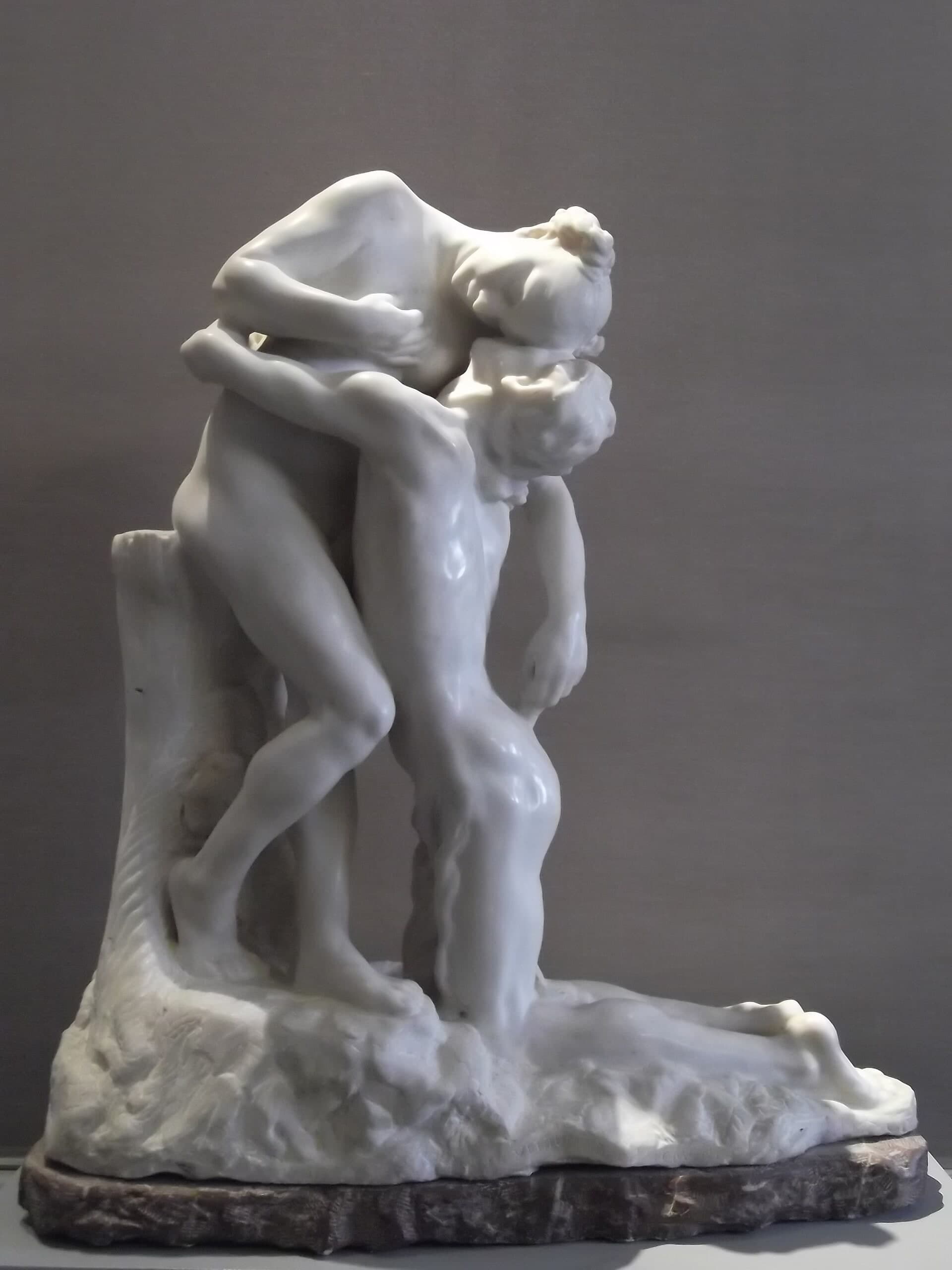
A man kneels in front of a standing woman and presses his face to her chest; she leans back with her eyes closed and one arm over his shoulders. Camille Claudel first modelled the group in plaster about 1886 and called it Sakountala, after an Indian play. Nearly twenty years later a private patron, the Comtesse de Maigret, paid for the marble, and the marble carries a different title. It is at the Musée Rodin as S.01293.
- modelled in plaster about 1886; this marble carved 1905
- White marble on a red marble base
- Musée Rodin, ParisParis, France
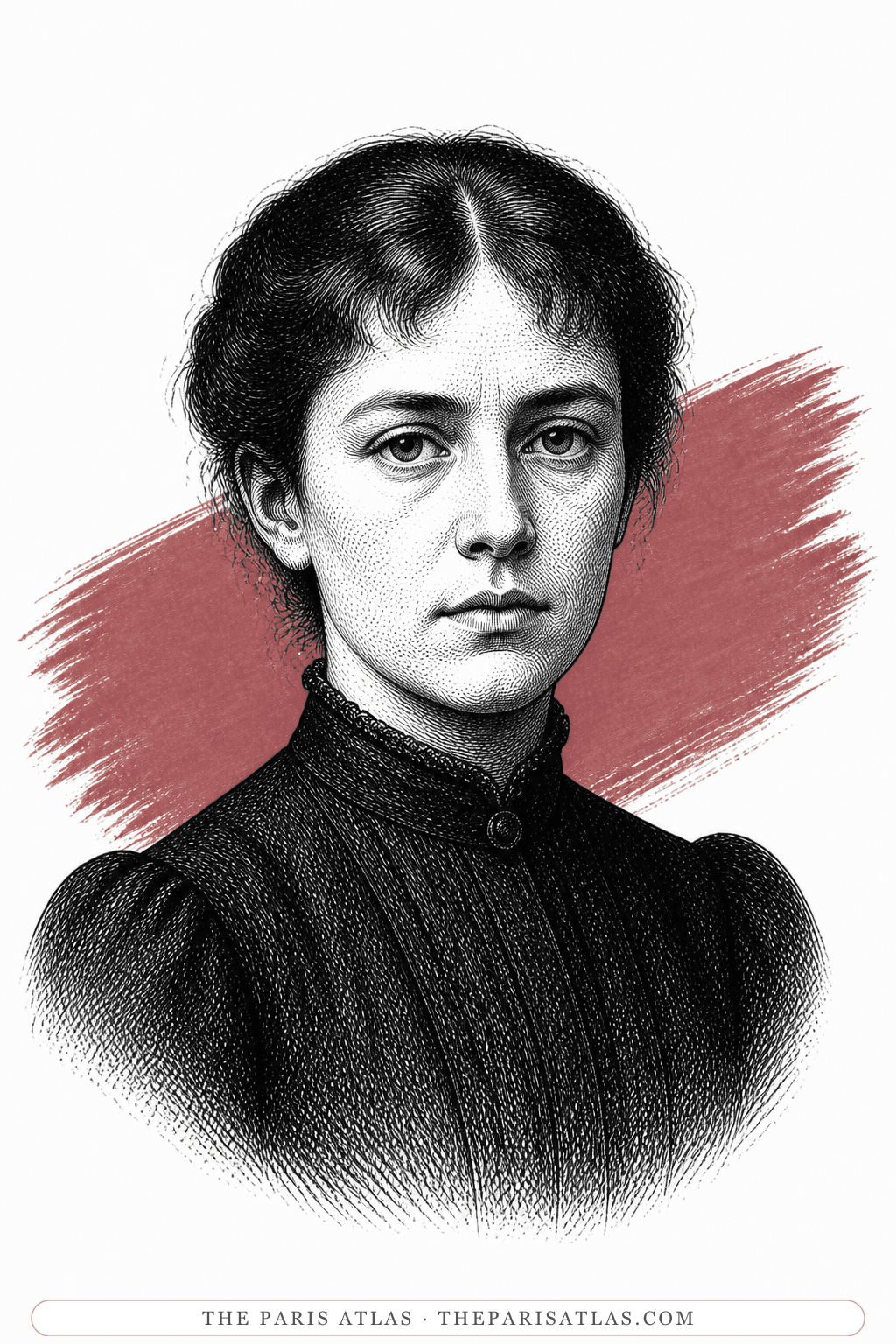
About Camille Claudel
What the sculpture shows
Two figures meet at the centre of a rough marble rock. The woman stands and leans back from the waist, her head tipped up, her eyes shut and her mouth slightly open. Her right arm curves over the kneeling man's shoulders and her hand comes to rest near his upper back.
He is on both knees, his legs trailing back along the base, and his arms are round her hips. His face is pressed against her breast and his eyes are not visible. A cut tree stump rises behind her and supports her back, which is what allows a figure leaning at that angle to be carved in stone.
The white marble group stands on a base of dark red-brown marble. It is 91 centimetres high and 80.6 wide, so the two figures are about half life size.
One composition, three titles
The plaster came first. The Musée Camille Claudel records that in November 1886 Camille Claudel set to work on a large group taken from Shakuntala, a drama by the Indian poet Kalidasa. She began it in the studio at 177 rue des Petits Champs and finished it at 113 boulevard d'Italie, where she moved in January 1888.
The subject is a reunion. The Musée Rodin describes the source as an Indian play in which Sakuntala is reunited with her husband after a long separation caused by a spell. The J. Paul Getty Museum names the writer as the fifth-century Indian poet Kālidāsa and calls the plaster group Camille Claudel's first major success, with an honourable mention at the Paris Salon of 1888.
The marble of 1905 carries the title Vertumnus and Pomona, a pair the Getty describes as belonging to a Roman myth. The Musée Rodin's own account calls the shift a move from Hindu to Greek mythology, so the two museums do not word it the same way. The bronze cast by the dealer Eugène Blot took a third title, Abandon, with no mythology in it at all.
The Musée Rodin treats the renaming as part of the work rather than a tidying-up, and says the variety of interpretations and meanings formed part of her research.
How the marble happened
A marble cost money she did not have. The Musée Rodin records repeated requests for a state commission and hopes that were crushed, and states that the work was finally carved in marble thanks to the Comtesse de Maigret in 1905.
The Comtesse de Maigret was her principal patron. The Musée Camille Claudel records that Camille Claudel met her in 1896 and that she supported the sculptor until 1905.
The bronze moved faster than the marble. Eugène Blot's cast was shown at the Salon d'Automne of 1905 as Abandon, and the J. Paul Getty Museum records that the French state acquired a version of it in 1907 — two years after the state had declined to pay for the stone.
Paul Claudel gave the marble to the Musée Rodin, where it is numbered S.01293 and displayed in Room 16 with the rest of her work there.
Close reading
Reading the work, detail by detail
The marble is photographed square-on against a plain grey wall, so the whole group and its red base are in frame. The two figures meet at the centre and everything else in the carving props that meeting up.
1.Her head is thrown back and her eyes are shut
Her head goes back until the chin is the highest point of the face, the eyes are closed and the mouth is slightly open. The hair is gathered in a rough knot that Camille Claudel left less finished than the skin, so the polished face reads against it.
2.His face is pressed into her chest
He kneels and pushes his face into her chest, so his features are not visible from any angle. The back of his head and his shoulders are what the viewer gets. Of the two figures, only she has a face in this composition.
3.Her arm comes over his shoulders
Her arm curves over his shoulders and the hand comes to rest against his upper back. The fingers are relaxed rather than gripping. It is the gesture that makes the group a reunion instead of a struggle.
4.His legs trail back along the rock
From the knees his legs stretch back and to the right, flat along the base, with the tops of the feet against the stone. The pose puts his whole weight forward into her. The long horizontal of the legs balances the vertical of her body.
5.A tree stump takes the load
Behind her at the left stands a cut tree stump, carved with the grain and bark showing. She leans back into it. A marble figure tipped at that angle cannot stand on its legs alone, and the stump is what makes the pose possible in stone.
6.White marble on a red base
The figures and their rocky ground are one block of white marble. Below that is a separate plinth of dark red-brown marble, cut with a wavy top edge that follows the rock. The colour change is where the sculpture stops and the mount begins.
Timeline
November 1886
Camille Claudel begins a large group from Kalidasa's Shakuntala in the studio at 177 rue des Petits Champs.
January 1888
She moves to the studio at 113 boulevard d'Italie and finishes the plaster there.
1888
The plaster group is shown at the Paris Salon and receives an honourable mention. No commission for a bronze or a marble follows.
1896
She meets the Comtesse de Maigret, who becomes her principal patron until 1905.
1905
The marble is carved at the Comtesse de Maigret's expense and titled Vertumnus and Pomona. Eugène Blot's bronze of the same composition is shown at the Salon d'Automne as Abandon.
1907
The French state acquires a version of the Blot bronze.
1952
Paul Claudel gives the marble to the Musée Rodin, where it is S.01293.
Where to see it
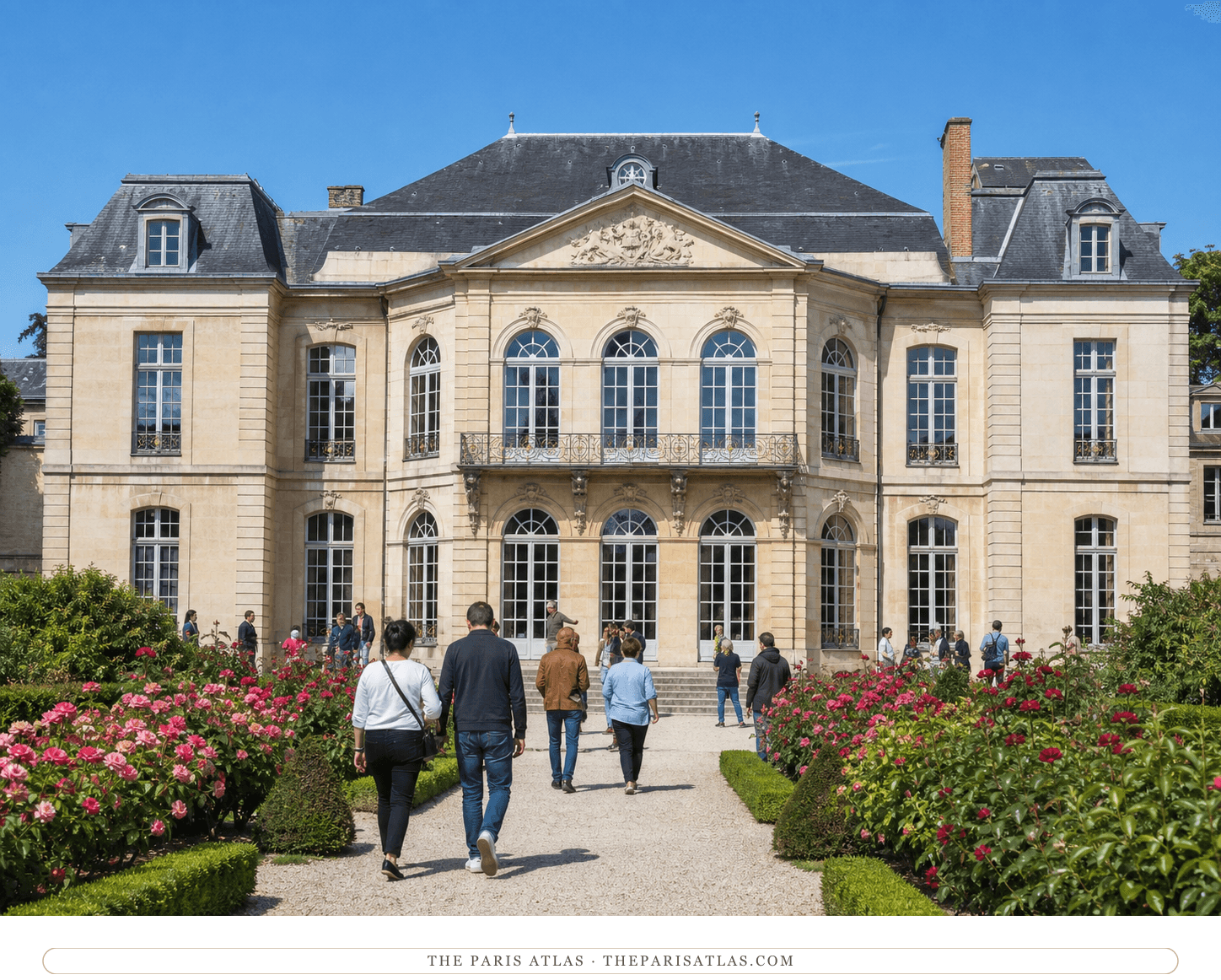
Musée Rodin, Paris
77 rue de Varenne, 75007 Paris, France
The Musée Rodin places it in Room 16 on the first floor. Displays change, so check the museum's own object record before travelling to see it.
Plan your visitFrequently asked questions
Where is Camille Claudel's Vertumnus and Pomona?
At the Musée Rodin in Paris, inventory number S.01293, in Room 16 on the first floor. It is the white marble version on a red marble base, carved in 1905. The plaster of 1888 and the Eugène Blot bronzes of the same composition are elsewhere.
Why does this sculpture have three names?
Because Camille Claudel retitled it as she remade it. The plaster of 1886–88 was Sakountala, after the Indian play by Kālidāsa. The 1905 marble is Vertumnus and Pomona, after a pair from Roman myth. Eugène Blot's bronze was called Abandon. The Musée Rodin treats the changing titles as part of her thinking about the group rather than as corrections.
What story does Sakountala tell?
A reunion after a long separation. The Musée Rodin describes the source as an Indian play in which Sakuntala meets her husband again after a spell has kept them apart. The J. Paul Getty Museum names the author as the fifth-century Indian poet Kālidāsa.
Who paid for the marble?
The Comtesse de Maigret, her principal patron from 1896 to 1905. The Musée Rodin records repeated unsuccessful requests for a state commission before the marble was carved in 1905 with the Comtesse de Maigret's support. The French state then bought a bronze of the same group in 1907.
How big is the Musée Rodin marble?
91 centimetres high, 80.6 wide and 41.8 deep, on its red marble base. The plaster shown at the Salon in 1888 was a much larger group.
What is the tree stump for?
It carries the load. The woman leans back from the waist, and the stump behind her takes the weight that a marble figure at that angle cannot take on its own legs. It also belongs to the outdoor setting the rough rock base suggests.
More by Camille Claudel
If you like Camille Claudel
Explore sculptors from the same movements and circles.
Arman
French-American artist, lifelong friend of Yves Klein, and a founder of New Realism.
View artist
Jean Arp
Strasbourg-born sculptor and poet — Hans in German, Jean in French, both all his life — who co-founded Dada at the Cabaret Voltaire in 1916, composed collages by dropping torn paper 'according to the laws of chance', and settled at Meudon outside Paris in a house his wife Sophie Taeuber-Arp designed.
View artist
Frédéric Auguste Bartholdi
Frédéric Auguste Bartholdi was a French sculptor best known for designing the Statue of Liberty, dedicated in New York Harbor in 1886. Born in Colmar and based in Paris, he created public monuments that gave visible form to ideas of freedom, resistance and national memory. His other major works include the Lion of Belfort and the fountain in Lyon's Place des Terreaux.
View artist
References
The sources below include collection records, catalogues, scholarly research, and primary materials that informed this page. They document Vertumnus and Pomona, its making, and its place in cultural history.


1Vertumnus and Pomona
WebsiteMusée Rodin, 2026Used forThe holding museum's record: the 1905 marble, its dimensions and signature, the plaster of about 1886, the Comtesse de Maigret, and the three titles.
2Camille Claudel — explore the exhibition
WebsiteJ. Paul Getty Museum, Los Angeles, 2024Used forThe J. Paul Getty Museum on Kālidāsa, the honourable mention of 1888, the Roman subject of the marble, and the state's purchase of the Blot bronze in 1907.
31886–1893: Rodin and Camille Claudel, a tumultuous love affair and an intense artistic dialogue
WebsiteMusée Camille Claudel, Nogent-sur-Seine, 2026Used forNovember 1886 as the start of the group, and the two studios: 177 rue des Petits Champs and 113 boulevard d'Italie from January 1888.
41893–1908: period of solitary creation
WebsiteMusée Camille Claudel, Nogent-sur-Seine, 2026Used forThe Comtesse de Maigret as her principal patron from 1896 to 1905, and Eugène Blot's bronzes.
5Camille Claudel
WebsiteMusée Rodin, 2026Used forWeb source consulted for documented facts and historical context presented on the Vertumnus and Pomona page.
These references provide the documented foundation for this work's history and interpretation. Claim-level citations remain attached to the specific claims they support.
 Explore more resources