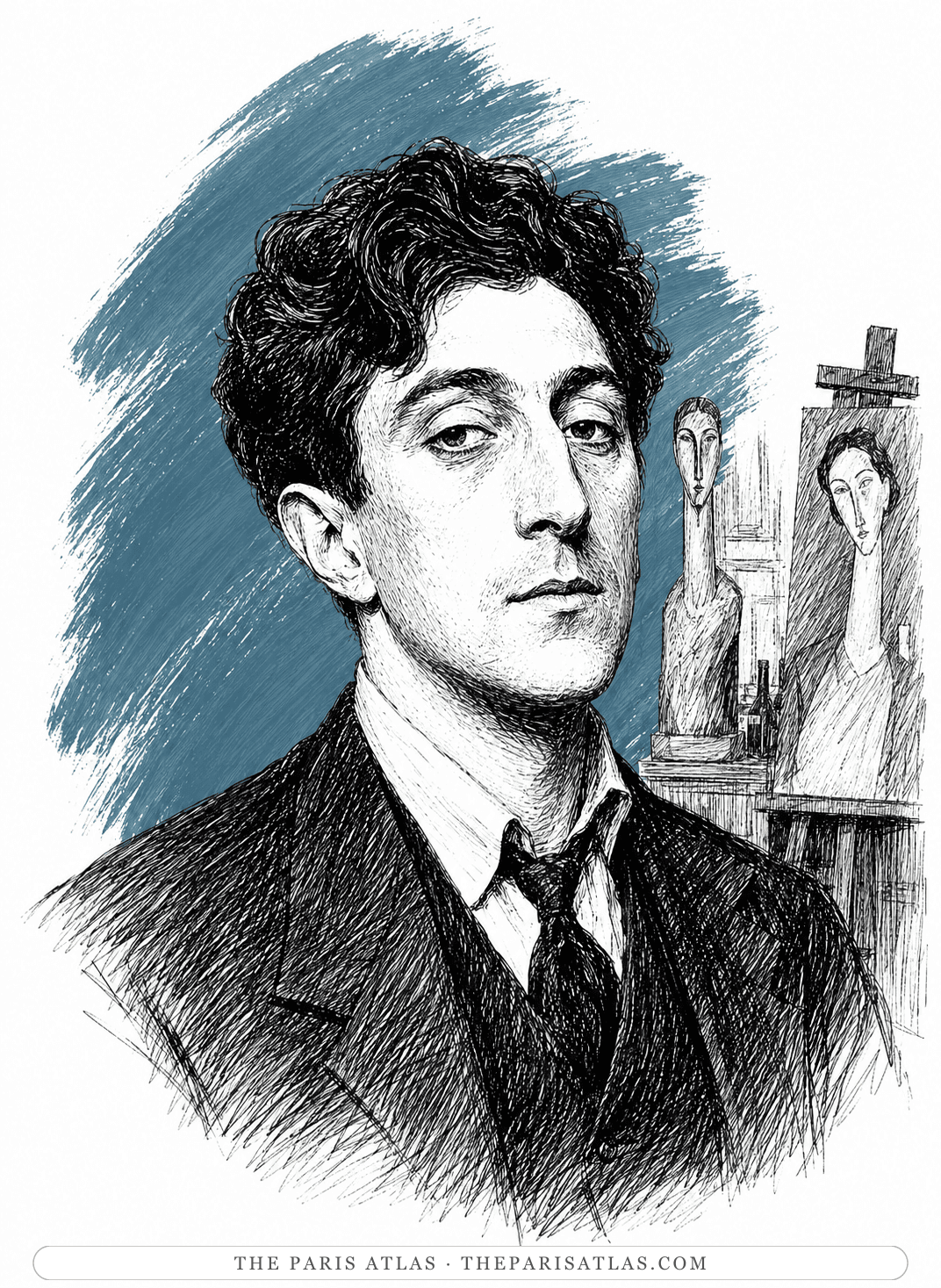
Amedeo Modigliani
- Painter
- Sculptor
Met · 1909
Montparnasse neighbours and friends from about 1909; Brancusi taught Modigliani direct stone carving, and the elongated limestone heads Modigliani carved over the next five years are the visible result.
Romanian shepherd's son who walked much of the way to Paris in 1904, left Rodin's studio because 'nothing grows in the shade of large trees', and pared sculpture down to the egg and the wing. His studio at 11 impasse Ronsin is rebuilt beside the Centre Pompidou, exactly as he willed it.
Constantin Brâncuși was a Romanian sculptor who worked in Paris for fifty years and is generally considered the founder of modern sculpture. He was born at Hobița in southern Romania on 19 February 1876 and died in Paris on 16 March 1957.
He reduced his subjects until almost nothing was left: a head becomes a smooth ovoid, a bird becomes a single upward curve, a kiss becomes two blocks pressed together with one shared eye. He said he was not making things abstract but looking for the essential form inside them.
He is also responsible for a court case that changed the law. In 1926 United States customs refused to admit his Bird in Space as art, classifying it as a manufactured metal object and charging duty. Brâncuși sued, and in 1928 the court ruled that a sculpture need not resemble anything to be art.
He worked in his studio in the impasse Ronsin in Montparnasse, arranging and rearranging the finished sculptures as a single environment, and left the whole contents to the French state on condition it was reconstructed exactly.[1]
Constantin Brâncuși was born on 19 February 1876 at Hobița, a village in the Carpathian foothills of southern Romania, into a family of peasant farmers.[2]
He herded sheep from the age of seven and ran away from home repeatedly. He was skilled with wood from childhood — the region had a strong tradition of carved wooden houses, gates and furniture, and that vocabulary of geometric carving stayed in his work for the rest of his life.[3]
He worked as a dyer's assistant, a shop boy and a barrel-maker. At eighteen he built a violin by hand from an orange crate, which impressed a local industrialist enough to pay for him to enter the craft school at Craiova.
He went on to the National School of Fine Arts in Bucharest, where he trained in academic modelling and anatomy, and made a flayed figure so accurate it was used for years in medical teaching.[2]
In 1903 Brâncuși set out for Paris. He travelled through Vienna, Munich and Switzerland, much of it on foot, and arrived in July 1904 after more than a year on the road. He was twenty-eight.[2]
He enrolled at the École des Beaux-Arts and worked as a dishwasher to eat. In 1907 Auguste Rodin, then the most famous sculptor alive, took him into his studio as an assistant.[2]
He left after about a month. His reason is the most quoted thing he ever said: that nothing grows in the shade of great trees.[3]
From 1907 Brâncuși stopped modelling in clay to be cast, and started carving directly into stone and wood, which almost nobody was doing.[4]
Direct carving meant the material set the terms. The Kiss, carved in 1907 and 1908, is a single block of stone with two figures barely cut into it, arms wrapped round each other, mouths joined, a single eye shared between two profiles. Rodin's Kiss of twenty years before is two naturalistic nudes. Brâncuși's resembles carved stone figures made long before the modern period.[4]
From there he worked in series, returning to the same few subjects for decades: the ovoid heads of the Sleeping Muse and The Newborn, the spiral of the Mademoiselle Pogany portraits, birds, columns, fish, the Kiss.[5]
The best-known series is the birds. He made about thirty bird sculptures from 1910 onwards, and the Bird in Space group from 1923, in bronze and marble: a tall, tapering, polished form, wider in the middle, rising to a point, without wings, head or feet.[5]
He said he was not making a bird but the movement of flight. The bronzes are polished to a mirror, so the surface disappears into reflected light.[4]
In 1926 the photographer Edward Steichen shipped one to New York. United States customs refused to admit it duty-free as art, on the grounds that it did not resemble a bird and was therefore a manufactured metal object, taxable at forty per cent. Brâncuși sued. In 1928 the court found in his favour, accepting that a work by a recognised sculptor need not imitate nature to count as art. Brâncuși v. United States is the case usually cited as the moment American law caught up with modern art, and it remains the legal landmark for modern art's status.[5]
In 1937 and 1938 Brâncuși built a monument at Târgu Jiu, in Romania, to the men of the region killed in the First World War.[2]
It is three works set along one axis about a mile long. The Table of Silence is a stone table with twelve stools. The Gate of the Kiss is a stone gateway carved with his paired-eye motif. The Endless Column is a cast-iron stack of identical rhomboid modules nearly thirty metres high.
The column repeats one shape upward until it stops, and the design implies that it could go on. It comes directly from the carved wooden posts of Romanian peasant houses, which is the tradition he grew up in, made at monumental scale.[3]
Brâncuși lived and worked in the impasse Ronsin in Montparnasse from 1916. He treated the studio as the work: he made his own bases and plinths, photographed everything himself, and rearranged the sculptures constantly so that they formed one composition in white plaster, stone and polished bronze.[6]
When he sold a piece he often carved a plaster replacement so the arrangement was not broken.[6]
He entertained there. Marcel Duchamp, Erik Satie, Man Ray, Amedeo Modigliani, Ezra Pound and Peggy Guggenheim all came, and he cooked for them on a stone slab. Duchamp was his closest ally, handled his American sales and hung his exhibitions, and Brâncuși taught Modigliani to carve stone. He lived in the same rough conditions for forty years while his work sold for large sums.
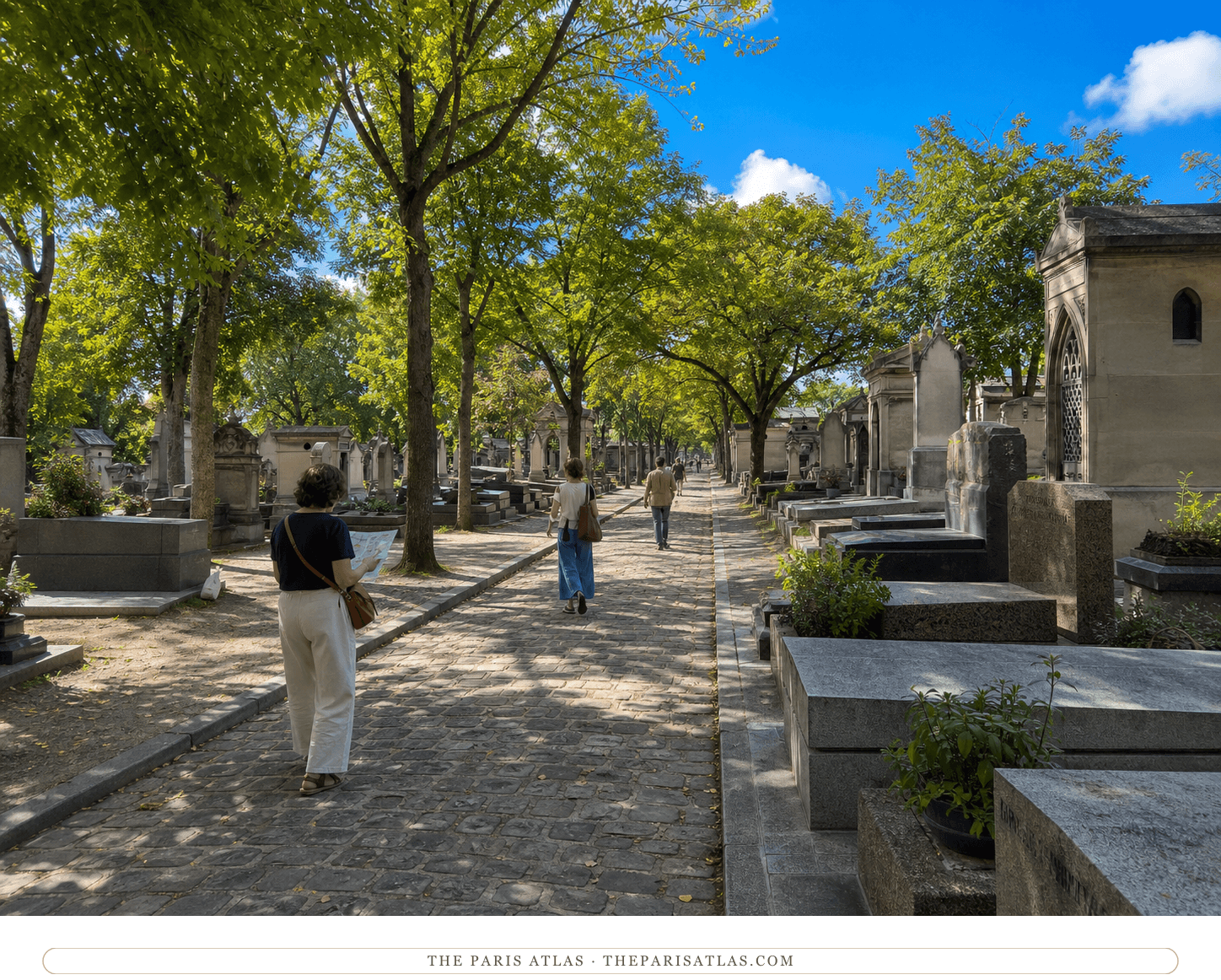
Brâncuși became a French citizen in 1952. He died in Paris on 16 March 1957, aged eighty-one, and is buried in Montparnasse cemetery.[2]
He left the entire contents of his studio to the French state, on condition that it be reconstructed exactly as he had left it. That reconstruction now stands beside the Centre Pompidou in Paris. It holds more than a hundred sculptures, with their bases, tools and furniture in the positions he chose.[1]
Brâncuși invented the language modern sculpture used for the next fifty years: simplified geometric form, the material left visible and doing the work, the base treated as part of the sculpture, and the polished surface that reflects the room. Almost every sculptor after him worked in the space he opened, from Henry Moore and Barbara Hepworth to the minimalists of the 1960s.
Casts and versions are held by the Museum of Modern Art in New York, the Centre Pompidou, the Philadelphia Museum of Art and Tate.[5]
The Bird in Space case is his other legacy, and it belongs to everyone who came after. Until 1928, American customs law defined art as imitation of nature. The ruling that a sculpture does not have to look like anything is one of the few places where the argument about modern art was settled in a courtroom.
Brâncuși was born at Hobița, a village in the Gorj county of southern Romania. In his last years he refused to sell finished pieces, on the grounds that removing one broke the arrangement of the studio, which he had come to treat as a single work. He took French citizenship in 1952 partly so that his bequest of the studio to the French state would be legally valid. The reconstructed Atelier Brâncuși, beside the Centre Pompidou, is free to visit.
Born on 19 February at Hobița, a village in the Carpathian foothills of southern Romania, into a family of peasant farmers.
Herds sheep from the age of seven and runs away from home repeatedly.
Works as a dyer's assistant, a shop boy and a barrel-maker in Craiova and Slatina.
Builds a violin by hand from an orange crate, and a local industrialist pays for him to enter the craft school at Craiova.
Enters the National School of Fine Arts in Bucharest, training in academic modelling and anatomy.
Makes a flayed anatomical figure so accurate that it is used in medical teaching for years.
Sets out for Paris, travelling through Vienna, Munich and Switzerland, much of it on foot.
Arrives in Paris in July after more than a year on the road, at twenty-eight, and works as a dishwasher.
Enrols at the École des Beaux-Arts under Antonin Mercié.
Works in Auguste Rodin's studio as an assistant and leaves after about a month, saying that nothing grows in the shade of great trees.
Begins carving directly into stone and wood instead of modelling for casting, which almost nobody is then doing.
Carves The Kiss, two figures barely cut into a single stone block, sharing one eye between two profiles.
Begins the Sleeping Muse series of ovoid heads.
Makes Maiastra, the first of the bird sculptures that occupy him for the next forty years.
Shows five works at the Armory Show in New York, the exhibition that introduces modern European art to America.
Moves into the studio in the impasse Ronsin in Montparnasse, where he works for the rest of his life.
Makes the first wooden Endless Column in his studio courtyard.
His Princess X is removed from the Salon des Indépendants after complaints that the polished form is obscene.
Makes the first Bird in Space.
United States customs refuses to admit a Bird in Space as art, classing it as a manufactured metal object and charging forty per cent duty.
The United States Customs Court rules in Brâncuși's favour, accepting that a sculpture need not imitate nature to be art.
Meets the Maharajah of Indore, who commissions a temple of meditation that is never built.
Travels to India for the temple project, which is abandoned.
Completes the monument at Târgu Jiu in Romania: the Table of Silence, the Gate of the Kiss and the Endless Column, nearly thirty metres high.
Visits New York for the World's Fair, his last journey outside Europe.
Completes his last sculpture. He continues arranging and photographing the studio.
Becomes a French citizen.
Has his first large retrospective, at the Solomon R. Guggenheim Museum in New York.
Leaves the entire contents of his studio to the French state, on condition that it is reconstructed exactly as he left it.
Dies in Paris on 16 March, aged eighty-one, and is buried in Montparnasse cemetery.
The studio reconstruction opens with the Centre Pompidou.
The reconstructed studio is rebuilt on the Pompidou piazza to Renzo Piano's design, holding more than a hundred sculptures in the positions Brâncuși chose.
Met · 1909
Montparnasse neighbours and friends from about 1909; Brancusi taught Modigliani direct stone carving, and the elongated limestone heads Modigliani carved over the next five years are the visible result.
Met
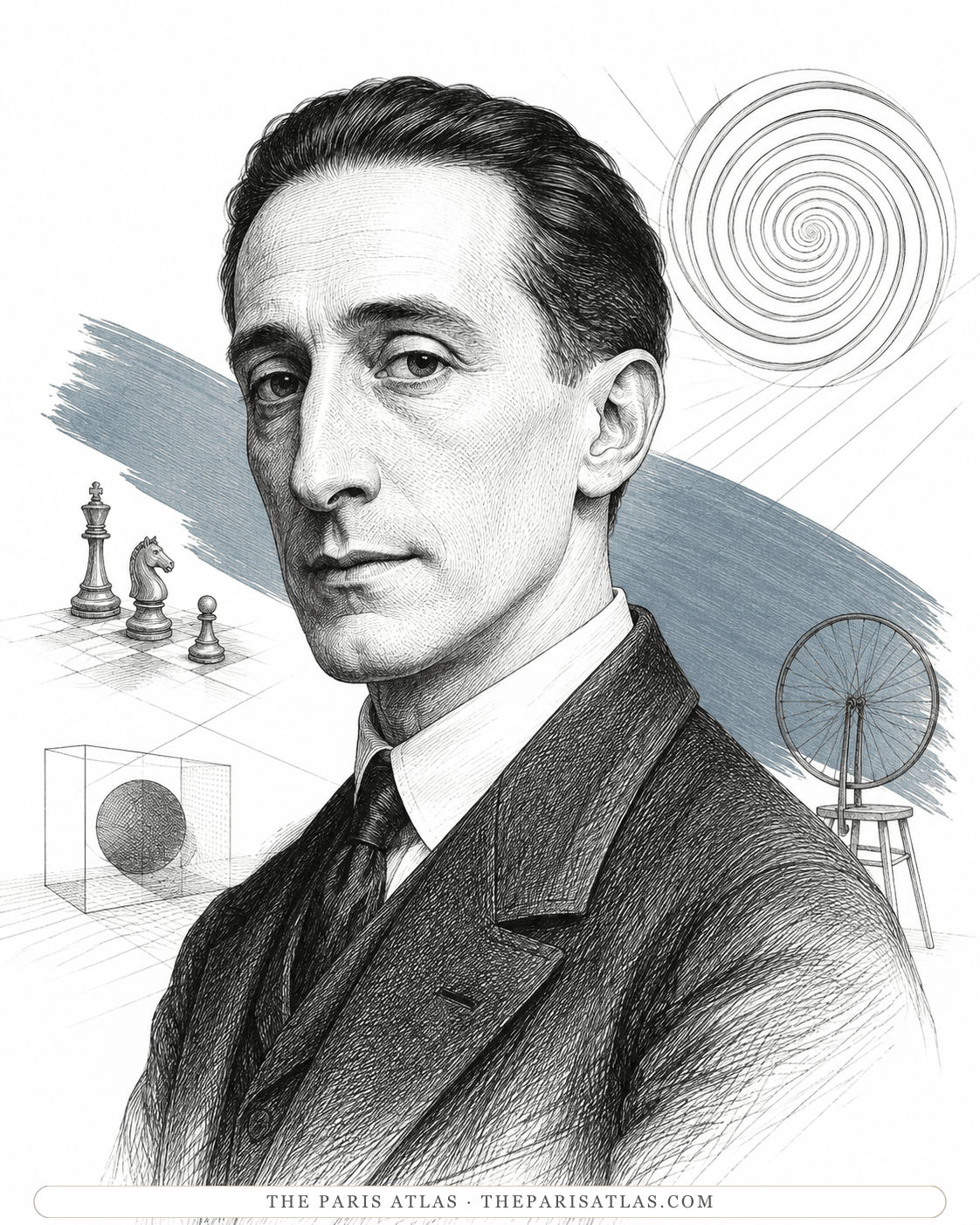
Close friends from the early 1910s — it was with Brâncuși and Léger that Duchamp visited the 1912 aviation salon. Duchamp later organized exhibitions of Brâncuși's sculpture and brokered its sale to American collectors.
Met · 1923
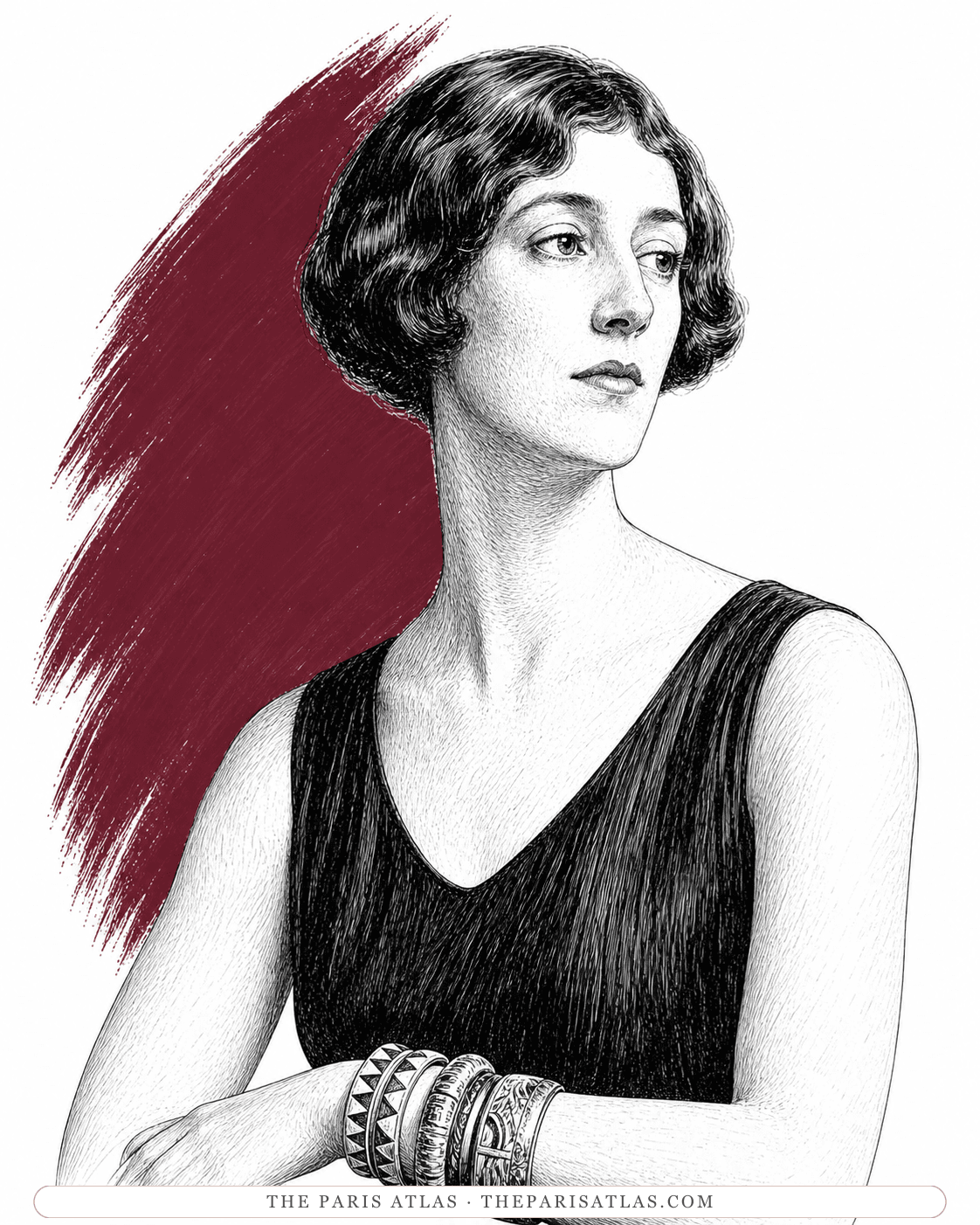
They met in Paris in 1923, introduced by the Dada poet Tristan Tzara. Brancusi made a portrait of her: the Centre Pompidou holds a plaster of about 1928 and a separate fragment catalogued as her chignon, and the polished bronze Jeune fille sophistiquée was cast in 1932. The edge is 'met' rather than a sitting, because the accounts say she did not pose for him and only learned afterwards that the work carried her name.
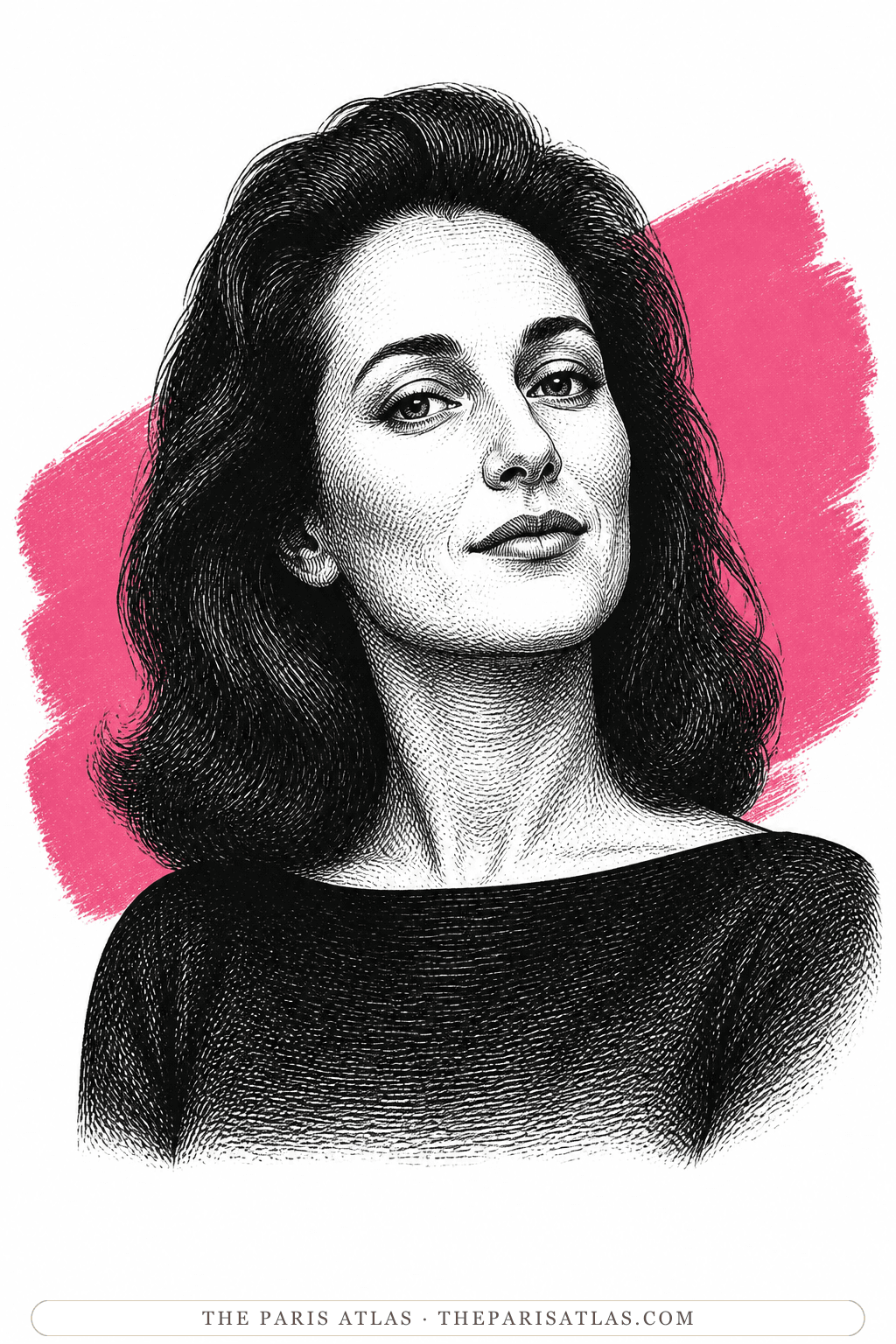
Met · 1956
Tinguely's studio, where Saint Phalle worked and staged the first Tirs, stood in the impasse Ronsin a few doors from Brancusi's; accounts of the alley in the mid-1950s place the young couple among the old sculptor's neighbours in his last years. The shared address is documented; a recorded meeting is not.
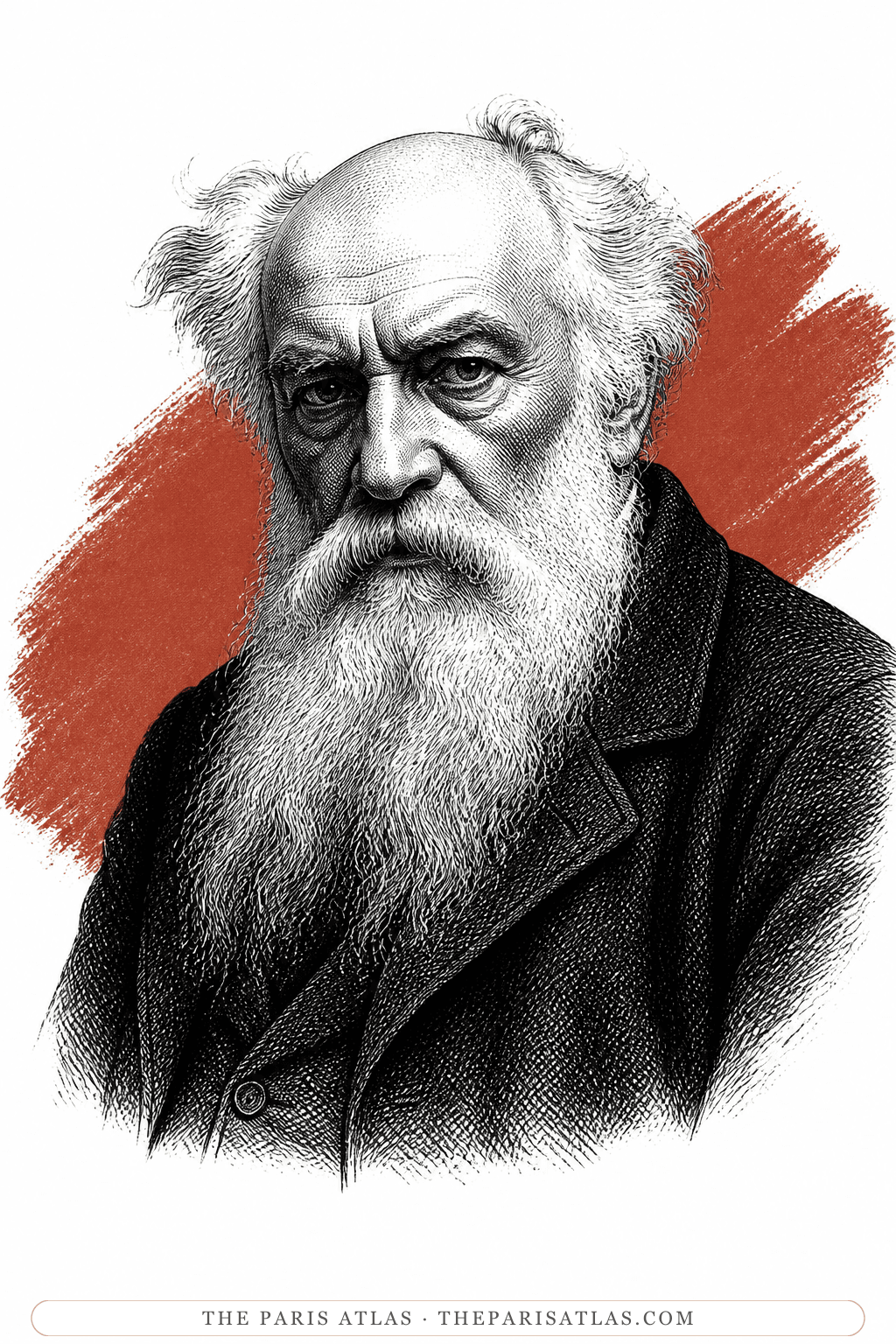
Brâncuși worked briefly as a studio assistant to Rodin in spring 1907 and left after less than a month, saying — in the sentence every subsequent modernist sculptor would learn — that 'nothing grows under big trees.' The exit was itself the influence: Brâncuși's later refusal of Rodin's textured surface for the smooth pared reduction of Sleeping Muse (1910) and Bird in Space (1923) is a direct answer to the modelling method he had just watched at close range.
A Romanian sculptor, born in a Carpathian village in 1876 and died in Paris in 1957, who worked in France for over fifty years. He is generally considered the founder of modern sculpture.
He worked there as an assistant for about a month in 1907 and left, saying that nothing grows in the shade of great trees. He then stopped modelling for casting and began carving directly into stone and wood, which set him against everything Rodin's studio practised.
In 1926 United States customs refused to admit one of Brâncuși's Bird in Space sculptures duty-free as art, arguing that it did not look like a bird and was therefore a manufactured metal object taxable at forty per cent. He sued, and in 1928 the court ruled that a sculpture need not imitate nature to be art.
Beside the Centre Pompidou in Paris. He left the entire contents to the French state on condition that it be reconstructed exactly as he had left it. It holds more than a hundred sculptures, with their bases, tools and furniture in the positions he chose.
A cast-iron stack of identical rhomboid modules nearly thirty metres high, built in 1938 at Târgu Jiu in Romania as part of a war memorial. The shape comes from the carved wooden posts of Romanian peasant houses, and the design implies that the repetition could continue indefinitely.
He denied it. His position was that he was not making things abstract but cutting away everything unnecessary to reach the essential form inside a subject — a head, a bird, a kiss. The results look abstract, which is why customs officials refused to treat them as art in 1926.
Met · 1909
Montparnasse neighbours and friends from about 1909; Brancusi taught Modigliani direct stone carving, and the elongated limestone heads Modigliani carved over the next five years are the visible result.
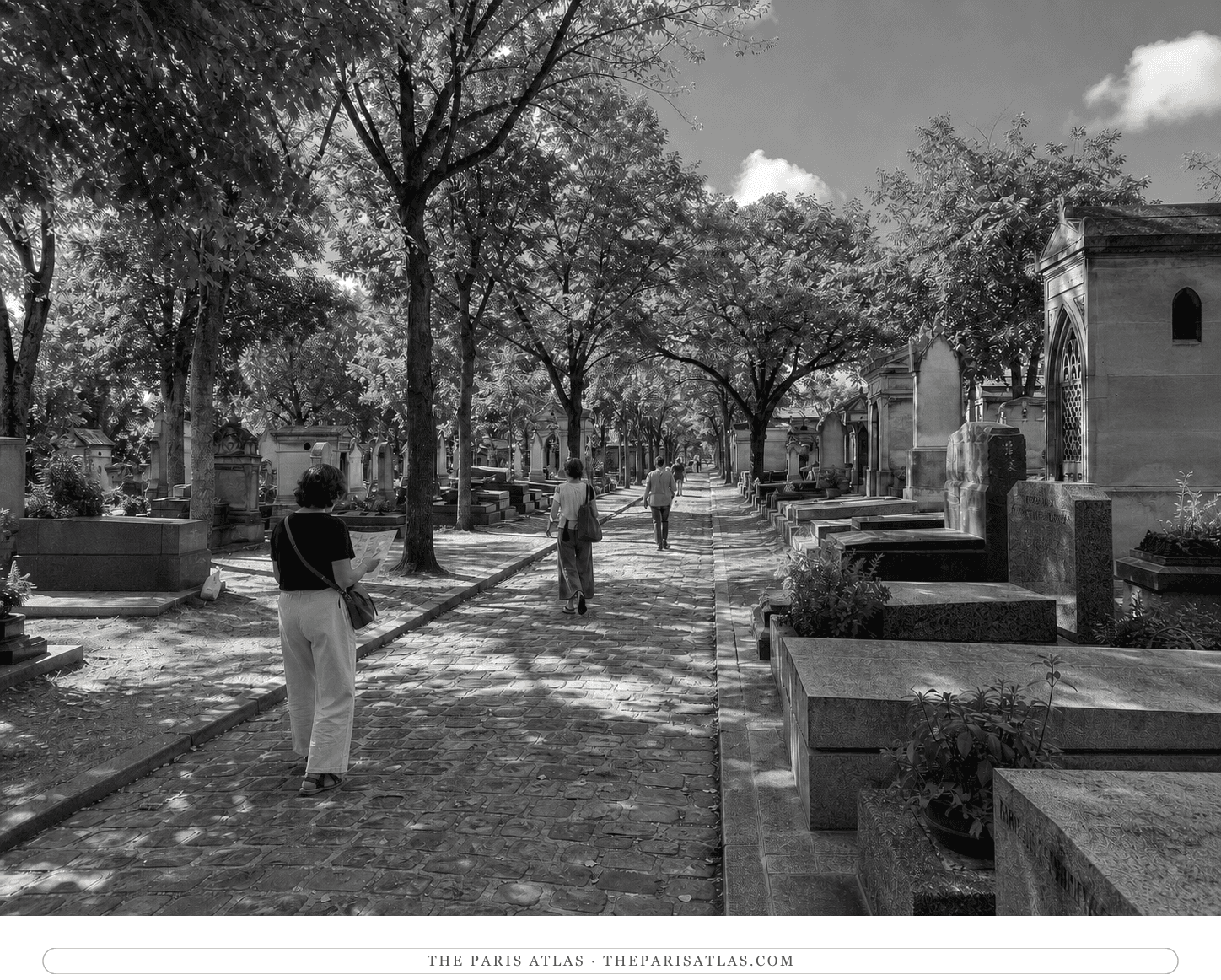
Buried at · 1957
Buried in division 18 after his death in Paris in March 1957. His 1909 sculpture Le Baiser stands on a grave in the same cemetery; Brancusi photographed it there and left the photograph to the French state with the rest of his studio.
Met
Close friends from the early 1910s — it was with Brâncuși and Léger that Duchamp visited the 1912 aviation salon. Duchamp later organized exhibitions of Brâncuși's sculpture and brokered its sale to American collectors.
Met · 1923
They met in Paris in 1923, introduced by the Dada poet Tristan Tzara. Brancusi made a portrait of her: the Centre Pompidou holds a plaster of about 1928 and a separate fragment catalogued as her chignon, and the polished bronze Jeune fille sophistiquée was cast in 1932. The edge is 'met' rather than a sitting, because the accounts say she did not pose for him and only learned afterwards that the work carried her name.
Influenced by · 1907
Brâncuși worked briefly as a studio assistant to Rodin in spring 1907 and left after less than a month, saying — in the sentence every subsequent modernist sculptor would learn — that 'nothing grows under big trees.' The exit was itself the influence: Brâncuși's later refusal of Rodin's textured surface for the smooth pared reduction of Sleeping Muse (1910) and Bird in Space (1923) is a direct answer to the modelling method he had just watched at close range.
Met · 1956
Tinguely's studio, where Saint Phalle worked and staged the first Tirs, stood in the impasse Ronsin a few doors from Brancusi's; accounts of the alley in the mid-1950s place the young couple among the old sculptor's neighbours in his last years. The shared address is documented; a recorded meeting is not.
The sources below include biographies, scholarly essays, interviews, and primary materials that informed this page. They reflect both the historical record and ongoing critical conversations about Constantin Brâncuși and their work.


Reference article cross-checked for the Romanian childhood, the walk to Paris, the Rodin month, the customs case and the Târgu Jiu monument.
These references anchor the page in the documented record and in the scholarly conversations around Constantin Brâncuși. Every claim on this page traces back to one or more of the works listed here.
 Explore more resources