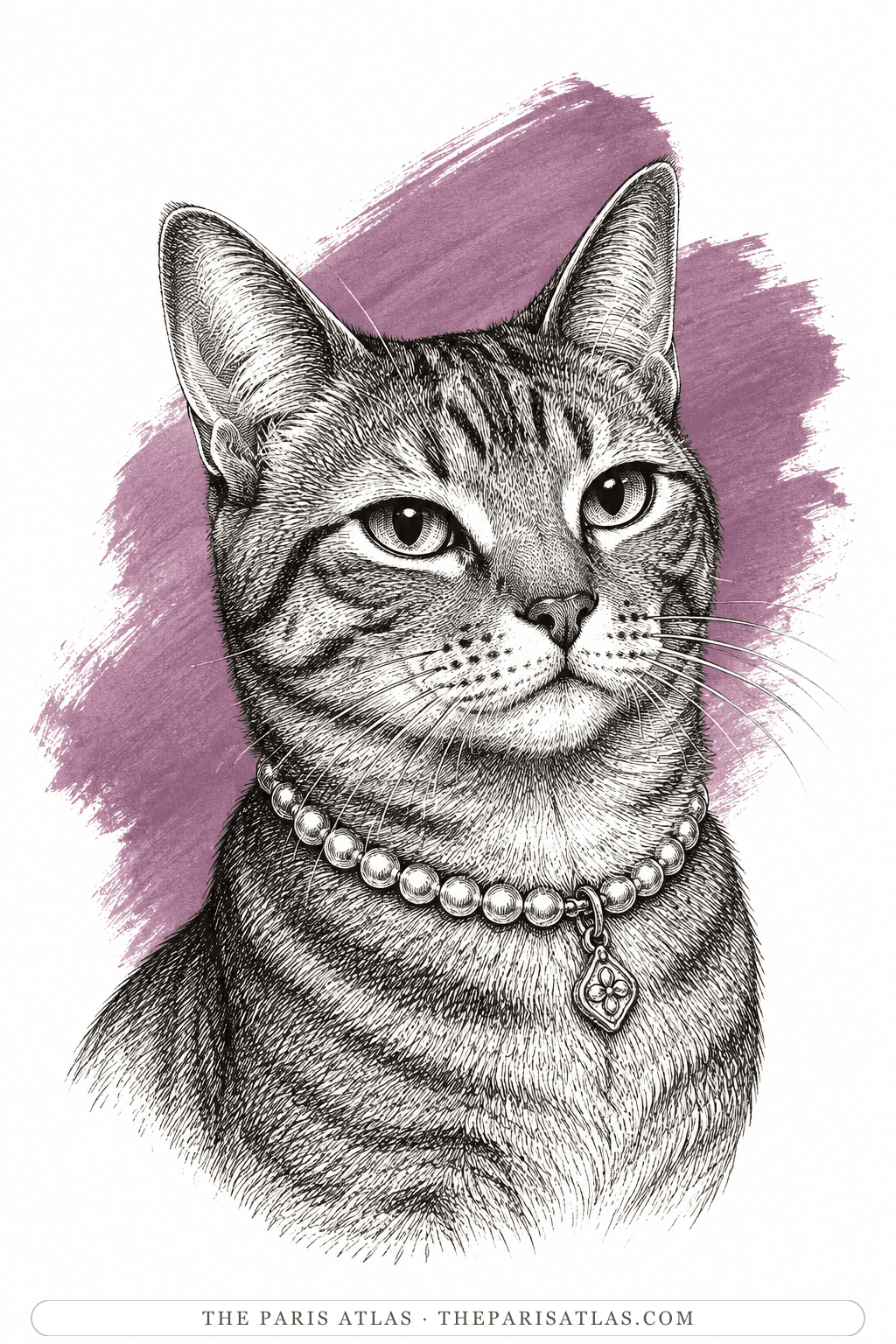
Kiki-la-Doucette
Colette's cat — cool, self-possessed, and unimpressed, observing the household from a height the dog can never reach.
To be treated as a guest in the house rather than a plaything, which is how he puts it to the dog in the first dialogue. He adds that he has a right to everything.
The book

At a glance
- A grey cat with a thick, dark-striped coat; the English translation's cast list calls him a Maltese, meaning a grey one
- All seven dialogues: a country house through summer and autumn, a train, and a Paris studio in winter
- A collar with a bell, which announces him and spoils his hunting
- The man of the house, who writes all day; the cat sits on his papers and is carried up to bed on his shoulder
- Toby-Chien, the household's French bulldog
- Kiki-the-Demure, in the translation published as Barks and Purrs; the woman also calls him Minet
Who they are in the book
Spoiler-freeKiki-la-Doucette is a big grey cat with a thick, dark-striped coat, and Animal Dialogues is a set of short comic conversations between him and the household dog, Toby-Chien, a French bulldog. Colette gave her own two pets voices and let them talk over the two people they live with, a man and a woman who are never named and who appear in the script only as He and She. The cat does more of the talking, and takes the superior line in every argument.
He does not consider himself a pet. Early in the book he tells the dog that a cat is a guest in the house rather than a plaything, and that what the household calls a cat's selfishness is really self-preservation, reserve, and the tiredness of never being understood. He claims the same rights the two people take for granted: his own moods, his own appetite, his own hours alone. When the dog objects that he is already given more than anyone, he answers that the more he is given the more he demands.
His loyalty in the house runs to the man, who sits at a desk writing all day. The cat lies down on the paper and the man moves aside for him. He walks over the pens and letters when he wants attention, and at bedtime he is carried upstairs on a shoulder. The woman he finds too loud and too physical. She jostles him, holds his paws together and rocks him in the air, and imitates his voice too accurately.
His name in French means roughly the gentle one. The English translation, published as Barks and Purrs, calls him Kiki-the-Demure and lists him as a Maltese cat, which in older English meant a grey one; in a later book where the same two animals talk, Colette calls him a Chartreux, the French grey breed.
How Kiki-la-Doucette Is Portrayed
- What he looks likeGrey and long-bodied, with a coat that thickens and darkens in the stripes as winter comes, a tail ringed in black and fawn, tufts on his ear-tips that the woman calls his earrings, and long hair between his toes that he offers as proof of his breeding. The markings above his eyes make an M, which she tells him stands for miaou and for Minet. His eyes are green. He wears a collar with a bell, and two jays in the wood laugh at him every time he passes, because it gives him away.
- He performs his own sufferingShe once held him down on the dressing table to sponge the dirt out of his leg hair. He decided to convince her it was agony and worked through a repertoire: a calf, a beaten child, a cat at night, wind under a door. He kept it up long after she had finished, admits he became absorbed in his own singing, and reports her verdict, which was that he lied like a woman.
- The trick for getting a door openedHe explains the method to the dog as though handing on a technique. Choose a rickety chair. Sit on it and wash yourself so that its legs knock out a steady beat on the floor. Ignore her when she tells you to stop. Keep going until she gets up and holds the door open, then walk out slowly, like someone being sent into exile.
- The day they put him on a trainHe vanished on the morning of the journey and was found on top of the bookcase, out of reach, ignoring the empty plates and the butcher's paper the maids waved at him. He came down only when she fetched the whip and cracked it twice. In the carriage he announced that he was a martyr, shredded the upholstery, ate cold chicken, caught himself purring and made himself stop in case anyone thought he had accepted the trip. When it was time to change trains he sat through both the man's coaxing and her threat of a whipping, then got up on his own and lay down in the basket.
- The horse he tried to kill by staring at itA farmer's horse grazed in the meadow for a month and he could not stand it: the weight of its feet on the ground, its smell, the noise it made. What decided him was seeing the whole of himself reflected in one of its eyes. He planted himself in front of it and tried to will it to death with a look. The horse blew a long breath at him through its nostrils, and he fell over in convulsions.
- What he says about killingHe tells the dog that live birds are better than chicken because they crackle, and that he prefers to swallow small mice whole. Watching the first fire of the autumn he plans the winter's hunting in order: the wait in the brushwood, the single spring, then carrying the bird back to the house still alive so that the man will look up from his desk and the woman will chase him, shouting at him to drop it. He also describes attacking the concierge's cat, which was dragging a wounded paw. The dog begs him not to finish. He explains that he wanted to destroy the reminder of his own death.
- He keeps away from illnessAfter she fell from her horse he stayed out of her room for three days. Part of the reason was that the man had pushed him aside on the stairs with one foot, the way you move a chair. The rest was the fever. He describes standing in the doorway looking for whatever was in there with her, and calls fever the beginning of the thing nobody talks about.
- How he gets the dog punishedShut in the sick-room, he wants the door opened, and the dog will not let him scratch at it while she is asleep. So he begins talking quietly about what the dog is missing: the farmer's dog crunching bones in the kitchen, the rabbit hole he left half dug, the great dane keeping the farmer's dog company while she waits. He turns it into a low, repeating chant until the dog's nerves give way and he howls. She wakes, a step comes up the stairs, and the cat waits for the result: the door will open for him, and the dog will be punished.
If you like Animal Dialogues


If you like Colette
Explore authors with a similar voice, perspective, and influence.

Henry Miller
The Brooklyn dropout who arrived in Paris broke at thirty-eight and wrote the exuberant, banned books that ended American censorship.
View author
Louis-Ferdinand Céline
The doctor of the Paris slums who wrote the century's blackest, funniest novel — and changed the sound of French prose.
View author
Martha Gellhorn
War correspondent who covered the Spanish Civil War, D-Day, and conflicts across five more decades; Hemingway's third wife, 1940–1945.
View author