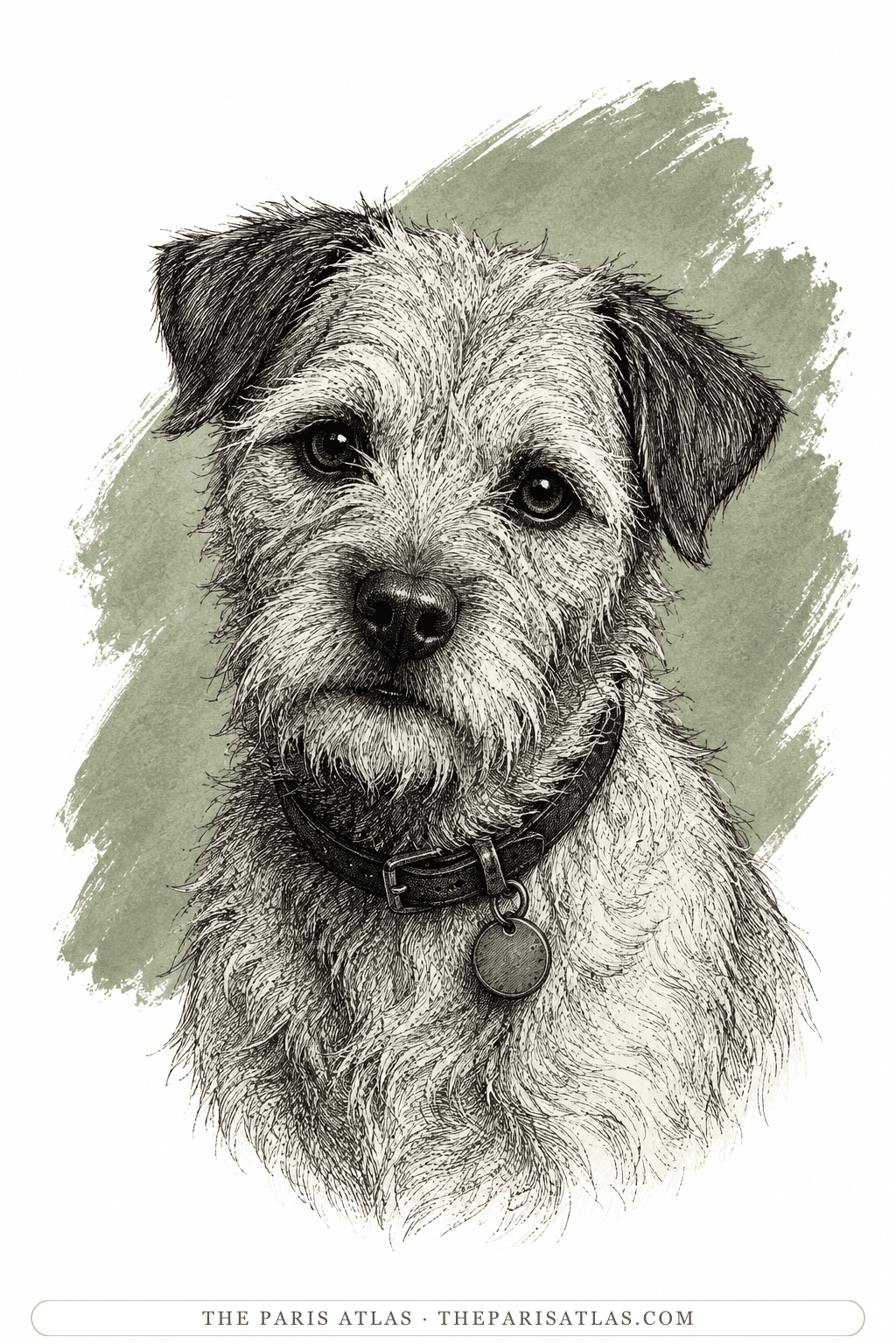
Toby-Chien
Colette's dog — eager, devoted, and easily wounded, forever trying to make sense of his humans and win their approval.
To be taken with her wherever she goes. He tells the woman he would go without dinner if she promised it, and says elsewhere that he has promised to follow her for life and could not stop if he wanted to.
The book

At a glance
- A French bulldog, black; the cast list at the front of the book gives the breed
- All seven dialogues: a country house through summer and autumn, a train, and a Paris studio in winter
- A man and a woman who are never named; the script calls them only He and She
- Kiki-la-Doucette, the household cat, who is in every dialogue with him
- Toby-Dog, in the translation published as Barks and Purrs
Who they are in the book
Spoiler-freeToby-Chien is a French bulldog, and Animal Dialogues is a set of short comic conversations between him and the household cat, Kiki-la-Doucette. Colette gave her own two pets voices and let them talk over the two people they live with, a man and a woman who are never named and who appear in the script only as He and She. Toby-Chien is the dog half of the argument: affectionate, anxious, greedy, easily hurt, and slower than the cat at almost everything.
He tells the cat where he came from. He was born one evening in a stable, almost under the feet of a chestnut mare who then stayed on her feet all night rather than lie down on his mother and the litter. He drank out of the stable pails and got up whenever he heard hooves come in. Then the woman arrived and picked him out of the litter herself, and he is clear about why: he was the stockiest one, with the flattest face.
The cat's verdict is that he has no dignity. He loves everybody, takes any snub without complaint, and is as pleasant and as ordinary as a public park. Toby-Chien's answer is that he is only being polite to visitors who already know his name. Most of the dialogues run on that difference between them.
In the English translation, published as Barks and Purrs, he is called Toby-Dog and the cat Kiki-the-Demure.
How Toby-Chien Is Portrayed
- Born in a stableThe mare he was born under stood all night so as not to crush his mother and the puppies. He grew up on the smell of horses and the sound of carriages being washed, and he defends them to the cat afterwards: after man, he says, a horse is the most beautiful thing in the world.
- What he looks likeLow, thick-set, short-legged and black, with a flat face and barely enough tail to balance him. He says so himself after rolling down the stairs in his hurry to answer her whistle. His eyes bulge, and she keeps a supply of names for them, comparing them to a lobster's and to a frog's. His nose she calls a truffle and his ears an elephant's.
- The bathShe runs warm water, drops in a brown block of soap that smells of tar, and calls him. He describes the fear precisely: his legs go, the reflection of the window shakes on the surface and blinds him, and he lets himself be picked up without struggling, keeping his eyes on hers the whole time. She scrubs him cheerfully and hauls him out by the scruff of the neck, and he recovers under a rough towel and a warm blanket. He forgives her, he says, because he loves her.
- The castor oilWhen she decides he needs dosing she holds him between her knees and opens his jaws. He does not fight, and he gives his reason: he is afraid of hurting her. The cat's account of the same treatment is that he scratched and bit her hard enough that she never tried it on him again.
- He thinks every station is a crashOn the summer journey to the country the train stops and a conductor shouts down the platform. Toby-Chien throws himself at the carriage door and scratches at it, certain there has been an accident and that everyone should run. It happens at three stops in a row. By the third he interrupts himself halfway through the word and says he has had enough of that.
- The hedgehog he was not allowed to haveComing back from a walk he spots a hedgehog by the park gate, rolled up and impossible to get at, and begs her to open it for him, since she can do nearly anything. She turns it over with a stick, remarks that she cannot find the top of it, then picks it up by a single spine and carries it home in her work basket. It unrolls, she admires it, and she never does open it for him. He suspects the cook ate it.
- The week she was illShe fell from her horse and spent a week lying on a couch with her ankle bound. Toby-Chien says he felt his heart crack when she screamed and went down, and that he has taken no pleasure in eating since. He is kept indoors with the cat to watch her sleep, and the sight of her lying still is what frightens him most.
- The visitor from the drawing roomThe last dialogue is set in the Paris studio in winter. A caller's toy terrier is let into the room on her own: black and tan, in a gold collar, announcing that she weighs one pound eleven ounces and that her mother took a prize at the dog show. Toby-Chien tells her within minutes that he loves her, and offers to court her by holding himself straight, walking round her and barking low. She calls him unmannerly and backs away.
If you like Animal Dialogues


If you like Colette
Explore authors with a similar voice, perspective, and influence.

Henry Miller
The Brooklyn dropout who arrived in Paris broke at thirty-eight and wrote the exuberant, banned books that ended American censorship.
View author
Louis-Ferdinand Céline
The doctor of the Paris slums who wrote the century's blackest, funniest novel — and changed the sound of French prose.
View author
Martha Gellhorn
War correspondent who covered the Spanish Civil War, D-Day, and conflicts across five more decades; Hemingway's third wife, 1940–1945.
View author