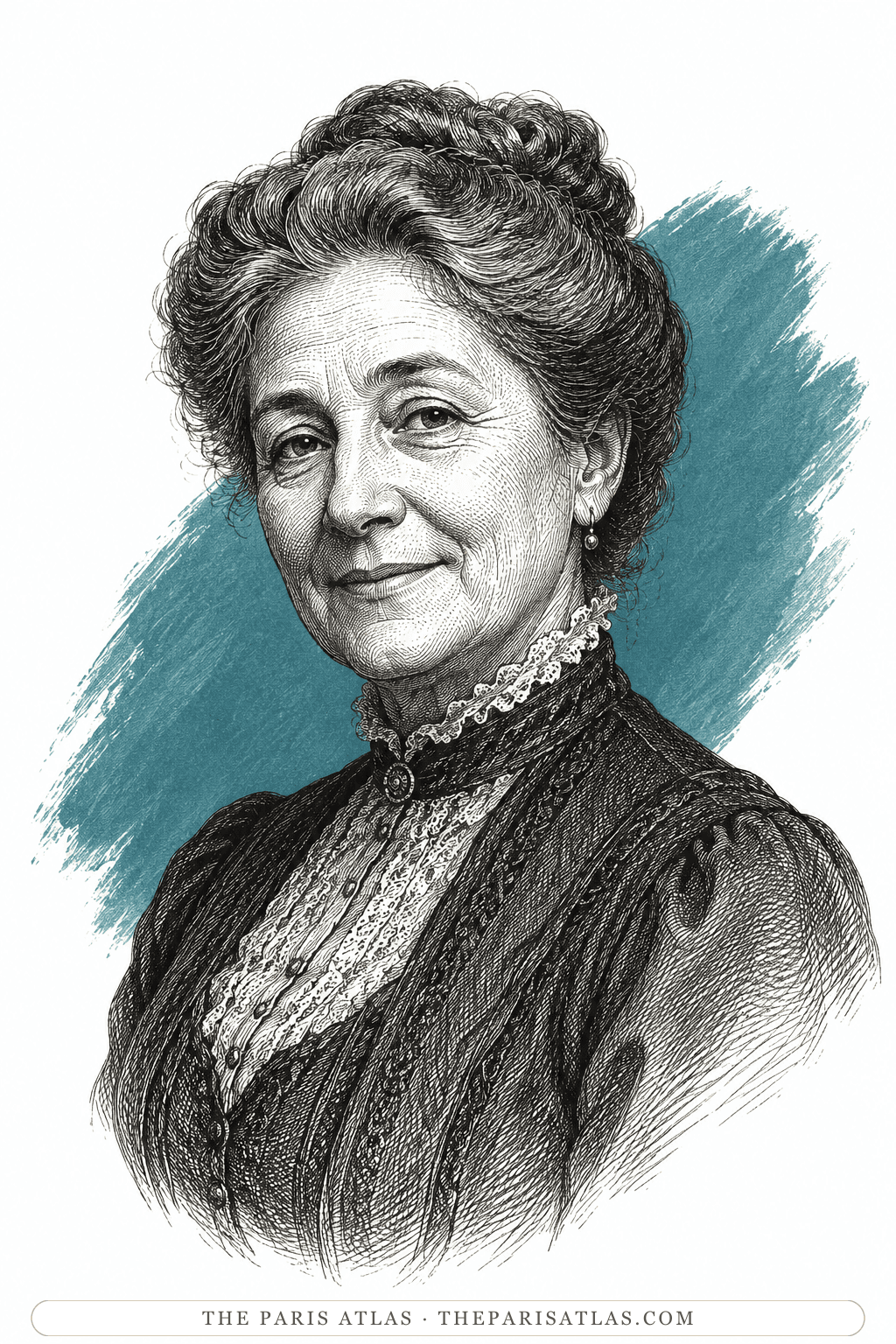
Sido
The narrator's mother, present through reworked letters — the book's measure of how to love the world's particulars and how to relinquish them.
To keep her house and her mornings to herself. She got up at six, then at five, and at the end lit a small lamp long before the church bell, to have the beginning of the beginning to herself; in one of her last letters she admits she had lied about the old woman who was supposed to be sleeping in the house, and says she would rather die than be shut up at night with someone else's breathing.
The book

At a glance
- The narrator's mother, dead before it opens, present through the letters her daughter kept and copies out
- Almost always ma mère, my mother, or ma très chère, my dearest. Her name is printed twice, both times in full — Sidonie Colette, née Landoy at the foot of the opening letter, and Sidonie Landoy on a later page. The word Sido appears nowhere in this book
- Seventy-six in the letter that opens the book, and dead the following year at seventy-seven. In another letter she reports being complimented on her youth at a wedding dinner at seventy-five, and asks her daughter whether one really has to give up being young soon
- A village, in a small house with a garden and a narrow, fast river at the end of it, where she was washing linen at seven in the morning a year before she died
- Twice, and twice widowed. The narrator's father was Jules-Joseph Colette, a captain in the 1st Zouaves, whom she called cher Colette. Asked what she would do in her daughter's place, she said: something stupid, and the proof is that I married your father
- Four, including an eldest son whose adolescence she watched with jealousy and fury. She called her daughter Minet-Chéri
- Having copied out one of the letters, the narrator asks which of the two of them is the better writer and answers that obviously it is her mother
- Adèle Eugénie Sidonie Landoy — Colette's own mother, whose real letters the book draws on
Who they are in the book
Spoiler-freeSido is the narrator's mother, and she is dead before the book starts. Its opening page prints a letter she wrote; its second page says that she died the following year, at seventy-seven. Everything the reader gets of her after that arrives as a letter, kept by her daughter and copied into the book.
Break of Day almost never calls her Sido. To her daughter she is ma mère, my mother, or ma très chère, my dearest. Her name is printed twice, both times in full: the opening letter is signed Sidonie Colette, née Landoy, and a later page, sorting her dead husband's desk, mentions what was left of the fortune of Sidonie Landoy.
That opening letter is the book's foundation, and it is a refusal. Her daughter's second husband has written inviting her to spend a week with them. She declines, and gives her reason at length: she has been given a pink cactus, a rare plant which she has been told flowers in this climate only once every four years, and it is about to flower. She is already a very old woman, and if she went away while it flowered she is certain she would never see it flower again. She signs off with her thanks and her regret. Her daughter reads the letter as proof that at seventy-six her mother was still planning journeys, and that the possible opening of one flower could stop everything, even in a heart made for love.
The letters show a woman with very little money and a great deal of appetite. She opened her village house to stray cats, tramps and pregnant servants. She once ran out into wind-driven snow to bang on rich people's doors because a child had just been born nearby with nothing to wrap it in. She calls that selfishness and explains what she means: she is never at peace if she thinks a child or an animal is hungry, so she does something about it in order to get some peace.
She is not sentimental about marriage or about love. She told her daughter it was not the divorce she blamed but the marriage, and that anything would be better than marrying, only it is not done. She wrote that love is not an honourable feeling. Of her own husband's devotion to her, which she believed had killed off one by one the gifts that should have taken him into literature and science, she wrote: what frivolity.
How Sido Is Portrayed
- The letter about the pink cactusInvited to spend a week with her daughter and her daughter's second husband, she says no. A rare pink cactus she has been given is about to flower, she has been told it flowers here only every four years, and at her age she will not get a second chance to watch it. The book opens with this letter, in full.
- Dead before the first pageShe died the year after writing that letter, at seventy-seven, and the narrator says so straight away. What follows is a woman assembled entirely out of correspondence — at one point the narrator states plainly that she has just copied a letter out.
- What she looked like at seventy-fiveA big straw hat that slept outdoors in every season. Grey eyes, wandering and never satisfied, which watchfulness had pinched into the shape of a diamond. No more eyebrows than the Mona Lisa, and a nose she disliked: she used to tell her daughter that we have an ugly nose, in the tone of someone saying we have a lovely property. Strangers who heard her quick step on the stairs and her wild way of opening a door turned round and were startled to find a small old lady.
- The letter written beside a fireFive in the morning, and the neighbour's hay barn is burning across the road. Firemen are in her garden trampling the beds she had prepared for flowers and strawberries, fire is falling on her hen-house, and she is enjoying herself enormously. She is glad she gave up keeping hens, because eating birds she had fed herself horrified her. She is sorry for the rats bolting out of the barn. She tells her daughter not to worry, the wind is easterly, and goes off to drink her morning coffee where she can watch.
- What she calls her selfishnessShe has sent wood to a sick neighbour and gone begging round the village for her again, which she says she cannot do graciously, because the sight of people who give nothing and live inside their own cheese makes her want to swear at them rather than charm them. She also walks to her daughter's empty house every afternoon to give the cat warm milk and light it a fire, and boils it an egg when there is nothing else. None of it amuses her, she says. She simply cannot rest, so she arranges to be able to.
- On her daughter's menShe would not congratulate her daughter on the handsome, clever, enviable one. She said she was not pleased; that she had preferred the other one, the fool; that with the fool her daughter would write beautiful things; and that with this one she would hand over everything precious she had and be made unhappy into the bargain. Her daughter laughed and called her Cassandra. She agreed that she was one, and said that if she told everything she foresaw...
- Chess with the wool merchantShe plays chess in the back room of a small fat ugly man who sells buttons and darning wool all day without a word, and who turns out to play finely. There is a stove, a chair he pushes forward for her, and two impossible geraniums of the kind that only grow in poor houses. He asks each time whether she would like a cup of tea, because she is a lady and tea is a distinguished drink. She writes that she plays and wonders what is shut up inside that man, that she will never know, and that she is quite content to be certain there is something and to be the only one who knows it.
- The shroud she has had madeShe has had her two white flannel bed-jackets, made for her operation, sewn into a single one with a hood, trimmed at hood, sleeves and collar with real linen lace — she cannot bear to touch cotton lace. It is to be buried in. She is still annoyed that a magnificent ebony coffin with silver handles, cut to measure for a woman who turned out too swollen to fit it, went instead to her sister-in-law Caro, who was appalled by the gift and passed it on to her charwoman. She would have been beautifully housed in it. She tells her daughter not to be upset by the letter: it comes at its proper time and is what it has to be.
The final letter in the book is not a letter. Two pencilled sheets carry only marks: arrows leading out of a half-formed word, small rays, two yeses, and one phrase written out perfectly clearly, « elle a dansé », which means she has danced. Lower down she has written « mon amour », my love, the name she used for her daughter when they had been apart a long time.
The narrator refuses to read the sheets as delirium. She reads them as one of those trick landscapes with things hidden in them — a face in the leaves, an arm between two branches — and as a hand trying to hand over a new alphabet. She admits, too, what she has put the letter on top of in order not to look at it: a half-beaten head turning from side to side on the pillow, its neck dry, impatient like a goat tethered too short.
If you like Break of Day


If you like Colette
Explore authors with a similar voice, perspective, and influence.

Henry Miller
The Brooklyn dropout who arrived in Paris broke at thirty-eight and wrote the exuberant, banned books that ended American censorship.
View author
Louis-Ferdinand Céline
The doctor of the Paris slums who wrote the century's blackest, funniest novel — and changed the sound of French prose.
View author
Martha Gellhorn
War correspondent who covered the Spanish Civil War, D-Day, and conflicts across five more decades; Hemingway's third wife, 1940–1945.
View author