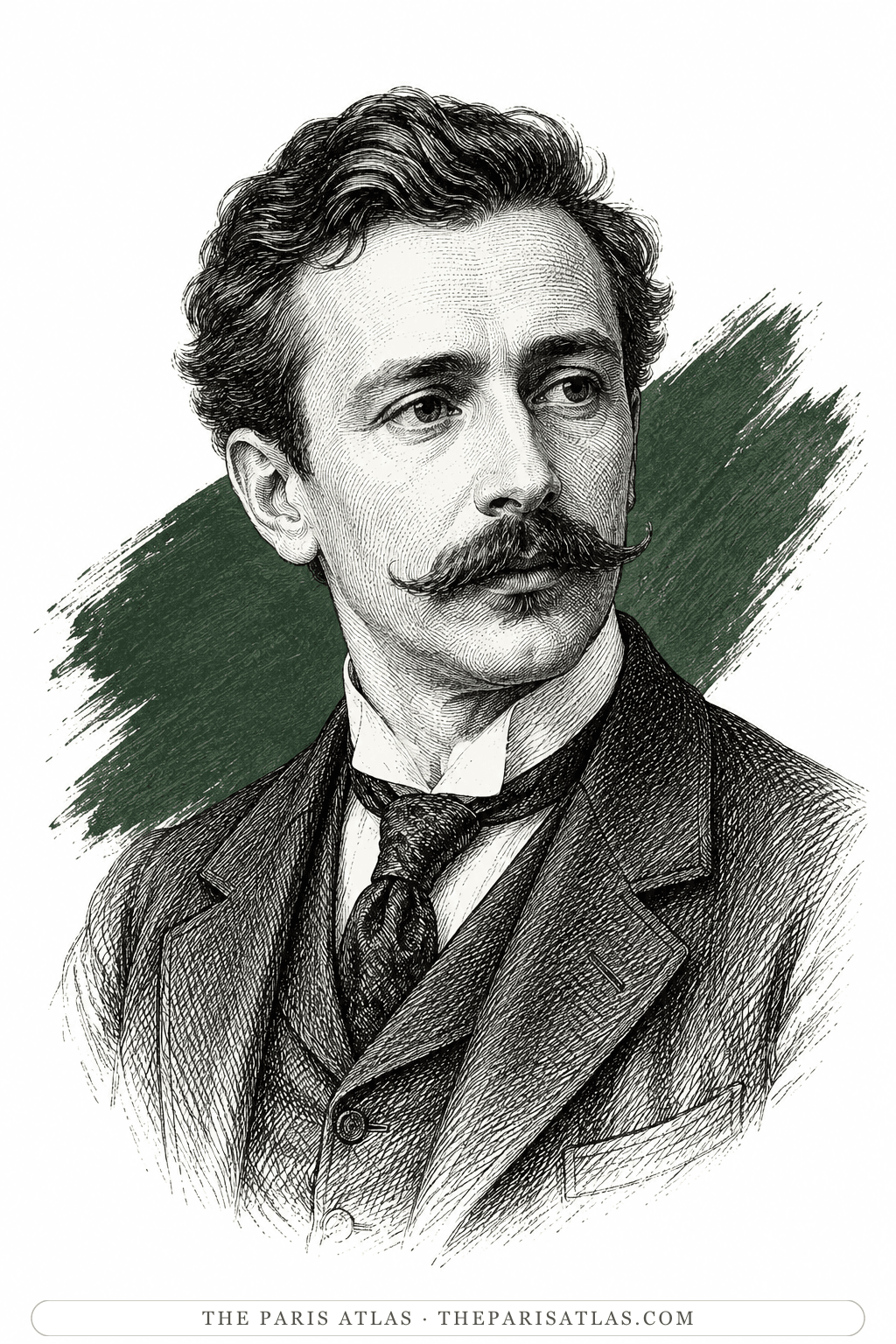
Valère Vial
The younger man attached to the household and drawn to the narrator — the last love affair she considers and lets go.
To be left where he is, near her, with nothing settled. Asked what he lives on apart from her, he answers that he lives on very little, and on her; told that she can still be hurt, he says he would make do even with that.
The book

At a glance
- The narrator's summer neighbour on the Provençal coast, and the one man the book puts in front of her
- Thirty-five. He gives the figure himself, when she tells him he ought to marry. The book puts fifteen years between them
- Valère Vial, called Vial by everyone. He once claims his first name is Hector
- Trained as an upholsterer, he now calls himself a decorator. He keeps a small Paris shop, half romantic bookshop and half bric-a-brac, and designs furniture
- A whole set of model rooms — living room, bedrooms, dining room — for a Paris department store, the Quatre Quartiers. He is building the models in wood and metal at his own expense. If they take them, he gets to run their modern furnishing workshops
- He served, and came out with two scars on one arm. His comrades teased him for being too fastidious to bother with ordinary women
- Hélène Clément, a painter of twenty-six who lodges in a nearby boarding house and drives her own five-horsepower car. He said things to her the previous summer that she took seriously; this year, he tells the narrator, it has changed
- Real painters, writers and performers of the day, named in the book under their own surnames: Segonzac, Carco, Luc-Albert Moreau, Géraldy, Thérèse Dorny. They summer along the same coast, and they are the narrator's friends rather than his
Who they are in the book
Spoiler-freeValère Vial is a character in the novel, and everybody in it calls him Vial. He is thirty-five, he has been coming to this stretch of the Provençal coast for two or three summers, and he lives three hundred metres from the narrator in a small house painted pink that the summer crowd calls le Dé, the dice, because it is a cube. He swims, he dances well, and he says very little.
He is an upholsterer's son. He fought in the First World War and came out of it with two scars on one arm, and afterwards he refused to go back into the family trade; he says he was frightened of his father, a man still vigorous, sharp at business and proud of it. He now keeps a small shop in Paris, half romantic bookshop and half bric-a-brac, and hands out calling cards reading « Vial, décorateur » — Vial, decorator. He designs furniture, reads, likes painters, and tells them what he thinks of their work, which they find funny.
All summer he is the narrator's neighbour and her errand-runner. He fetches her melons and peaches from the market, pours oil into her sauce, and lies on her terrace with his head on his folded arms. She calls him tu, the familiar form, and calls him my little Vial; he calls her madame. Everyone along the coast has quietly decided he belongs to her. After the eleven o'clock swim nobody offers him a lift home, because they all take it for granted that he is staying to lunch.
The middle of the book is a single conversation between the two of them that runs from evening until first light. Most of what a reader learns about him is said in it, by him.
How Valère Vial Is Portrayed
- The house across the vineyardHe lives three hundred metres away in a pink cube of a house that everyone calls le Dé, the dice. At night his red lamp faces her green one across the dark. He jokes that she is the port light and he is the starboard; she answers that the two never look at each other.
- The name he checks she has forgottenShe asks what his first name is. He says Hector. She says she thought it was Valère. He agrees that it is, and says he only wanted to establish that she had more or less forgotten.
- What he looks likeBurnt brown, with wide shoulders, a thick cylindrical neck, and skin that looks green at the loins and blue at the shoulders as he moves. His features are regular and nearly handsome, but the narrator thinks the face dozes above a body that is precise and awake, and she has told him he could be guillotined without anyone noticing. Long nose with a slight bump, brown eyes, strong teeth, and long fine fingers that do not match the arm they are on.
- He does her shoppingHe comes back from the market with two melons, a frangipane tart and two kilos of peaches, and no idea what he has spent. She works it out from the size of the melons and the tart and tells him she owes him between forty-five and fifty francs. He also brings bars of nougat, and carob branches with green fruit that keep if you stand them in jars of damp sand.
- He tells her she looks awfulShe asks him, half joking, whether she is hideous after a morning's gardening. He looks at her and says yes, then explains: three hours at what he calls idiotic work, hands like a hired man's, a top that has lost its colour, a face she has not powdered since morning. He asks her to spare a thought for the people who love her.
- He answers questions with questionsShe tells him she does not like it and that it is not courteous. He carries on doing it, and she later catches herself using the same trick on Hélène Clément, the young painter who is in love with him.
- The cat will not have himHe is in love with the narrator's cat and says he would stoop to anything to win her round. The cat comes to the door, sees him laugh at her, gives him one cold look and goes away again.
- What he says in the nightHe tells her he has never for a minute had the illusion of being her friend, and that he has never once used her name when the two of them are alone — in front of other people he says Colette in order to be lost in the crowd. He admits that when she was too busy to see him in Paris he used to console himself with the thought that she would suddenly be sixty or seventy and life would become possible again. He admits, too, that at certain moments her death would not have displeased him.
The night conversation settles nothing. At dawn he says au revoir and drives off to Moustier-Sainte-Marie to buy Provençal quilts and Varages pottery for his shop, and he does not come back to the coast. He turns up next at Vaison, then in Paris, working flat out on the Quatre Quartiers commission.
Hélène Clément goes after him. Her father was at school with the minister and is steering Vial through the right offices, and she tells the narrator, with a raised finger, how much she would love to help him. The narrator writes that Hélène will have Vial and that it will be justice. She also writes that she handed him over, that she regrets it, and that one day, going back over the loves of her past, she may decide she had better than any of them: she had Vial.
If you like Break of Day


If you like Colette
Explore authors with a similar voice, perspective, and influence.

Henry Miller
The Brooklyn dropout who arrived in Paris broke at thirty-eight and wrote the exuberant, banned books that ended American censorship.
View author
Louis-Ferdinand Céline
The doctor of the Paris slums who wrote the century's blackest, funniest novel — and changed the sound of French prose.
View author
Martha Gellhorn
War correspondent who covered the Spanish Civil War, D-Day, and conflicts across five more decades; Hemingway's third wife, 1940–1945.
View author