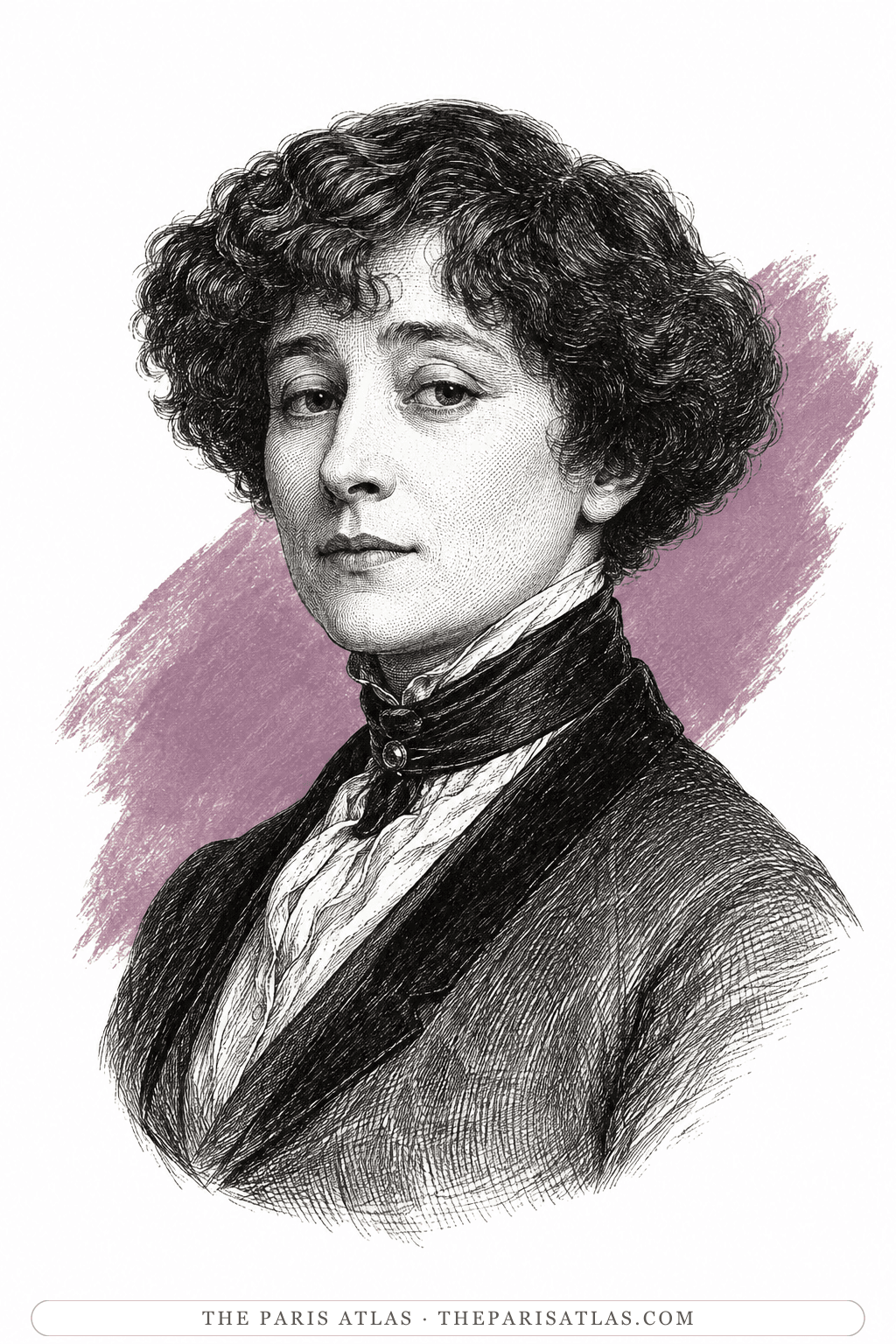
Colette (the narrator)
A writer named Colette, in her early fifties, spending a summer in Provence and deciding what to want after desire — invented and autobiographical at once.
To find out who she is once her life stops depending on love. She tells Valère Vial that for the first time since she was sixteen she will have to live, and perhaps die, without a love affair deciding it.
The book

At a glance
- The narrator of every page. It is her own account of one summer, and she writes most of it at night, as it happens
- Never stated. She says she is no longer forty and counts herself among the over-forties; one of her husbands once told her she should write a manual on living with a man at about fifty; and she calls the fifteen years between her and the thirty-five-year-old Valère Vial a trifle
- A small, deliberately ordinary house on the Provençal coast, with a vineyard running down to the sea and a village port within walking distance. Her father's house, she says, stood sixty kilometres away at Le Mourillon
- Novelist. She mentions the Claudine books, her own characters Renée Néré and Léa, and a touring stage production of Chéri
- Twice, and both husbands are alive. She quotes both: one asked whether she could not write a book that was not about love, adultery and rupture; the other said that walking in on her alone with animals felt indiscreet
- Her father was Jules-Joseph Colette, a captain in the 1st Zouaves. Her mother signed herself Sidonie Colette, née Landoy, and called her Minet-Chéri. She has a daughter, and refuses to write about her
- Divine, the Provençal cook, who sleeps in a hut in the vineyard; a cat, the cat's mate and their half-grown daughter; and the ageing Brabançon griffon bitch
- Colette — writing under her own name, about her own parents and her own house, and inventing freely around them · 1873–1954 · Saint-Sauveur-en-Puisaye, Burgundy
Who they are in the book
Spoiler-freeBreak of Day is narrated by a woman called Colette. She is a writer, and she is spending a summer alone in a small house on the Mediterranean coast of France. Colette is also the name of the woman who wrote the book, and the narrator's circumstances match the author's closely: the same dead mother, the same father, two former husbands, the same published novels. The book is a novel all the same, and it says so at the front. Its epigraph reads: « Imaginez-vous, à me lire, que je fais mon portrait ? Patience : c’est seulement mon modèle. » That means, roughly: do you imagine, when you read me, that I am painting my portrait? Be patient, this is only my model. She is telling readers not to take the woman in the book for the woman who wrote it.
There is almost no plot. The book is her account of one season, written as she lives it. She swims every morning, gardens through the heat until her hands look like a hired labourer's, digs seaweed into the trenches round her young tangerine trees, feeds ten friends at a time from a charcoal grill on the terrace, and writes at night on bluish paper. Her Provençal cook, Divine, sleeps in a hut in the vineyard. She expects to pick the grapes before 15 September and reckons on eighteen hundred to two thousand litres, half of them hers.
Two things press on her that summer. One is a neighbour, Valère Vial, a man of thirty-five who lives three hundred metres away and is in love with her. The other is a decision she has already made: she has stopped arranging her life around love. She says it to Vial outright, in the middle of one long night. It is the first time since she was sixteen that she will have to live, and possibly die, without her life or her death depending on a love affair, and she tells him she finds that extraordinary.
Behind both is her mother, dead before the book opens. The narrator kept her letters, copies them into her pages, and measures herself against them all summer. She is hard on the comparison. Having copied one out, she asks which of the two of them is the better writer and answers that obviously it is her mother.
How Colette (the narrator) Is Portrayed
- Her morningShe is awake before almost everyone. She swims off the crescent of beach below the house, then gardens through the heat, packing washed seaweed into the trenches dug around the young tangerine trees and treading the earth down with both feet the way grapes are trodden.
- The hand she describesShe rests her hand on her neighbour Valère Vial's chest and then looks at it: brown, nails cut short, thumb turned back, scars and grazes, the skin going loose around the knuckles. She says it carries a few more years than she does and that she is not ashamed of it. Two of the nails are pretty, a gift from her mother; three are not, from her father.
- The second place settingShe sometimes lays a second place opposite her own at the shaded table: a green plate, a thick old clouded glass, and a brass lyre taken off a last-century ophicleide, used to pinch the napkin so she can tell it from hers. She notes that it now belongs to a friend who comes and goes, not to a man who walks about upstairs at night.
- The lunch she cooksFour small chickens split in half, struck flat with a hatchet, salted, peppered and basted with oil brushed on with a sprig of the herb the household calls pebreda. She looks at the broken joints and asks why not cook a child while they are at it. Then she says that next year she will be a vegetarian, and that this year she is too hungry.
- Asked whether she looks awfulAfter three hours in the sun she asks Vial, half joking, whether she is hideous. He says yes. He then lists it: hands like a day-labourer's, a top that has lost its colour, a face she has not powdered since morning. She tries to laugh it off and does not quite manage.
- Her animalsA cat she counts as the third of the great ones in her life, the cat's magnificent mate, and an ageing Brabançon griffon bitch who has watched her without stopping for years. She says she no longer wants to write portraits of animals, and that she will end by hiding hers from everyone except the few friends the animals pick themselves.
- Writing at nightShe works in bed on a low table with rubber feet, on bluish paper, under a green porcelain shade. Across three hundred metres the green light faces the red lamp Vial burns in his house. He jokes that she is the port light and he is the starboard; she answers that the two never look at each other.
- The names she used to write underShe points out that she used to call her narrator Renée Néré, or arrange a character called Léa. Now, she says, legally, in her books and among her friends, she has only one name left, and it is her own.
She turns Valère Vial down. Their long night conversation settles nothing and ends at first light with him driving off to buy Provençal quilts and pottery for his Paris shop. He does not come back to the coast. She writes afterwards that she gave him away to a younger woman, and that the gesture had a handsome air of extravagance about it. She also writes, plainly, that she regrets it.
The book ends before the vintage, at dawn, with the day's grape-cutting ahead of her and her hand cold with what she calls a young emotion. She writes that she will not gather anything again except by the armful: great armfuls of wind, of coloured atoms, of generous emptiness, to be unloaded on the threshing floor with pride.
If you like Break of Day


If you like Colette
Explore authors with a similar voice, perspective, and influence.

Henry Miller
The Brooklyn dropout who arrived in Paris broke at thirty-eight and wrote the exuberant, banned books that ended American censorship.
View author
Louis-Ferdinand Céline
The doctor of the Paris slums who wrote the century's blackest, funniest novel — and changed the sound of French prose.
View author
Martha Gellhorn
War correspondent who covered the Spanish Civil War, D-Day, and conflicts across five more decades; Hemingway's third wife, 1940–1945.
View author