Claudine
The Burgundy schoolgirl transplanted to Paris at seventeen: bored, watchful, and engaged by the end of the book to a man of forty who is also, by marriage, her uncle.
To go back to Montigny. She says so to her aunt in as many words, and the diary returns again and again to the same woods, the same lane and the same violets.
The book

At a glance
- Seventeen, as of two days before the diary opens
- A dark third-floor flat on the rue Jacob in Paris, between two courtyards; before that, the family house at Montigny in Burgundy
- Her father Claude, who is finishing a treatise on the slugs and snails of the Fresnois; Mélie, the servant who nursed her; Fanchette, her white cat
- Her aunt Wilhelmine Cœur on the avenue de Wagram, whom she had met once, aged nine; Wilhelmine's grandson Marcel; Marcel's father Renaud
- A dowry of 150,000 francs left by her mother and lodged with a notary at Montigny, which her father mentions to her for the first time over pudding
- Two months in bed after the move with what the doctor treats as a brain fever; she is still convalescing when the book begins
Who they are in the book
Spoiler-freeClaudine is the narrator of this novel and its only real subject. The book is written as her diary, so nothing in it happens where she cannot see it. She is seventeen — she turns seventeen two days before the first entry — and she had spent every one of those years in Montigny, a village in Burgundy, until her father moved the two of them to Paris. He is a scholar writing a treatise on the slugs and snails of his home district, and he moved because the printers were too slow at posting his proofs out to the country. Colette published the novel in 1901 under her husband's pen name, Willy.
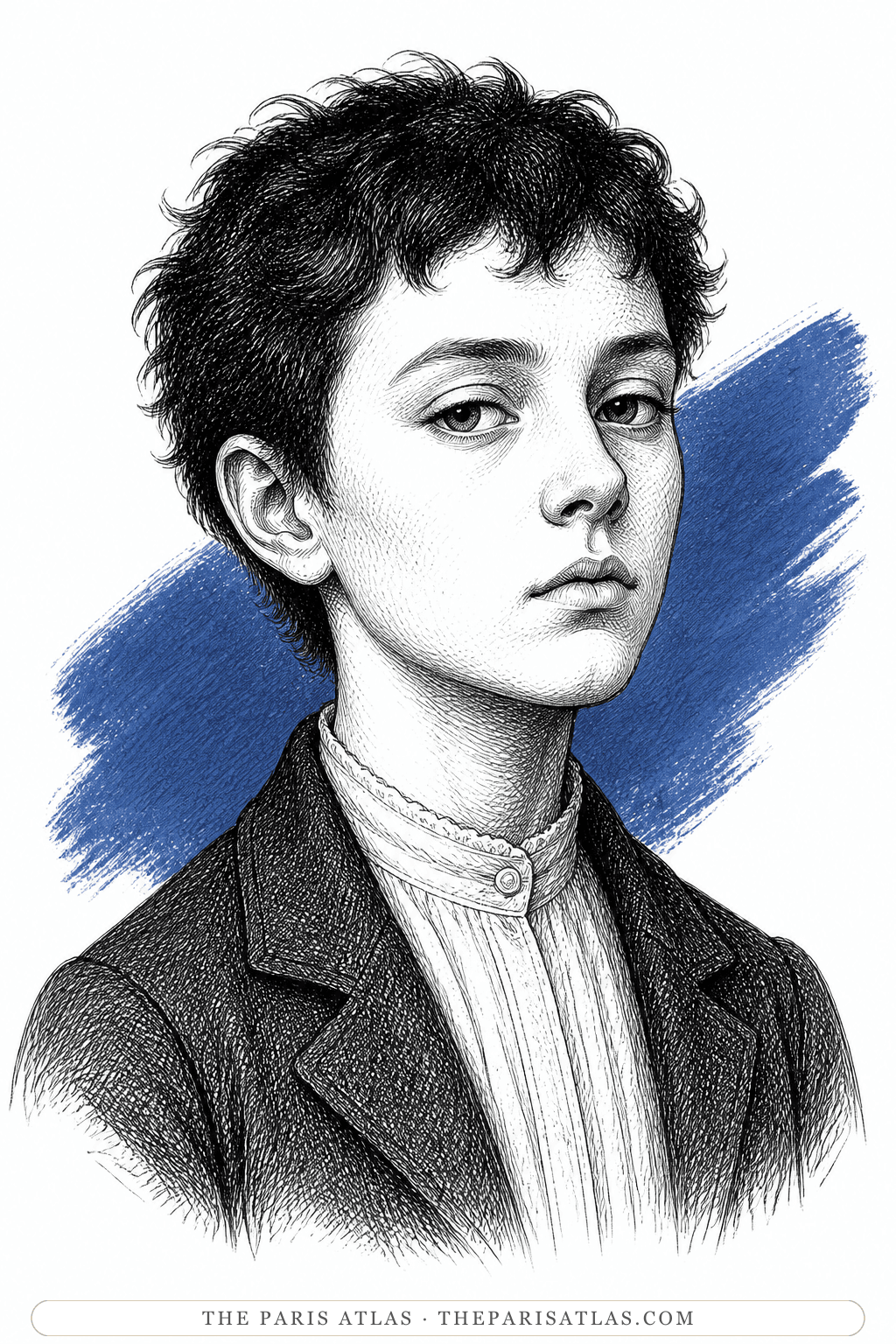
The move made Claudine ill. She refused to eat, wandered around the dark flat on the rue Jacob for ten days, and then fell into two months of fever that the doctor treated as something close to typhoid. She came out of it thin, unable to stand, and shorn: her hair had matted while she lay in bed, and Mélie, the servant who nursed her as a baby and still cooks for them, cut it off against her scalp with a pair of scissors. Claudine refuses to go outdoors until it grows back. Her first walk in Paris is in March, and people turn round in the street to look at her.
She is rude, physical and almost impossible to embarrass. She tips half a jug of water over a maid she has caught beating a dog in the courtyard, then invents a story about the girl spitting in the breakfast cups to make sure it stops. She reads whatever she likes, because her father has never thought to stop her. She is also lonelier than she admits: the only person of her own age she knows in Paris is Marcel, the son of a cousin, and her diary keeps going back to the woods, the sunken lane and the particular bank of violets she was taken away from.
This is the second of the four Claudine novels, and the one in which the series stops being about school. What takes its place is Renaud, a man of forty who was married to Claudine's first cousin and who is Marcel's father. He starts by taking her to concerts, and the second half of the diary is about what happens to her because of him.
How Claudine Is Portrayed
- She takes stock in the mirrorThe first thing she does in the book, once the fever has passed, is inspect herself item by item: a pointed chin she asks not to overdo the point, hazel eyes, a mouth so pale she rubs it with petals pulled off the red geranium on the windowsill, which leaves a dirty purple she licks straight off, and small white ears she hides under her curls and pinches to make them redden. Later, on the public weighing machine in the place Saint-Germain-des-Prés, she comes to 50 kilos.
- The hair the fever cost herMélie cut it off in uneven steps while Claudine was too ill to be combed. She grieves for it more than for anything else in the book, refuses to leave the flat until it is long again, and finally levels it herself with a pair of dressmaker's scissors in front of two mirrors. By the middle of the novel she has changed her mind and cut three more centimetres off, because the short curls suit her narrow face. Her milliner tells her the effect makes her look exactly like Polaire, a music-hall star of the day.
- She hits a man with her umbrellaA well-dressed man follows her along the rue des Saints-Pères. For the first quarter of an hour she is thrilled to be followed at all. Then he overtakes her, pinches her behind with a detached air, and she brings the umbrella down on his head. His hat lands in the gutter, the street enjoys it enormously, and she leaves quickly, embarrassed by the size of her success.
- She goes about Paris on her ownHer father objects once and gives up when she points out that she used to roam the woods at Montigny, which was more dangerous than a pavement. Her aunt is appalled to learn that she crossed Paris alone on the omnibus. She falls asleep on it for forty minutes and wakes at the terminus, and notes down what she has learnt from walking: that Paris is much hotter than Montigny, that the inside of your nose is black when you get home, and that a woman standing alone at a newspaper kiosk is stared at.
- Nobody stops her readingShe grew up loose in her father's library and calls herself a mouse in his books. She reads Balzac, Voltaire's philosophical dictionary, and whatever contemporary novel is lying on her desk. When Renaud tells her that reading everything is ridiculous and that there are kinds of ignorance she may come to regret, it is the only thing anyone says to her in the whole book that brings her near tears.
- Her cat, and the night the kittens comeFanchette, a white cat brought from Montigny, is the household member Claudine writes about most. Mélie has her mated with a striped tom borrowed from the maid downstairs, and the three kittens arrive at night on Claudine's floor while Claudine sits by with her head turned away, fetching milk to give the cat time to tidy up. Two are taken away to be drowned the next morning. Claudine keeps the male and calls him Limaçon, which means little snail, to please her father.
- She turns down a proposal of marriageHer father's secretary, a shy, heavily bearded speleologist called Maria, arrives at ten in the morning in a new frock coat and gloves and asks for her, through her father, offering to wait a year if she thinks herself too young. Claudine seizes both his hands in delight, tells him he is very kind, refuses him flatly, and goes off to dance by herself in the drawing room because somebody wanted to marry her.
- What she missesHer homesickness is a physical thing rather than a mood. She tries eating tree shoots in the Luxembourg Gardens the way she did at home and finds them gritty with coal dust. She asks correspondents whether the violets on the west bank of a particular lane are early or late this year, and none of them answers. Bringing her a bunch of violets in February nearly sends her back to bed.
- The night she drinks AstiShe drinks nothing but water at home. After the theatre she insists on going into a bright, noisy brasserie because she is thirsty, orders a dozen crayfish, and gets through three large glasses of sweet Asti. The chandeliers begin to blur, the tables look stuck to the walls, and she announces that everything has gone into Japanese perspective. She then talks without stopping for the first time in the book.
The evening at the brasserie is the turn. Drunk, in the cab home, Claudine tells Renaud that she does not want to be left at her door, accuses him of going off to other women, and says she should have been his daughter, his friend and his wife, all of it. He kisses her, and the cab stopping at the kerb separates them.
The next day Marcel arrives, works out what has happened, and congratulates her on a neat piece of work — his father still has money, and marrying him would take Marcel's inheritance. Claudine puts her nails into his face, tears the skin under one eye, and pushes him out of the flat telling him to get bandaged at Charlie's.
Her answer to the accusation is to decide, at three in the morning, that she will not marry Renaud at all: she will be his mistress instead, so that nobody can say she wanted the money. She tells him so the next afternoon. He refuses. 'Ma femme, ou rien !' he repeats, which means: my wife, or nothing. Then he walks straight past her into her father's study and asks for her. Her father, who is sitting on the floor among his papers, swears at length, says he would not have married her himself because he prefers a fuller sort of woman, and consents.
The novel's most uncomfortable line is Claudine's own, written the morning after the brasserie and not softened afterwards: her freedom weighs on her, her independence is more than she wants, and what she has been looking for for months without knowing it is a master.
If you like Claudine in Paris


If you like Colette
Explore authors with a similar voice, perspective, and influence.

Henry Miller
The Brooklyn dropout who arrived in Paris broke at thirty-eight and wrote the exuberant, banned books that ended American censorship.
View author
Louis-Ferdinand Céline
The doctor of the Paris slums who wrote the century's blackest, funniest novel — and changed the sound of French prose.
View author
Martha Gellhorn
War correspondent who covered the Spanish Civil War, D-Day, and conflicts across five more decades; Hemingway's third wife, 1940–1945.
View author