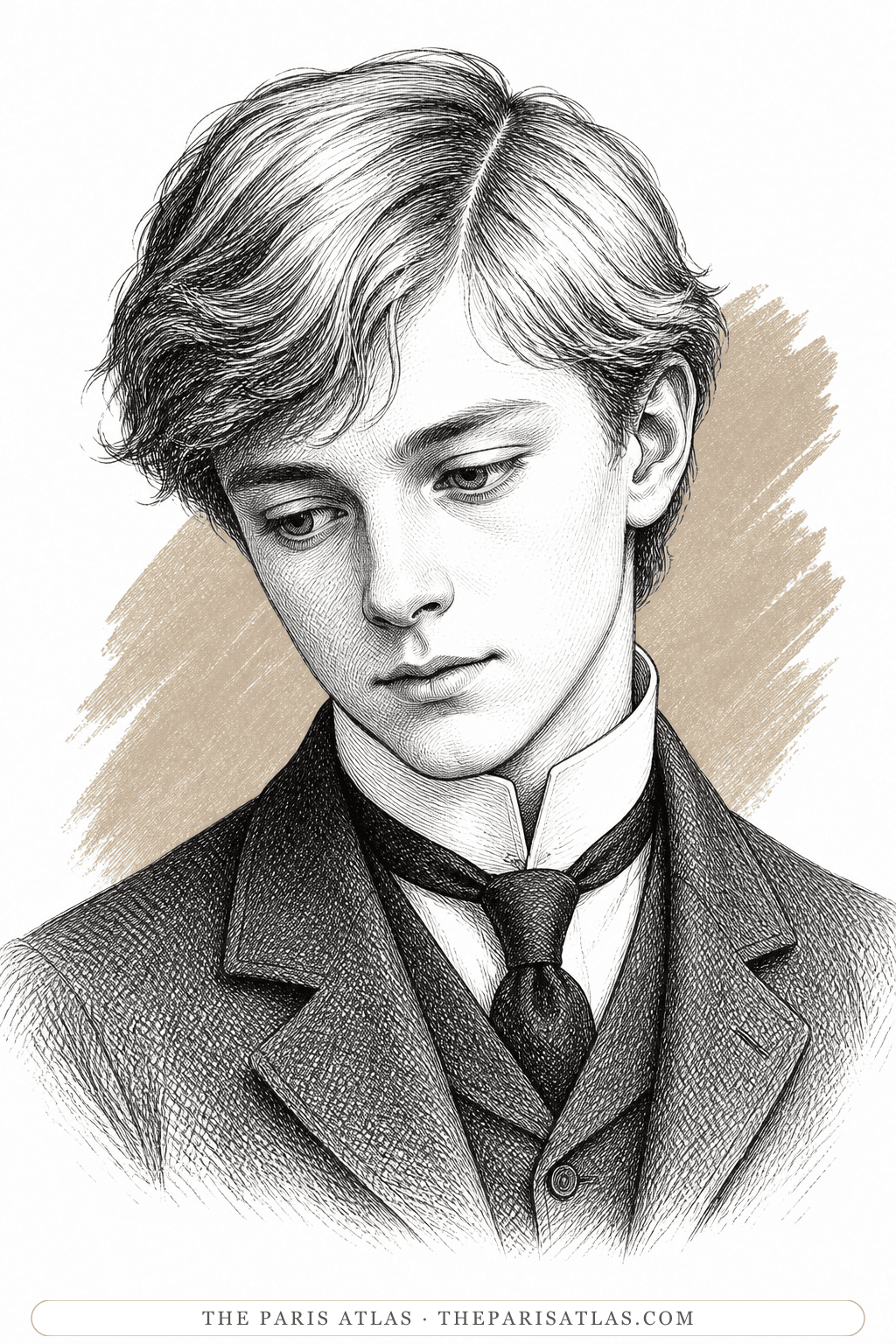
Marcel
Renaud's son, a young dandy whose tastes run to other young men — Claudine's ambiguous new companion in the city.
The full story of Claudine's schoolgirl affair with Luce. He asks for it at every visit, offers presents for it, and sulks when she stops.
The book

At a glance
- Seventeen, the same as Claudine
- Son of Renaud; grandson of Claudine's aunt Wilhelmine Cœur, who has raised him since his mother Ida died
- His grandmother's white-and-gold flat on the avenue de Wagram
- Doing his philosophy year, the last of the French lycée; before that a day boy at the lycée Boileau, where he met Charlie Gonzalès
- Charlie Gonzalès, eighteen, expelled from the lycée Boileau
- 'My nephew' — by the family tree she is his aunt
Who they are in the book
Spoiler-freeMarcel is seventeen, exactly Claudine's age, and he is the only friend she makes in Paris. He is the son of Renaud and the grandson of Claudine's aunt Wilhelmine Cœur, who has brought him up since his mother died and who says she has never once had to raise her voice to him. Because the family tree runs that way, Claudine is technically his aunt; they both enjoy this, and she calls him 'my nephew' for the rest of the book.
He is blond, pink and very pretty, and Claudine's first thought on shaking his hand is that he is a girl in trousers. Her father says the same thing out loud at dinner, agreeing that Marcel is far more of a girl than his daughter is, and the two of them look at their plates, half wanting to laugh and half flattered.
Marcel is in love with another boy, and the novel says so within a few pages of introducing him. His friend Charlie Gonzalès, who is eighteen, was a pupil at the same school; his photograph stands on Marcel's mantelpiece; they write to each other almost daily and spend Sundays in the country. Claudine works it out within days of meeting him, tells him so to his face, and reassures him that she is not going to make trouble. After a bad five minutes he decides she is useful, and from then on he treats her as the one person he can talk to.
What he wants from her is stories. Claudine's closest friend at her village school was a girl called Luce, who was in love with her and whom Claudine bullied and occasionally kissed. Marcel wants the whole account of it, in detail, and every visit is a negotiation for the next instalment. Claudine, who can see exactly which details he is after, starts inventing some.
How Marcel Is Portrayed
- The first time Claudine sees himHe comes in at five o'clock at his grandmother's: fair hair worn slightly long and parted on the right, a complexion like a girl's, English blue eyes, no more moustache than Claudine has. He speaks softly, with his head tilted and his eyes on the floor. His grandmother stands the two of them shoulder to shoulder to prove he is the taller, which he is, by three centimetres.
- How his grandmother raised himWilhelmine Cœur watches him constantly. Half an hour late and he finds her in tears; every time he goes out he is told not to take the rue Cardinet, which is rough, or the Étoile after dark, because of the traffic. To get a lamp left burning in his room so that he can read at night, he told her he was frightened of the dark. He admits to Claudine, without embarrassment, that his grandmother has brought him up as a girl and is still doing it.
- The photograph on his mantelpieceDark eyes, curled lashes, a hint of black moustache, the parting on the right like Marcel's own. This is Charlie Gonzalès, eighteen, almost a brother, and Marcel insists the photograph cannot do justice to the white skin and the black hair. Claudine says the obvious thing out loud, and he goes cold and white for a minute before deciding not to mind.
- What he wants Claudine to tell himHe sits on a cushion on the floor at her feet, pulls the blind down against the ugly courtyard, and asks her to start at the beginning. When she is vague he tells her that generalities are colourless and orders a short chapter of description first. He offers to buy the cat a collar for a better instalment. Claudine notices which words make his cheeks go blotchy and gives him more of those.
- His clothes, and everyone else'sHe is dressed like a fashion plate — a dinner jacket that fits like a glove, a dove-grey suit, a turquoise tie. He tells Claudine to wear suede gloves rather than pearl-grey with blue, and takes her to a tailor, where he sits three feet away on a chair and directs the fitter and the cutter over the hip darts and the skirt length while Claudine is told to stand still. The tailor's woman cannot work out what he is to her.
- The card-case he leaves behindClaudine slides a cake plate over his green card-case while he is talking, and he goes home without it. Inside: Charlie's letter, a photograph of Charlie bare-shouldered with a fillet round his head, notes arranging and cancelling meetings signed Jules, a photograph of a slender woman in spangled lace blowing a kiss and signed with the same name, and a cook's-hand letter about which hotels and cafés are safe. Claudine fetches her father's magnifying glass to work out the neck muscles in the photograph, decides that Jules is a young man, and sends the case straight back by hand with a covering note.
- How he speaks to his fatherYes, father. No, father. Nothing more, and only when asked. He tells Claudine that his father made his mother unhappy for eighteen months, not by hitting her but by never being at home, and that the two of them simply do not get on. When Claudine says how nice Renaud is, Marcel congratulates her on the discovery and points out that he has known the man for seventeen years.
- The Sunday in the countryHe and Charlie take a train out of Paris for the day, eat fried potatoes and drink the local grey wine at a riverside inn, and lie about in the grass. Marcel comes back with mauve shadows under his eyes and describes it to Claudine as nothing at all, a friend the colour of the weather. His grandmother knows perfectly well where he went and who took him, and reports it to Claudine without a flicker.
He is the one who breaks it. Sent away from the theatre by his father over a tie, he arrives at the rue Jacob the next afternoon to find out what he missed, works out from Claudine's face that she and his father are in love, and turns nasty about it: his father has money left, and marrying him would take the inheritance out of Marcel's hands. He calls her clever, and calls the whole thing a nice piece of work.
Claudine puts her nails into his face, aiming for his eyes and missing by less than a centimetre. She tears the skin under the lower lid, will not let him wash it in her basin, and pushes him out onto the landing telling him to go and get bandaged at Charlie's. He leaves his stick behind.
That is his last appearance. He does not come back, and Claudine spends a night working out that the accusation will follow her — that he will repeat it, and that other people will believe it. Her whole plan to be Renaud's mistress rather than his wife is built to answer a charge Marcel made in her bedroom.
If you like Claudine in Paris


If you like Colette
Explore authors with a similar voice, perspective, and influence.
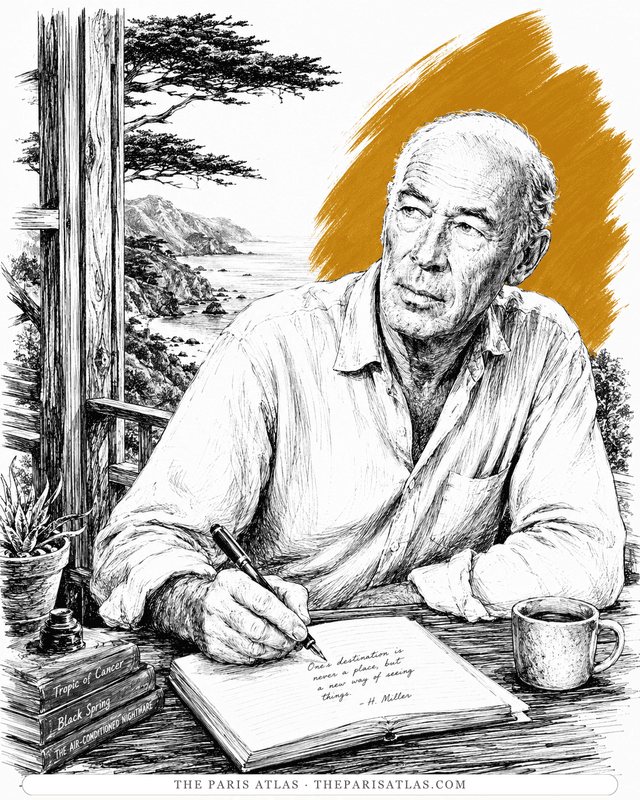
Henry Miller
The Brooklyn dropout who arrived in Paris broke at thirty-eight and wrote the exuberant, banned books that ended American censorship.
View author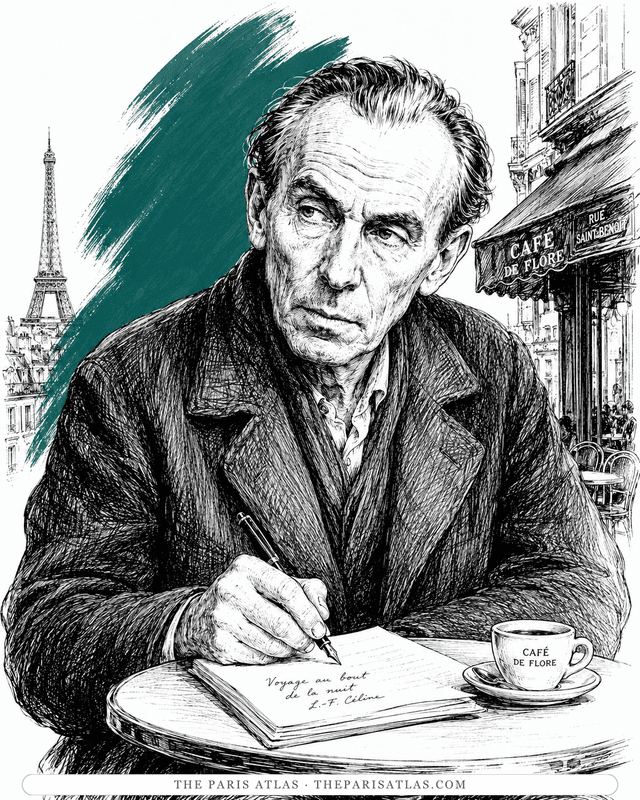
Louis-Ferdinand Céline
The doctor of the Paris slums who wrote the century's blackest, funniest novel — and changed the sound of French prose.
View author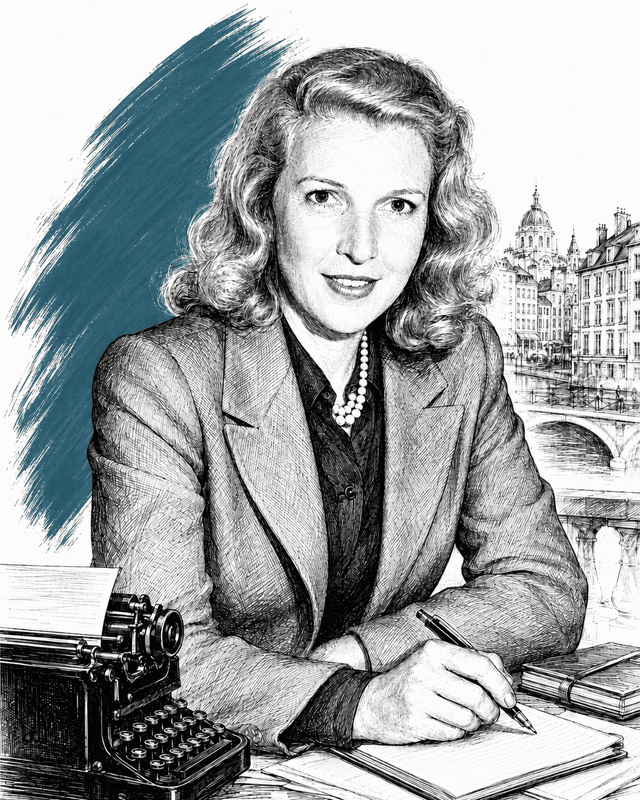
Martha Gellhorn
War correspondent who covered the Spanish Civil War, D-Day, and conflicts across five more decades; Hemingway's third wife, 1940–1945.
View author