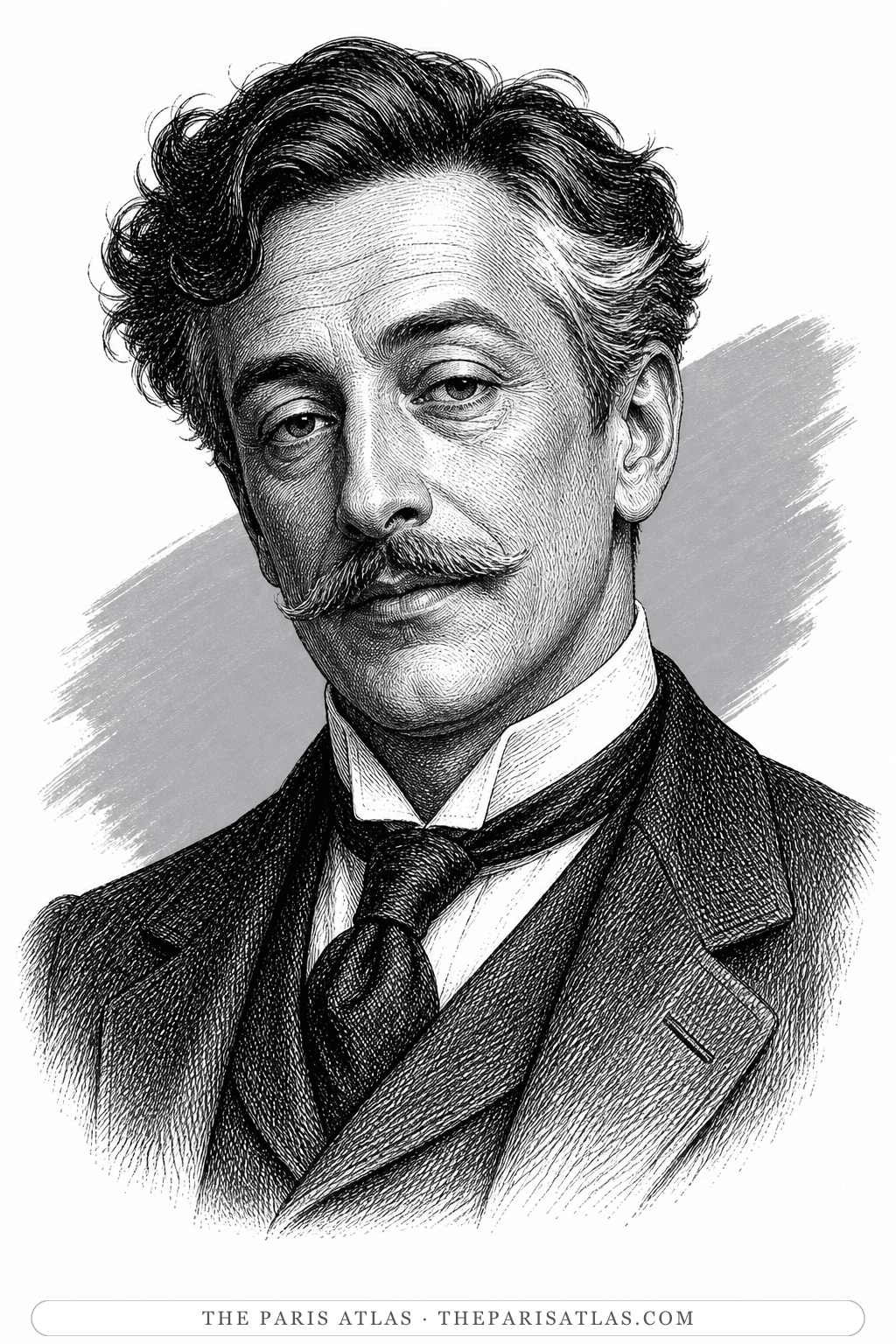
Renaud
The worldly, indulgent older man Claudine meets and agrees to marry — the center of the book's romantic turn.
A daughter. He says outright that he wishes he had had one and would have brought her up his own way, and he attaches himself to Claudine as an uncle first.
The book

At a glance
- Forty. Claudine is seventeen
- The widower of her first cousin Ida, and the father of her friend Marcel. She calls him 'my uncle' as a joke before she calls him Renaud
- Foreign politics for a diplomatic review, three times a week
- The rue de Bassano, in a flat he refuses to show her
- Married Ida, Wilhelmine Cœur's daughter, very young. Claudine's father remembers that she announced she was going back to her mother and that Renaud offered to call her a cab. She died soon afterwards of something quick
- Marcel, seventeen, brought up by his grandmother since Ida died and barely on speaking terms with him
Who they are in the book
Spoiler-freeRenaud is forty years old, and the seventeen-year-old girl who narrates this novel falls in love with him. The book states both figures plainly. He says once, near the end, that to anyone outside the family she could be his daughter.
He is a relative, though a loose one. He married Ida, the daughter of Claudine's aunt Wilhelmine Cœur, when they were both young; Ida left him and died shortly afterwards, so he is the widower of Claudine's first cousin. Their son Marcel is seventeen, the same age as Claudine, which by the arithmetic of the family makes Claudine his aunt. Claudine finds this funny and calls Renaud 'my uncle' for half the book, until she asks whether she may use his first name instead.
By trade he writes foreign politics for a diplomatic review. He is candid with Claudine about why. He spent twenty years being regarded, by Wilhelmine Cœur among others, as a man who amused himself and his friends, and for the last ten he has been getting even by boring his contemporaries in the manner they like best: documented, conventional, pessimistic and complaining. He also goes to the races, loses, and knows the whole musical and literary crowd of Paris well enough to point them out one by one.
What he is to Claudine before he is anything else is company. He takes her to a concert and a play, explains who everyone in the foyer is, listens to her stories about the village school, tells her not to read everything, and writes down the list of things she likes so he can send her some. She has a father who forgets her age; Renaud remembers it exactly, and says he has fatherly feeling to spare because his own son will barely speak to him.
How Renaud Is Portrayed
- What Claudine sees when he walks inA tall, thin, well-dressed man with a dark complexion, a lot of brown hair going white at the temples, and tired eyelids over eyes that are still young. His moustache is the colour fair hair turns when it silvers. Claudine notices his short curved nose with its moving nostrils, decides his ears are not bad for a man's, and gets caught staring.
- He loses at the racesHe arrives at his mother-in-law's Sunday tea as if he lived there, kisses her hand, and remarks under a blazing chandelier in an all-white drawing room how restful the soft half-light of modern flats is. Asked whether he backed anything, he says he lost, and so gave the cab ten francs on the way home, because with what he had already lost it made a round number. Claudine snorts into the china.
- The articles he writesForeign politics for a diplomatic review, three times a week. He tells Claudine he has produced twenty-four articles on the Ems telegram alone, two dozen, and that for the past six months he has been taking a professional interest in Russian policy in Manchuria, which is how he earns his money. When she says the review sounds dull and then tries to take it back, he tells her not to patch it up, the first version was the compliment.
- He writes down what she likesAsked what she enjoys, Claudine reels off overripe bananas, chocolate creams, lime buds, the inside of artichoke stems, new books and knives with a lot of blades. Renaud takes out a notebook and starts writing, then asks for a pause: the chocolates and the artichokes are easy, but he knows no Paris supplier for lime buds. It is in the same conversation that he says he would have liked a daughter.
- What he did when he found his son's letterMarcel's account, given to Claudine: his father took a letter from Charlie Gonzalès out of his room, or picked it up off the floor as he says, read it, slapped Marcel across the face, and then went to the lycée Boileau and made enough noise that Charlie was expelled. Renaud never tells the story himself. He does warn Marcel, in front of Claudine, that the day he has had enough he will not send word about it.
- He tells her she reads too muchVisiting the rue Jacob, he approves of the cat, the sagging armchair and the old boat bed, and then picks up the novel on her desk. Claudine says grandly that she reads everything. He answers that everything is not much, and that there are kinds of ignorance she may come to regret. She goes white with anger, he sees she is close to crying, apologises for moralising, and asks for her hand as a peace offering.
- He takes her to a concertA Sunday afternoon at the Châtelet, Berlioz's La Damnation de Faust conducted by Édouard Colonne, with Marcel in tow. Claudine has almost never heard an orchestra and nearly cries with nerves at the first chords. In the interval Renaud walks her round the foyer naming the audience with the critic Maugis, whose descriptions are coarse enough that Renaud keeps trying to head him off.
- He will not show her his flatHe lives on the rue de Bassano. Claudine asks whether it is nice, and whether she may see it. He says it is nice for him, and then no, twice, because it is a great deal too eighteenth-century for her. He would rather she went on thinking that this sort of thing still matters.
He engineers the evening that decides it. Marcel is meant to come to the theatre with them; Renaud picks a fight about the crêpe de chine tie Charlie gave him, throws him out, and lies to Claudine's father about it. In the cab he admits the lie, and says he was afraid her father would take her away from him.
After the play Claudine gets drunk on Asti and tells him everything, including that she has dreamt about him. He gets her home, kisses her, and leaves. Two days later he comes back having, by his own account, spent both nights arguing with himself: he had stopped remembering that he was forty, and knew she would remember it for him sooner or later.
Claudine then offers to be his mistress rather than his wife, so that nobody can accuse her of marrying his money. He refuses — 'Ma femme, ou rien !', which means: my wife, or nothing — and walks past her into her father's study to ask for her. When Claudine whispers that she does not want Marcel's money, he says lightly that his son still has his grandmother's to eat through.
If you like Claudine in Paris


If you like Colette
Explore authors with a similar voice, perspective, and influence.

Henry Miller
The Brooklyn dropout who arrived in Paris broke at thirty-eight and wrote the exuberant, banned books that ended American censorship.
View author
Louis-Ferdinand Céline
The doctor of the Paris slums who wrote the century's blackest, funniest novel — and changed the sound of French prose.
View author
Martha Gellhorn
War correspondent who covered the Spanish Civil War, D-Day, and conflicts across five more decades; Hemingway's third wife, 1940–1945.
View author