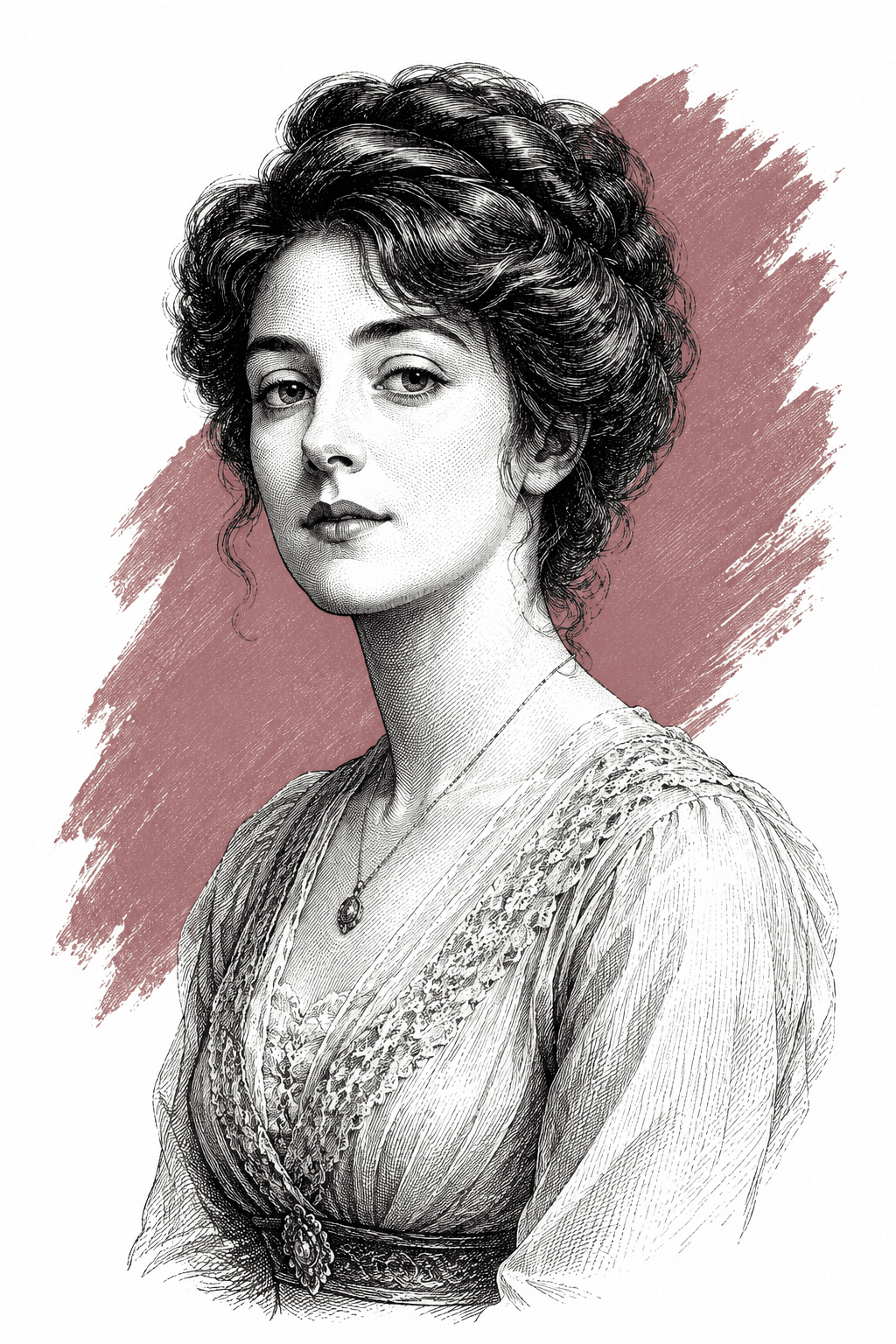
Alice
The wife, whose long-past liaison meant little to her and everything to Michel — unable to make a closed episode weigh as lightly as it truly did.
To get the marriage repaired and the subject closed, quickly. She thinks about it in exactly those terms all week — hide it, smooth it over, forget it — and gives herself a deadline more than once: tomorrow this has to be finished.
The book

At a glance
- One of the two people it is about; the novel keeps her to the house, its hill, and the village at the bottom of it
- Thirty-seven, and pleased about it; Michel is six years older
- Costume and set designer for the shows her husband manages, and she also sells furnishing and decorating designs
- One of the four daughters of a piano and sight-singing teacher named Eudes — Hermine, Colombe, Bizoute and Alice, who was always called the plainest of the four. They shared a Paris studio, played in a quartet together, and still use a private vocabulary invented in childhood
- Three weeks in November 1932 with Ambrogio, a man from Nice left running her husband's cinema while he worked on the coast. Three letters survive it; she never answered any of them
- Ten years to Michel, who calls her long as a river
Who they are in the book
Spoiler-freeAlice is the wife in Duo, a novel the French writer Colette published in 1934, and one of only two people in it. She is thirty-seven, she designs costumes and sets for the shows her husband Michel puts on, and the book opens with her at a desk in a window at his country house, drawing, with a bunch of wild orchids in a glass trough beside her. The purple of the flowers is repeated by a leather blotter under her hand, and the reflection of it on her face is what her husband walks in and admires. Asked about the blotter, she says there is no such thing. It is a small, immediate lie and it costs her the rest of the book: inside the blotter is a letter from a man named Ambrogio.
The affair had lasted three weeks in November 1932, while Michel was away on the coast running a casino season and she was at home in Paris getting over influenza. Ambrogio was the man Michel had left in charge of his cinema. It ended when she stopped wanting it, and she never wrote him a line. Her first instinct is to make the thing disappear — cover it, tidy it, get through the evening — and when that fails she tries the opposite and tells her husband exactly what it was.
She grew up poor and working. Her father, Eudes, taught piano and sight-singing, and his four daughters lived by their wits: two hats between them, a piano-and-strings quartet in a brasserie that went bankrupt, one sister at a box office, one modelling on black coffee, Alice cutting dresses and selling ideas for furnishings. She married the least secure kind of husband, a man whose income depends on which show is running. Money frightens her much less than misery does.
How Alice Is Portrayed
- The fringe and the flat noseShe is tall, long-legged and long-armed, with grey-green eyes set in long narrow lids and a wide lower lip that is usually chapped. Her black hair is cut in one thick fringe, level with her eyebrows, and never curled: she wears daring dresses but will not touch her hair. Colette gives her a small flat nose and writes that when her eyes close her whole face looks East Asian, a comparison Michel repeats admiringly and then throws at her as an insult when he is angry.
- The lie she tells in the first ten minutesShe could have said the blotter was hers and left it there. Instead she says it does not exist, watches her husband's face come apart, and understands too late that the denial is the thing he will not recover from. She spends the afternoon telling herself she should simply have made something up.
- Forty-four sketchesHer drawing is real work, not a hobby. She already has forty-four costume designs for the ballet numbers of a show called Daffodyl, and when the revival looks likely she goes down to the village and comes back with schoolchildren's pencils, bottles of red and violet ink and a box of paints sold as safe to put in the mouth, because that is all the shop has.
- The sisters in the Vaugirard flatSitting on the terrace she starts a letter to her sisters — Hermine, Colombe and Bizoute — and the studio in Paris comes back to her: the grand piano jammed against the front door, the trestle table covered in music paper, the enamel plate of cigarette ends that migrates around the room. She writes to them in the private nonsense words the four of them invented as girls, and is briefly ashamed that it is all she has to say.
- She refuses to be unhappyGoing without money is something she was trained for from childhood. Sitting inside a romantic misfortune and making a performance of it is not. When Michel talks about needs, she lists hers: their love, a car when she feels like it, the right to tell certain people where to go, an old tailored suit with a good shirt underneath, tap water all year and a refrigerator to ice it.
- She dresses the servant's burnMaria, the caretaker, has a badly tied bandage on her forearm and admits she put it on one-handed and knotted it with her teeth. The burn is from a poker, and her husband did it — because he is her man and she is his wife, she says, which is reason enough. Alice drains the blister and binds the arm properly, and Maria, before pulling her sleeve down, presses the clean dressing against her cheek.
- The truth she offers as a cureBecause Michel keeps saying he could have forgiven pure appetite, she decides to give him pure appetite. It comes out as a shout: «Eh bien, j'ai couché avec Ambrogio parce que j'en avais envie, uniquement parce que j'en avais envie !» — she slept with the man because she wanted to, only because she wanted to, and stopped when she stopped wanting to. Michel decides she has changed her story to spare him, and asks for proof.
- Afraid only from behindSeveral times she feels what she describes as a drop of warm water running down her spine, and each time it is her husband watching her back from across the room. When she turns round and faces him it goes, and she notes the rule as if it were useful information.
She goes to bed believing the worst is behind them. Michel says he will stay up to finish his post, tells her that tomorrow will be better, and then walks down to the river in the dark and does not come back. The novel ends before she wakes.
Colette returned to her five years later in Le Toutounier (1939), which picks Alice up three weeks after the funeral, back in Paris in the flat she grew up in with her sisters.
If you like Duo


If you like Colette
Explore authors with a similar voice, perspective, and influence.

Henry Miller
The Brooklyn dropout who arrived in Paris broke at thirty-eight and wrote the exuberant, banned books that ended American censorship.
View author
Louis-Ferdinand Céline
The doctor of the Paris slums who wrote the century's blackest, funniest novel — and changed the sound of French prose.
View author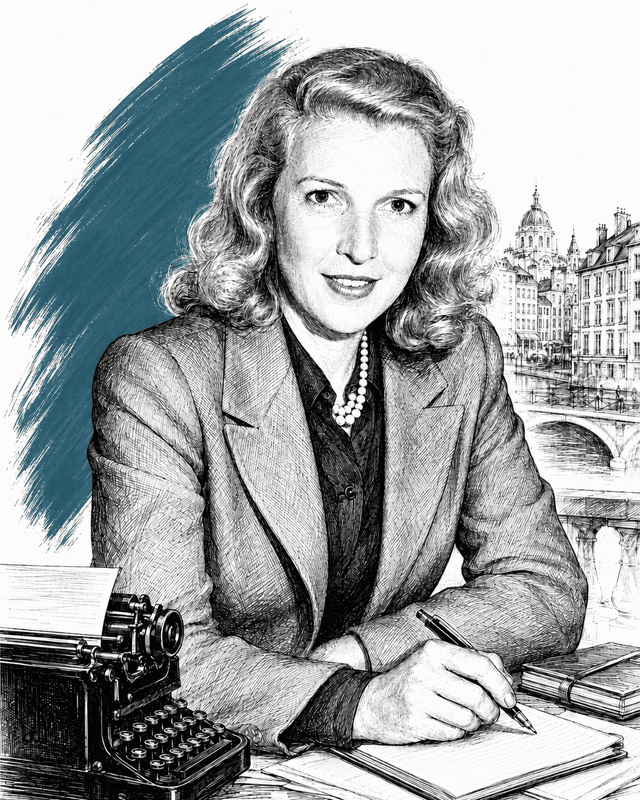
Martha Gellhorn
War correspondent who covered the Spanish Civil War, D-Day, and conflicts across five more decades; Hemingway's third wife, 1940–1945.
View author