El Jaleo
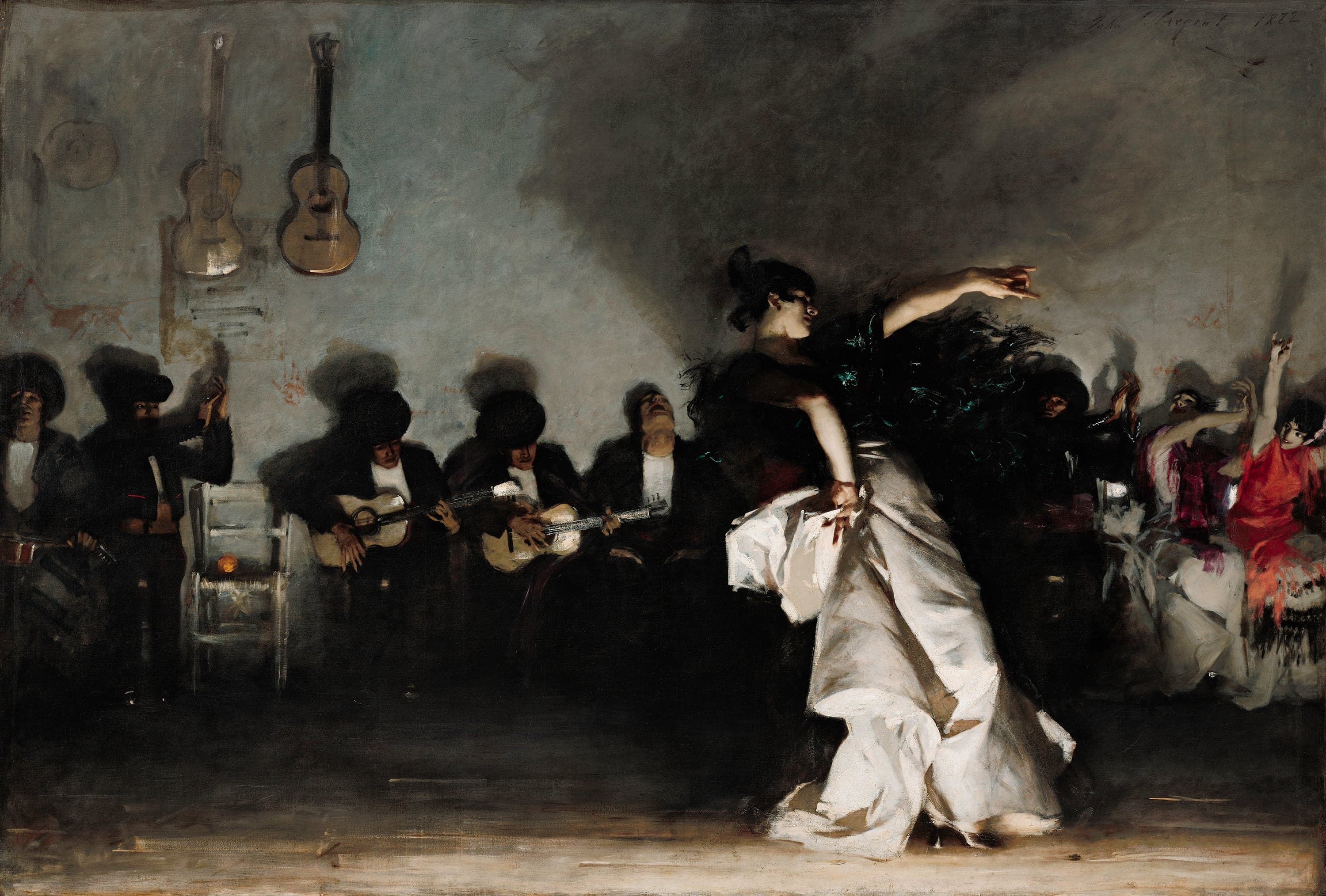
A woman dances in a low room, lit from beneath so that her white skirt blazes and her face stays in shadow. Behind her a line of guitarists, singers and clappers sits against a gray wall. John Singer Sargent built the picture in his Paris studio from drawings made in southern Spain in 1879, and showed it at the Salon of 1882. It has been at the Isabella Stewart Gardner Museum in Boston since 1914.
- 1882
- Oil on canvas
- Isabella Stewart Gardner Museum, BostonBoston, United States
About John Singer Sargent

What the painting shows
The dancer is off to the right of center, leaning back, her left arm thrown up and out with two fingers extended. She wears a black shawl over a dark top and a heavy white skirt that she grips with her right hand. The light comes from floor level, which is why her chin and her forearms are bright, her face is dark, and a large shadow spreads on the wall behind her.
Along the wall to the left sits the rest of the group. One man holds a guitar across his lap and appears to have his eyes shut. Two more play, heads down over their instruments. A man beside them leans his head back against the wall with his mouth wide open, singing. Others clap. At the right, two women in red and magenta shawls clap and raise their arms.
Three small things fix the room. Two guitars hang on the wall at the upper left, and a plain white chair in the middle distance has an orange sitting on it. The word ole is written on the wall in red, and there are red splashes and handprints under the hanging guitars.
The canvas is 232 by 348 centimeters, roughly eight feet by eleven and a half.[1]
What the title means
In flamenco, jaleo is what the audience does. Jaleos are shouts of praise and encouragement, thrown at the performers along with palmas, the handclaps, and pitos, the finger snaps.[2] The painting is full of them: the clapping hands, the open mouth, the word written on the wall.
The Isabella Stewart Gardner Museum, which owns the picture, glosses the title as the name of an Andalusian dance and translates it loosely as "the ruckus".[1] Both readings are in the word. Flamenco itself is built from three parts — cante, the singing; baile, the dancing; and toque, the guitar playing — and Sargent painted all three at once.[2]
Spanish subject, Paris studio
Sargent traveled through southern Spain in 1879, on his teacher Carolus-Duran's instruction to go and look at Velázquez, and he drew what he saw at performances there.[1] The picture itself came more than two years later and was not painted in Spain at all.
He built it in his Paris studio from those drawings, from memory, and from detailed studies made with models he posed himself.[2] Nothing in it was recorded live, although it is put together to look as though it was.
The Salon catalogue of 1882 prints each exhibitor's address, and Sargent's was 73 rue Notre-Dame-des-Champs, in the 6th arrondissement.[3] He moved to the larger studio at 41 boulevard Berthier afterward, and it was there that he painted Madame X.
The Salon of 1882
The Salon opened at the Palais des Champs-Élysées on 1 May 1882. El Jaleo hung as catalogue number 2397, listed as "El Jaleo; — danse de Gitanes". Sargent showed a second canvas as number 2398, a portrait he titled only Portrait de Mlle, and the catalogue marks him hors concours, exempt from the jury after winning a second-class medal the year before.[3]
It was the success of that year's Salon for him. The Fine Arts Museums of San Francisco describe the sensation as a matter of both the painting and the fashion for the subject, which was then at its height in Paris.[2] Sargent was twenty-six.
The National Gallery of Art in Washington devoted an exhibition to the painting and its studies in 1992, with a catalogue by Mary Crawford Volk that remains the standard account of how it was made.[4]
How Boston got it
The New York dealer Schaus Gallery bought the painting out of the Salon of 1882 for 10,000 francs. It sold the same year to Thomas Jefferson Coolidge, a Boston businessman and diplomat who lived from 1831 to 1920.[1] Coolidge was connected to Isabella Stewart Gardner by marriage: he was the brother of her husband John Lowell Gardner's brother-in-law.[5]
Gardner wanted the picture. In 1913 she pulled down the two-story music room on one side of her museum and built three new galleries in its place. One of them was a Spanish Cloister with a deep niche under a Moorish arch, sized for El Jaleo. She finished in December 1914 and showed it to Coolidge, who gave her the painting.[5]
That is the museum's own account, and the museum hedges the last step: Coolidge "apparently" gave it on the spot.[1] The circumstantial part is documented. Coolidge had lent the painting to the Museum of Fine Arts in 1913, and that museum was then keen to buy a major Sargent of its own.[5]
The room built around it
The installation is part of the work now. The painting sits in a niche behind a Moorish arch, with a mirror to its left that pulls in daylight from the courtyard and appears to widen the room. Gardner lit the canvas from below, repeating the footlights inside the picture, and set ordinary objects on the floor in front so that a visitor stands where the audience would.[5][1]
The tiles are not Spanish. Nearly two thousand seventeenth-century Talavera tiles came from the church of San Agustín at Atlixco in Puebla, Mexico, bought there by the American painter Dodge MacKnight, probably in the autumn of 1908. He could not send photographs of how they had been laid, so Isabella Stewart Gardner worked out her own arrangement in Boston.[6]
The museum does not name the dancer or any of the musicians, and no sitter has been identified. The figures were posed in Paris for a scene Sargent assembled.
Close reading
Reading the work, detail by detail
The light comes from the floor, so faces go dark and forearms go bright, and everything casts its shadow upward. That one decision organizes the whole canvas. Work from the dancer outward along the wall.
1.The dancer's arm
The left arm is thrown up and back and the hand is open, with two fingers held out. Because the footlights are below her, the underside of the arm is the lit side. Nothing above her shoulder is bright.
2.Lit from the floor
The white skirt is the brightest area in a painting that is otherwise black, brown and gray. Sargent laid it in with wide slabs rather than drawn folds. Isabella Stewart Gardner later lit the canvas itself from below, repeating the effect inside the picture.
3.The guitarists
Two players are bent over their guitars with their heads down, and a third holds an instrument across his lap without playing. None of them watches the dancer. In flamenco this part is the toque, the guitar playing, one of the form's three elements alongside song and dance.
4.The singer
The man with his head against the wall and his mouth open is singing. This is the cante, and it is the sound the painting is named for as much as the dancing is. His throat catches the floor light while his eyes stay in shadow.
5.Two guitars on the wall
Two spare guitars hang on the wall, and the plaster under them carries red splashes and what read as handprints. The room is a working one, not a stage, and those marks are the only evidence of earlier nights in it.
6.An orange on a chair
An orange sits alone on a plain chair in the middle distance. It is the one warm color on the left half of the canvas, and it fixes the depth of the room: everything nearer than the chair is floor, everything past it is figures.
7.The women at the right
At the right, two women clap with their arms up. This is the jaleo the picture takes its name from: the audience's own noise, made with palmas, the handclaps, and pitos, the finger snaps.
Timeline
1879
Sargent travels in southern Spain and draws flamenco performers, some of the sheets made on the spot in Seville.
1882
Shown at the Paris Salon from 1 May as number 2397, El Jaleo; danse de Gitanes, and bought out of the exhibition by the Schaus Gallery of New York for 10,000 francs.
1882
Sold by Schaus to Thomas Jefferson Coolidge of Boston, and shown that autumn at the Schaus Gallery in New York.
1913
Isabella Stewart Gardner begins demolishing her museum's music room to build the Spanish Cloister. Coolidge lends the painting to the Museum of Fine Arts, Boston.
1914
The Spanish Cloister is finished in December, and Coolidge gives Gardner the painting for the niche she built for it.
1992
The National Gallery of Art in Washington gathers the painting with its preparatory studies for an exhibition and catalogue.
Where to see it
Isabella Stewart Gardner Museum, Boston
25 Evans Way, Boston, MA 02115, United States
Spanish Cloister, in the niche built for it in 1914.
Plan your visit on the museum’s official website (opens in a new tab)Frequently asked questions
What does El Jaleo mean?
In flamenco, jaleos are the shouts of praise and encouragement an audience throws at the performers, along with handclaps, called palmas, and finger snaps, called pitos. The Isabella Stewart Gardner Museum also reads the title as the name of an Andalusian dance and translates it loosely as "the ruckus". The picture shows the clapping, the singing and the shouting as much as the dancing.
Where is El Jaleo?
In the Spanish Cloister at the Isabella Stewart Gardner Museum in Boston, where it has hung since 1914. The object number is P7s1. Isabella Stewart Gardner built the room around it, so the niche, the Moorish arch, the mirror and the lighting from below are part of how the painting is meant to be seen.
Did Sargent paint El Jaleo in Spain?
No. He traveled in southern Spain in 1879 and drew performers there, but the painting was made more than two years later in his Paris studio, using those drawings, his memory, and studies from models he posed. The Salon catalogue of 1882 gives his address as 73 rue Notre-Dame-des-Champs.
How big is El Jaleo?
232 by 348 centimeters, or 91 by 137 inches — about eight feet high and eleven and a half feet wide. It is one of the largest canvases Sargent painted, and it was made at that size for the Paris Salon, where scale competed for attention.
Who is the dancer in El Jaleo?
Nobody knows, and the museum names no one. The figures were posed in a Paris studio for a scene Sargent invented out of what he had seen in Spain. She is sometimes confused with La Carmencita, the Spanish dancer Carmen Dauset Moreno, but Sargent painted her about eight years later and in a separate picture.
How did the Isabella Stewart Gardner Museum get El Jaleo?
Thomas Jefferson Coolidge, a Boston businessman connected to Isabella Stewart Gardner by marriage, had owned it since 1882. In 1913 she demolished her museum's music room and built a Spanish Cloister with a niche sized for the painting. She finished in December 1914 and showed him the room, and he gave her the painting. The museum's own account says he did so on seeing it, with the word "apparently" attached.
Why is the dancer lit from below in El Jaleo?
Because the room she is in is lit that way. Footlights along the floor throw her skirt and forearms into brightness, leave her face in shadow, and cast her shadow up the wall behind her. Isabella Stewart Gardner repeated the effect when she installed the painting, lighting the canvas itself from beneath.
More by John Singer Sargent
If you like John Singer Sargent
Explore painters from the same movements and circles.
Tarsila do Amaral
Brazilian painter who spent the 1920s moving between São Paulo and Paris, studied Cubism under André Lhote, Albert Gleizes and Fernand Léger, and used what she learned to paint Brazilian towns, railways, plants and bodies. Her 1928 painting Abaporu prompted the manifesto that gave the Anthropophagic movement its name.
View artist
Arman
French-American artist, lifelong friend of Yves Klein, and a founder of New Realism.
View artist
Jean Arp
Strasbourg-born sculptor and poet — Hans in German, Jean in French, both all his life — who co-founded Dada at the Cabaret Voltaire in 1916, composed collages by dropping torn paper 'according to the laws of chance', and settled at Meudon outside Paris in a house his wife Sophie Taeuber-Arp designed.
View artist
References
The sources below include collection records, catalogues, scholarly research, and primary materials that informed this page. They document El Jaleo, its making, and its place in cultural history.


3abExplication des ouvrages de peinture, sculpture, architecture, gravure et lithographie des artistes vivants exposés au Palais des Champs-Élysées le 1er mai 1882
Official recordCharles de Mourgues Frères, Paris, 1882Used forThe official Salon catalogue of 1882, giving the exhibited title, the catalogue number and Sargent's studio address.
4↑John Singer Sargent's El Jaleo
Exhibition catalogueNational Gallery of Art, Washington, 1992Used forThe National Gallery of Art exhibition catalogue devoted to this painting and its preparatory studies.

6↑Blending Cultures: Mexican Talavera Tiles
WebsiteIsabella Stewart Gardner Museum, 2021Used forOn the Mexican Talavera tiles in the Spanish Cloister, their source church and how they were acquired.

7John Singer Sargent: Figures and Landscapes, 1874-1882 (Complete Paintings, Volume IV)
NonfictionYale University Press, 2006Used forThe catalogue raisonné entry for the painting, in the volume covering the figures and landscapes of 1874 to 1882.
These references provide the documented foundation for this work's history and interpretation. Claim-level citations remain attached to the specific claims they support.
 Explore more resources