Madame X
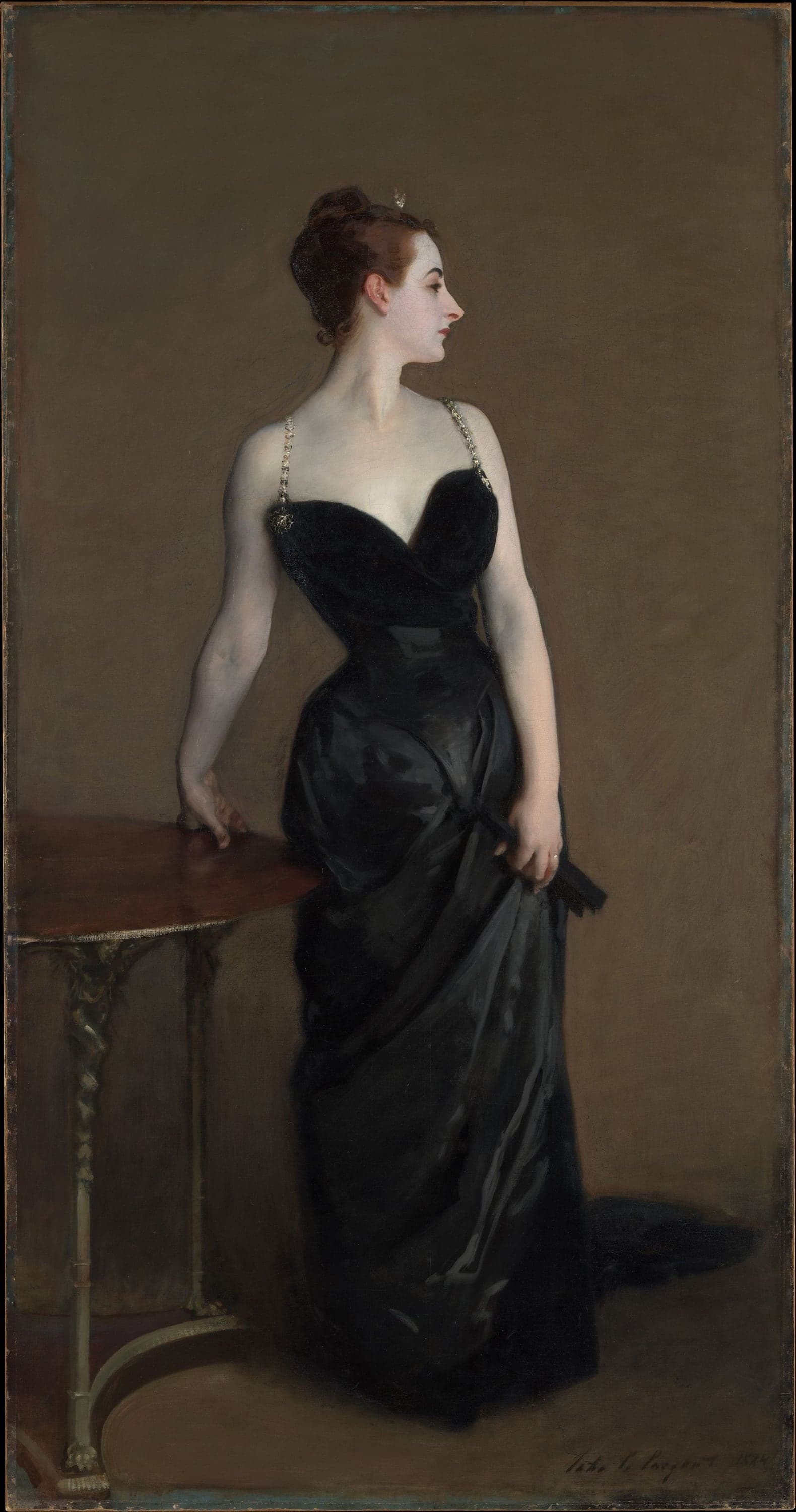
A woman in a black evening dress stands with her face turned away in profile, one hand pressed to a small table. She is Virginie Amélie Avegno Gautreau, and John Singer Sargent painted her in Paris across 1883 and 1884 without a commission, hoping the picture would make his name. It was mocked at the Salon of 1884 instead, and he left France. The Metropolitan Museum of Art bought it from him in 1916.
- 1883–84
- Oil on canvas
- The Metropolitan Museum of Art, New YorkNew York, United States
About John Singer Sargent

What the painting shows
A standing woman fills most of a canvas over two meters tall. Her dress is black and sleeveless, boned to a hard point at the waist, held up by two thin jeweled straps. Her skin is painted several shades paler than life, a flat lavender-white against a brown-gray wall with nothing on it.
She has turned her head to a strict profile, looking away to the right, out of the picture. Her right hand presses down on the mahogany top of a small gilt-legged table, taking the weight of a twisted pose. Her left hand hangs at her side holding a closed black fan against the black skirt. A small jeweled crescent is pinned into her hair. The Metropolitan Museum's printed catalogue identifies the crescent as the attribute of Diana, the Roman goddess of the hunt.[1]
The canvas is 208.6 by 109.9 centimeters. Sargent signed and dated it 1884 at the lower right, and the Metropolitan Museum of Art shows it in Gallery 771 of the American Wing.[2]
Who Madame X was
Virginie Amélie Avegno was born in Louisiana in 1859. Her father, Major Anatole Placide Avegno of New Orleans, was mortally wounded at the battle of Shiloh and died in April 1862, and her mother, Marie Virginie de Ternant of Parlange Plantation, took her two daughters to Paris.[1] In August 1878, at nineteen, she married Pierre-Louis Gautreau, a Paris banker and fertilizer importer roughly twice her age.[3]
In Paris she became what the newspapers of the day called a professional beauty: a woman known, as the Metropolitan Museum of Art puts it, for her artful appearance rather than for anything she did.[2] The appearance was partly manufactured and everyone knew it. Sargent said her skin was a "uniform lavender or blotting-paper colour all over".[4] He painted that effect instead of correcting it, which is why the skin in the portrait reads as powdered rather than living.
There was no commission. Sargent went after the sitter himself, with her agreement, because a sensational portrait of a famous beauty at the Salon was the fastest way for a young painter to be talked about.[2] He was twenty-eight. He worked on the portrait in the summer of 1883 at the Gautreaus' country house, Les Chênes at Paramé in Brittany, and wrote from there of "struggling with the unpaintable beauty and hopeless laziness of Madame Gautreau".[1][5]
The Salon of 1884
The painting hung at the Salon of 1884 as catalogue number 2150, under the title Portrait de Mme ***.[6] In that version the right-hand strap of the dress had slipped off the shoulder and hung down her arm.[2] That is the only significant difference between the picture shown in 1884 and the one hanging in New York today.
Sargent's friend and fellow painter Ralph Curtis was at the Salon on the opening day and wrote to his parents about it. His letter is the closest thing to an eyewitness record of the reception.
“There was a grande tapage before it all day. In a few minutes I found him dodging behind doors to avoid friends who looked grave. By the corridors he took me to see it. I was disappointed in the colour. She looks decomposed. All the women jeer.”
Curtis also recorded that the mockery turned during the afternoon, and that painters in the room were calling the picture superb. The press stayed split. Writing in the Revue des Deux Mondes on 1 June, Henry Houssaye went through the figure feature by feature and rejected each one. The profile was pointed, the eye microscopic, the mouth imperceptible, the complexion wan, the neck corded, the right arm out of joint, the hand boneless.[7] Louis de Fourcaud, in the Gazette des Beaux-Arts, listed the insults being thrown at the picture and then said he was won over by it.
None of that helped the sitter. Gautreau and her mother came to the studio in tears and asked for the portrait to be withdrawn, and her mother told Sargent that her daughter was ruined and would die of grief. He refused, on the ground that a picture cannot be taken out of the Salon.[5]
Evan Charteris records that the family meant to buy the picture back and destroy it once the Salon closed, and that Sargent removed it himself before the exhibition was over to stop them.[5] He repainted the strap upright afterward and kept the canvas in his studio.
What is under the paint
The Metropolitan Museum examined the painting with X-radiography and infrared reflectography in 1995, and with scanning X-ray fluorescence later. The X-rays show that Sargent adjusted the profile repeatedly, moved the ear a significant distance, and changed the positions of both arms before he was finished.[4][8]
The strap moved three times, not once. The X-radiograph shows that Sargent first placed it over the shoulder, then dropped it for the Salon, then put it back.[8] Paint samples date the last change. There is a layer of varnish underneath the reworking, so the canvas had been finished and varnished before he touched it again.
The background was not always this color. Sargent wrote that he had dashed a tone of light rose over what he called the former gloomy background.[4] He then covered that in turn with a loose mixture of yellow ochre, white and black, which is the neutral brown-gray there now.[8] Because he repainted the canvas while it was still in its frame, a strip of the earlier color survives along the edges.
The fluorescence maps turned up the pigments. There is a great deal of viridian, a dark transparent green, in both the black dress and her reddish-brown hair. Vermilion, the hot opaque red, appears only in small places — the eye, the nostrils, the lips, the ear — while the pale flesh of the chest and left arm is colored with a subtler transparent red lake.[4]
A photograph of the picture as it hung at the Salon survives, given to the museum by Sargent's sister, and an 1885 photograph of his studio is the first record of the repainted strap.[4] Tate holds an unfinished second version, Study of Mme Gautreau, accession N04102, which differs from the finished portrait throughout the figure and the background.[9]
Sold for a thousand pounds
Sargent did not show the portrait publicly for more than twenty years. It reappeared at the Carfax Gallery in London, and was then seen in London in 1908, Berlin in 1909 and Rome in 1911.[10] In 1915 he sent it across the Atlantic to the Panama-Pacific International Exposition in San Francisco, where the catalogue listed it as number 3630, Madam Gautrin.[1]
On 8 January 1916 he wrote from London to Edward Robinson, the director of the Metropolitan Museum of Art and a friend since the early 1890s, and offered him the painting.
“My portrait of Mme. Gautreau is now, with some other things I sent from here, at the San Francisco Exhibition, and now that it is in America I rather feel inclined to let it stay there if a Museum should want it. I suppose it is the best thing I have done. I would let the Metropolitan Museum have it for £1,000.”
Robinson had the letter by 22 January and told the museum's Committee on Purchases that he had tried in vain for years to get the picture. The committee approved the purchase six days later, and he cabled Sargent that the museum would take it at the price named.[10] A thousand pounds was then worth about 4,770 dollars.
Sargent attached one condition: on account of the row he had had with the lady years before, he would rather the picture were not called by her name.[10][4] The museum entered it as Portrait of Madame X. The New York Herald ran the acquisition under the headline "Sargent Masterpiece Rejected by Subject Now Acquired by Museum".[10]
Close reading
Reading the work, detail by detail
Almost the whole canvas is two colors: a gray-brown wall and a black dress. What Sargent gives detail to is small and widely spaced — a profile, two straps, two hands, a bit of gilt furniture. Take those first.
1.The profile
The head is turned to a full profile and the skin is painted a flat lavender-white. Sargent described Virginie Amélie Avegno Gautreau's skin as a uniform lavender or blotting-paper color all over, and painted the result rather than correcting it. Because she looks out of the picture to the right, nothing in the portrait meets the viewer.
2.The strap on the shoulder
At the Salon of 1884 this strap was painted fallen, hanging down her upper arm. That was the detail the crowd fixed on, and Sargent repainted it back onto the shoulder afterward. The version at the Metropolitan Museum of Art is the repainted one, so the scandal is not visible in the picture that caused it.
3.The crescent in her hair
A small jeweled crescent is pinned into the coiled hair, catching a point of light at the top of the canvas. The Metropolitan Museum's printed catalogue identifies it as the attribute of Diana, the Roman goddess of the hunt. It is the only ornament on her besides the two shoulder straps.
4.The hand on the table
The right hand takes real weight. The fingers are bent back against the tabletop and the arm is locked, which is what holds the twisted pose up. It is the only part of the picture that shows effort.
5.The fan
The left hand holds a closed black fan against a black dress. Sargent separates them with almost nothing — a change of sheen and a few grey edges — and that is most of what the dress does across its whole length.
6.The gilded table leg
The table has a carved and gilded winged figure for a leg and a scrolled base. It is the only furniture in the picture and the only ornament in the room, and its warm gold is the one color that is neither black nor brown-gray.
7.The signature
Sargent signed and dated the canvas 1884, the year of the Salon. He then kept it unsold in his own possession for thirty-two years, until the Metropolitan Museum of Art bought it in 1916.
Timeline
1883
Sargent persuades Virginie Amélie Avegno Gautreau to sit, without a commission, and works on the portrait over the summer at the Gautreaus' house at Paramé in Brittany.
1884
Shown at the Paris Salon as number 2150, Portrait de Mme ***, with the right shoulder strap painted fallen. The ridicule is immediate, Gautreau and her mother ask for the picture to be withdrawn, and Sargent refuses.
1884
He removes the canvas himself before the Salon closes, repaints the strap onto the shoulder, and keeps the picture in his studio.
1905
Exhibited again for the first time in over twenty years, at the Carfax Gallery in London, followed by London in 1908, Berlin in 1909 and Rome in 1911.
1915
Sent to the Panama-Pacific International Exposition in San Francisco. Virginie Amélie Avegno Gautreau dies the same year.
1916
Sargent offers the painting to Edward Robinson of the Metropolitan Museum of Art on 8 January for 1,000 pounds. The purchase is approved late in the month, and the museum enters it as Portrait of Madame X.
1995
X-radiography and infrared reflectography at the museum reveal repeated changes to the profile, the ear and the arms.
2023–24
Lent to Fashioned by Sargent at the Museum of Fine Arts, Boston, and to Sargent and Fashion at Tate Britain.
Where to see it
The Metropolitan Museum of Art, New York
1000 Fifth Avenue, New York, NY 10028, United States
Gallery 771, The American Wing.
Plan your visit on the museum’s official website (opens in a new tab)Frequently asked questions
Who is Madame X?
Virginie Amélie Avegno Gautreau, born in Louisiana in 1859 and taken to France as a child. She married the Paris banker Pierre Gautreau and was widely known in the city for her striking, deliberately constructed appearance. She died in 1915, the year before Sargent sold her portrait to the Metropolitan Museum of Art.
Why was Madame X a scandal?
Because of the shoulder strap. In the version shown at the Paris Salon of 1884, the jeweled right strap of the black dress had slipped off her shoulder and hung down her arm. On a living woman half the room could name, that read as an impropriety rather than a detail, and the mockery fell on the sitter as hard as on the painter. The commissions Sargent had hoped for did not come, and he moved to London.
Did Sargent change the painting after the Salon?
Yes. He repainted the strap back onto the shoulder, which is how the picture looks now, and he also repainted the background, having first tried a light rose tone before settling on the neutral brown-gray. Because he worked on the canvas while it was still framed, the earlier background color is still visible along the edges.
Where is Madame X?
At the Metropolitan Museum of Art in New York, Gallery 771 in the American Wing. The accession number is 16.53 and the credit line reads "Arthur Hoppock Hearn Fund, 1916". The museum lends it occasionally, most recently to Boston and London in 2023 and 2024.
How much did the Met pay for Madame X?
One thousand pounds, about 4,770 dollars at the time. Sargent named the price himself in a letter of 8 January 1916 to the museum's director, Edward Robinson, adding "I suppose it is the best thing I have done". The Committee on Purchases approved it within a month.
Why is the painting called Madame X?
Because Sargent asked for the sitter's name to be kept off it. Selling the portrait in 1916, he wrote that he would rather it were not called by her name, on account of the row he had had with the lady years before. The museum entered it as Portrait of Madame X. The Metropolitan's catalogue today gives both: Madame X (Virginie Amélie Avegno Gautreau).
How big is Madame X?
208.6 by 109.9 centimeters, about six feet ten inches by three feet seven. In its frame the museum records it at 243.2 by 143.8 centimeters. The figure is life size and stands almost the full height of the canvas.
More by John Singer Sargent
If you like John Singer Sargent
Explore painters from the same movements and circles.
Tarsila do Amaral
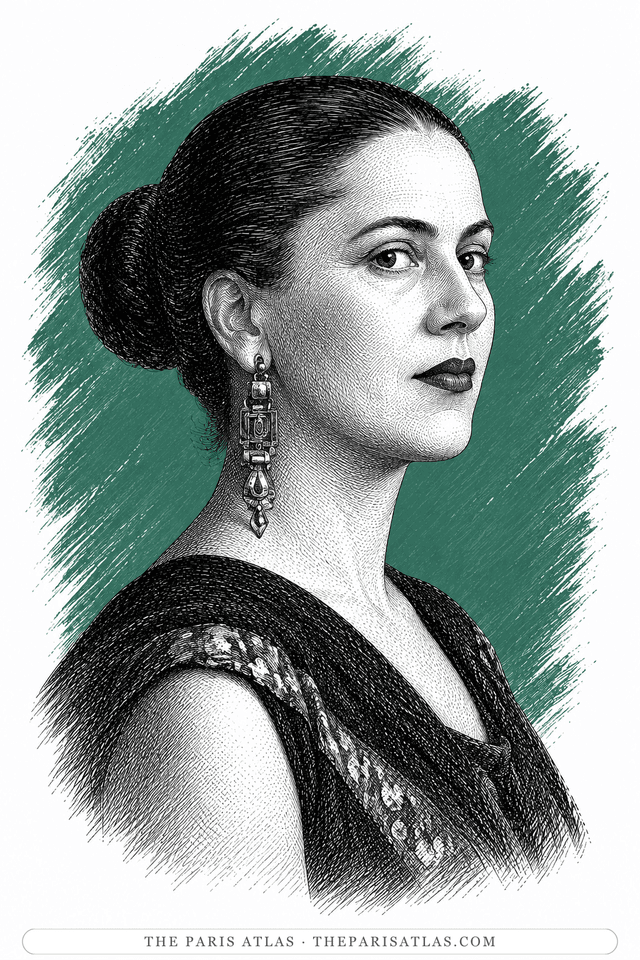
Brazilian painter who spent the 1920s moving between São Paulo and Paris, studied Cubism under André Lhote, Albert Gleizes and Fernand Léger, and used what she learned to paint Brazilian towns, railways, plants and bodies. Her 1928 painting Abaporu prompted the manifesto that gave the Anthropophagic movement its name.
View artist
Arman
French-American artist, lifelong friend of Yves Klein, and a founder of New Realism.
View artist
Jean Arp
Strasbourg-born sculptor and poet — Hans in German, Jean in French, both all his life — who co-founded Dada at the Cabaret Voltaire in 1916, composed collages by dropping torn paper 'according to the laws of chance', and settled at Meudon outside Paris in a house his wife Sophie Taeuber-Arp designed.
View artist
References
The sources below include collection records, catalogues, scholarly research, and primary materials that informed this page. They document Madame X, its making, and its place in cultural history.


1abcdAmerican Paintings in The Metropolitan Museum of Art, Volume III: A Catalogue of Works by Artists Born between 1846 and 1864
NonfictionThe Metropolitan Museum of Art, New York, 1980Used forThe museum's own printed catalogue of its American paintings, for the sitter's Louisiana family, the Brittany sittings and the exhibition history.

3↑Virginie Amélie Avegno Gautreau: Living Statue — Nineteenth-Century Art Worldwide, volume 17, number 2
EssaysNineteenth-Century Art Worldwide, 2018Used forScholarly article on the sitter, for her marriage, her husband's business and her public self-presentation.
6↑Explication des ouvrages de peinture, sculpture, architecture, gravure et lithographie des artistes vivants exposés au Palais des Champs-Élysées le 1er mai 1884
Official recordSociété des Artistes Français, Paris, 1884Used forThe official Salon catalogue of 1884, giving the number and the title under which the portrait was exhibited.
7↑Le Salon de 1884 — Revue des Deux Mondes, third series, volume 63, 1 June 1884, page 589
PeriodicalRevue des Deux Mondes, Paris, 1884Used forA hostile review of the Salon of 1884 that takes the portrait apart feature by feature.

9↑John Singer Sargent, Study of Mme Gautreau (c.1884), N04102 — collection record
WebsiteTateUsed forTate's record of the unfinished second version of the portrait.
11John Singer Sargent: The Early Portraits (Complete Paintings, Volume I)
NonfictionYale University Press, 1998Used forThe catalogue of the early portraits, for the sittings and the repainted shoulder strap.
12Fashioned by Sargent, 8 October 2023 to 15 January 2024 — exhibition press release
Official recordMuseum of Fine Arts, Boston, 2023Used forMuseum of Fine Arts, Boston press release naming the painting among the loans, with the Boston and Tate Britain dates.
These references provide the documented foundation for this work's history and interpretation. Claim-level citations remain attached to the specific claims they support.
 Explore more resources