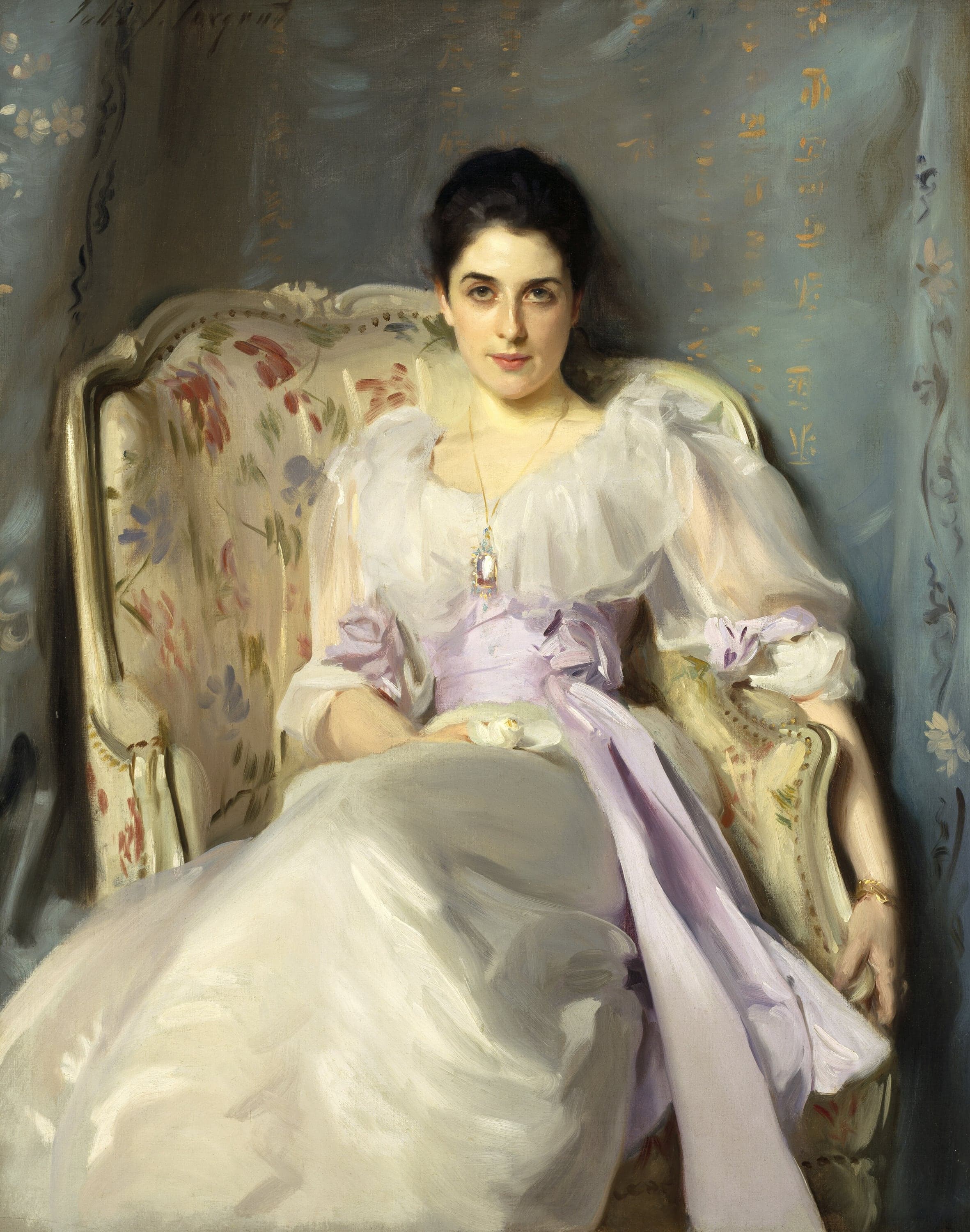
Lady Agnew of Lochnaw
A young woman sits well back in a flowered armchair, one arm along its arm, and looks straight out of the picture. She is Gertrude Vernon, Lady Agnew of Lochnaw, painted by John Singer Sargent in 1892 on a commission from her husband. The portrait was the success of the Royal Academy exhibition the following year and settled Sargent's reputation in Britain. It has belonged to the National Galleries of Scotland since 1925.
- 1892
- Oil on canvas
- National Galleries of Scotland, EdinburghEdinburgh, Scotland
About John Singer Sargent
What the painting shows
The sitter fills a wide armchair upholstered in cream silk with red and blue flowers on it. She wears a white dress with big gathered sleeves and a lilac sash tied at the waist, its long ends falling across her lap. A jeweled pendant on a thin gold chain hangs at her breastbone; a gold bracelet shows on her right wrist. Her left hand rests in her lap and her right arm lies along the arm of the chair.
She looks straight out at the viewer. The head is the most finished thing in the picture and almost everything else is painted fast — the sash is laid in with a few loaded strokes, and the folds of the skirt are wide, wet sweeps of near-white. Behind her hangs a pale blue-green silk with a woven pattern in gold and gray, which the loose handling turns into a screen of marks rather than a wall.
The National Galleries of Scotland describes the relaxed posture and the direct gaze as unusual for the portraiture of the day, and credits the fluid brushwork with the picture's spontaneous feel.[1] The canvas is 127 by 101 centimeters, roughly four feet by three, so the figure is close to life size from the waist up.
Who Lady Agnew was
Gertrude Vernon was born on 14 May 1864, a daughter of the Honorable Gowran Charles Vernon. On 15 October 1889 she married Sir Andrew Noel Agnew of Lochnaw, a Scottish barrister who held the ninth Agnew baronetcy and the family estates in Galloway, in the southwest of Scotland. She was about twenty-eight when she sat.
Her husband commissioned the portrait, and the Frick Collection reports that Sargent finished it in six sittings.[2] That is fast for a portrait of this size, and the surface bears it out. The head is carefully worked; most of the rest is laid in with single strokes and left.
The catalogue of Sargent's later portraits, by Richard Ormond and Elaine Kilmurray, records that Gertrude Vernon was convalescing from influenza while she sat.[3] The National Galleries of Scotland repeats the illness in its own materials with the qualifier that it is reported rather than documented. Nothing in the picture states it, and Sargent left no comment on it.
The Royal Academy, 1893
The portrait went on show at the Royal Academy in London in the summer of 1893, and the press decided in its favor at once. The Illustrated London News called it "without doubt one of the most remarkable pictures of the year" on 29 April.[4] The Art-Journal wrote that "as a portrait, a decorative pattern, or a piece of well-engineered impressionistic painting, it tops everything."
The critic R. A. M. Stevenson, writing in the Pall Mall Gazette on the same April day, said of the handling that "every audacity of touch becomes beauty and truth."[4] The Leeds Mercury answered the objection British critics most often made to French methods. Sargent had shown himself an advanced Impressionist before, it wrote, and here he proved "that he can draw with perfect correctness."
Sargent was elected an Associate of the Royal Academy in January 1894. The Sunday Times put the election down to the success of this picture.[4] The Frick Collection, which borrowed the portrait in 2014, states the wider effect plainly: the reception launched Lady Agnew as a society hostess and Sargent as the most fashionable portraitist on both sides of the Atlantic.[2]
How Edinburgh got it
The painting stayed with the Agnew family for a little over thirty years. The National Galleries of Scotland bought it in 1925 with the aid of the Cowan Smith Bequest Fund, and its accession number is NG 1656.[1] Gertrude Vernon died on 3 April 1932.
The museum has since expanded the catalogue title to name her first: Gertrude Vernon, Lady Agnew of Lochnaw (1864-1932).[1] The picture hangs at the Scottish National Gallery on the Mound in Edinburgh, and it travels. It went to New York in 2014 for the Frick Collection's Masterpieces from the Scottish National Gallery. It went to Boston and London in 2023 and 2024, for the show the Museum of Fine Arts called Fashioned by Sargent and Tate Britain called Sargent and Fashion.[5]
Close reading
Reading the work, detail by detail
The head is the only part of this picture that is fully finished. Everything else — the sash, the skirt, the chair, the wall behind — is laid in fast and left. Comparing the two is the point of looking closely.
1.The gaze
Gertrude Vernon looks straight out at the viewer, with her head tipped very slightly back. The National Galleries of Scotland describes both the gaze and the loose posture as unusual for the portraiture of the day, when a sitter was more often shown turned away or occupied.
2.The pendant
A single pendant on a thin gold chain hangs at the breastbone. It is one of only three pieces of jewelry in the picture, along with a gold bracelet at the wrist, and it marks the center of the composition.
3.The lilac sash
The sash is the only strong color in the picture and it is painted in a handful of strokes. In places the brush moved fast enough to leave the canvas weave visible through the paint, which is the fluid handling the museum credits with the portrait's spontaneous feel.
4.The hand over the chair arm
The right arm lies along the chair and the hand hangs off the end, fingers loose. Nothing is being held or done. That slackness is what makes the pose read as unforced rather than arranged.
5.Flowers on the chair
The chair is upholstered in cream silk printed with red and blue flowers, and Sargent painted the pattern as separate dabs rather than as drawn shapes. Step back and it resolves into chintz; up close it is a scatter of marks.
6.The gold-patterned hanging
Behind the sitter hangs a blue-green silk with a woven pattern in gold and gray. Sargent painted the pattern loosely enough that it reads as a screen of marks rather than as a wall, which keeps the background flat and pushes the figure forward.
Timeline
1889
Gertrude Vernon marries Sir Andrew Noel Agnew of Lochnaw, ninth baronet, on 15 October in London.
1892
Sargent paints the portrait on a commission from Sir Andrew Noel Agnew, reportedly in six sittings.
1893
Shown at the Royal Academy in London, where the press receives it as the picture of the year.
1894
Sargent is elected an Associate of the Royal Academy in January, an election the Sunday Times credits to this portrait.
1925
Bought for the nation in Scotland with the aid of the Cowan Smith Bequest Fund, accession NG 1656.
1932
Gertrude Vernon, Lady Agnew of Lochnaw, dies on 3 April.
2014
Lent to the Frick Collection in New York for Masterpieces from the Scottish National Gallery.
2023–24
Lent to Fashioned by Sargent at the Museum of Fine Arts, Boston, and to Sargent and Fashion at Tate Britain.
Where to see it
National Galleries of Scotland, Edinburgh
The Mound, Edinburgh EH2 2EL, United Kingdom
Displays and loans can change. Check whether this work is on view before making a special trip.
Plan your visit on the museum’s official website (opens in a new tab)Frequently asked questions
Who is Lady Agnew of Lochnaw?
Gertrude Vernon, born 14 May 1864 and died 3 April 1932. She married Sir Andrew Noel Agnew of Lochnaw, a Scottish barrister and the ninth Agnew baronet, in October 1889, and it was her husband who commissioned the portrait from John Singer Sargent in 1892.
Where is Lady Agnew of Lochnaw?
At the Scottish National Gallery on the Mound in Edinburgh, part of the National Galleries of Scotland. The accession number is NG 1656 and the credit line reads "Purchased with the aid of the Cowan Smith Bequest Fund 1925". The picture is lent abroad from time to time, so check before traveling to see it.
How big is Lady Agnew of Lochnaw?
127 by 101 centimeters, or about 50 by 40 inches. In its frame the museum records it at 159.5 by 133.3 centimeters and 50 kilograms.
How long did Sargent take to paint Lady Agnew of Lochnaw?
Six sittings, according to the Frick Collection. The picture supports the claim: the head is carefully finished and most of the dress, sash and background are laid in with broad, visible strokes that were not gone over again.
Why does Lady Agnew of Lochnaw matter to Sargent's career?
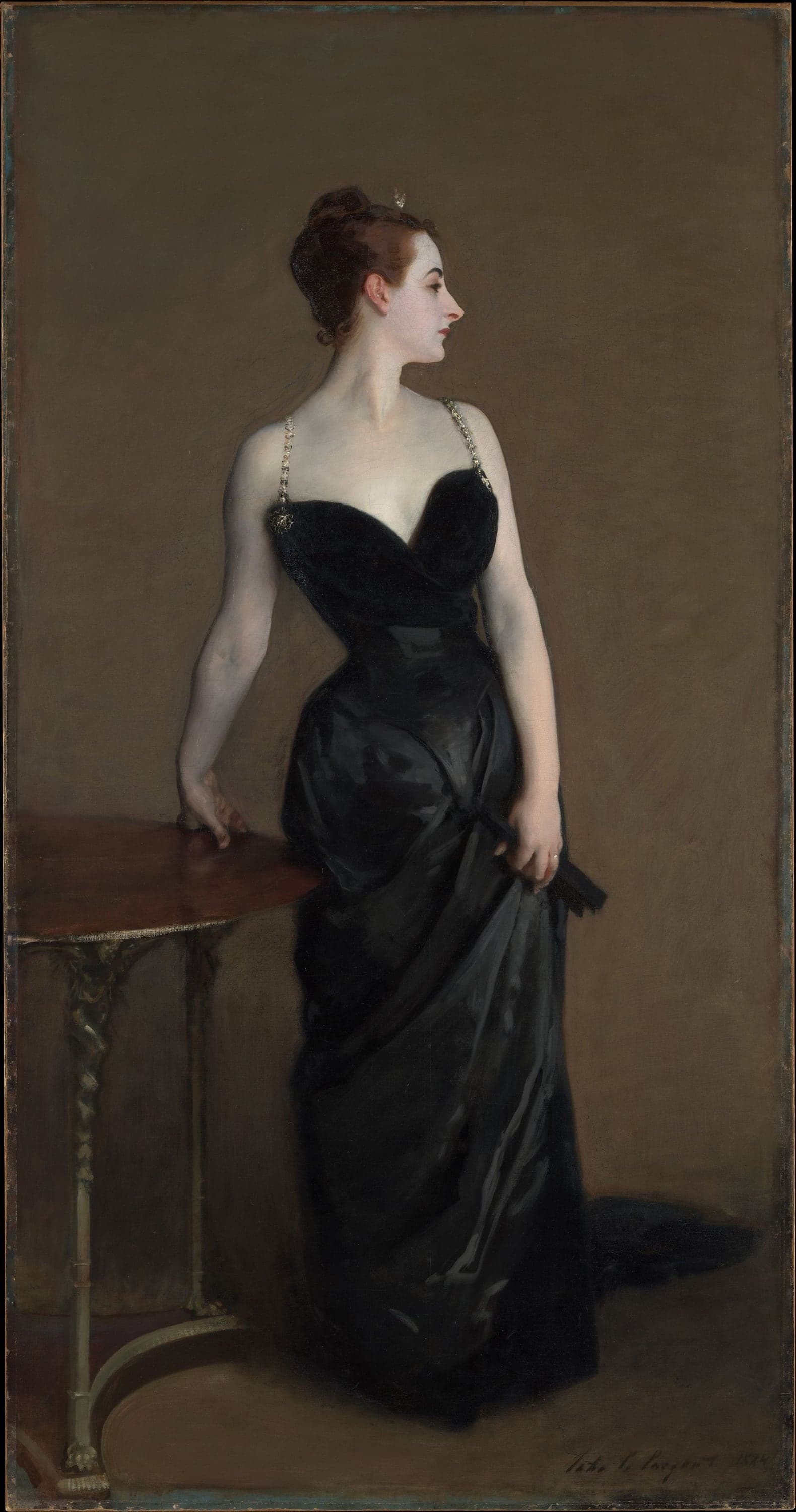
It was the success of the Royal Academy exhibition of 1893, nine years after the Madame X scandal had ended his practice in Paris. The London press treated it as proof that he could draw as well as handle paint freely, and he was elected an Associate of the Royal Academy the following January.
Was Lady Agnew ill when she sat for the portrait?
Richard Ormond and Elaine Kilmurray's catalogue of Sargent's later portraits records that she was convalescing from influenza during the sittings. The National Galleries of Scotland repeats it as a report rather than as a documented fact, and the collection record itself makes no mention of her health.
What is the painting's full title?
The National Galleries of Scotland now catalogues it as Gertrude Vernon, Lady Agnew of Lochnaw (1864-1932), giving the sitter her own name ahead of her husband's title. It is still widely known, and searched for, as Lady Agnew of Lochnaw.
More by John Singer Sargent
If you like John Singer Sargent
Explore painters from the same movements and circles.
Tarsila do Amaral
Brazilian painter who spent the 1920s moving between São Paulo and Paris, studied Cubism under André Lhote, Albert Gleizes and Fernand Léger, and used what she learned to paint Brazilian towns, railways, plants and bodies. Her 1928 painting Abaporu prompted the manifesto that gave the Anthropophagic movement its name.
View artist
Arman
French-American artist, lifelong friend of Yves Klein, and a founder of New Realism.
View artist
Jean Arp
Strasbourg-born sculptor and poet — Hans in German, Jean in French, both all his life — who co-founded Dada at the Cabaret Voltaire in 1916, composed collages by dropping torn paper 'according to the laws of chance', and settled at Meudon outside Paris in a house his wife Sophie Taeuber-Arp designed.
View artist
References
The sources below include collection records, catalogues, scholarly research, and primary materials that informed this page. They document Lady Agnew of Lochnaw, its making, and its place in cultural history.


3↑John Singer Sargent: The Later Portraits (Complete Paintings, Volume II)
NonfictionYale University Press, 2002Used forThe catalogue raisonné of the later portraits, for the commission and the sitter's convalescence from influenza.


5↑Fashioned by Sargent, 8 October 2023 to 15 January 2024 — exhibition press release
Official recordMuseum of Fine Arts, Boston, 2023Used forMuseum of Fine Arts, Boston press release naming the picture among the loans and giving the Boston and Tate Britain dates.
6Sargent, John Singer — Union List of Artist Names, record 500023972
ArchiveGetty Research InstituteUsed forAuthority record for the artist's dates, training and working life.
These references provide the documented foundation for this work's history and interpretation. Claim-level citations remain attached to the specific claims they support.
 Explore more resources