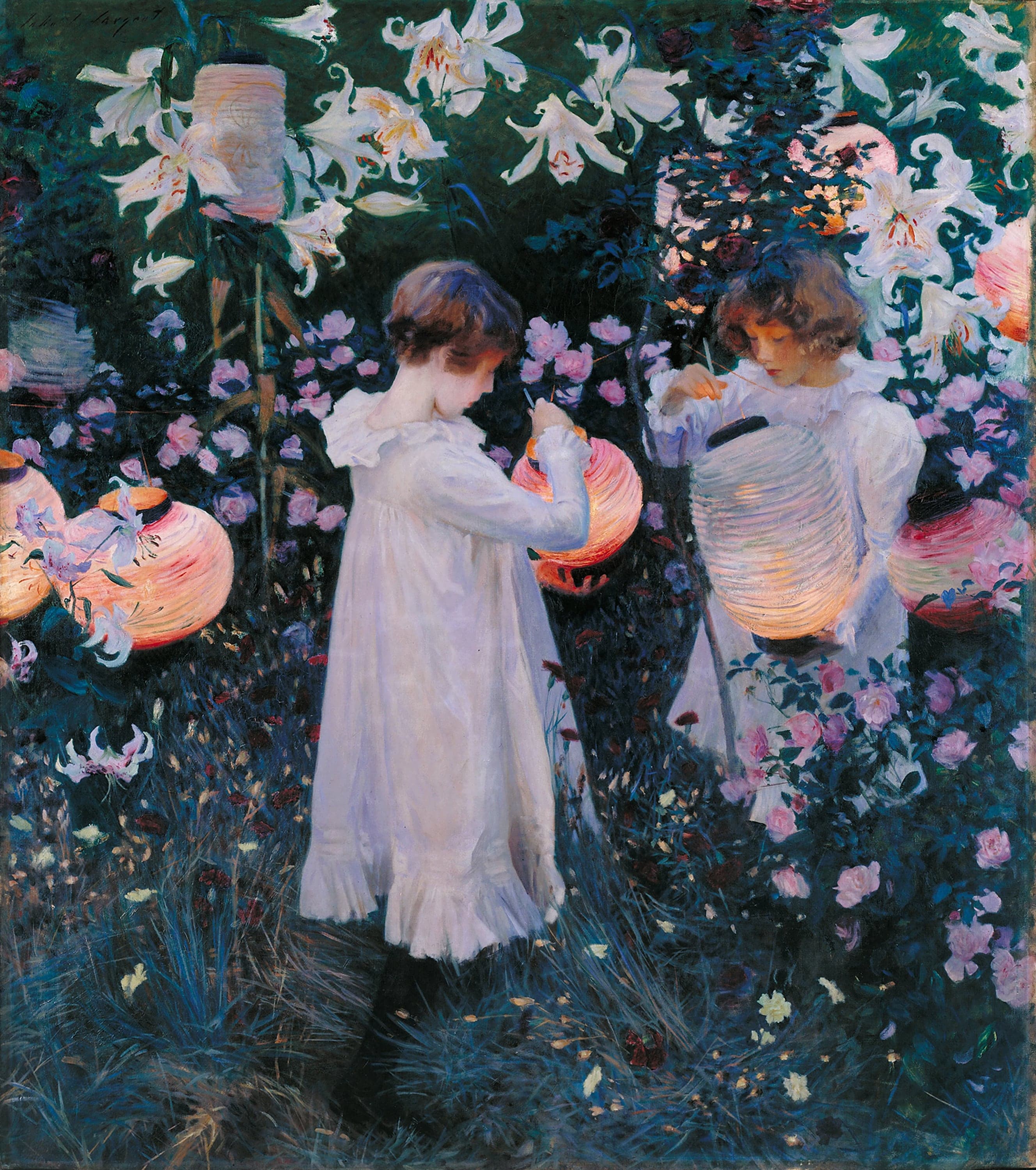
Carnation, Lily, Lily, Rose
Two girls in white stand among lilies and roses at dusk, lighting Chinese paper lanterns. John Singer Sargent painted them in a Cotswold garden at Broadway in Worcestershire, working only in the few minutes each evening when the light was right, across the summers of 1885 and 1886. The Royal Academy showed it in 1887 and the Chantrey Bequest bought it for the nation for £700. It is at Tate.
- 1885–6
- Oil paint on canvas
- TateLondon, England
About John Singer Sargent

What the painting shows
Two girls in long white pinafore dresses stand in a garden after sunset. The older one, on the left, bends her head and holds a lantern that is already lit; the younger, on the right, reaches up to the wick of a second one. Around them are tall white lilies, pink and mauve roses and carnations, and dark massed foliage with no sky above it.
Seven Chinese paper lanterns hang and sit among the flowers, four of them lit. The light in the picture comes only from those lanterns and from whatever is left of the day, which is why the whites go lilac and the grass goes blue-green. There is no horizon and no ground plane to speak of, so the figures sit inside the planting rather than in front of it.
Tate holds the painting and dates it 1885 to 1886. It measures 174 by 153.7 centimeters, close to square.[1]
Who the two girls were
They are sisters: Dorothy Barnard, known as Dolly, aged eleven, on the left, and Marion Alice Barnard, known as Polly, aged seven, on the right. Their father was the illustrator Frederick Barnard.[2]
They were not the first choice. Sargent began the canvas in August 1885 using Katharine Millet, the five-year-old daughter of his host, the American painter Francis Davis Millet. He switched to the Barnard sisters within a few weeks because their hair was the color he wanted.[1][2]
Dorothy Barnard kept the two pencil studies Sargent made of the sisters' heads for the rest of her life and left them to Tate in 1949.[1]
Ten minutes an evening
Sargent painted the picture outdoors, from the thing itself, which he almost never did at this scale. The light he wanted lasted only a few minutes each evening, and a minute or two less with every day that passed. Everything had to be ready before it arrived: easel, canvas, flowers, and the two girls in their dresses.
He told his sister Emily what the difficulty was. The flowers were more brilliant than any paint he had, the lawn behind them was the brightest green, and the effect he was after only lasted ten minutes.[3]
The writer Edmund Gosse was at Broadway that autumn and described the routine in a letter to Sargent's biographer Evan Charteris. The artists played lawn tennis until the moment came, then stopped and walked the painter out to his canvas.
“Instantly, he took up his place at a distance from the canvas, and at a certain notation of the light ran forward over the lawn with the action of a wag-tail, planting at the same time rapid dabs of paint on the picture, and then retiring again, only with equal suddenness to repeat the wag-tail action. All this occupied but two or three minutes, the light rapidly declining.”
Another painter in the group, Edwin Howland Blashfield, said the canvas looked scraped down most mornings, the previous evening's work removed, and that this happened over and over.[1]
The garden could not keep up either. As the roses died, Charteris records, artificial blooms were bought from the London draper Marshall and Snelgrove and wired onto the withered bushes.[4] For the second summer Sargent sent fifty Aurelian lily bulbs ahead to Broadway so that Lucia Millet could grow them in pots and move them where he needed them.[5]
He worked from September to early November 1885 in the garden of Farnham House, where the Millets were renting, and resumed in the summer of 1886 at their new house in the same village, Russell House. He finished in about October 1886.[1]
The canvas, and a story about a pitchfork
The unfinished picture spent the winter of 1885 rolled up in the Millets' barn. Millet family tradition held that Sargent unrolled it in 1886 to find a pitchfork had gone through it, and that he cut about two feet off the left side to lose the damage. The story also claimed the severed strip became another Sargent painting.
Tate examined the canvas and published the results in 2016. The conservator Rebecca Hellen and the Sargent scholar Elaine Kilmurray found a genuine puncture about fifteen millimeters long in the upper right, with an early patch on the back, so something did happen to the rolled canvas.[2]
What did not happen is the cut. No part of the picture was removed from the left and repainted elsewhere. Sargent had started on a much larger working stretcher and reduced it to something near square, and the paint that went missing went from the top and the bottom, where turned-over edges still carry flowers that no longer show.[2]
Where the title comes from
A visitor asked Sargent in the garden what he meant to call the picture. He was humming a song the group had sung the night before, and one line of it answered the question. Evan Charteris printed the anecdote in 1927.[4]
The song is "The Wreath", a pastoral glee for three voices by the composer Joseph Mazzinghi, identified by the Sargent scholar David McKibbin. It opens by asking shepherds whether they have seen Flora pass this way, and it describes the wreath she wore: carnation, lily, lily, rose.[1]
The line is a list of flowers and nothing more. It is not a description of the picture, and the plants in the picture are not arranged to match it.
The Royal Academy, 1887
The painting hung at the Royal Academy summer exhibition of 1887 as catalogue number 359.[6] The critics split over it. Harry Quilter called it an exquisite work of art in the Spectator; the Daily Telegraph wondered in print whether the whole thing was meant as a practical joke.[3]
Claude Phillips, writing in the Academy, granted the eccentricity and the straining after a new kind of impression, and then said it would be hard to name another painter who could have brought the thing off.[3]
It was bought that year for the nation under the Chantrey Bequest, the fund left by the sculptor Francis Chantrey to buy British art for the public collection. The price was 700 pounds.[6] Tate's own account credits the purchase largely to the insistence of Frederic Leighton, the President of the Royal Academy, who chaired the Chantrey committee.[1] It was one of the first pictures Sargent made after leaving Paris for London, three years after the reception of Madame X had ended his practice in France.
Close reading
Reading the work, detail by detail
There are two light sources here and no daylight to speak of: paper lanterns burning from inside, and the last blue of a sky that is not in the picture. Look at what each one does to white.
1.The lantern in her hands
The lantern Dorothy Barnard holds is lit, and it is the brightest thing in the picture. The paper ribs show as dark curves against the flame inside. The orange light it throws is what turns the front of her white dress warm while the rest of it stays cold.
2.The bowed head
Dorothy Barnard was eleven. Her head is bent, her face is in shadow, and the only light on it comes up from the lantern. Sargent gives her no expression to read, which keeps the picture about the light rather than about the child.
3.Polly's reach
Marion Alice Barnard, seven, has her hands at the top of a second lantern. Sargent had begun the canvas with a different child, Katharine Millet, and changed to the two Barnard sisters within weeks because their hair was the color he wanted.
4.Lilies against the dark
The lilies at the top are painted against foliage dark enough to read as black. Sargent had fifty Aurelian lily bulbs sent ahead for the second summer so that Lucia Millet could grow them in pots and move them where he needed them.
5.A lantern in the grass
Two of the lanterns sit at ground level rather than hanging, and they light the plants from underneath. That is why the lower flowers have shadows above them instead of below.
6.Roses at the edge
As the roses died through the autumn of 1885, artificial blooms were bought from the London draper Marshall and Snelgrove and wired onto the bare bushes. Evan Charteris recorded it in 1927. Which of the flowers here are real is no longer recoverable.
Timeline
1885
Sargent arrives at Broadway in Worcestershire in August and begins the canvas in the garden of Farnham House, first using Katharine Millet as the model.
1885
By early September the Barnard sisters, Dorothy and Marion Alice, have replaced her. He works in the garden until early November, then the canvas is stored rolled in the Millets' barn.
1886
Work resumes in the summer at the Millets' new house in Broadway, Russell House, with lilies grown in pots for the purpose. Sargent finishes in about October.
1887
Shown at the Royal Academy as number 359 and bought for the nation through the Chantrey Bequest for 700 pounds.
1926
Shown again at the Royal Academy, as number 47 of the winter memorial exhibition held after Sargent's death.
1949
Dorothy Barnard bequeaths Sargent's two pencil studies of her and her sister to Tate.
2016
Tate publishes a technical study of the painting that disproves the long-repeated story of two feet cut from the left edge.
Where to see it
Tate
London, England
Tate has several galleries. A specific viewing address has not been confirmed here; check which venue, if any, is displaying this work before travelling.
Plan your visit on the museum’s official website (opens in a new tab)Frequently asked questions
Who are the girls in Carnation, Lily, Lily, Rose?
Dorothy Barnard, aged eleven, on the left, and her sister Marion Alice Barnard, aged seven, on the right. They were known as Dolly and Polly, and their father was the illustrator Frederick Barnard. Sargent had started the picture with a different child, Katharine Millet, and changed models because the Barnard sisters' hair was the color he wanted.
Where was Carnation, Lily, Lily, Rose painted?
Outdoors, in gardens at Broadway in Worcestershire, in the Cotswolds. The 1885 campaign was at Farnham House, which the American painter Francis Davis Millet was renting; the 1886 campaign was at the Millets' next house in the same village, Russell House.
Why did Carnation, Lily, Lily, Rose take two years to paint?
Because Sargent would only paint it in the few minutes of dusk when the lanterns and the last daylight balanced, and that window closed earlier every evening as the season went on. He also scraped back much of what he had done. When the autumn killed the flowers he broke off, stored the canvas over the winter, and started again the following summer.
What does the title Carnation, Lily, Lily, Rose mean?
It is a line from a song, not a description. The words come from "The Wreath", a glee for three voices by Joseph Mazzinghi, which Sargent was humming in the garden when someone asked what the picture would be called. The song lists the flowers in a wreath worn by a shepherdess named Flora.
Where is Carnation, Lily, Lily, Rose?
At Tate, accession number N01615, with the credit line "Presented by the Trustees of the Chantrey Bequest 1887". Tate Britain has shown it in its historic British displays. Tate has several galleries and lends the picture out, so check which venue holds it before traveling to see it.
How much did Carnation, Lily, Lily, Rose cost?
700 pounds, paid in 1887 out of the Chantrey Bequest, the fund left by the sculptor Francis Chantrey to buy British art for the nation. The figure appears both in the Chantrey trustees' own published accounts and in Algernon Graves's dictionary of Royal Academy exhibitors.
Was Carnation, Lily, Lily, Rose cut down?
Yes, but not the way the story usually goes. Sargent began on a much larger stretcher and reduced the canvas to something close to square, losing paint at the top and bottom. The Millet family told a different story: two feet sliced off the left after a pitchfork went through the rolled canvas. Tate's conservators tested it in 2016 and it does not hold, though they did find a small puncture and an early repair.
More by John Singer Sargent
If you like John Singer Sargent
Explore painters from the same movements and circles.

Tarsila do Amaral
Brazilian painter who spent the 1920s moving between São Paulo and Paris, studied Cubism under André Lhote, Albert Gleizes and Fernand Léger, and used what she learned to paint Brazilian towns, railways, plants and bodies. Her 1928 painting Abaporu prompted the manifesto that gave the Anthropophagic movement its name.
View artist
Arman
French-American artist, lifelong friend of Yves Klein, and a founder of New Realism.
View artist
Jean Arp
Strasbourg-born sculptor and poet — Hans in German, Jean in French, both all his life — who co-founded Dada at the Cabaret Voltaire in 1916, composed collages by dropping torn paper 'according to the laws of chance', and settled at Meudon outside Paris in a house his wife Sophie Taeuber-Arp designed.
View artist
References
The sources below include collection records, catalogues, scholarly research, and primary materials that informed this page. They document Carnation, Lily, Lily, Rose, its making, and its place in cultural history.


2abcdCarnation, Lily, Lily, Rose and the process of painting — British Art Studies, issue 2
EssaysPaul Mellon Centre for Studies in British Art and Yale Center for British Art, 2016Used forTate's technical study of the canvas, which dates the change of models and disproves the story of two feet cut from the left edge.

5↑John Singer Sargent's Carnation, Lily, Lily, Rose 1885-6 — Tate Etc, issue 40
PeriodicalTate, 2017Used forElaine Kilmurray on the fifty lily bulbs sent ahead for the second summer, and the words of the song the title comes from.
6abThe Royal Academy of Arts: A Complete Dictionary of Contributors and their Work from its Foundation in 1769 to 1904, Volume VII
ArchiveHenry Graves and Co. and George Bell and Sons, London, 1905Used forRoyal Academy exhibitor dictionary, for the 1887 catalogue number and the 700-pound Chantrey purchase price.
These references provide the documented foundation for this work's history and interpretation. Claim-level citations remain attached to the specific claims they support.
 Explore more resources