The Daughters of Edward Darley Boit
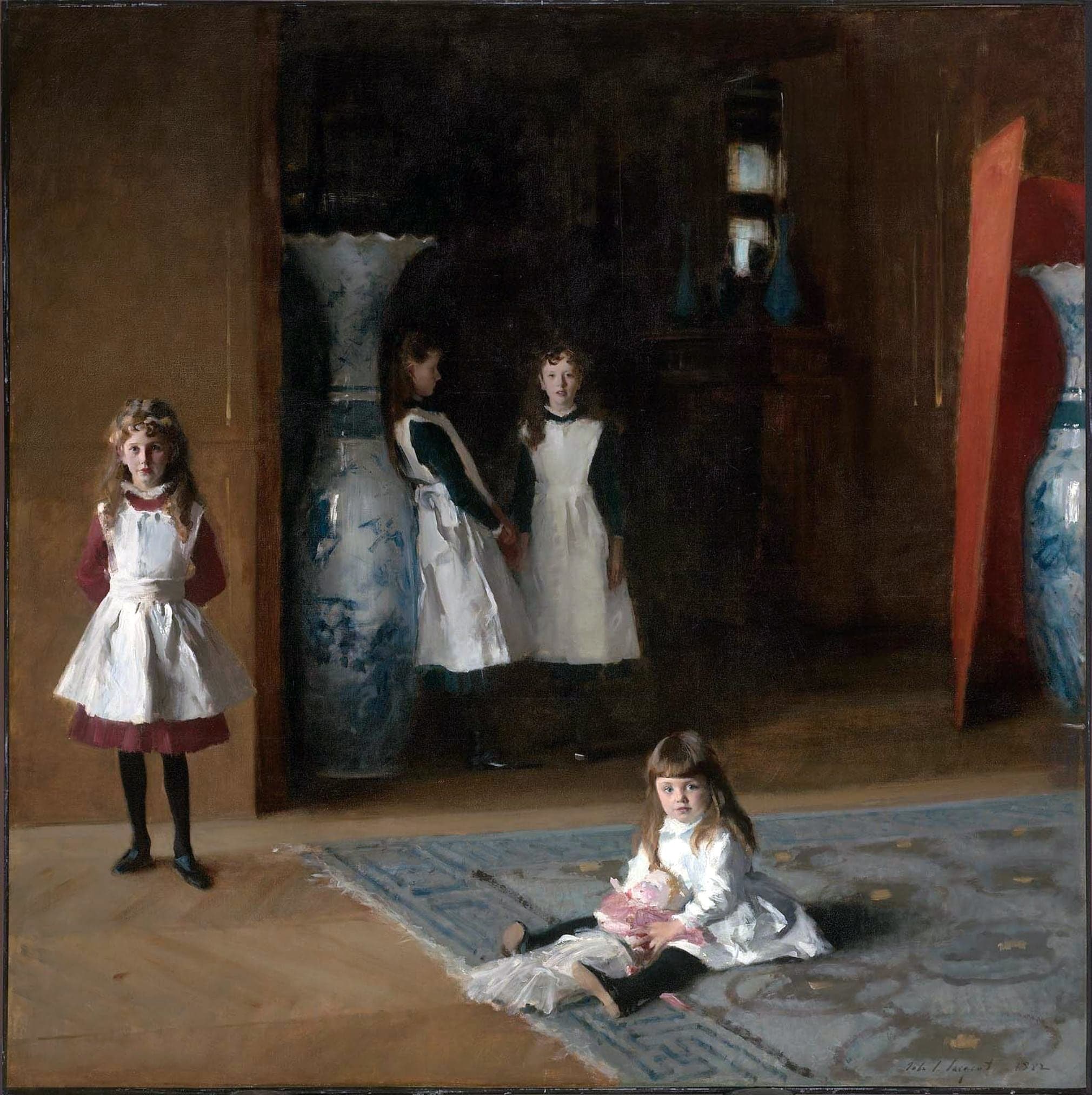
Four sisters stand and sit in a dim, nearly square room with two tall blue-and-white Japanese vases. They are the daughters of Edward Darley Boit, an American family living in Paris, and John Singer Sargent painted them in the hall of their apartment in the autumn of 1882. He gave most of the canvas to the room. The painting has been at the Museum of Fine Arts, Boston, since 1919.
- 1882
- Oil on canvas
- Museum of Fine Arts, BostonBoston, United States
About John Singer Sargent

What the painting shows
The youngest sister sits on a patterned rug in the foreground with a doll across her lap, looking straight out. To the left, in full light, another girl stands alone in a white pinafore over a dark red dress, hands behind her back. Behind them the room opens into shadow, and two more sisters stand there: one facing out, one turned almost into profile against a tall vase.
Two blue-and-white Japanese vases frame the dark opening, one at each side. A red screen or lacquer panel glows at the right edge. Almost nothing else is described. The floor, the walls and the space between the girls take up more of the picture than the girls do.
The canvas is 221.93 by 222.57 centimeters, so it is very nearly square, and the figures are close to life size.[1] Sargent signed and dated it at the lower right.
Who the four sisters are
The Museum of Fine Arts, Boston, names them and gives their ages at the time of painting.[1] From the front of the room backward, they are:
- Julia Overing Boit, four, seated on the rug with her doll. She was born in 1877 and died in 1969.
- Mary Louisa Boit, eight, standing alone at the left. She was born in 1874 and died in 1945.
- Jane Hubbard Boit, twelve, one of the two girls in the shadowed room. She was born in 1870 and died in 1955.
- Florence Dumaresq Boit, fourteen, the eldest, standing in profile against the left-hand vase. She was born in 1868 and died in 1919.
Their parents were Edward Darley Boit, a Boston lawyer who gave up the law to paint, and Mary Louisa Cushing Boit. The family kept an apartment on the avenue de Friedland in the 8th arrondissement of Paris, a neighborhood full of wealthy Americans, and the foyer of that apartment is the room in the picture.[1]
None of the four married. Mary Louisa and Julia lived together in later life, and Julia became a watercolor painter who showed at a Boston gallery in 1929.[2] Erica E. Hirshler wrote a book about the picture and the family, Sargent's Daughters, published in 2009.[3]
The two vases are real, and they survive
The vases are Arita ware, Japanese porcelain with underglaze blue decoration of birds and flowers, made in the nineteenth century for export to the West. Each stands 188 centimeters tall, a little over six feet, which is why the two girls beside them look small.[4]
They belonged to the Boits and crossed the Atlantic with the family more than a dozen times, picking up damage to their rims on the way.[2] They passed by inheritance to Julia O. Beals, and in 1997 her daughters gave them to the Museum of Fine Arts, Boston, where they carry the accession numbers 1997.211 and 1997.212.[4]
Since the museum opened its Art of the Americas Wing on 20 November 2010, the painting has hung with the two vases standing beside it.[5] They are the only objects from the Paris hall known to have survived.
Four corners and a void
Sargent called it Portraits d'enfants — portraits of children — and showed it in December 1882 at the Paris gallery of the dealer Georges Petit. The notices were good enough that he sent it to the Salon the following spring.[1]
There, a critic complained of "its four corners and a void", meaning that the sisters had been pushed to the edges of a picture with nothing in the middle. Nobody has identified who wrote it. The earliest printing of the phrase is in Evan Charteris's 1927 biography of Sargent, which gives it without a name.[6][2]
The novelist Henry James, who knew both Sargent and the Boits, wrote about the painting in Harper's New Monthly Magazine in October 1887 and described the same empty room as a setting made for the children.
“The artist has done nothing more felicitous and interesting than this view of a rich dim, rather generalized French interior (the perspective of a hall with a shining floor, where screens and tall Japanese vases shimmer and loom), which encloses the life and seems to form the happy play-world of a family of charming children.”
James also called the room "The Hall with the Four Children", and the title the painting carries now was not attached until 1912, when the Boits first lent it to the Museum of Fine Arts.[2]
Velázquez in the background
Sargent had gone to Madrid in 1879 to copy Diego Velázquez at the Museo del Prado. One of the pictures he studied there was Las Meninas, painted about 1656, in which a young Spanish princess stands with her attendants in a large, dim room and looks directly out at the viewer.[1]
The Museum of Fine Arts, Boston, reads the Boit portrait as an adaptation of that picture: the same deep shadowed space, the same dark restricted palette, the same self-possessed child meeting the viewer's eye. The museum adds a second, nearer source in Edgar Degas, whose off-center compositions and disconnected figures were current in Paris while Sargent was working.[1]
In March 2010 the Museo del Prado borrowed the painting and hung it in relation to Las Meninas, the first time the two were shown together.
Close reading
Reading the work, detail by detail
Four girls, four distances from the viewer, and a great deal of empty floor and wall between them. Read them in the order Sargent set them, from the rug at the front to the dark at the back.
1.Julia and the doll
Julia Overing Boit was four. She sits on the rug with a doll across her lap and looks directly out at the viewer, and she is the only sister who does. Her pinafore is the brightest white in the picture.
2.Mary Louisa, alone in the light
Mary Louisa Boit was eight. She stands by herself against the wall at the left, hands behind her back, with a clear space between her and everyone else. She is the only sister lit fully from the front.
3.The two in the dark
Florence Dumaresq Boit, fourteen, stands turned away against the vase; Jane Hubbard Boit, twelve, faces forward beside her. They are the two eldest and the two least visible, set back into a room Sargent barely describes.
4.The left-hand vase
The vases are Japanese Arita porcelain, made in the nineteenth century for export. Each is 188 centimeters tall, a little over six feet, which is why the twelve-year-old beside this one looks small. Both are now at the Museum of Fine Arts, Boston, standing beside the painting.
5.The red panel and the second vase
A red panel at the right edge is the only strong color in the room, and the second vase stands against it, cut off by the frame. The picture is almost square, and Sargent used the edges to crop rather than to contain.
6.What the room does not show
Beyond the two standing sisters the hall goes almost black, with the shape of a mirror just readable in it. Diego Velázquez put the king and queen in the mirror at the back of Las Meninas, which Sargent had copied at the Prado in 1879. Here the mirror reflects nothing that can be made out.
Timeline
1879
Sargent goes to Madrid and copies paintings by Velázquez at the Prado, among them Las Meninas.
1882
Painted in the autumn in the hall of the Boit apartment on the avenue de Friedland, Paris, and shown in December at Georges Petit's gallery as Portraits d'enfants.
1883
Shown at the Paris Salon, where a critic complains of its four corners and a void.
1887
Henry James writes about the picture in Harper's New Monthly Magazine, calling it the happy play-world of a family of charming children.
1912
The Boits lend the painting to the Museum of Fine Arts, Boston, and it takes the title it carries now.
1919
The four daughters give it to the museum in memory of their father, accession 19.124.
1997
The two Japanese vases in the painting enter the same museum, given by the daughters of Julia O. Beals.
2010
Lent to the Museo del Prado in Madrid and hung near Las Meninas, then installed in the museum's new Art of the Americas Wing beside the two vases.
Where to see it
Museum of Fine Arts, Boston
465 Huntington Avenue, Boston, MA 02115, United States
Ruth and Carl J. Shapiro Gallery (Gallery 232).
Plan your visit on the museum’s official website (opens in a new tab)Frequently asked questions
Who are the four girls in The Daughters of Edward Darley Boit?
Florence Dumaresq Boit, fourteen, stands in profile in the shadowed room, with Jane Hubbard Boit, twelve, beside her. Mary Louisa Boit, eight, stands alone in the light at the left. Julia Overing Boit, four, sits on the rug in front with a doll. They were the daughters of Edward Darley Boit and Mary Louisa Cushing Boit, an American family living in Paris.
Where was The Daughters of Edward Darley Boit painted?
In the entrance hall of the Boit family's apartment on the avenue de Friedland, in the 8th arrondissement of Paris, in the autumn of 1882. The Museum of Fine Arts, Boston, describes the room as neither entirely public nor entirely private, which is part of why the picture feels unsettled.
What are the vases in The Daughters of Edward Darley Boit?
Two Japanese Arita porcelain vases, decorated in underglaze blue with birds and flowers and made in the nineteenth century for export. Each is 188 centimeters tall. They were the Boits' own, they crossed the Atlantic with the family many times, and they entered the Museum of Fine Arts, Boston, in 1997, where they now stand beside the painting.
Who said the painting was four corners and a void?
Nobody knows. The phrase comes from the reception at the Paris Salon of 1883 and the critic has never been identified. The earliest printing of it is in Evan Charteris's biography of Sargent, published in 1927, which quotes it without a name.
Where is The Daughters of Edward Darley Boit?
At the Museum of Fine Arts, Boston, accession number 19.124, in the Ruth and Carl J. Shapiro Gallery. The four sisters gave it to the museum in 1919 in memory of their father. The picture is lent out occasionally, so check before traveling to see it.
Is The Daughters of Edward Darley Boit based on Las Meninas?
The Museum of Fine Arts, Boston, says so directly. Sargent copied Velázquez at the Prado in 1879, three years before painting the Boit girls. The museum points to the borrowed elements: the deep shadowed room, the dark restricted palette, and the child who looks straight out at the viewer. The Prado made the same case when it borrowed the painting in 2010 and hung it near Las Meninas.
How big is The Daughters of Edward Darley Boit?
221.93 by 222.57 centimeters, about seven feet three inches each way. It is very nearly square, and the four figures are close to life size.
More by John Singer Sargent
If you like John Singer Sargent
Explore painters from the same movements and circles.
Tarsila do Amaral
Brazilian painter who spent the 1920s moving between São Paulo and Paris, studied Cubism under André Lhote, Albert Gleizes and Fernand Léger, and used what she learned to paint Brazilian towns, railways, plants and bodies. Her 1928 painting Abaporu prompted the manifesto that gave the Anthropophagic movement its name.
View artist
Arman
French-American artist, lifelong friend of Yves Klein, and a founder of New Realism.
View artist
Jean Arp
Strasbourg-born sculptor and poet — Hans in German, Jean in French, both all his life — who co-founded Dada at the Cabaret Voltaire in 1916, composed collages by dropping torn paper 'according to the laws of chance', and settled at Meudon outside Paris in a house his wife Sophie Taeuber-Arp designed.
View artist
References
The sources below include collection records, catalogues, scholarly research, and primary materials that informed this page. They document The Daughters of Edward Darley Boit, its making, and its place in cultural history.


3↑Sargent's Daughters: The Biography of a Painting
NonfictionMFA Publications, Boston, 2009Used forThe monograph on this painting by the Museum of Fine Arts curator who wrote its collection text.

5↑Art of the Americas Wing opening, 20 November 2010 — press release of 19 May 2010
Official recordMuseum of Fine Arts, Boston, 2010Used forMuseum press release for the wing that opened on 20 November 2010, where the painting hangs with the vases it depicts.

6↑John Sargent
BiographyWilliam Heinemann, London, 1927Used forThe first biography, and the earliest known printing of the four corners and a void complaint, given without a critic's name.
7John S. Sargent — Harper's New Monthly Magazine, volume 75, October 1887, pages 683 to 691; reprinted in Picture and Text (1893)
PeriodicalHarper and Brothers, New York, 1887Used forHenry James's essay on Sargent, the source of the happy play-world description quoted ever since.
These references provide the documented foundation for this work's history and interpretation. Claim-level citations remain attached to the specific claims they support.
 Explore more resources