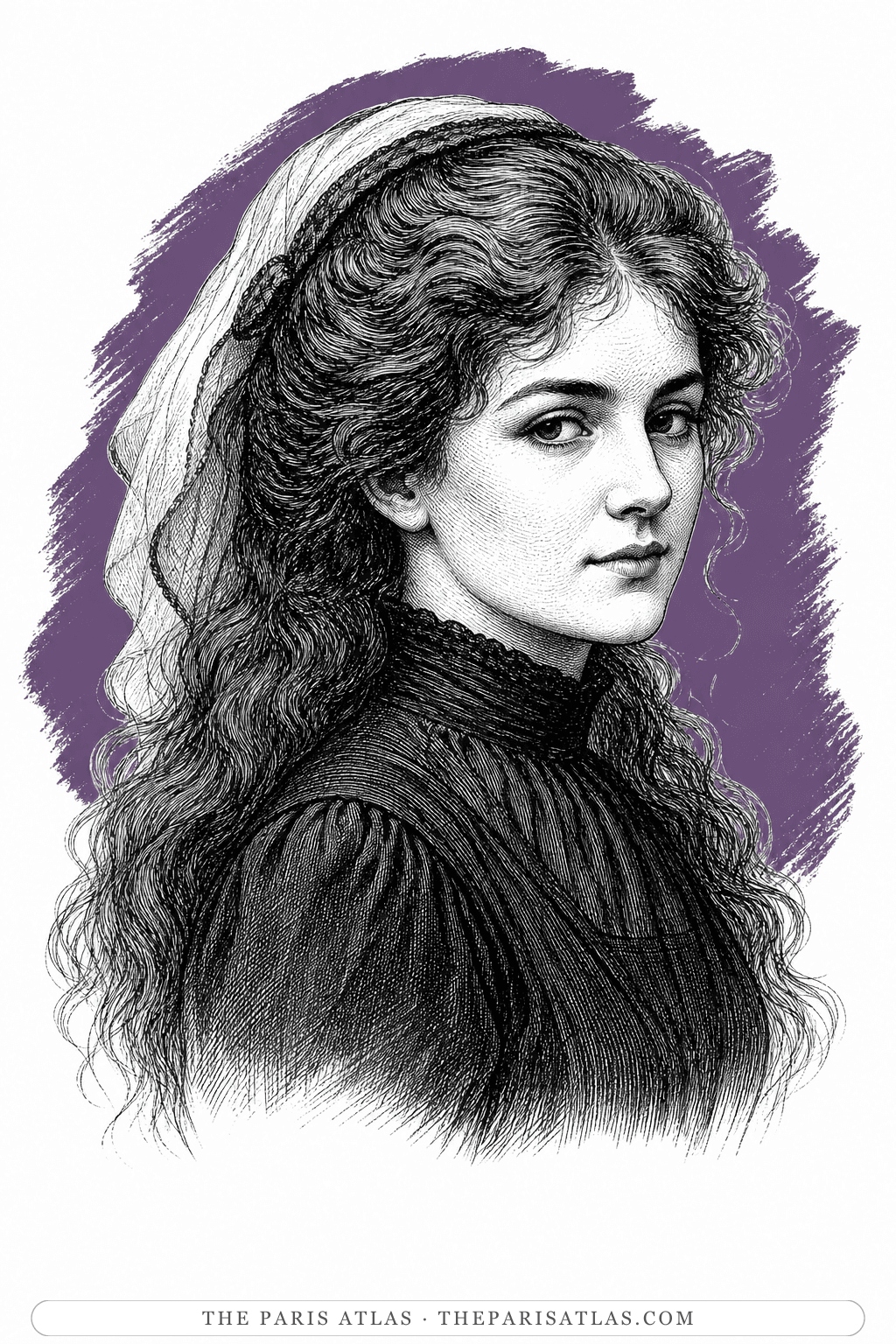
Angèle
Cascade's wife, who arrives from Paris and pulls Ferdinand into her orbit. She earns her money as a prostitute, and she knows more about her husband than he would like.
To keep the money she makes off English officers and to run her own operation, not Cascade's. She tells him to his face at the Hyperbole: "You stink Cascade and you can fuck off … I can ditch you whenever I like."
The book

At a glance
- Angèle Boisson — Cascade's wife, twenty years old, from Paris
- Walking into the Salle Saint-Gonzef with a pass Cascade has arranged for her
- Widow's mourning; a false pass in the name Angèle Cascade
- Shared with Amandine Destinée, the Hyperbole barmaid
- English officers only — upper-class ones, the kind afraid of being seen fucking
Who they are in the book
Spoiler-freeAngèle is Cascade's twenty-year-old wife — Parisian, small and undulating, with mahogany-red hair to her hips and dark velvety eyes — and she arrives in Peurdu-sur-la-Lys because Cascade sends for her. She is supposed to work the English garrison under his direction. She refuses to be directed from the first afternoon, starts picking off English officers on her own, dresses in widow's mourning as a pity trick, and turns out to know more about her husband than he had assumed a wife of hers could ever get her hands on.
She sleeps with Amandine Destinée the barmaid at night in their shared room upstairs at the Hyperbole. She sizes Ferdinand up on the first day and files him away as useful. By the middle of the book she is running everything in her corner of Peurdu, and by the end she is running Ferdinand.
How Angèle Is Portrayed
- The mahogany hairCascade advertises it before she arrives — mahogany-colored and real, falling to her hips, and (he claims) capable of coming twelve times in a row. She is smaller than the buildup and more dangerous than he understands.
- The widow's mourning actShe works the corner opposite the English headquarters in full black — veil, black dress — and tells English officers in careful French that she has just lost her father in the Somme and her husband is dying in the local hospital. Twelve pounds a night; both details are technically true.
- "You stink, Cascade"The first afternoon Cascade tries to control her at the Hyperbole she looks him up and down in front of Ferdinand and Destinée and tells him to his face that he stinks and she can leave him whenever she likes. He deflates. She slides them a 100-franc note on the way out.
- The Scot in the closetShe teaches Ferdinand her Paris husband-scam by demonstrating it on a redheaded Scottish officer in her room above the Hyperbole while Ferdinand watches through the closet door. Afterwards she tells Ferdinand: tomorrow you're the husband.
- Destinée in the room upstairsShe sleeps in Amandine Destinée's room above the café and makes the barmaid come two or three times a night after Destinée has been on her feet since 6:15 in the morning. The more tired Destinée is, the harder Angèle works to get her off.
- The Purcell schemeShe picks Major Cecil B. Purcell out of the English headquarters as her mark — fifty-two, wealthy, an engineer with three factories in London — and turns the husband-scam into a full extraction: an offer to take Angèle to England, and Ferdinand along with her as her wronged wounded relative.
At the Harnache lunch Angèle exposes Cascade in front of the whole room — that he is a bigamist, that he shot himself in the foot to escape service, and that she has sent the letter in which he wrote it to his colonel. Cascade sings through the whole thing. Four days later he is executed by firing squad. Angèle does not attend and does not leave town.
She uses the intervening days to close the Purcell operation. She talks Purcell out of prosecuting Ferdinand for the pretended assault, converts him into a rescuer, and negotiates passage to England for both of them under the fiction that Ferdinand is a wounded relative. She travels ahead. Ferdinand follows two days later on the Boulogne–England boat, alone, with the medal in his pocket. The book ends with him vomiting into a bucket at the ship's rail.
If you like War


If you like Louis-Ferdinand Céline
Explore authors with a similar voice, perspective, and influence.
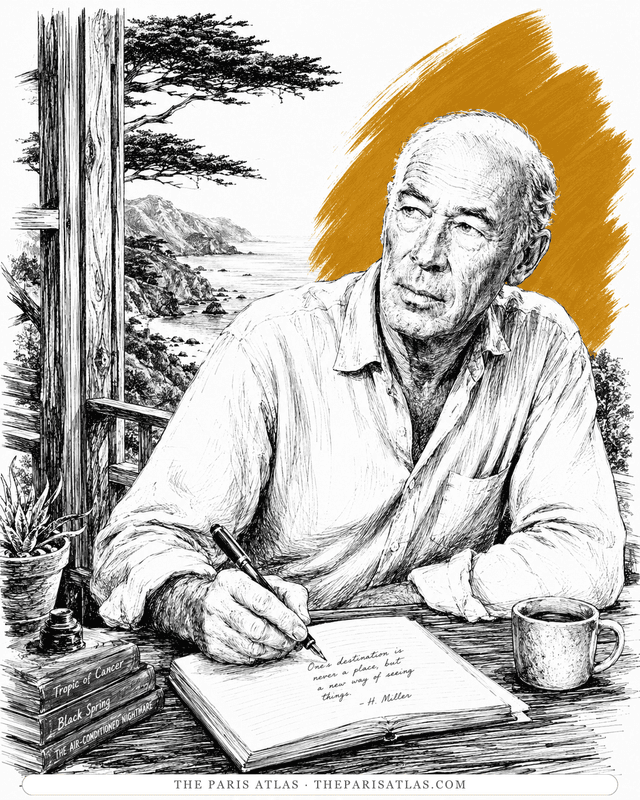
Henry Miller
Miller read Journey in manuscript while writing Tropic of Cancer and never recovered — the two books are the era's twin gutter-testaments.
View author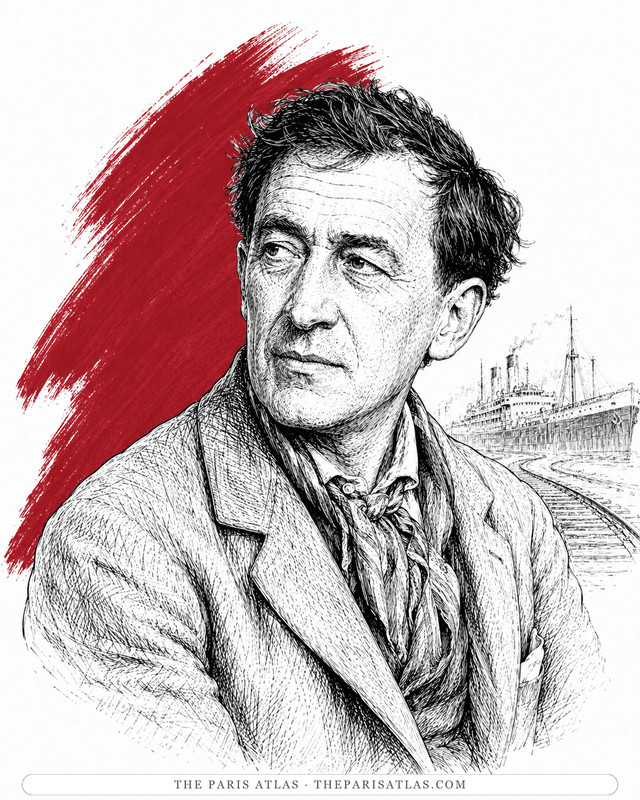
Blaise Cendrars
The other French modernist Céline could not look away from: a war-wounded amputee whose spoken prose ran ahead of grammar and whose Moravagine anticipates Bardamu's tour of the century's slaughterhouses.
View author
Ernest Hemingway
The same war, the same refusal of the big words — delivered in whispers where Céline delivers it in screams. Both writers died in the same week of July 1961.
View author