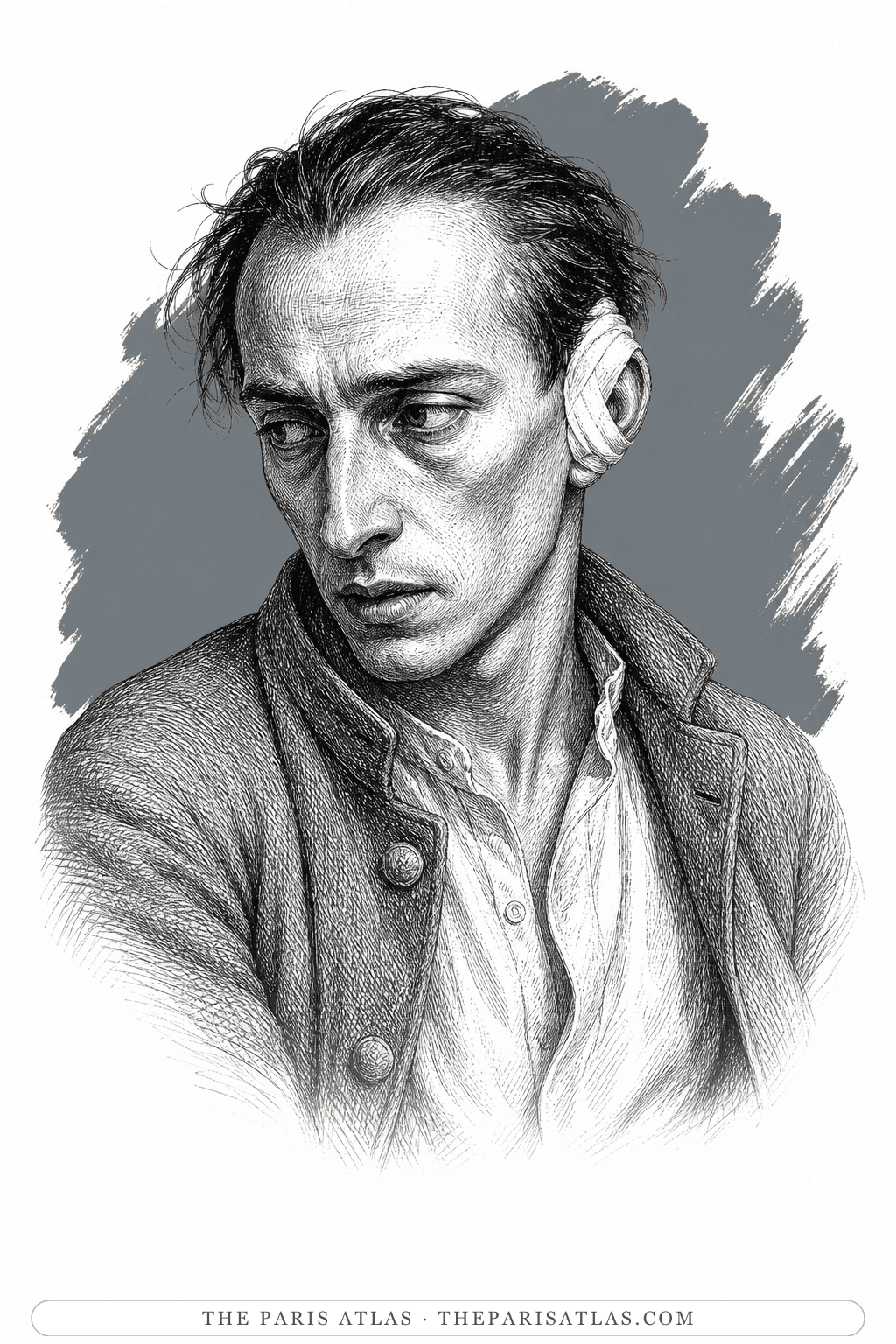
Ferdinand
The narrator. A young French soldier who comes to on the battlefield gravely wounded, survives the hospital, and moves through convalescence toward the criminal underground that will take him to London.
To get out of the war alive, by any route the war leaves open. He says out loud that he does not want to be brave anymore and, when a chance to reach England appears, he takes it without ceremony.
The book

At a glance
- Corporal Ferdinand — French cavalry, wounded on the retreat with the Le Drellière convoy
- Face down in a Flanders mud enclosure surrounded by ten dead horses and the burnt-out forge wagon, his left arm shredded at the shoulder
- Left ear blown out (permanent tinnitus and vertigo), right arm shattered at the shoulder, a bullet lodged behind the ear that Dr. Méconille wants to remove and Ferdinand refuses
- The Salle Saint-Gonzef at the Virginal Secours hospital, then a private pavilion at the end of Mlle L'Espinasse's garden
- A shopkeeper father who writes perfect censored postcards and a mother who sees his suffering as a story of patriotism
- Louis-Ferdinand Destouches · 1894–1961 · Paris (Passage Choiseul)
Who they are in the book
Spoiler-freeFerdinand is a corporal in a French cavalry unit who wakes on a Flanders battlefield in the winter of 1914 with his left ear stuck to the ground with blood, his right arm hanging in shreds, and an entire cavalry convoy dead around him. He walks off the field alive, and he never gets the noise out of his head again.
He is twenty years old and already a survivor. In the military hospital at Peurdu-sur-la-Lys he plays half-conscious to buy time, uses the head nurse to hide him from a court-martial investigator, and drifts into a working friendship with a fellow patient — a self-inflicted foot-wound named Cascade — that becomes the whole social world of the book. When a medal citation for imaginary heroism lands on him by clerical accident, he takes it and runs.
How Ferdinand Is Portrayed
- The war locked in his headThe head wound leaves him with a permanent roaring, ringing, whistling noise inside the skull — "an immense noise," "in excruciating noise," "the war caught in my head." It never stops and it is what everything else in the book is heard through.
- The walk off the battlefieldHe comes to, drinks Bordeaux from a dead officer's coat, hallucinates the members of his lost convoy as an escort around him, and reaches an English soldier in yellow who supports him the last miles into Ypres.
- "Ferdinand you're going to die"He talks to himself out loud in the second person the whole way, and keeps doing it through the book. "Shit, Ferdinand. You're going to die, just when you've gotten through the worst of it!" is the first of dozens.
- The dream about King KrogoldWhen adults ask him questions he cannot answer, he sings a nonsense narrative about a Nordic king, a princess called Wanda and the traitors Thibaut and Joad. It is a self-defence disguised as delirium — the first surviving trace of the Krogold saga Céline worked on his whole life.
- The parents in the doorwayHis father and mother arrive from Paris in their best clothes and try to talk to him about his shopkeeping future. He tells them to fuck off. His father's tender censored postcards from home stay with him afterwards as a cruelty of a different order.
- The medal for imaginary heroismGeneral Joffre awards Corporal Ferdinand the Military Medal for "single-handedly" charging Bavarian lancers three times to cover the retreat of three hundred wounded. None of it happened. He wears the medal in town anyway and says nothing.
Ferdinand uses the medal, the head nurse's fear of exposure and Angèle's Purcell scheme to engineer his escape from France. He threatens L'Espinasse with denouncing what he saw her doing to a corpse in the lazaretto, extorts six months' sick leave from her, and boards a boat at Boulogne with a legitimate travel pass. The book ends with him on the Channel crossing, watching France recede — the recovered Londres (2022) picks up almost exactly where he steps off.
Louis Destouches was twenty-one years old when he was wounded on 27 October 1914 at Poelkappelle, in Flanders, on a courier ride between two forward positions. He was cited for the Military Medal three weeks later, was treated for his wounds in French hospitals for a year, and left the front-line army in 1915. The head injury gave him tinnitus, vertigo and partial deafness for the rest of his life — Ferdinand's "noise" is his. He fictionalised the year fifteen years later in Journey to the End of the Night (1932) and again in the manuscript that became Guerre, believed lost from 1944 until 2021 and published by Gallimard in 2022.
If you like War


If you like Louis-Ferdinand Céline
Explore authors with a similar voice, perspective, and influence.
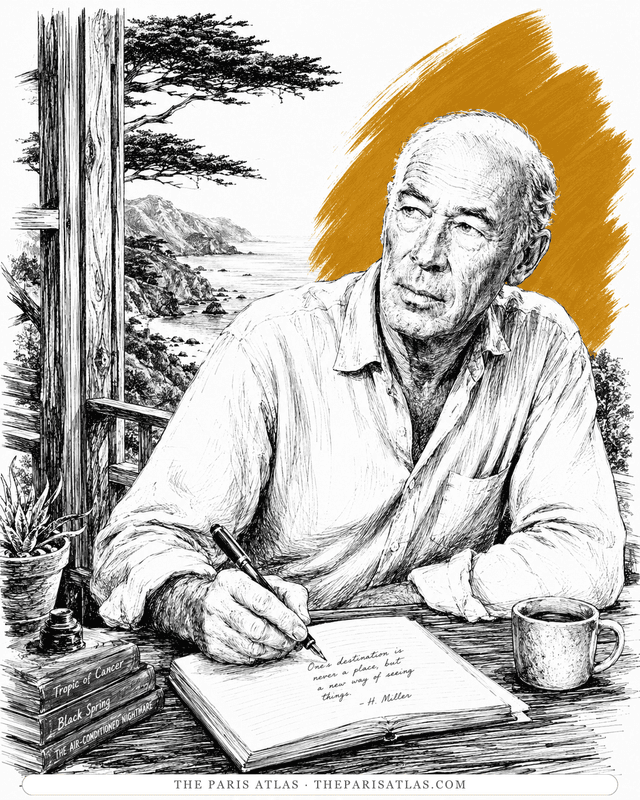
Henry Miller
Miller read Journey in manuscript while writing Tropic of Cancer and never recovered — the two books are the era's twin gutter-testaments.
View author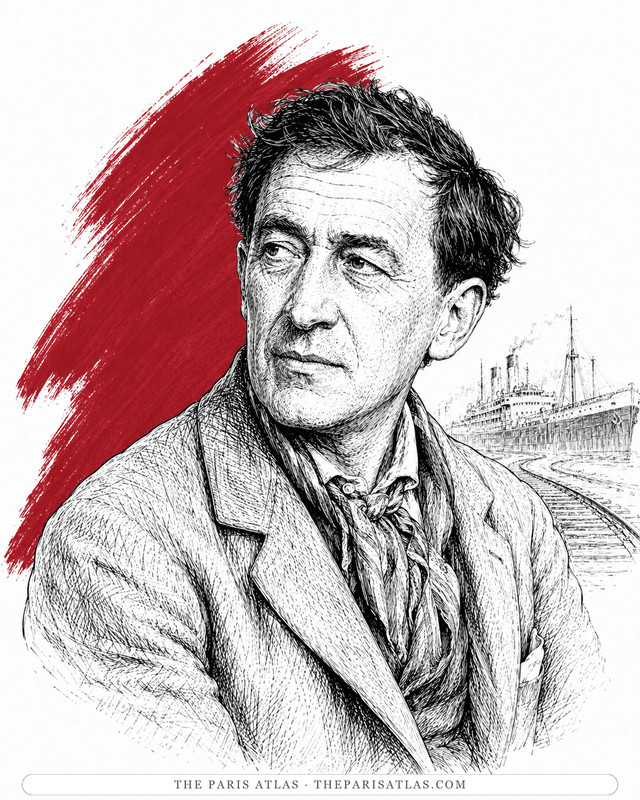
Blaise Cendrars
The other French modernist Céline could not look away from: a war-wounded amputee whose spoken prose ran ahead of grammar and whose Moravagine anticipates Bardamu's tour of the century's slaughterhouses.
View author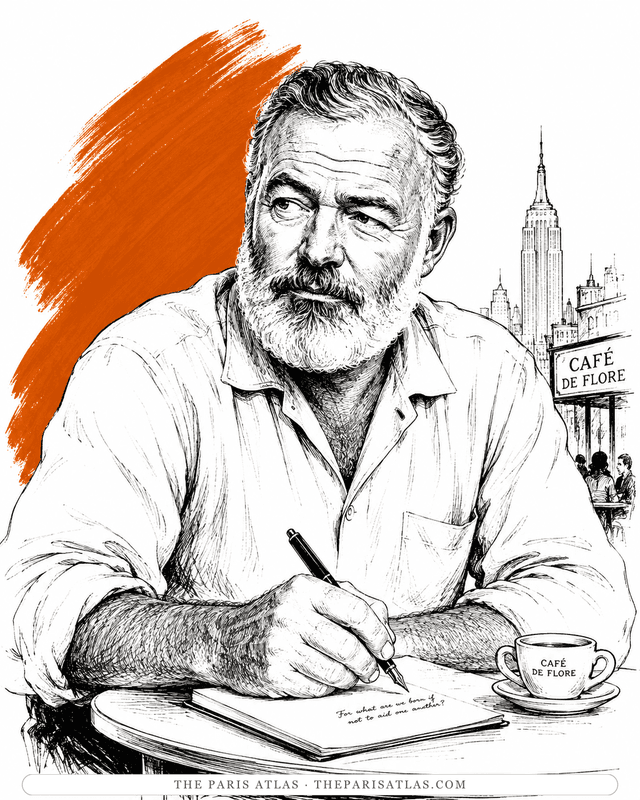
Ernest Hemingway
The same war, the same refusal of the big words — delivered in whispers where Céline delivers it in screams. Both writers died in the same week of July 1961.
View author