Man, Controller of the Universe
by Diego Rivera
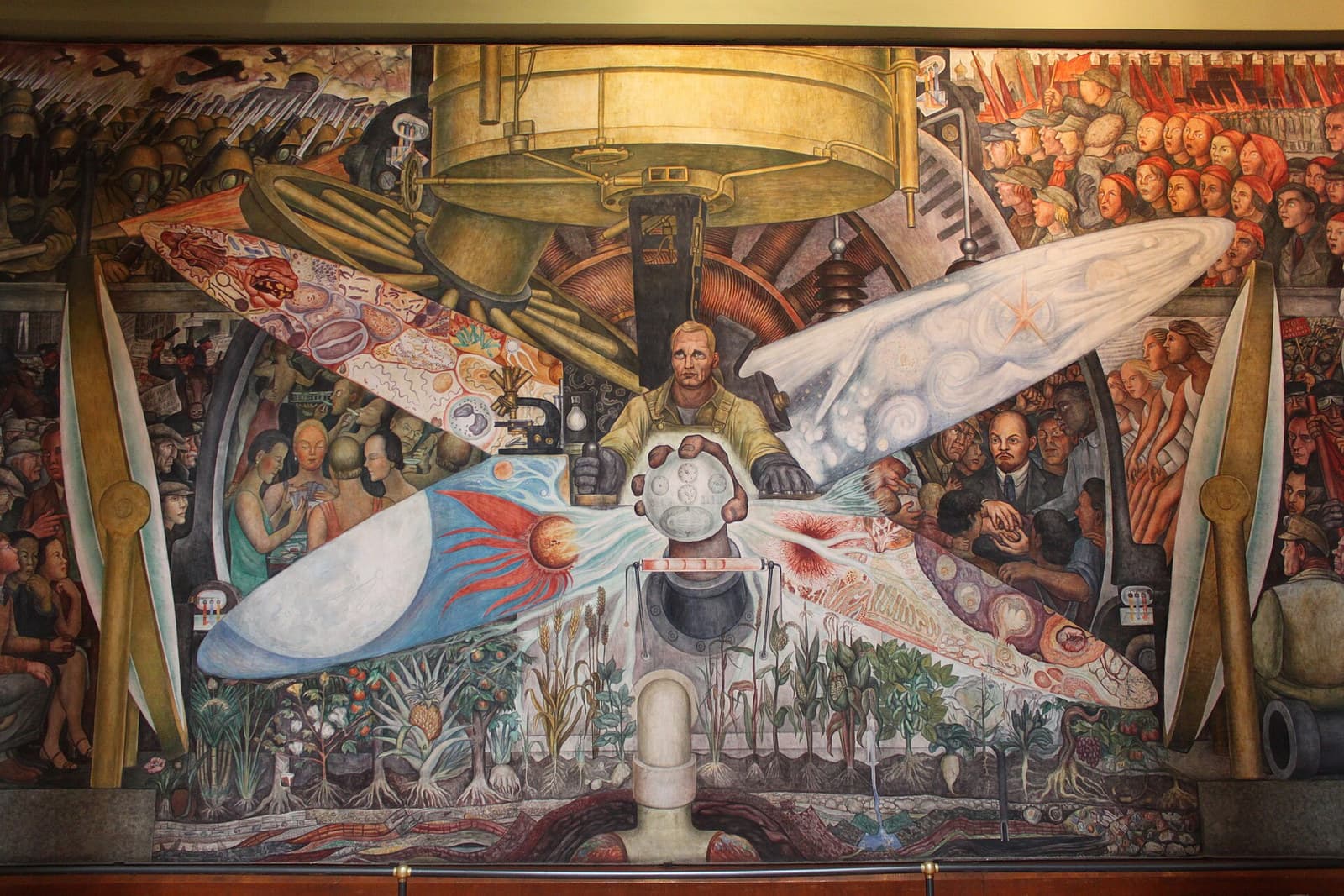
A worker in overalls stands at a set of controls at the centre of a wall eleven and a half metres wide. Four long lenses cross behind him, carrying cells, nebulae, a sun and embryos. To his left are police, the unemployed and a nightclub; to his right, Lenin joining the hands of four workers. Diego Rivera painted it in 1934 for the Palacio de Bellas Artes in Mexico City, after the Rockefellers destroyed the first version in New York.
- 1934
- Mural, painted for the Palacio de Bellas Artes; the museum publishes no technique for it
- Museo del Palacio de Bellas Artes, INBALMexico City, Mexico
About Diego Rivera
A wall, not a picture
The Museo del Palacio de Bellas Artes records the work as a mural made for the Palacio de Bellas Artes, 480 by 1145 centimetres. It is part of the building and does not travel.
The museum publishes no technique for it. That is worth stating rather than filling in: on the same page it does give a technique for another Diego Rivera work in the building, frescoes on transportable stretchers, and that description belongs to the other work.
It publishes no floor or level either, so a visitor should ask at the museum rather than plan around a room number.
What the mural shows
A fair-haired worker in khaki overalls stands at the centre, one gloved hand on a lever and both hands closing round a pale sphere set with round lenses. A brass drum of machinery hangs directly over his head.
Four long pointed ellipses cross behind him in an X. One carries cells and tissue under a microscope, one white spiral nebulae and a red star, one a sun throwing red flares across a blue sky, and one pale cellular and embryonic forms. Read together they are the fields of a microscope and a telescope crossing at the man's hands.
The upper left corner is filled with soldiers in steel helmets and gas masks advancing with fixed bayonets under biplanes, a tank beside them. The upper right answers it with rows of young people in red headscarves singing under red banners, in front of a crenellated wall and onion domes.
Along the bottom runs a band of crops shown above and below the ground at once: tomatoes, orange, pineapple, wheat, maize, cabbage, grapes. Their root systems are drawn pale against striped earth, and a stone cistern rises through the middle.
The mural the Rockefellers destroyed
In 1933 Nelson Rockefeller commissioned Diego Rivera to paint the lobby of the RCA Building at Rockefeller Center in New York, on the theme of humanity at the crossroads. Diego Rivera included a portrait of Lenin, which the commission had not asked for and the sketches had not shown. He refused to remove it, was paid off, and the unfinished fresco was chipped off the wall in February 1934.
The Museo del Palacio de Bellas Artes states the sequence directly. The inclusion of Lenin's face was the trigger that led to the destruction of the first version. In 1934, for the inauguration of the Palacio de Bellas Artes, Diego Rivera was invited to make a replica of the controversial work.
He was a communist and made no secret of it. He had joined the Mexican Communist Party in 1922, been expelled in 1929, and would shelter Leon Trotsky in Mexico in 1937 before breaking with him in 1939.
What he added in Mexico City
The museum calls the differences between the two versions minimal but significant, and names them.
John D. Rockefeller Jr. appears in the nightclub scene, in a passage the museum relates to venereal diseases. In the reproduction he is the bald man in rimless round glasses behind the women at the card table, with a microscope and a slide of stained bodies painted directly above his head.
To the image of Lenin, Diego Rivera added Marx, Engels and Trotsky, along with James P. Cannon, Jay Lovestone and Bertram Wolfe, who hold the flag of the Fourth International. Bertram Wolfe later wrote The Fabulous Life of Diego Rivera, the biography still cited on the subject.
The Lenin group itself survives from the New York design. A bald man with a reddish goatee in a dark suit brings together the clasped hands of a Black worker, a worker in a blue shirt, a helmeted soldier and a woman.
Why no large reproduction is shown
The Museo del Palacio de Bellas Artes prints its own copyright line under the mural: D.R. © Banco de México, trustee of the trust relating to the Diego Rivera and Frida Kahlo Museums. The trust asserts copyright in Diego Rivera's work, and the Artists Rights Society represents it in the United States.
Diego Rivera died on 24 November 1957, and Mexico protects an author's work for the life of the author plus a hundred years, so the mural is in copyright there until 2057. The United States has no freedom-of-panorama exception for a two-dimensional artistic work.
The photograph used here was taken in the building on 29 July 2012 by the Wikimedia Commons contributor AAP86 and released by that photographer under CC BY-SA 3.0. That licence covers the photograph only. A reduced copy is shown under fair use, for commentary, and excluded from commercial reuse.
Close reading
Reading the work, detail by detail
The mural is eleven and a half metres wide and crowded end to end, and the reproduction is a photograph of it on the wall at the Palacio de Bellas Artes. The views below take only what resolves at that size, working out from the man at the controls to the two halves of the world Rivera set on either side of him.
1.The man at the controls
At the dead centre a worker in khaki overalls holds a lever in one gloved hand and a pale sphere in both. The sphere is set with round lenses, and the machinery above and the crops below both converge on it.
2.Four long ellipses cross behind him
Four long pointed ellipses cross behind the figure. One carries cells and tissue, one white spiral nebulae and a red star, one a sun throwing red flares across blue, and one pale cellular forms. They read as the fields of two lenses at once.
3.Lenin joining four hands
Right of centre, a bald man with a reddish goatee in a dark suit joins four clasped hands — a Black worker, a worker in a blue shirt, a helmeted soldier and a woman. The Museo del Palacio de Bellas Artes names this figure as Lenin, whose inclusion triggered the destruction of the New York version.
4.The nightclub, and the man in glasses
Four women in evening dress sit at a card table with drinks, and men smoke and drink behind them. The Museo del Palacio de Bellas Artes identifies John D. Rockefeller Jr. in the nightclub scene, which it relates to venereal diseases; the bald figure in round rimless glasses is the one that answers that description.
5.A brass microscope and a stained slide
A brass microscope sits on the bench just above the nightclub group, and a round slide painted into the ellipse beside it shows two large purple lobed bodies inside a ring. The museum relates this passage to venereal diseases.
6.Soldiers in gas masks, upper left
The upper left corner is filled with soldiers in steel helmets and gas masks, bayonets fixed, marching under biplanes with a tank beside them. The sky behind them is red-brown with smoke.
7.Red flags, upper right
The upper right answers it with a demonstration: rows of young people in red headscarves singing, banners raised, in front of a crenellated wall and onion domes. The two corners are painted at the same scale and face each other across the mural.
8.The machine overhead
Directly above the worker, a brass-coloured drum with pipes and wheels hangs over the whole composition, a black armature dropping from it towards his head. It is painted in flat gold-green with no smoke and no noise.
9.Roots and crops along the bottom
The bottom band shows crops above and below the soil at the same time — tomatoes, orange, pineapple, wheat, maize, cabbage, grapes — with the root systems drawn pale against striped earth. A stone cistern rises through the middle of it.
Timeline
1933
Nelson Rockefeller commissions a mural for the lobby of the RCA Building at Rockefeller Center in New York, on the theme of humanity at the crossroads.
1933
Diego Rivera includes a portrait of Lenin, refuses to remove it, and is paid off. The unfinished fresco is covered.
1934
The New York mural is chipped off the wall in February and destroyed.
1934
Invited to repaint the work for the inauguration of the Palacio de Bellas Artes in Mexico City, and adds Marx, Engels, Trotsky, James P. Cannon, Jay Lovestone, Bertram Wolfe and John D. Rockefeller Jr.
1937
Persuades President Lázaro Cárdenas to grant Leon Trotsky asylum in Mexico.
1963
Bertram Wolfe, one of the figures painted into the mural, publishes The Fabulous Life of Diego Rivera.
2024
Shown in the museum's own exhibition Diego Rivera. New Life into the Destroyed Mural 1933/1934.
Where to see it
Museo del Palacio de Bellas Artes, INBAL
Mexico City, Mexico
A public viewing address has not yet been confirmed for this holding.
Painted for the Palacio de Bellas Artes and part of the building, so it does not travel. The museum publishes no floor or room number for it.
Frequently asked questions
Where is Man, Controller of the Universe?
The Palacio de Bellas Artes in Mexico City, in the Museo del Palacio de Bellas Artes, which is run by INBAL. It is a mural painted for the building and cannot be lent or moved. The museum publishes no floor or room for it, so ask on arrival.
Is Man, Controller of the Universe the same as Man at the Crossroads?
It is the second version of it. Diego Rivera painted Man at the Crossroads in the lobby of the RCA Building at Rockefeller Center in 1933. The Museo del Palacio de Bellas Artes records that the inclusion of Lenin's face triggered its destruction, and that he was invited in 1934 to make a replica for the Palacio's inauguration.
Why was the Rockefeller Center mural destroyed?
Because Diego Rivera painted a portrait of Lenin into it. The commission had not asked for one and the sketches had not shown one. When newspapers noticed, he was asked to replace the head, refused, and was paid off. The unfinished fresco was covered and then chipped off the wall in February 1934.
Who is in Man, Controller of the Universe?
The museum names Lenin, Marx, Engels and Trotsky, together with James P. Cannon, Jay Lovestone and Bertram Wolfe holding the flag of the Fourth International, and John D. Rockefeller Jr. in the nightclub scene. Those are the figures it identifies; others in the crowds it does not name.
How big is Man, Controller of the Universe?
480 by 1145 centimetres, or roughly sixteen feet high by thirty-eight feet wide, as the Museo del Palacio de Bellas Artes gives it. The museum publishes no technique for the mural.
What is the man at the centre holding?
A lever in one gloved hand and a pale sphere set with round lenses in both. Four long pointed ellipses cross behind him carrying cells and tissue, spiral nebulae, a sun with red flares, and embryonic forms, so the machine reads as a microscope and a telescope meeting at his hands.
More by Diego Rivera
If you like Diego Rivera
Explore painters from the same movements and circles.
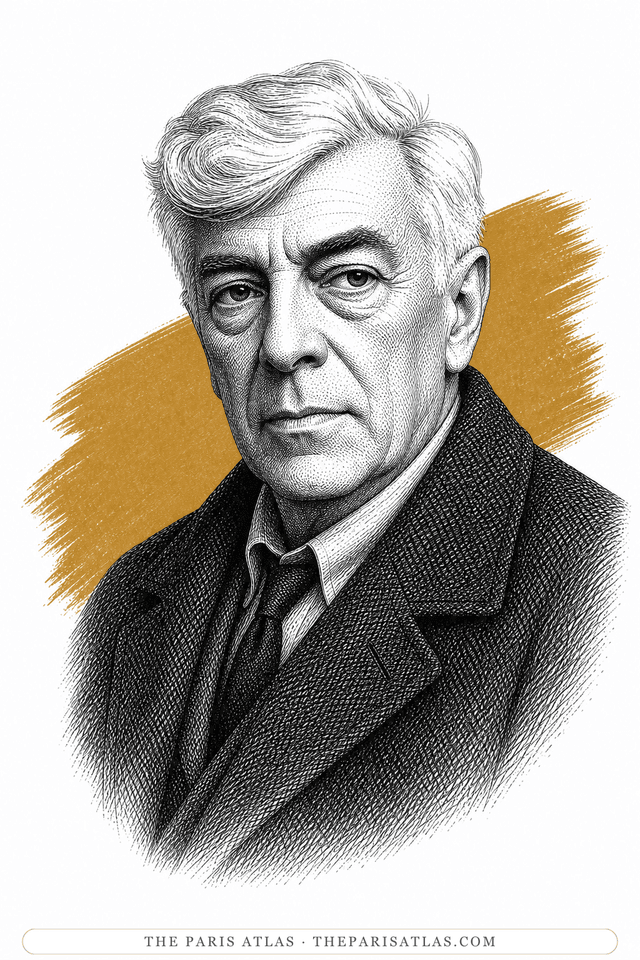
Georges Braque
The Le Havre house-painter's son who invented Cubism in Montmartre with the Spanish painter Pablo Picasso between 1908 and 1914 — the quieter half of the most consequential partnership in modern art — and who invented papier collé, the pasted-paper picture, in September 1912. He was given a French state funeral in 1963.
View artist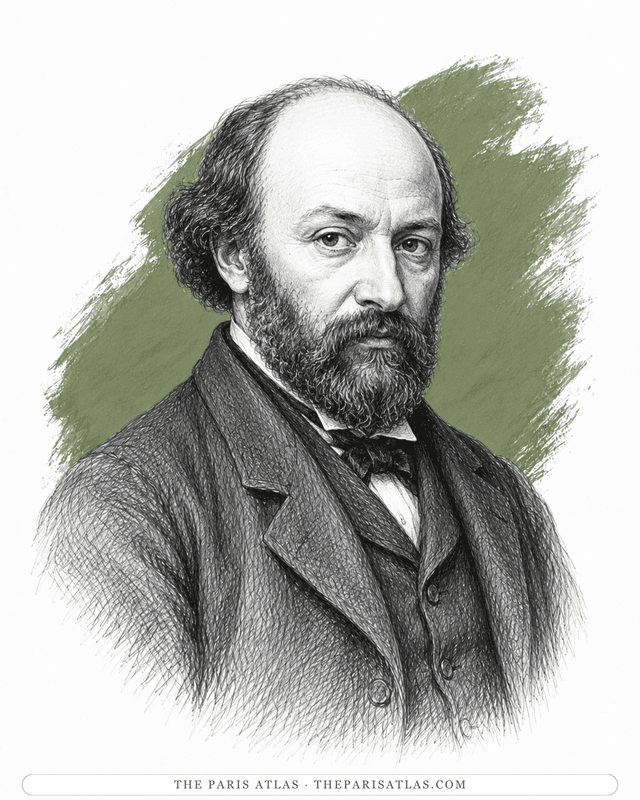
Paul Cézanne
Painter between Impressionism and everything after — shown in the independents' exhibitions, emulated by the Cubists, and present at the Orangerie through 15 works in the Walter-Guillaume collection.
View artist
Marcel Duchamp
The century's quietest revolutionary — readymades, the abandonment of painting, chess on a Paris rooftop in Entr'acte, and one anemic film of spinning puns signed Rrose Sélavy.
View artist
References
The sources below include collection records, catalogues, scholarly research, and primary materials that informed this page. They document Man, Controller of the Universe, its making, and its place in cultural history.

1El hombre controlador del universo — mural record
WebsiteMuseo del Palacio de Bellas Artes, INBAL, Mexico CityUsed forWeb source consulted for documented facts and historical context presented on the Man, Controller of the Universe page.
2Diego Rivera. New Life into the Destroyed Mural 1933/1934 — exhibition text
WebsiteMuseo del Palacio de Bellas Artes, INBAL, Mexico City, 2024Used forWeb source consulted for documented facts and historical context presented on the Man, Controller of the Universe page.
3The Fabulous Life of Diego Rivera
BiographyStein and Day, 1963Used forBiographical evidence used to verify chronology, relationships, and historical context connected to Man, Controller of the Universe.
4Diego Rivera
WebsiteMuseum of Modern ArtUsed forWeb source consulted for documented facts and historical context presented on the Man, Controller of the Universe page.
These references provide the documented foundation for this work's history and interpretation. Claim-level citations remain attached to the specific claims they support.
 Explore more resources