The Café Terrace
by Diego Rivera
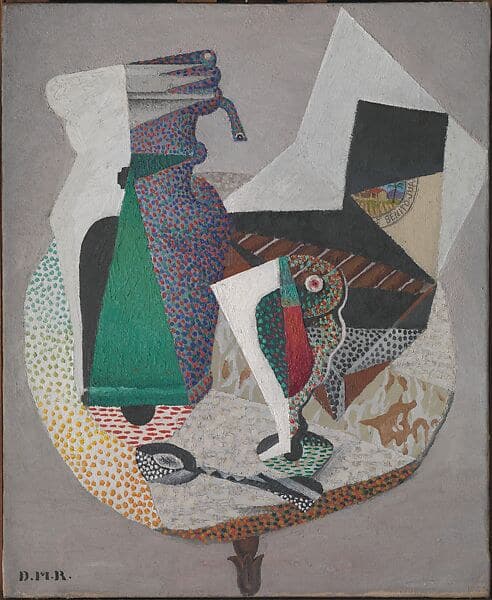
A Paris café table, taken apart and reassembled: a green bottle, a stemmed glass, a slotted spoon and an open box of cigars, spread across a cloth painted entirely in coloured dots. Diego Rivera painted it in 1915, in the middle of the eleven years he spent in Montparnasse. Alfred Stieglitz bought it in New York in 1916 for a hundred and seventeen dollars, and it reached The Metropolitan Museum of Art with his collection in 1949.
- 1915
- Oil on canvas
- The Metropolitan Museum of ArtNew York, United States
About Diego Rivera
What the painting shows
Four things sit on a café table. A tall green bottle stands left of centre, painted as a plain tapering cone. A stemmed glass stands to its right, its bowl dotted green and white with a wedge of red inside it. A spoon with a pierced bowl lies flat near the bottom edge. At the upper right an open box of cigars shows its brown contents and its round paper label.
The Metropolitan Museum of Art reads the objects together. The green liquid is presumably absinthe, and the metal spoon is the one needed to prepare it. The strip of camouflage cloth under them is a reference to the First World War, then in its second year and a few hours by train from the studio.
The dots are the other constant. The museum identifies the technique as Pointillism, used here to sharpen the contrasts between textures and patterns rather than to model light. Diego Rivera had carried divided brushwork with him out of Spain and into Cubism.
The canvas measures 60.6 by 49.5 centimetres, about twenty-four by nineteen inches. He signed it at the lower left with three stencilled initials, D. M. R., for Diego María Rivera.
A Mexican president on the cigar box
The round label at the upper right carries lettering round its rim. The Metropolitan Museum of Art reads it as a partial label reading BENITO JUA, under a miniature Mexican landscape, and names it as one of the references to his homeland that Diego Rivera worked into the picture.
Benito Juárez was President of Mexico from 1858 until his death in 1872, and his name was carried by a cigar brand. The landscape inside the label is painted in full: a low red-roofed building, dark trees, a strip of blue sky and a yellow-green field.
It is the only depicted scene in a painting otherwise made of flat planes and pattern, and it is the point where a Montparnasse café table touches the country Diego Rivera had left in 1907.
There is another painting underneath
The reverse of the canvas carries an earlier composition, upside down, of two figures in a landscape. The Metropolitan Museum of Art dates it to about 1911 to 1913 with a query.
Diego Rivera had the canvas restretched for The Café Terrace, and then painted over the parts of the earlier picture that were still visible between the stretcher bars, using an opaque paint.
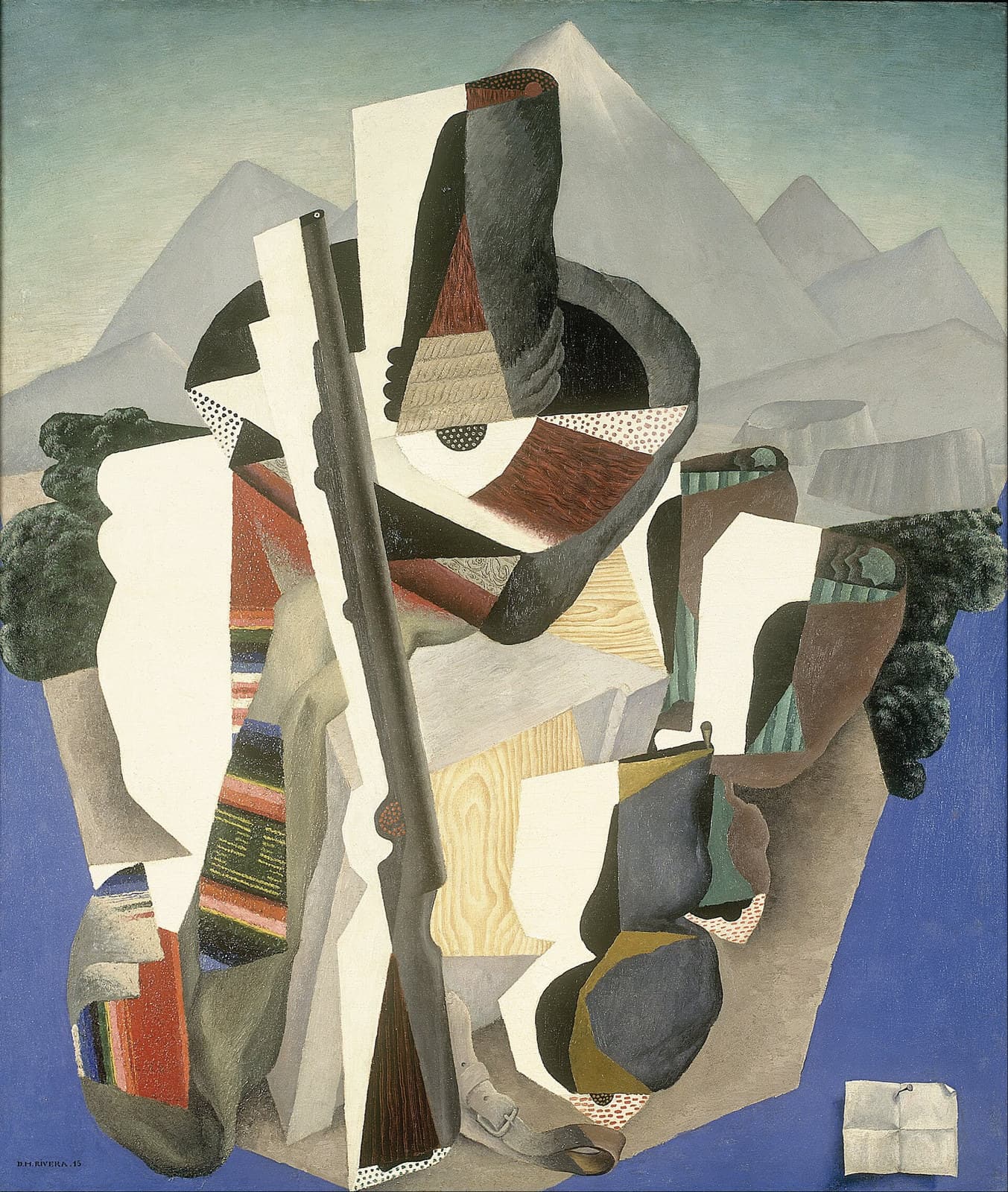
He reused canvases in these years more than once. The Museo Nacional de Arte in Mexico City catalogues Zapatista Landscape as a double-sided object, with a painting of 1913 on its back.
Where it sits in his Cubist years
Diego Rivera arrived in Paris in 1909 and settled in Montparnasse, where he stayed for most of the next twelve years. He worked through Impressionism first, then took up Cubism seriously around 1913. The National Gallery of Art in Washington puts the output at nearly two hundred Cubist works.
1915 was the centre of that run. It is the year of Zapatista Landscape, of the portrait of the writer Martín Luis Guzmán, and of a group of still lifes of which The Café Terrace is one.
The National Gallery of Art identifies the café as almost certainly La Rotonde, on the boulevard du Montparnasse, whose terrace was sunny enough to be nicknamed Raspail beach. That is the gallery's attribution rather than a documented fact, and the museum that owns the painting names no café.
The National Gallery of Art records that by 1918 Diego Rivera had left Montparnasse and abandoned Cubism altogether. The Museo Nacional de Arte gives one of the reasons: he quarrelled with the critic Pierre Reverdy, after a period of intense dialogue with the poet Guillaume Apollinaire.
From Marius de Zayas to the Met
The painting left Diego Rivera's hands in 1916 and went to the Modern Gallery in New York, run by the Mexican caricaturist Marius de Zayas. The Metropolitan Museum of Art records that Alfred Stieglitz reserved it in March 1916 and bought it on 19 July that year for a hundred and seventeen dollars.
Alfred Stieglitz was the American photographer who ran the gallery known as 291 on Fifth Avenue and showed European modernism in New York before almost anyone else. He kept the painting until his death in 1946, lending it to the Philadelphia Museum of Art from 1944 to January 1947.
His estate gave it to The Metropolitan Museum of Art in 1949, and it carries the accession number 49.70.51 under the credit line Alfred Stieglitz Collection, 1949. The museum keeps it in its Department of Modern and Contemporary Art and lists it in gallery 965.
Why no large reproduction is shown
The Metropolitan Museum of Art's own collection record treats the painting as in copyright. Its public collection interface returns no Open Access image, the rights line reads © 2026 Artists Rights Society (ARS), New York, and the object page carries a notice that the image cannot be enlarged or downloaded.
Diego Rivera died on 24 November 1957, and Mexico protects an author's work for the life of the author plus a hundred years. Wikimedia Commons does host a small reproduction taken from the museum's page, tagged public domain; the atlas follows the museum rather than the tag.
A reduced reproduction is shown here under fair use, for commentary, and excluded from commercial reuse. The four-factor rationale and the archived museum response are kept beside the image file.
Close reading
Reading the work, detail by detail
The reproduction available is small — 492 pixels across — so the views below stay with what still resolves at that size: the bottle, the cigar box and its label, the slotted spoon, the dotted cloth and the signature. Passages that will not resolve are named as such.
1.The bottle and its green contents
The one large area of unbroken colour is the bottle, painted as a plain tapering cone. The Metropolitan Museum of Art reads the green liquid in it as probably absinthe. Its neck disappears behind a dark plane rather than being drawn through.
2.A label reading BENITO JUA
The roundel is a cigar-box label. Capitals run clockwise round its lower rim and read BENITO JUA, for Benito Juárez, the nineteenth-century Mexican president whose name a cigar brand carried. Inside it Rivera painted a complete small landscape.
3.Cigars lying in the open box
Below the label, brown rounded forms lie side by side with pale gaps between them — the cigars in the open box. The dark plane above is the lid, tipped back, and the box is the picture's one Mexican object.
4.A slotted spoon on the cloth
Near the bottom lies a spoon with a pierced bowl, its holes painted as a row of pale dots and its handle running off to the right. A slotted spoon of that shape is the one used to dissolve sugar into absinthe.
5.The dotted cloth
The cloth on the table is described by dotting alone, shifting from pale green through yellow to orange as it comes down the canvas, with a patch of red dashes beside it. The Metropolitan Museum of Art reads the camouflage-like cloth as a reference to the war.
6.A glass with red in it
The stemmed glass is the clearest object in the picture. Its bowl is dotted green and white, a red wedge inside it stands for the drink, and the round foot below carries a different pattern again.
7.A nozzle at the top
A bent tube ending in a small nozzle leans out at the top, over a stack of tapering tubes in the same red and blue speckle. The museum's account of the picture does not name this object; the form is that of the tap of a seltzer siphon.
8.The foot below the table
Below the tabletop, on the bare grey ground, Rivera painted the flared cast-iron foot of a café pedestal table. It is the only part of the picture that shows the floor.
9.Signed with three initials
The signature is three initials only — D.M.R., for Diego María Rivera — set on the bare grey ground clear of the table. He signed the Zapatista canvas of the same year with the full surname instead.
Timeline
1909
Diego Rivera moves to Paris and settles in Montparnasse, where he stays for most of the next twelve years.
1913
Takes up Cubism seriously. The National Gallery of Art puts his output over the following years at nearly two hundred Cubist works.
1915
Paints The Café Terrace, in the same year as Zapatista Landscape and the portrait of Martín Luis Guzmán.
1916
The painting goes to the Modern Gallery in New York, run by Marius de Zayas. Alfred Stieglitz reserves it in March and buys it on 19 July for $117.
1920
Shown at the Pennsylvania Academy of the Fine Arts under the title Still Life.
1944
Goes on extended loan from Alfred Stieglitz to the Philadelphia Museum of Art, where it stays until January 1947.
1949
Enters The Metropolitan Museum of Art from the Stieglitz estate, as accession 49.70.51.
1984
Shown as number 36 in Diego Rivera: The Cubist Years, the exhibition Ramón Favela organised for the Phoenix Art Museum with the Instituto Nacional de Bellas Artes.
Where to see it
The Metropolitan Museum of Art
1000 Fifth Avenue, New York, NY 10028, United States
Listed in gallery 965, Department of Modern and Contemporary Art. A gallery number is not a promise of display; check the museum's record before travelling.
Plan your visit on the museum’s official website (opens in a new tab)Frequently asked questions
Where is Diego Rivera's The Café Terrace?
The Metropolitan Museum of Art in New York, accession number 49.70.51, in the Department of Modern and Contemporary Art. The museum lists it in gallery 965. Check the museum's own record before travelling, since a gallery number is not a promise of display.
Was Diego Rivera a Cubist?
For about five years. He moved to Paris in 1909 and took up Cubism seriously around 1913. The National Gallery of Art puts his output at nearly two hundred Cubist works and records that by 1918 he had left Montparnasse and given the style up. The Café Terrace belongs to the middle of that run.
What is in The Café Terrace?
A green bottle, a stemmed glass, a spoon with a pierced bowl, and an open box of cigars, on a cloth painted in coloured dots. The Metropolitan Museum of Art identifies the green liquid as presumably absinthe, the spoon as the one needed to prepare it, and the cloth as camouflage, a reference to the First World War.
What does the writing in The Café Terrace say?
The round label on the cigar box carries a partial label reading BENITO JUA, under a miniature Mexican landscape. The Metropolitan Museum of Art identifies it as a reference to Benito Juárez, President of Mexico from 1858 until his death in 1872. The painting itself is signed D. M. R. at the lower left, with a stencil.
Is there another painting on the back of The Café Terrace?
Yes. The Metropolitan Museum of Art records an earlier composition of two figures in a landscape on the reverse, upside down, dated to about 1911 to 1913. Diego Rivera had the canvas restretched and painted over the parts of the older picture that were still visible between the stretcher bars.
How big is The Café Terrace?
60.6 by 49.5 centimetres, or 23 7/8 by 19 1/2 inches — oil on canvas, in portrait format.
Why is the reproduction of The Café Terrace so small?
Because the painting is still in copyright. The Metropolitan Museum of Art publishes no Open Access image and prints an Artists Rights Society notice on its record. Diego Rivera died in 1957, and Mexico's term is the author's life plus a hundred years. A reduced reproduction is shown under fair use and excluded from commercial reuse.
More by Diego Rivera
If you like Diego Rivera
Explore painters from the same movements and circles.
Georges Braque
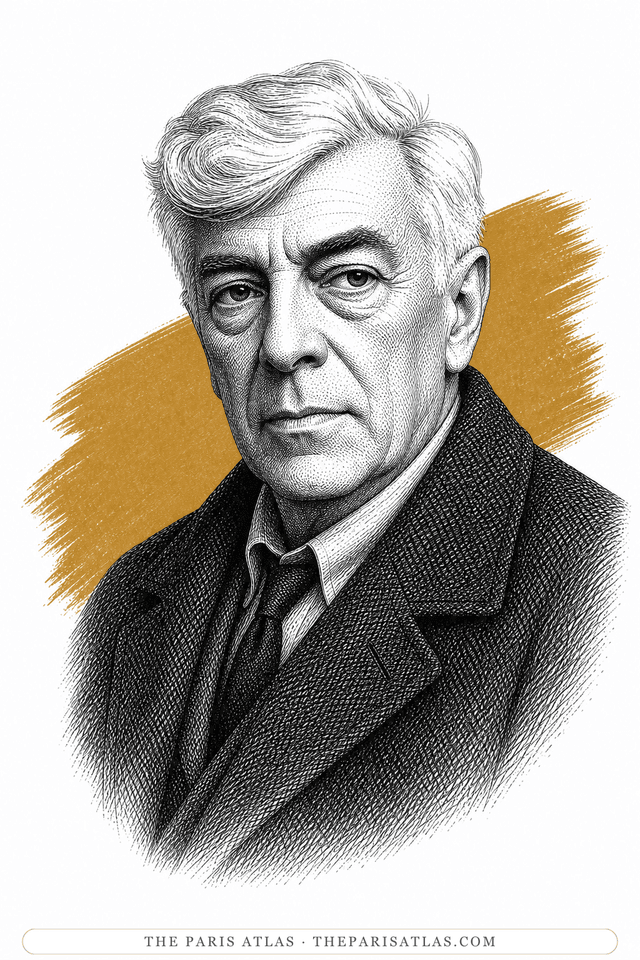
The Le Havre house-painter's son who invented Cubism in Montmartre with the Spanish painter Pablo Picasso between 1908 and 1914 — the quieter half of the most consequential partnership in modern art — and who invented papier collé, the pasted-paper picture, in September 1912. He was given a French state funeral in 1963.
View artist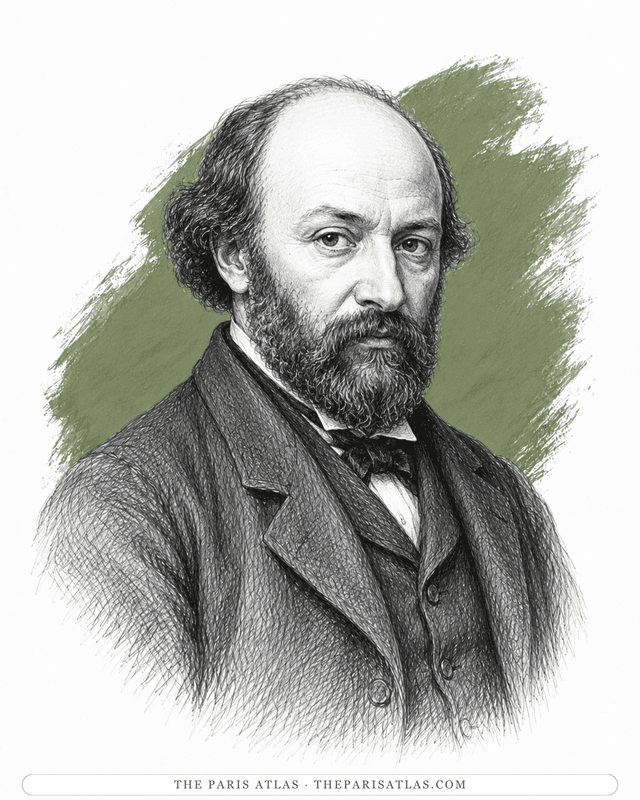
Paul Cézanne
Painter between Impressionism and everything after — shown in the independents' exhibitions, emulated by the Cubists, and present at the Orangerie through 15 works in the Walter-Guillaume collection.
View artist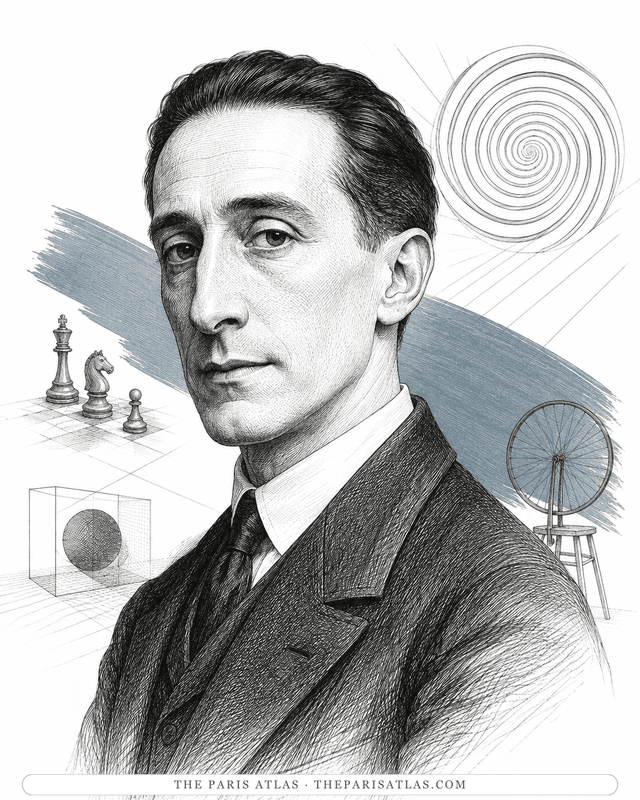
Marcel Duchamp
The century's quietest revolutionary — readymades, the abandonment of painting, chess on a Paris rooftop in Entr'acte, and one anemic film of spinning puns signed Rrose Sélavy.
View artist
References
The sources below include collection records, catalogues, scholarly research, and primary materials that informed this page. They document The Café Terrace, its making, and its place in cultural history.

1The Metropolitan Museum of Art — Diego Rivera, The Café Terrace, 1915.
WebsiteUsed forWeb source consulted for documented facts and historical context presented on the The Café Terrace page.
2The Cubist Paintings of Diego Rivera: Memory, Politics, Place — exhibition site
WebsiteNational Gallery of Art, Washington, 2004Used forWeb source consulted for documented facts and historical context presented on the The Café Terrace page.
3Paisaje zapatista, 1915 (anverso) / La mujer del pozo, 1913 (reverso) — collection record
WebsiteMuseo Nacional de Arte, INBAL, Mexico CityUsed forWeb source consulted for documented facts and historical context presented on the The Café Terrace page.

4Diego Rivera: The Cubist Years
Exhibition cataloguePhoenix Art Museum, 1984Used forCatalogue scholarship used to verify attribution, provenance, chronology, and interpretive context for The Café Terrace.
5The Fabulous Life of Diego Rivera
BiographyStein and Day, 1963Used forBiographical evidence used to verify chronology, relationships, and historical context connected to The Café Terrace.
6Mexique 1900–1950: Diego Rivera and the Paris avant-garde
Exhibition catalogueGrand Palais / Réunion des musées nationaux, 2016Used forCatalogue scholarship used to verify attribution, provenance, chronology, and interpretive context for The Café Terrace.
These references provide the documented foundation for this work's history and interpretation. Claim-level citations remain attached to the specific claims they support.
 Explore more resources