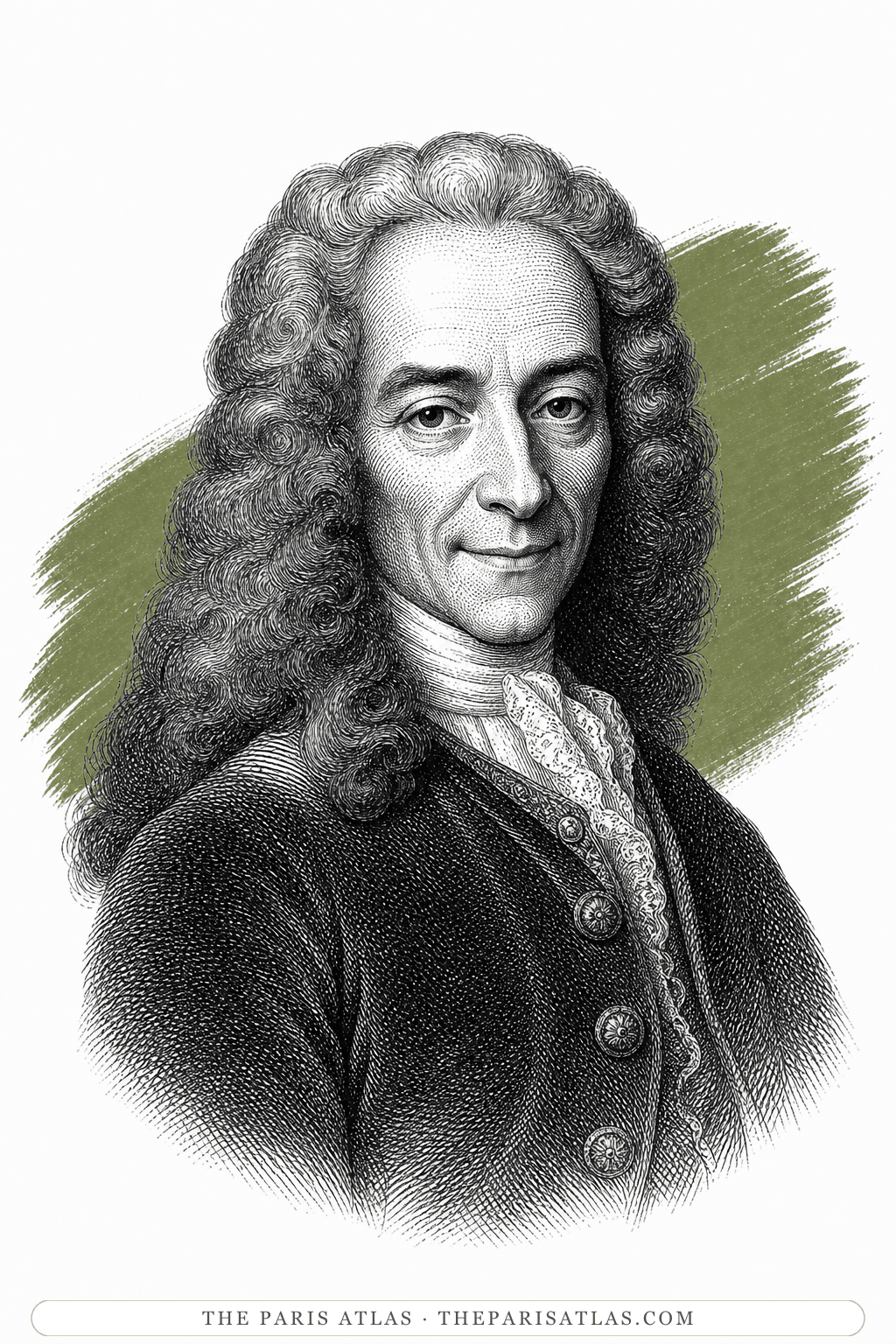

Candide
Voltaire's best-known tale, seven years later, again sends a traveller through a world that keeps disproving the philosophers.
Read our takeMicromégas
Voltaire
by Voltaire
A giant from a planet near Sirius and a dwarf from Saturn land on Earth, pick up a shipful of scientists, and ask them what a soul is.
Micromégas is a short comic tale by Voltaire, published in 1752. Its hero is a young giant from a planet that circles the star Sirius, and he stands eight leagues tall. Banished from his planet's court over a book about insects, he travels from world to world. On Saturn he makes friends with the secretary of the local academy, and the two of them reach Earth in July 1737. Diamonds from the giant's necklace work as microscopes, and through them the travellers find a ship of scientists sailing home from the Arctic. The tiny humans can measure the giants to the inch. They cannot agree on what a soul is.[1][2]
Voltaire had been playing with the idea for years. In June 1739 he sent the future Frederick II of Prussia a manuscript about a certain baron de Gangan, which he called a philosophical trifle. The manuscript of that first version is lost. Georges Pilard and Karen Chidwick of the Voltaire Foundation trace Micromégas back to it.[3]
The tale came out in 1752, while Voltaire was living at Frederick's court in Prussia. Roger Musnik of the Bibliothèque nationale de France says it was published in London and then in Berlin. Myrtille Méricam-Bourdet's chronology of Voltaire's histories records a 1752 edition, printed without his approval, that bound Micromégas together with his history of the Crusades.[2][4]
Giants and dwarfs were an old joke by then. Musnik names François Rabelais and Jonathan Swift as the writers Voltaire was following. What Voltaire adds is arithmetic. Micromégas is 120,000 royal feet tall, and his nose alone is 6,333 feet long. The people of Saturn have seventy-two senses and the people of Sirius nearly a thousand, and both still feel short of something.[2][1]
The name is made of two Greek words, micros for small and megas for great. The Moland edition of Voltaire's works glosses it that way in its first footnote. Everyone in the story turns out to be both, depending on who is looking.[5]
Micromégas is a clever young man from a planet near Sirius. Before he is two hundred and fifty he has worked out more than fifty of Euclid's propositions, eighteen more than the thirty-two Blaise Pascal worked out for fun, according to his sister. Later he writes a book about insects too small for ordinary microscopes, each only a hundred feet across. His planet's chief priest, the mufti, finds heresy in it. After a trial lasting two hundred and twenty years, judges who never read the book condemn it. Micromégas is banished from court for eight hundred years.[1]
He takes the exile lightly and sets off through space, riding sunbeams and comets. On Saturn the people are dwarfs, only about a thousand fathoms tall. He becomes close friends with the secretary of the Academy of Saturn. The two compare their senses, their lifespans and the colours of their suns, and decide to travel together. They spend a year on Jupiter, pass Mars and its two moons, and land on the northern shore of the Baltic Sea on 5 July 1737.[1]
The travellers walk round the whole Earth in thirty-six hours and see no sign of life. The dwarf decides the planet must be empty. Then Micromégas breaks his diamond necklace, and the stones turn out to be perfect microscopes. Through them the dwarf spots a whale, and then a ship. The ship is carrying a party of scientists home from the Arctic Circle. Micromégas lifts it out of the sea and sets it on his fingernail.[1]
The people on board think a storm has thrown them onto a rock. One of them jabs an iron-tipped pole a foot deep into the giant's finger. Micromégas cuts a paring from his thumbnail and rolls it into an ear trumpet. After a few hours he can hear them talking, in French. A mathematician takes out a quadrant and measures the dwarf's height exactly, which astonishes the dwarf.[1][5]
Micromégas assumes that such clever atoms must be happy. One of the philosophers tells him most people are knaves, fools and wretches. At that very moment, he says, a hundred thousand men in hats are killing a hundred thousand men in turbans, over a heap of earth no bigger than the giant's heel.
Asked what the soul is, the philosophers all answer at once and all differently. One quotes Aristotle in Greek he admits he cannot read. A follower of John Locke says he does not know how he thinks, only that he has never thought without his senses. Then a small man in a square cap declares that the giants, their suns and their stars were all made for mankind. The two giants laugh so hard that the ship falls into the dwarf's pocket.
Before he leaves, Micromégas gives the humans a book of philosophy that will explain the essence of things. The book is taken to the Academy of Sciences in Paris. When the old secretary opens it, every page is blank. He says he suspected as much.
The ship the giants pick up is a real one, slightly bent. In April 1736 a party of French scientists, among them Pierre-Louis Moreau de Maupertuis and Alexis Clairaut, left Paris for Lapland. Their job was to measure a stretch of the earth near the Arctic Circle and settle the argument over the planet's shape. The Moland edition of Voltaire's works names the men in the ship as Maupertuis, Clairaut, Camus and Le Monnier, back from measuring a degree in Lapland.
In early June 1737 the boat carrying their equipment back to Stockholm was caught in a storm, took on water and ran aground. The scientists were home in Paris on 20 August 1737. They reported to the Academy of Sciences at the end of that summer. Their measurements agreed with Isaac Newton: the earth is flattened at the poles.
Voltaire lands his giants on the Baltic coast on 5 July 1737, in time to meet that voyage home. His narrator says the newspapers reported the scientists' ship ran ashore on the coast of Bothnia. He adds that nobody ever learns what really goes on in this world. In his version, a giant lifted the ship out of the water.
Voltaire had taken Newton's side of that argument long before. In the fourteenth of his Letters on the English, printed in 1733, he wrote that people in Paris imagined the earth shaped like a melon, while in London it was flattened. Georges Pilard and Karen Chidwick point out that the Lapland voyage helped prove Newton right.
The tale ends at the Academy of Sciences in Paris, where the giant's book of philosophy turns out to be blank. The Moland edition identifies the old secretary who opens it as Bernard le Bovier de Fontenelle. He was about eighty in 1737. He gave up the post of permanent secretary in 1740.
Fontenelle is also the dwarf from Saturn, the giant's companion for the whole trip. Voltaire describes the secretary of the Academy of Saturn as a man who had invented nothing himself but explained other people's inventions very well. He also wrote small poems and large calculations. The Moland notes put Fontenelle's name against that sentence.
When the dwarf first tries to describe nature, he compares it to a flower bed, then to a crowd of fair and dark women, then to a picture gallery. Micromégas stops him each time. Nature is like nature, he says. A note in the Moland edition says Voltaire was mocking the flowery style of Fontenelle's popular book on the plurality of worlds.
The man in the square cap, the one who says everything was made for mankind, is Parisian too. The Moland notes identify him as a doctor of the Sorbonne, the theology faculty of the University of Paris. He claims the whole secret is in the Summa of Thomas Aquinas. His speech is what sets the two giants laughing.
The humans in the ship are very good at numbers. With a quadrant they get the dwarf's height exactly right, and they measure the giant with a chain of triangles. They know the distance to the moon and the weight of the air. Micromégas decides that nothing should ever be judged by its size.
On the soul they are hopeless. One philosopher quotes Aristotle, another René Descartes, then Nicolas Malebranche, Gottfried Wilhelm Leibniz and John Locke, and no two agree. Only the follower of Locke pleases the giants. He doubts that God is unable to give matter the power of thought. Voltaire had made the same case for Locke in the thirteenth of his Letters on the English.
The war the philosopher describes was real as well. A hundred thousand men in hats are killing a hundred thousand men in turbans, for a scrap of land none of them will ever own. The Moland notes read the passage as the war between Russia and the Ottoman Empire of 1736 to 1739. The rulers who start such wars, the philosopher says, never go near the fighting.
On the way to Earth the travellers pass Mars and see two moons that no astronomer has noticed. The narrator expects a Father Castel to write against them. He leaves the matter to people who reason by analogy, since a planet so far from the sun could surely not manage with fewer than two moons.
Nobody saw a moon of Mars until August 1877. Asaph Hall found two with the new 26-inch telescope at the Naval Observatory in Washington. Writing in 1879, John Le Conte pointed back to Micromégas and to Jonathan Swift's Gulliver's Travels, which also gave Mars two moons. Voltaire had been mocking people who reasoned by analogy, and Le Conte noted that the discovery turned the tables on him.
Paris had its part in that discovery too. Le Conte records that a Monsieur Henry of the Paris Observatory saw the two moons on 27 August 1877, once the glare of the planet was screened out.
I tell you once for all, nature is like nature, and comparisons are odious.
I am now more than ever convinced that we ought to judge of nothing by its external magnitude.
we measure lines, we make calculations, we agree upon two or three points which we understand, and dispute upon two or three thousand that are beyond our comprehension.
The whole tale is a few dozen pages. The idea is simple: everyone, however large, looks small to someone larger, and nobody knows what a soul is.
The ship the giants pick up carries Maupertuis's expedition home from Lapland in 1737, the voyage that showed the earth is flattened at the poles.
The giant's book of philosophy is delivered to the Academy of Sciences in Paris. The Moland edition says the old secretary who opens it and finds it blank is Fontenelle.
Georges Pilard and Karen Chidwick of the Voltaire Foundation call it science fiction, a fable, a tale and a settling of scores, all at once.
A young giant from a planet near Sirius, eight leagues tall, banished for eight hundred years over a book about insects. Curious, polite and hard to impress.
The secretary of the Academy of Saturn, a mere thousand fathoms tall, who travels with Micromégas and keeps jumping to conclusions. The Moland notes identify him with Fontenelle.
1736
On 20 April Maupertuis's expedition leaves Paris to measure the earth in Lapland.
1737
In the tale, the two giants land on the Baltic coast on 5 July and pick up the scientists' ship.
1737
The real expedition is back in Paris on 20 August and reports to the Academy of Sciences that the earth is flattened at the poles.
1739
In June Voltaire sends the future Frederick II a manuscript about a baron de Gangan, the lost first form of the tale.
1740
Fontenelle, the model for the old secretary, gives up the post of permanent secretary of the Academy of Sciences.
1752
Micromégas is published, in London and then in Berlin, while Voltaire lives at the Prussian court.
1877
Asaph Hall finds the two moons of Mars in August. A Monsieur Henry of the Paris Observatory sees them on 27 August.
1889
Peter Eckler of New York prints the anonymous English translation in Voltaire's Romances.
2014
Alma Classics publishes Douglas Parmée's translation in Micromegas and Other Stories.


Voltaire's best-known tale, seven years later, again sends a traveller through a world that keeps disproving the philosophers.
Read our take
An earlier philosophical tale in which careful observation gets the hero into trouble with the authorities.
Read our takeLetters on the English
Voltaire
The earlier book where Voltaire first argued for Newton and Locke, the two thinkers whose side the giants take.
Read our take
Voltaire's short alphabetical essays on the soul, religion and prejudice, argued directly rather than through giants.
Read our take
Montesquieu's visitors from Persia do on a smaller scale what the giants do here: look at Europe from outside and find it strange.
Read our takeA giant from a planet near Sirius and his friend, a dwarf from Saturn, travel to Earth in 1737. Using diamonds as microscopes, they find a ship of scientists and question them. The humans measure things perfectly but argue endlessly about the soul, and the story laughs at human pride.
In 1752, according to the Bibliothèque nationale de France, the Moland edition of Voltaire's works and Myrtille Méricam-Bourdet's chronology. A 2017 Voltaire Foundation article by Georges Pilard and Karen Chidwick gives 1751. Voltaire had sent an early version to the future Frederick II of Prussia in June 1739.
Small and great. The name joins the Greek words micros, small, and megas, great, as the first footnote of the Moland edition explains. The narrator says the name suits all great men.
A portrait of Bernard le Bovier de Fontenelle, according to the notes in the Moland edition. Fontenelle was the long-serving permanent secretary of the Academy of Sciences in Paris. He is also the old secretary who opens the blank book at the end.
The tale gives Mars two moons, 125 years before Asaph Hall found two in August 1877. Jonathan Swift had done the same in Gulliver's Travels. Writing in 1879, John Le Conte noted that Voltaire was actually mocking people who reasoned that Mars must have two moons.
Georges Pilard and Karen Chidwick of the Voltaire Foundation call it science fiction, a fable, a tale and a settling of scores all at once. The tale has space travel, visitors from other worlds and a first meeting with humans.
The giant gives the humans a book of philosophy that will explain the essence of things. The book is taken to the Academy of Sciences in Paris. The old secretary opens it, finds every page blank, and says he suspected as much.
Project Gutenberg ebook 35595, Voltaire's Romances, prints an anonymous public-domain translation from Peter Eckler's 1889 edition. The text is slightly shortened. Douglas Parmée's Alma Classics translation of 2014 is complete but in copyright.
Explore authors with a similar voice, perspective, and influence.
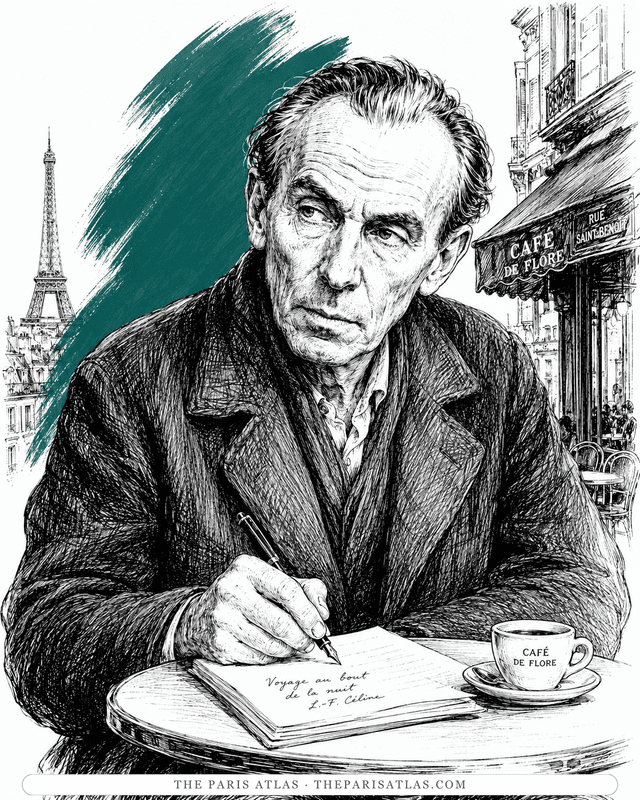
The doctor of the Paris slums who wrote the century's blackest, funniest novel — and changed the sound of French prose.
View author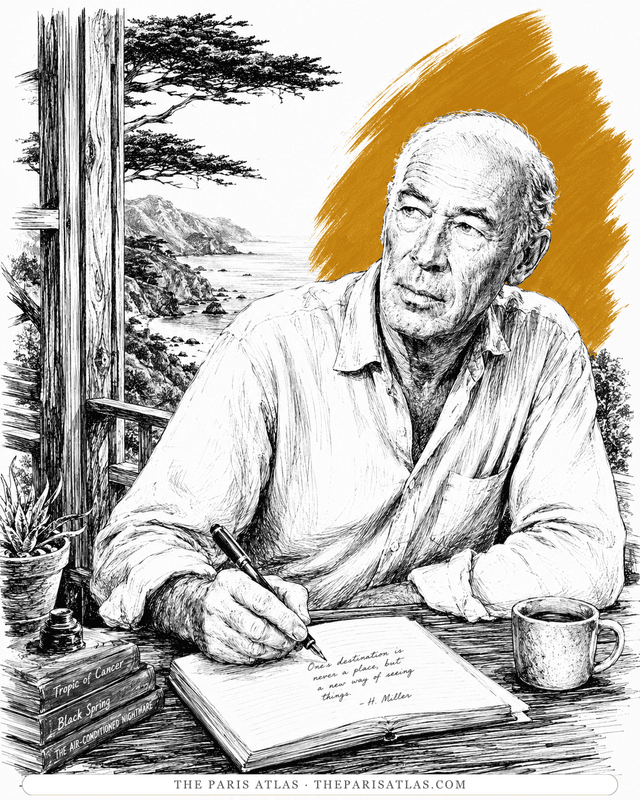
The Brooklyn dropout who arrived in Paris broke at thirty-eight and wrote the exuberant, banned books that ended American censorship.
View author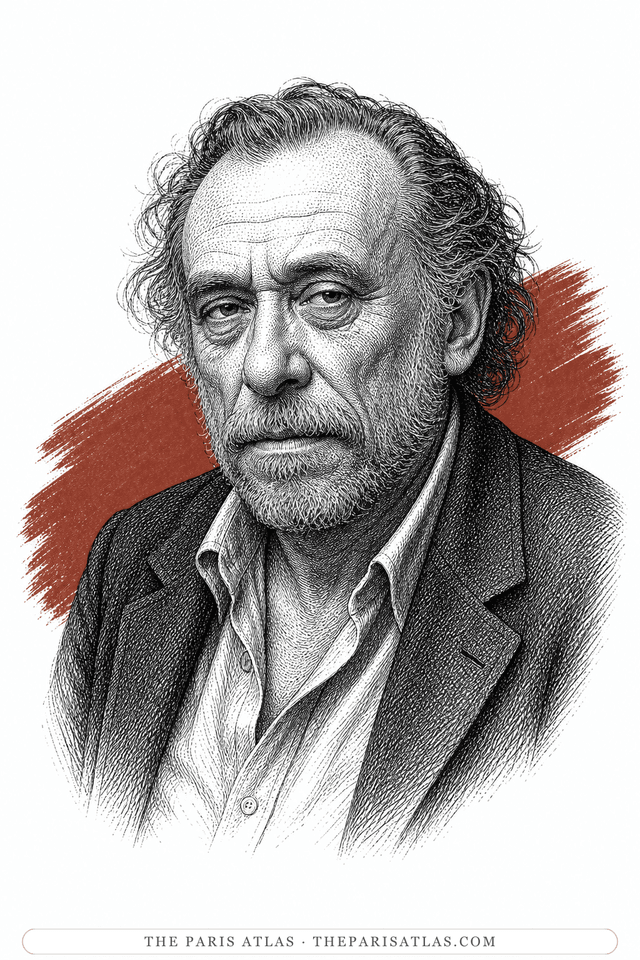
American poet and novelist of Los Angeles rooming houses, racetracks and the post office, who quit his job to write when a publisher offered him a hundred dollars a month. He came to Paris once, in September 1978, drank his way through a live television book programme and walked off the set — and French television has been replaying it ever since.
View authorThe sources below include the primary text, editions, scholarship, archival materials, and other records that informed this page. They document Micromégas, its publication, and its place in literary history.

The public-domain English text used for the plot and every quotation. Chapter numbers follow its six-chapter arrangement unless the French is named.
Georges Pilard and Karen Chidwick on the 1739 baron de Gangan manuscript, the Lapland expedition and what kind of work the tale is.
Records the unauthorised 1752 volume that printed Micromégas with the history of the Crusades.
The French text in the Moland edition of 1877, with editors' notes identifying Fontenelle, the Lapland scientists, the doctor of the Sorbonne and the war of 1736 to 1739, and glossing the name.
Hugues Chabot and Yves Gomas on the Lapland expedition: its dates, the grounded equipment boat and the result.
Letters XIII and XIV, where Voltaire first argued for Locke on thinking matter and for Newton on the shape of the earth.

John Le Conte on Asaph Hall's discovery of the moons of Mars, the Paris Observatory sighting, and the passages in Swift and Voltaire.
Publisher's page for Douglas Parmée's translation: ISBN, contents and length.
Catalogue record for the 1995 Penguin edition of the tale on its own.
The primary text represented by this page, used for descriptions of the work’s contents and for any quoted passages shown here.
The primary text is the baseline reference for every book page. Additional references document publication history, interpretation, and historical context where that evidence is available.
 Explore more resources