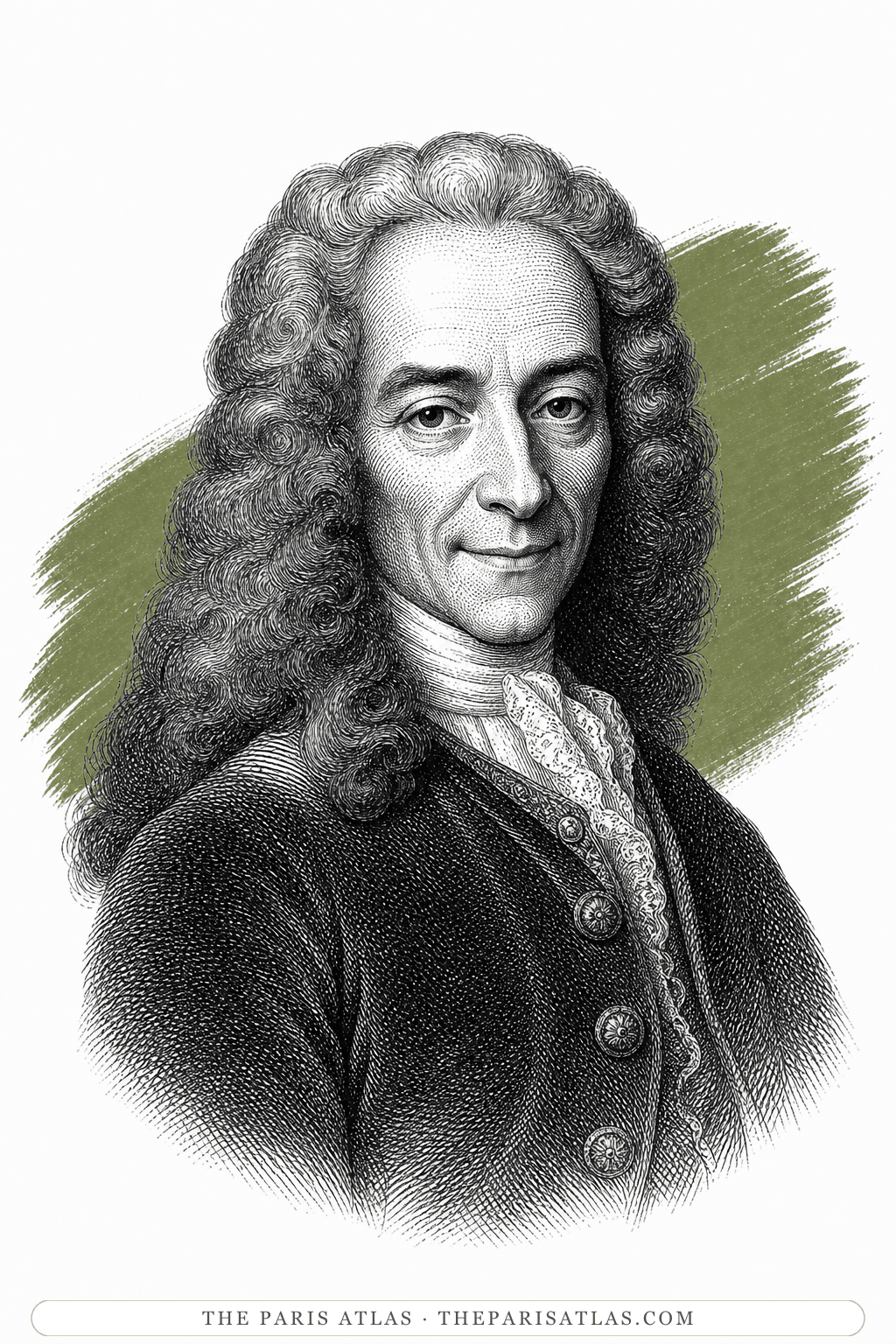

Persian Letters
Montesquieu's letters of 1721 used the same trick in reverse: foreign visitors describing Paris, so that France looks strange.
Read our takeLetters on the English is Voltaire's account of England, where he lived from 1726 to 1728 after his second spell in the Bastille. In twenty-four short letters he writes about English religion, Parliament, trade, smallpox inoculation, science and theatre. Nearly every letter is also a comparison with France, and France usually loses. The book came out first in English, in London in 1733. The French text, Lettres philosophiques, followed in 1734. On 10 June 1734 the Parlement of Paris, the city's high court, had it torn up and burned by the public executioner.[1][2][3]
The preface to the first London edition says the letters were never meant for the public. Voltaire wrote them for his friend Nicolas-Claude Thieriot, who had asked for his remarks on English manners and customs while he was in England.[2]
The English version came out first, from the London booksellers C. Davis and A. Lyon in 1733. The library record for York University's copy of that edition names the translator as John Lockman. The same record notes that the French text followed a year later. Adrien Beuchot, who edited Voltaire's works in the nineteenth century, recorded the same order of events.[2][3]
The two first editions do not end the same way. The French added a twenty-fifth letter arguing with Blaise Pascal's Pensées. The London edition left Pascal out and closed instead with a letter about the burning of the town of Altona, which Voltaire had described in his History of Charles XII.[3][2]
Voltaire himself used several names for the book. He called it the Lettres anglaises most often and the Lettres philosophiques sometimes. Beuchot thought the proper title was Lettres sur les Anglais, Letters on the English.[3]
The first seven letters are about religion. Four describe the Quakers, starting with a visit to an old Quaker living quietly outside London. A note in the Moland edition gives his name as André Pitt. Then come the Church of England, the Presbyterians and the Socinians, who denied the Trinity. England, Voltaire says, is a country of many sects, and that is why they live in peace.[4][3]
Letters VIII to X deal with Parliament, the government and trade. Voltaire admires a country where a lord's younger brother can be a merchant without shame. Letter XI is about inoculation against smallpox, which the English had learned from Turkey through Lady Mary Wortley Montagu.[4]
Letters XII to XVII explain English thinkers to French readers: Francis Bacon, John Locke and, at length, Isaac Newton. Voltaire covers gravity, Newton's work on light and colour, and his calculus and chronology. He sets Newton against René Descartes, the French philosopher whose ideas then ruled in Paris.[4]
The last seven letters are about literature. They cover tragedy and William Shakespeare, comedy, noblemen who write, the Earl of Rochester and Edmund Waller, and Alexander Pope. The final two ask how a nation should honour its writers, and compare the Royal Society in London with the academies of Paris.[4]
The Parlement of Paris was the kingdom's senior law court, and it could condemn books. On 10 June 1734 the king's lawyer, Pierre Gilbert de Voisins, put the Lettres philosophiques before the judges. He told them the book was spreading fast and was fit to encourage the most dangerous free thinking about religion and public order.
The court ordered the book torn up and burned by the public executioner. The burning was to happen in the courtyard of the Palais, the old palace on the Île de la Cité where the court sat, at the foot of its great staircase. The order called the book scandalous, against religion and good morals, and short of the respect owed to those in power.
The order banned anyone from printing, selling or handing out the book, on pain of corporal punishment. Anyone holding a copy had to surrender it to the court. The sentence was carried out the same day, at eleven in the morning, as the court rose. A senior clerk, Marie-Dagobert Ysabeau, signed the record that the book had been torn and thrown into the fire.
Adrien Beuchot drew the obvious lesson in his notes on the book. The authorities did not yet understand, he wrote, that condemning a book makes it famous. The letters rose from their ashes and spread everywhere.
Voltaire's Rouen printer, Claude-François Jore, had printed the French text years before and held it back. When copies began to circulate in 1734, suspicion fell on him. He was arrested and put in the Bastille. He came out fourteen days later, once the police found that his type did not match the seized edition.
The police kept looking. On 9 June and 7 July they found a store of books against the Church and the State belonging to Jore. They also found an edition printed in secret by René Josse, a Paris bookseller, with a paper-maker named Coubray. On 23 October 1734 the royal council stripped Jore's son, Josse and a printer in Bayeux of their trades.
Voltaire was away from Paris, at Montjeu, when the trouble started. In May 1734 he took refuge at Cirey in Champagne with Émilie du Châtelet. He was not allowed back into Paris until the lieutenant of police gave permission by a letter of 2 March 1735, eight months later.
For years afterwards the book could not appear under its own title. Beuchot explains that later editions of Voltaire's works broke the letters up and scattered them among other pieces, so the banned title would not stop them at the French border. Rome condemned the book only on 4 July 1752.
Voltaire keeps setting London beside Paris, and Paris keeps losing. A Frenchman arriving in London, he writes in Letter XIV, finds that the world has changed. In Paris the universe is full of whirling currents of fine matter, as René Descartes taught. In London it is empty space held together by Newton's gravity. Paris imagines the earth shaped like a melon; London says it is flattened.
In Letter X, anyone who reaches Paris from the provinces with money and a name ending in -ac or -ille can call himself a marquis and sneer at merchants. Voltaire asks which is more use to a country. One is a powdered lord waiting in a minister's anteroom. The other is a merchant sending orders from his office to Surat and Cairo.
In Letter XI he counts the cost of French caution about inoculation. Twenty thousand people died of smallpox in Paris in 1723, he writes, who would have lived if a French ambassador's wife had brought the practice home from Constantinople.
Letter XXIII turns to how each country treats its artists. Isaac Newton was buried with honours in Westminster Abbey, and so was the actress Anne Oldfield. In France, Voltaire says, the actress he calls Mademoiselle Le Couvreur was buried in disgrace in the fields. He adds that the English writer Joseph Addison, had he been French, might have ended up in the Bastille.
Paris wins only once. In Letter XXIV Voltaire prefers the Academy of Sciences in Paris to the Royal Society in London, because a seat in Paris is paid and hard to win. He is much less kind about the Académie française. Its published speeches, he says, are mostly compliments.
Letter XIII is about John Locke, and it carries the book's riskiest idea. Voltaire praises Locke for tracing how a child's mind grows from what the senses bring in. He then repeats Locke's modest suggestion that we may never know whether a purely material being can think.
Churchmen in England, Voltaire says, took that as a claim that the soul is material and mortal. He replies that the question is one for philosophy, not faith. Locke's opponents, he says, only had to ask whether thinking matter is a contradiction, and whether God could give thought to matter.
Voltaire came back to the same point nearly twenty years later in Micromégas. There the one human philosopher who impresses the visiting giants is a follower of Locke. He doubts very much that God is unable to give matter the power of thought.
An Englishman, as one to whom liberty is natural, may go to heaven his own way.
There the Jew, the Mahometan, and the Christian transact together, as though they all professed the same religion, and give the name of infidel to none but bankrupts.
If one religion only were allowed in England, the Government would very possibly become arbitrary; if there were but two, the people would cut one another's throats; but as there are such a multitude, they all live happy and in peace.
The Parlement of Paris had it torn up and burned by the executioner at the foot of the great staircase of the Palais, on 10 June 1734. Its printer went to the Bastille and its author into hiding.
Quakers who will not take off their hats, a stock exchange where every religion trades together, and a nation that buried Isaac Newton as though he had been a king.
Voltaire explains Newton's gravity and light, and Locke's account of how the mind learns from the senses, in plain letters for general readers.
Letter XVIII calls Shakespeare natural and sublime but without a spark of good taste, and translates a speech from Hamlet to prove both points.
1726
After a second spell in the Bastille, Voltaire leaves France and reaches London in the autumn.
1726–1728
Two years in England, reading Locke and Newton.
1733
C. Davis and A. Lyon publish Letters concerning the English Nation in London, translated by John Lockman.
1734
The French edition, Lettres philosophiques, begins to circulate. In May Voltaire takes refuge at Cirey with Émilie du Châtelet.
1734
On 10 June the Parlement of Paris orders the book torn and burned. The executioner does it at eleven that morning, in the courtyard of the Palais.
1734
On 23 October the royal council strips Jore's son, the Paris bookseller René Josse and a Bayeux printer of their trades.
1735
On 2 March the lieutenant of police allows Voltaire to return to Paris.
1752
Rome condemns the book on 4 July.
1894
Cassell reprints Lockman's translation with an introduction by Henry Morley, the text now free on Project Gutenberg.
2009
Oxford World's Classics publishes Nicholas Cronk's edition under the 1733 English title.


Montesquieu's letters of 1721 used the same trick in reverse: foreign visitors describing Paris, so that France looks strange.
Read our take
Montesquieu's longer study of government, which also holds up England's balance of powers as a model.
Read our take
Voltaire's most famous book, where the attacks on religious intolerance and on the philosophers come in the form of a comic adventure.
Read our take
Thirty years on, the same subjects, from Quakers to the soul, in short alphabetical essays.
Read our takeMicromégas
Voltaire
The tale that returns to the Locke argument of Letter XIII and to the scientists who proved Newton right about the earth's shape.
Read our takeThe Parlement of Paris condemned it on 10 June 1734 as scandalous, against religion and good morals, and disrespectful to those in power. The king's lawyer said it encouraged dangerous free thinking. The executioner tore it up and burned it in the courtyard of the Palais the same morning.
Both. The English version appeared in London in 1733 as Letters concerning the English Nation. The French version, Lettres philosophiques, came out in 1734. The French text had been printed at Rouen some years earlier but was held back.
They are the same book. Letters concerning the English Nation is the title of the first English edition of 1733. Lettres philosophiques is the French title of 1734. Voltaire usually called it the Lettres anglaises, and Adrien Beuchot preferred Lettres sur les Anglais, Letters on the English.
John Lockman, according to the library record for York University's copy of the 1733 edition. The abbé Prévost also named Lockman at the time, as Adrien Beuchot records. Lockman's translation is the free public-domain text on Project Gutenberg.
He had already gone to Cirey in Champagne, to Émilie du Châtelet's house, in May 1734. He was not allowed back into Paris until 2 March 1735. His Rouen printer, Claude-François Jore, spent fourteen days in the Bastille.
In Letter XVIII he calls Shakespeare natural and sublime, with a strong fruitful genius. He also says Shakespeare had not a single spark of good taste and knew none of the rules of drama. He blames Shakespeare's greatness for ruining the English stage.
Twenty-four on England. The first French edition added a twenty-fifth, on Blaise Pascal's Pensées. The first English edition instead ended with a letter on the burning of Altona. Beuchot also counted a separate letter on the soul sometimes bound in, which made twenty-seven.
Project Gutenberg ebook 2445, Letters on England, reprints Lockman's 1733 translation with Henry Morley's introduction. The Internet Archive has a scan of the original 1733 London edition.
Explore authors with a similar voice, perspective, and influence.
The doctor of the Paris slums who wrote the century's blackest, funniest novel — and changed the sound of French prose.
View author
The Brooklyn dropout who arrived in Paris broke at thirty-eight and wrote the exuberant, banned books that ended American censorship.
View author
American poet and novelist of Los Angeles rooming houses, racetracks and the post office, who quit his job to write when a publisher offered him a hundred dollars a month. He came to Paris once, in September 1978, drank his way through a live television book programme and walked off the set — and French television has been replaying it ever since.
View authorThe sources below include the primary text, editions, scholarship, archival materials, and other records that informed this page. They document Letters on the English, its publication, and its place in literary history.

Voltaire's second Bastille imprisonment and his arrival in London in autumn 1726.
Scan and catalogue record of the 1733 London first edition: title, booksellers, translator, preface, the Altona letter. Quotations were checked against it.

Adrien Beuchot's notes in the Moland edition, printing the Parlement's order of 10 June 1734 and recording the editions, titles, arrests and aftermath.
The Voltaire Foundation chronology: the Rouen printing by Jore, the scandal and the flight to Cirey in 1734.
Key dates: the two years in England and the retreat to Cirey in 1734.
Micromégas, for the later return to Locke's argument.
Library of Congress record for the Oxford World's Classics edition, used for the ISBN.
Catalogue records for the Dover, Penguin and Hackett translations, used for their ISBNs.
The primary text represented by this page, used for descriptions of the work’s contents and for any quoted passages shown here.
The primary text is the baseline reference for every book page. Additional references document publication history, interpretation, and historical context where that evidence is available.
 Explore more resources