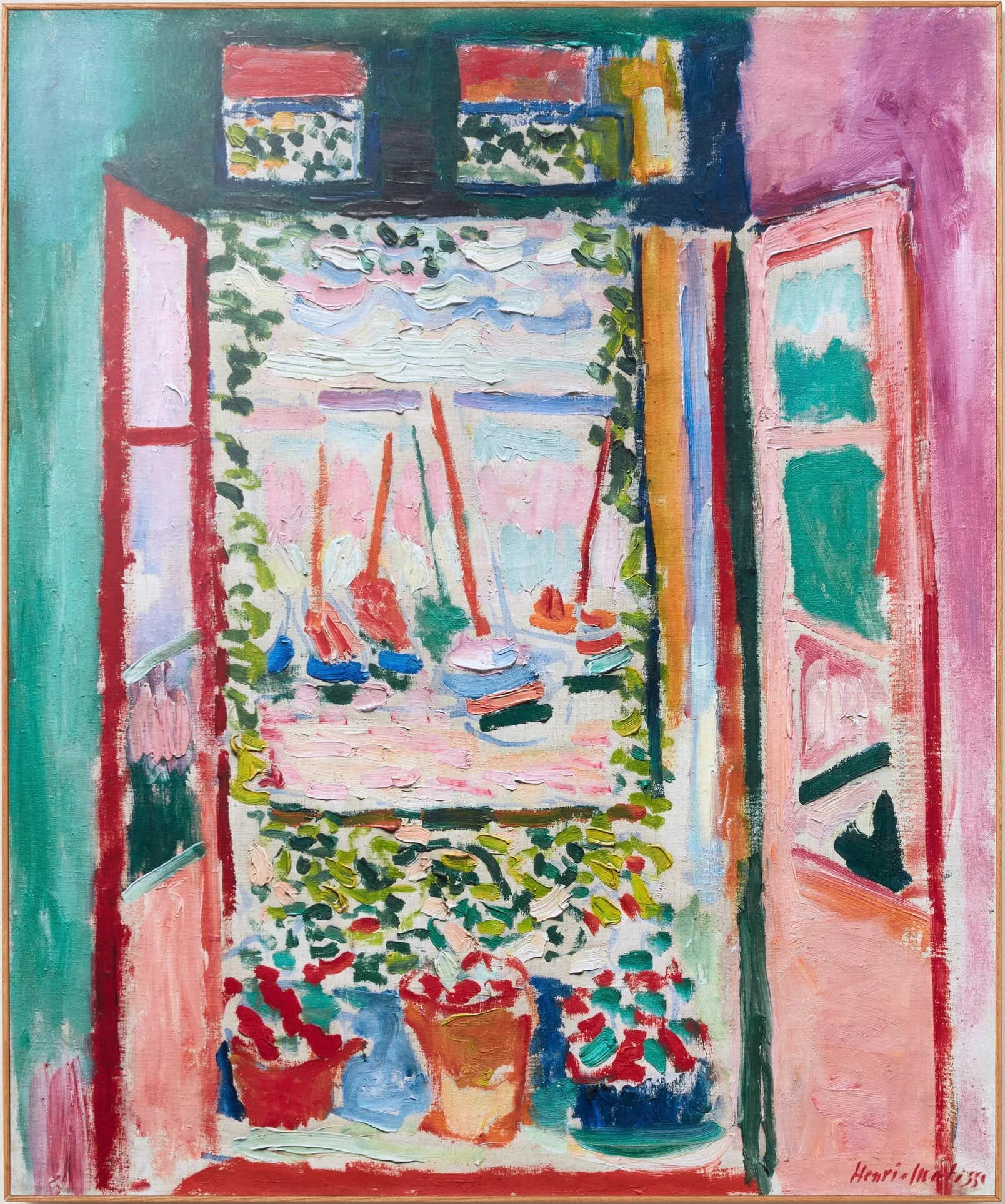
Open Window, Collioure
A harbour seen through an open window, painted with contrasting colours and loose brushstrokes.
- 1905
- Oil on canvas
About Henri Matisse
A window opening onto Collioure
Flowerpots sit on a sill between inward-opening windowpanes, beyond which sailboats bob off the Mediterranean town of Collioure. The window is both the painting’s subject and its organizing frame: interior walls and reflected panes surround the compact harbour view.
Matisse turns that view into colour and movement. Pink waves, orange masts, a multicoloured sky, and thick staccato marks for foliage, water, and boats replace the measured description expected of a conventional landscape.
A small painting with a large effect
Matisse exhibited Open Window, Collioure at the 1905 Salon d’Automne. The National Gallery of Art describes it as a milestone in his career and places it among the works that led a critic to call the loosely allied painters fauves, or wild beasts.
Across the central harbour Matisse uses broken touches, while the walls and windowpanes become larger areas of colour set against one another. The painting therefore balances the recognition of a place with an independent structure of coloured marks.
Close reading
Reading the work, detail by detail
The window promises a view into depth, but Matisse repeatedly turns it back into a stack of coloured surfaces. These details follow the architecture from transom to flowerpots and show how harbor, foliage, and frame occupy the same active plane.
1.The transom compresses another landscape
Each upper pane contains its own red band and dotted green field. The repeated miniature view makes the architecture feel less like neutral framing than a device that edits the world into colour blocks.
2.The left shutter is both door and stripe
Coral edges, a pale inner panel, and the surrounding turquoise wall reduce the shutter to a few vertical intervals. Its skewed drawing matters less than the pulse created by warm colour pressed against cool.
3.The right shutter answers in pink and green
Broad green shapes sit inside a pink frame like paintings hung within the painting. Their blunt edges echo the harbor beyond and unsettle the difference between reflection, glass, and applied pigment.
4.A harbor appears through a handful of verticals
Thin red, orange, and green uprights identify the crowded port with remarkable speed. They continue the window's own vertical rhythm, so distant boats and near architecture belong to one pattern.
5.The sill becomes a band of flickering leaves
Leaflike dabs spread laterally across the sill instead of describing individual stems. This broken band interrupts the rigid frame and lets the garden climb into the room.
6.The flowerpots anchor the threshold
Red, ochre, blue, and green containers carry the heaviest colour at the bottom edge. Their weight establishes the near side of the window even while the plants above them scatter into almost abstract marks.
Where to see it
National Gallery of Art, Washington, DC
Constitution Avenue NW, between 4th and 6th Streets, Washington, DC 20565, United States
The West Building entrance is at 6th Street; the East Building entrance is at 4th Street. Check the museum’s current display information for the work’s building and gallery.
Plan your visit on the museum’s official website (opens in a new tab)Frequently asked questions
What does Open Window, Collioure show?
It shows flowerpots on a sill and sailboats in the harbour at Collioure, seen through a French window opened inward.
When was Open Window, Collioure painted?
Matisse painted it in 1905 and showed it at the Salon d’Automne that year.
Why is Open Window, Collioure Fauvist?
Its pink water, orange masts, multicoloured sky, and loose staccato brushwork give colour an expressive role beyond naturalistic description.
How large is Open Window, Collioure?
The oil-on-canvas painting measures 55.25 by 46.04 centimetres.
Where is Open Window, Collioure?
It belongs to the National Gallery of Art in Washington, DC, a 1998 gift from Mr. and Mrs. John Hay Whitney.
More by Henri Matisse
If you like Henri Matisse
Explore painters from the same movements and circles.
André Derain
French painter who helped invent Fauvism with Henri Matisse at Collioure, translated London into explosive colour, and then turned toward an increasingly classical art.
View artist
Maurice de Vlaminck
Self-taught French painter whose intense colour and forceful brushwork around Chatou made him one of Fauvism’s central figures.
View artist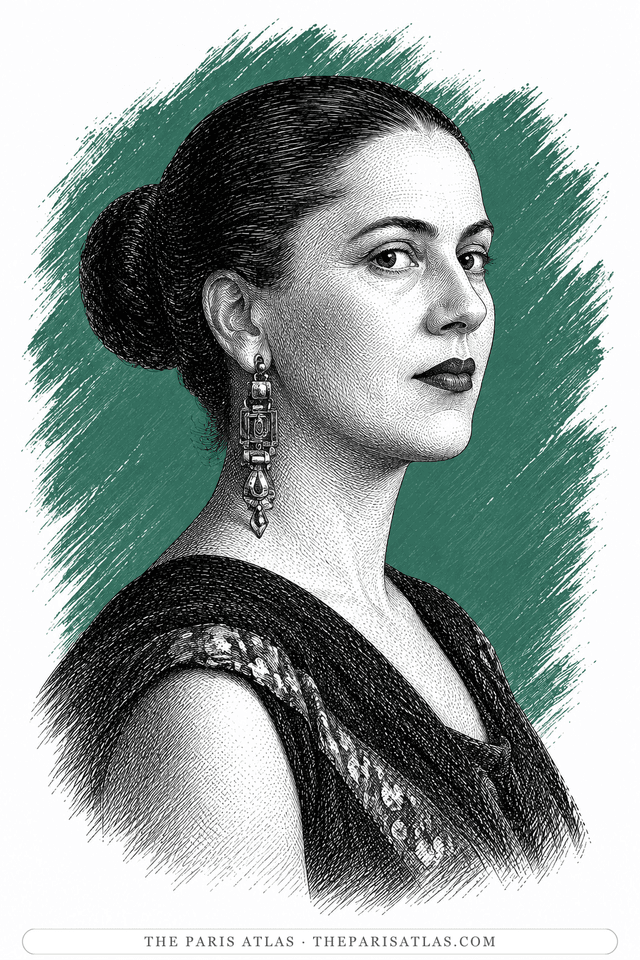
Tarsila do Amaral
Brazilian painter who spent the 1920s moving between São Paulo and Paris, studied Cubism under André Lhote, Albert Gleizes and Fernand Léger, and used what she learned to paint Brazilian towns, railways, plants and bodies. Her 1928 painting Abaporu prompted the manifesto that gave the Anthropophagic movement its name.
View artist
References
The sources below include collection records, catalogues, scholarly research, and primary materials that informed this page. They document Open Window, Collioure, its making, and its place in cultural history.


1Open Window, Collioure, Henri Matisse
WebsiteNational Gallery of ArtUsed forWeb source consulted for documented facts and historical context presented on the Open Window, Collioure page.
2Vertigo of Color: Matisse, Derain, and the Origins of Fauvism — Visiting Guide
WebsiteThe Metropolitan Museum of ArtUsed forWeb source consulted for documented facts and historical context presented on the Open Window, Collioure page.
3Henri Matisse (1869–1954)
WebsiteThe Metropolitan Museum of ArtUsed forWeb source consulted for documented facts and historical context presented on the Open Window, Collioure page.
4Fauvism
WebsiteThe Metropolitan Museum of ArtUsed forWeb source consulted for documented facts and historical context presented on the Open Window, Collioure page.
These references provide the documented foundation for this work's history and interpretation. Claim-level citations remain attached to the specific claims they support.
 Explore more resources